
Osnova
БесплатноПоддерживаетсяDeterministic code map for AI coding agents: a tree-sitter symbol and call graph served over MCP and a CLI, with no embeddings, network or telemetry.

Описание
Deterministic code map for AI coding agents: a tree-sitter symbol and call graph served over MCP and a CLI, with no embeddings, network or telemetry.
README
Osnova
npm version license Apache-2.0 ci node >=22.13
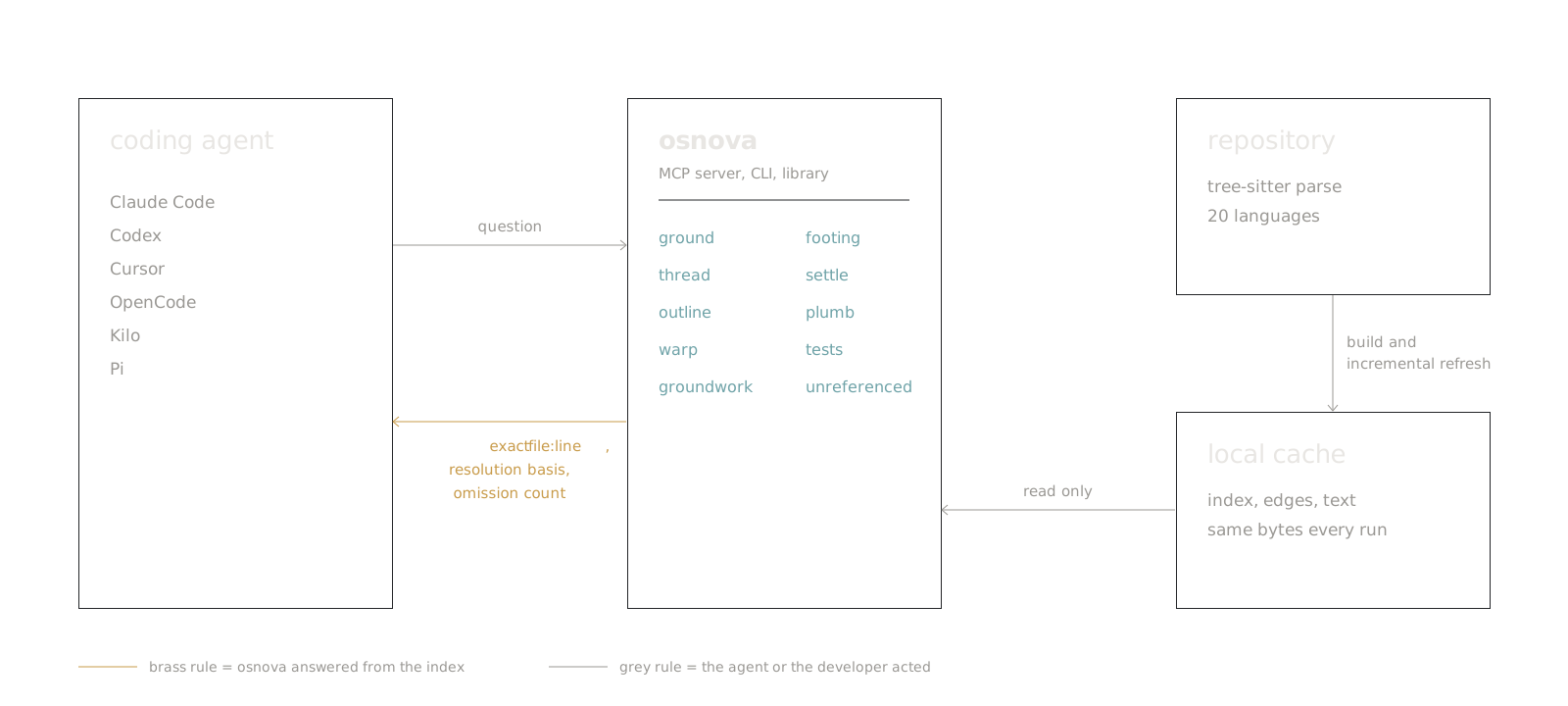
A deterministic code map for AI coding agents. Osnova indexes a repository into a symbol and call graph with tree-sitter, then serves it to any MCP client or from the command line. Same input, same output, byte for byte. No embeddings, no telemetry, and no network connection unless you type osnova update-check. Twenty languages, seven of them (TypeScript, JavaScript, Python, Go, Rust, Java, C#) with deep adapters.
Osnova is the Slavic word for base or foundation. That is the job: give an agent solid ground to stand on before it edits code.
Quick start
Node.js 22.13 or newer. Serve a repository to any MCP client:
npx -y @getdomovoi/osnova mcp --workspace /path/to/repo
Claude Code, one command after npm install -g @getdomovoi/osnova: the MCP entry and the session, prompt and stop hooks, with a backup of each file it changes.
osnova setup --apply --client claude-code --hooks
Or add the MCP entry by hand; replace osnova with npx -y @getdomovoi/osnova when there is no global install.
{ "mcpServers": { "osnova": { "command": "osnova", "args": ["mcp"] } } }
What you get back

osnova warp refreshWorkspace on this repository, cut to twelve lines:
function src/api.ts#refreshWorkspace: 70 indexed edges
reach: d1 callers 70 in 12 files (3 dirs); d2 +16 in 2 files; unresolved same-name 8; tests 15
d1 calls src/cli/cli.ts#ensureIndex:78 [import-binding]
d1 calls src/cli/hook.ts#runHook:189,201,223,238 [import-binding]
d1 calls src/mcp/server.ts#createOsnovaMcpServer.refresh:233 [import-binding]
d1 calls test/verification-fastpath.test.ts#<module>:37,47,48,51,53,57,58,64,68,74,78,85,110,114,132,145,154,166,171,197 [re-export-binding]
  via src/index.ts:64 refreshWorkspace -> src/api.ts (export refreshWorkspace)
This does not prove absence of callers or that deletion is safe.
unresolved evidence (8); not confirmed relationships
candidates for refreshWorkspace (1, unverified): src/api.ts#refreshWorkspace
d1 calls refreshWorkspace scripts/perf.mjs:100,102,111; test/artifact-format9.test.ts:76,83,102,118,138 [binding-blocked]
Each confirmed line names the caller, its lines and the evidence that tied the call to this definition: an import binding, a same-file definition, a re-export chain with its hop, or an identified receiver. Calls the index could not tie to a definition are listed apart as unresolved evidence, with the same-name candidates it found and the reason it stopped, so a name match is never mistaken for a caller. The reach line gives exact counts, not scores, and when the list outgrows its budget a capped: line and an omitted: footer count what was left out.
How much of the graph is exact
A call site counts as resolved when the index ties it to one definition through evidence it can name; everything else stays unresolved with a reason. These are the shares on the pinned checkouts under benchmarks/corpora/, recorded in benchmarks/results/resolution-coverage-2026-09-21b.json; the last column leaves out calls through packages outside the repository and calls to builtins, which can never resolve locally, and the reference defines every column.
| Corpus | Languages | Call sites | Resolved | Share | Excluding externals |
|---|---|---|---|---|---|
| click | all | 6593 | 2903 | 44.0% | 62.4% |
| cobra | all | 4374 | 1980 | 45.3% | 88.9% |
| gson | all | 23382 | 8473 | 36.2% | 56.7% |
| humanizer | all | 30517 | 7798 | 25.6% | 51.3% |
| pyright | all | 58578 | 30070 | 51.3% | 74.5% |
| ripgrep | all | 13387 | 6121 | 45.7% | 71.6% |
| zod | all | 53417 | 21630 | 40.5% | 73.2% |
Per-language rows are in the reference. osnova coverage reports the same numbers for your own repository, per language and per reason.
Resolved is not the same as right, so the call edges are also scored against a type checker. Every call site in two pinned checkouts was sent to the language's own checker for the callee's declarations, and each osnova edge was marked true when the symbol it names contains that declaration and false when it does not. On click (160 files, pyright 1.1.414) 2883 edges were decided and 0 are false, and osnova covers 90.4% of the call sites the checker resolves inside the repository. On zod (702 files, TypeScript 5.9.3) 21276 edges were decided and 4 are false, a false-edge rate of 0.02%, with 76.9% of in-repo sites covered. The four false edges are listed by site in benchmarks/results/type-checker-oracle-2026-09-21.json with the method and its limits.
Grep versus the graph
The reason to keep a call graph instead of running a text search is not speed. It is that the first regex a person types is wrong more often than it looks, and nobody notices. Nine call-site sets in five languages were verified line by line; each cell shows sites found (precision / recall), and the method lists what each side got wrong.
| Corpus | Target | Verified sites | Text search | Resolved graph |
|---|---|---|---|---|
| click | Context.invoke depth 2 |
13 | 12 (0.92 / 0.85) | 12 (1.00 / 0.92) |
| pyright | getChildNodes depth 2 |
28 | 5 (0.80 / 0.14) | 28 (1.00 / 1.00) |
| cobra | Command.Root depth 1 |
30 | 30 (1.00 / 1.00) | 30 (1.00 / 1.00) |
| cobra | Command.PersistentFlags depth 1 |
12 | 13 (0.92 / 1.00) | 12 (1.00 / 1.00) |
| humanizer | Configurator.GetFormatter depth 1 |
18 | 19 (0.74 / 0.78) | 18 (1.00 / 1.00) |
| ripgrep | Searcher.line_terminator depth 1 |
12 | 32 (0.38 / 1.00) | 12 (1.00 / 1.00) |
| ripgrep | LineTerminator.as_byte depth 1 |
26 | 26 (1.00 / 1.00) | 26 (1.00 / 1.00) |
| gson | JsonReader.beginObject depth 1 |
10 | 29 (0.34 / 1.00) | 10 (1.00 / 1.00) |
| gson | TypeToken.getRawType depth 1 |
27 | 43 (0.63 / 1.00) | 27 (1.00 / 1.00) |
The graph never returned a site that was not a call of the target. The record is benchmarks/results/grep-vs-graph-2026-09-21.json.
The ten tools
The names play on the foundation image. The CLI uses the same names without the prefix: osnova ground and osnova_ground are the same query.
| Tool | Meaning | Does |
|---|---|---|
osnova_ground |
the ground you stand on | Keyword search: ranked definitions with exact file:line |
osnova_thread |
the thread you follow through the cloth | Text search: regex or literal matches grouped by symbol |
osnova_outline |
the outline of one part | Signatures and line spans for one file |
osnova_warp |
the threads that hold the weave | Call graph: callers and callees, direct or transitive |
osnova_groundwork |
the groundwork under everything | Repository map: directory clusters, hubs and hotspots |
osnova_footing |
the footing you build on | Task context: definitions, relationships and candidate tests around a question |
osnova_settle |
how the ground settles after a change | Change impact: the symbols a diff touches and their indexed dependents |
osnova_plumb |
the plumb line dropped straight through | Check claims: which listed call sites the index confirms, and which dependents were left out |
osnova_tests |
the cloth pulled to see what holds | Tests: the test files that reference a symbol, or the symbols one test file reaches |
osnova_unreferenced |
threads left loose at the edge | Definitions with no indexed caller, each with its leads; candidates, never proof |
Every response opens with its index generation, says when the index is partial, and counts what its budget left out; the budgets are in the reference.
Hooks and clients
One global install serves every repository and every client: one entry in each client's global config, nothing per project, nothing written inside your repository. osnova setup --preview --client <name> shows the diff and writes nothing. What each hook prints, when it stays quiet, and what the trials measured are in the reference.
| Client | How to wire | What it adds |
|---|---|---|
| Claude Code | osnova setup --apply --client claude-code --hooks |
MCP entry plus session, prompt and stop hooks; --skill adds the skill, --nudge the opt-in grep nudge |
| Claude Code, as a plugin | /plugin marketplace add getdomovoi/osnova then /plugin install osnova@osnova |
The same MCP entry, hooks and skill, run through npx -y @getdomovoi/osnova, with no global install; updates follow the marketplace |
| Codex | osnova setup --apply --client codex --hooks |
MCP entry plus the same three hooks; trust them in /hooks or Codex skips them silently |
| Cursor | osnova setup --apply --client cursor --hooks |
MCP entry plus the stop hook as a follow-up message |
| OpenCode | osnova setup --apply --client opencode --plugin |
MCP entry plus a plugin: full contract in the system prompt, starting points on each message |
| Kilo | osnova setup --apply --client kilo --plugin |
MCP entry plus the same plugin |
| Pi | osnova setup --apply --client pi --plugin |
MCP entry through pi-mcp-adapter plus an extension that does the same |
In CI
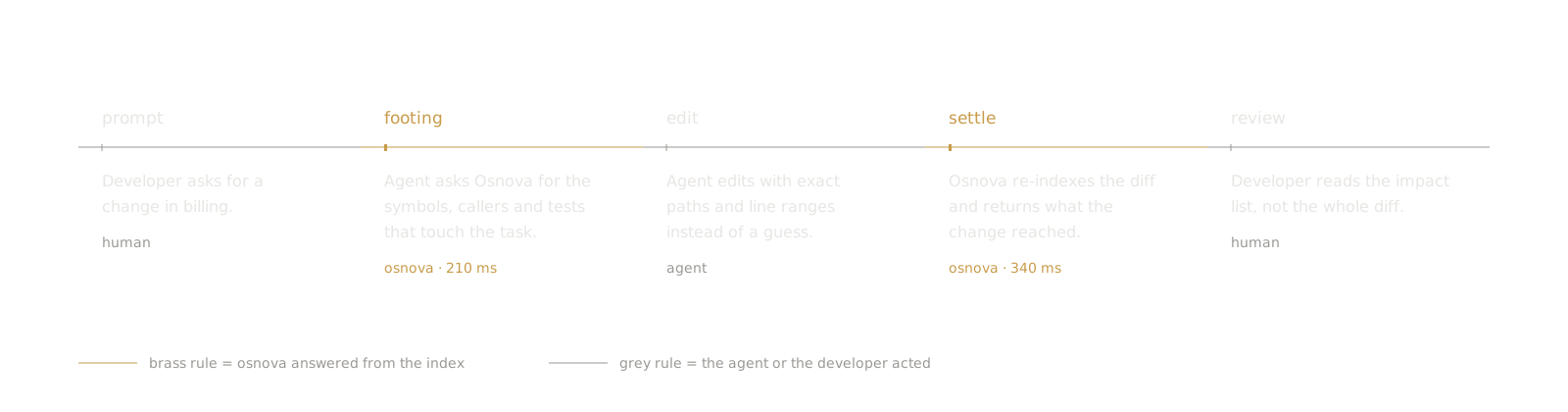
The action runs osnova settle --base-ref against the pull request base and lists every indexed dependent of the symbols the pull request changed; the report is indexed structural evidence only, so a missing dependent is not proof that nothing depends on the change.
- uses: actions/checkout@v4
  with:
    fetch-depth: 0
- uses: getdomovoi/osnova@main
  with:
    depth: "2"
Inputs and the local form are in the reference.
What osnova does not do
- No type inference and no dynamic dispatch. Edges come from syntax: direct calls, imports, exports, name references, declared heritage (a written superclass or interface name) and framework routes (a registration whose receiver binds to a listed framework import, with the verb and the literal path written at the site), with lexical binding and receiver hints for TypeScript, JavaScript and Python. Resolution is heuristic and says so.
- No route table. A
routesedge is one registration site tied to one handler; prefixes from mounts, blueprints and controllers are recorded on their own edges and never composed into a full path, a computed path records no path, and an inline closure or a wrapped handler records the route with no target. Express, NestJS, Flask and FastAPI are read; gin, axum, Django, Spring, ASP.NET, Rails and file-based routers are not. - That boundary has a measured price. Scored against a type checker on two pinned corpora, the calls osnova does not resolve are mostly calls whose receiver type is never written down: 2945 of 6359 missed sites on zod and 164 of 307 on click are a plain name carrying no annotation, and another 1478 on zod are a call result or a property chain. Only 349 missed sites on zod and 10 on click have a type written at the receiver's declaration, and 248 of those 349 are a single library idiom. Resolving every one of them would move recall from 76.9% to 78.2% on zod and from 90.4% to 90.7% on click, so the boundary costs roughly one recall point rather than ten. The full census is in benchmarks/results/receiver-boundary-census-2026-09-21.json.
- No semantic search.
osnova_groundis fielded lexical ranking over definitions. It is fast, deterministic and explainable, and it will not match a paraphrase. - No proof of safety. An empty caller list means the index found no caller, not that none exists.
- No cost claims. Agent trials so far show correctness parity with and without the graph on small tasks. A benchmark that separates the two is in progress.
How it stays honest
- Every query refreshes the index from the working tree first, uncommitted edits included, and reports its generation.
- Every clipped output says how much was clipped. Every ranked list says how many candidates it dropped. Partial indexes say so on every response.
- Every hit carries a
file:linespan, a source hash and an index generation, so you can check what the agent cites. - Every benchmark result in benchmarks/results/ is frozen with its corpus fingerprint, and rejected experiments stay on record next to accepted ones.
- The cache verifies a SHA-256 over the structural core before parsing it and hash-checks each source text on read. Nothing is written outside it.
CLI
Every tool is a subcommand: osnova build <root>, osnova warp <symbol>, osnova settle --base-ref <ref>, plus coverage, check, doctor, setup and mcp. The full list is in the reference.
Library
import { buildIndex, ask, callersDetailed, renderMapCard } from "@getdomovoi/osnova". The structured APIs return complete results with omission counts; the text budgets apply to CLI and MCP presentation only. Every export is in the reference.
Contributing
Bug reports, language adapters, benchmark corpora and agent trials are all welcome. Read CONTRIBUTING.md for the gates a change must pass: lint, typecheck, tests, build, perf budgets and package smoke.
pnpm install
pnpm lint && pnpm typecheck && pnpm test && pnpm build && pnpm perf
Determinism is the core invariant. A change that makes incremental refresh differ from a full rebuild by one byte is a bug.
License
Apache-2.0
Установить Osnova в Claude Desktop, Claude Code, Cursor
unyly install osnovaСтавит в Claude Desktop, Claude Code, Cursor и VS Code — сам разбирается с npx, uvx и сборкой из исходников.
Впервые? Поставь CLI: curl -fsSL https://unyly.org/install | sh
Или настроить вручную
Выполни в терминале:
claude mcp add osnova -- npx -y @getdomovoi/osnovaПошаговые гайды: как установить Osnova
FAQ
Osnova MCP бесплатный?
Да, Osnova MCP бесплатный — установка в пару кликов через Unyly без оплаты.
Нужен ли API-ключ для Osnova?
Нет, Osnova работает без API-ключей и переменных окружения.
Osnova — hosted или self-hosted?
Self-hosted: сервер запускается локально на твоей машине командой из раздела установки.
Как установить Osnova в Claude Desktop, Claude Code или Cursor?
Открой Osnova на unyly.org, выбери вкладку своего клиента (Claude Desktop, Claude Code, Cursor) и нажми Install — конфиг сгенерируется автоматически, без правки JSON.
Похожие MCP
GitHub
PRs, issues, code search, CI status
 автор: GitHub
Filesystem
Secure file operations with configurable access controls.
Memory
Knowledge graph-based persistent memory system.
Template MCP Server
A CLI tool to create a new Model Context Protocol server project with TypeScript support, dual transport options, and an extensible structure
 автор: mcpdotdirect
Amap Maps Mcp Server
MCP server for using the AMap Maps API
 автор: duxiaohui
Supabase
Database, auth and storage
 автор: Supabase
Everything
Reference / test server with prompts, resources, and tools.
Git
Tools to read, search, and manipulate Git repositories.
Sequential Thinking
Dynamic and reflective problem-solving through thought sequences.
Time
Time and timezone conversion capabilities.
Compare Osnova with
Не уверен что выбрать?
Найди свой стек за 60 секунд
Автор?
Embed-бейдж для README
Похожее
Все в категории development