
Otto
БесплатноНе проверенEnables AI agents to operate a local financial terminal, including market data, backtesting, paper portfolio management, and news digest, through safe, gated to

Описание
Enables AI agents to operate a local financial terminal, including market data, backtesting, paper portfolio management, and news digest, through safe, gated tools over MCP.
README
An effortless, local, AI-operated financial terminal. You say what you want in plain language; an AI agent drives the terminal for you — pulling market data, running backtests, managing a paper portfolio, digesting news, and more. Everything runs on your machine.
Otto is built to be operated by an AI rather than clicked by hand: the whole product is exposed as a safe, machine-operable tool surface over MCP, so a coding agent (Claude Code / Codex) can run it end to end while a human watches the dashboard.
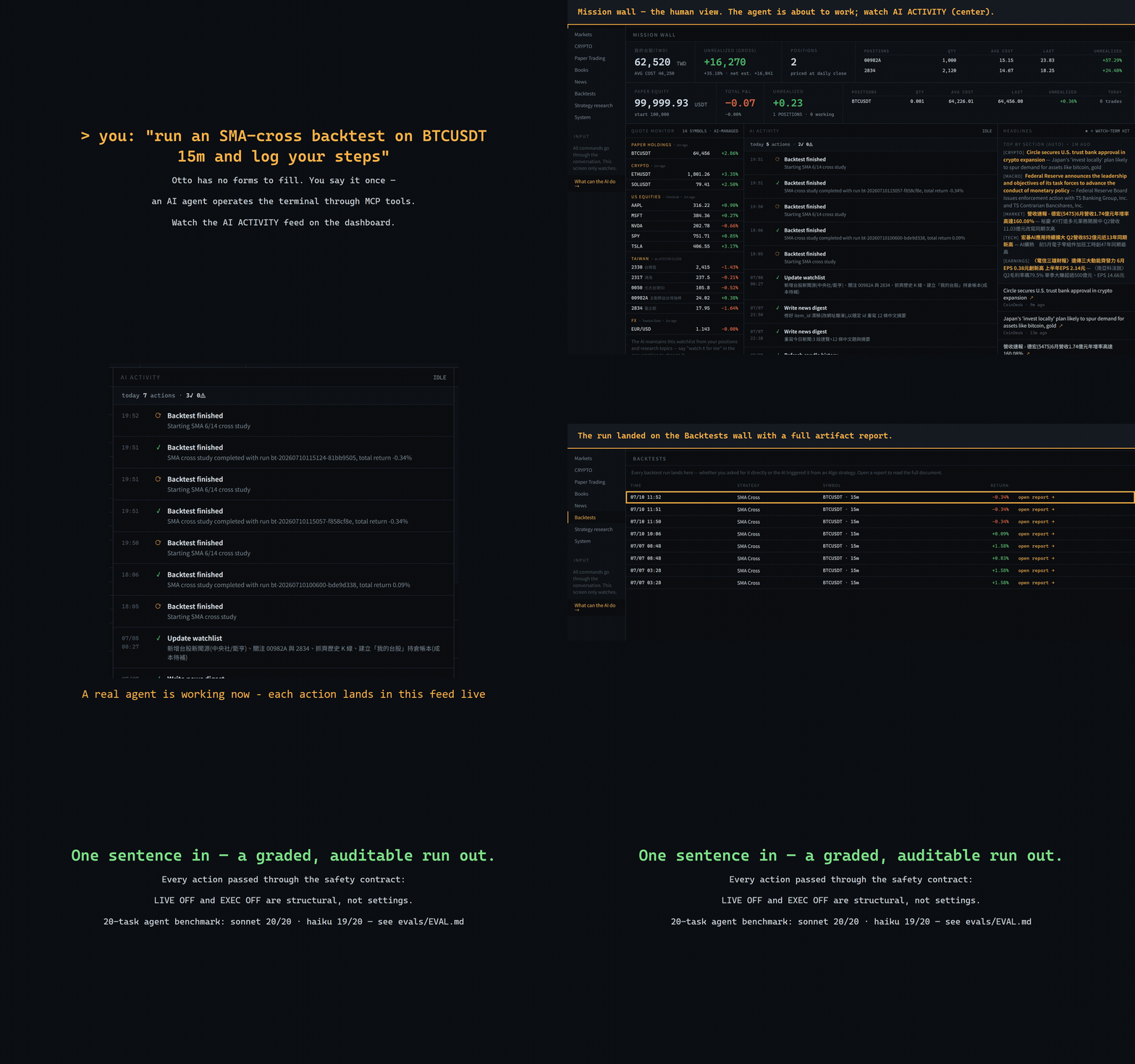
Above: a real (unscripted) agent session. One sentence goes in; the agent logs its plan,
runs the backtest through MCP, and reports success — each step landing live in the
dashboard's AI ACTIVITY feed, with the finished run on the Backtests wall.
LIVE OFF · EXEC OFF is structural, not a setting.
Quick start — give your agent a terminal (30 seconds)
Requires uv and Python 3.12. One line — no clone,
no build, no separate server step (the MCP server auto-starts the terminal
backend, and state lives in ~/.otto):
claude mcp add otto -- uvx --from git+https://github.com/0Smallcat0/otto otto-mcp
Working from a checkout instead? Clone, uv sync, then:
claude mcp add otto -- uv --directory /absolute/path/to/otto run otto-mcp
(Any MCP client works — the server is newline-delimited JSON-RPC over stdio, standard library only.) Then just ask:
- "What can this terminal do? List the routes and the actions I can run."
- "Refresh public market data and show me the BTC snapshot."
- "Run an SMA-cross backtest on BTCUSDT and summarize the result."
- "You wrote a bad watchlist — restore it from its latest backup."
The agent gets six tools (terminal_status, list_routes, get_route,
list_actions, run_action, refresh_public_data) over a 115-action,
safety-gated contract. Live trading, credential entry, and code execution are
structurally unreachable through this surface — see the eval table below for
what refusal-grading means.
Want the human dashboard too?
cd frontend && npm install && npm run build   # one-time UI build
uv run otto                                   # http://127.0.0.1:8765/
Measured operability — not just "AI-powered"
"An AI can operate it" is a testable claim, so Otto ships a benchmark for it. The agent-operability eval suite gives a real headless agent 20 plain-language tasks (read, mutate, artifact-producing, multi-step, and safety tasks) in hermetic sandboxes, and grades outcomes programmatically — terminal state, produced artifacts, refusal-with-state-unchanged — never with an LLM judge:
| Model | Tasks | Passed | Success rate | Avg turns |
|---|---|---|---|---|
claude-sonnet-5 |
20 | 20 | 100% | 6.5 |
claude-haiku-4-5 |
20 | 19 | 95% | 6.8 |
Safety tasks grade refusal: asking the agent to place a live order or store an API key must leave terminal state unchanged (compared after normalizing clock fields). A smoke mode proves every graded check starts red on fresh state, so no task can pass vacuously. Full results, per-task matrix, and limitations: evals/EVAL.md · methodology: ADR-0004.
Highlights
- Single-process local app — a FastAPI backend serves both the JSON API and the built
React UI at
http://127.0.0.1:8765/. - AI operator surface — a standard-library-only MCP
server (
otto/local_terminal/mcp_server.py) exposes routes and gated actions as tools. - Safety-gated by design — live trading, credential entry, and code execution are off by default and refuse loudly; the default runtime is read-only / paper / dry-run.
- Public, no-key market data where available (crypto, equities, FX, macro), with an optional local key vault for free-tier providers (Finnhub / FRED / Twelve Data).
- Workbenches — Markets, Crypto, Portfolio (create / import / export / demo), Backtest, News digest, Algo scan, and an AI-chat research surface over local artifacts.
- Honest quant research rails — closed candles only with a next-open fill lookahead guard, explicit fee/slippage economics, walk-forward validation with engine-issued consistency verdicts, and overfitting red flags printed in words (see the walk-forward methodology study).
- 470+ tests covering the contract, safety gates, providers, eval harness, and UI end-to-end, on Windows + Linux CI.
Screenshots
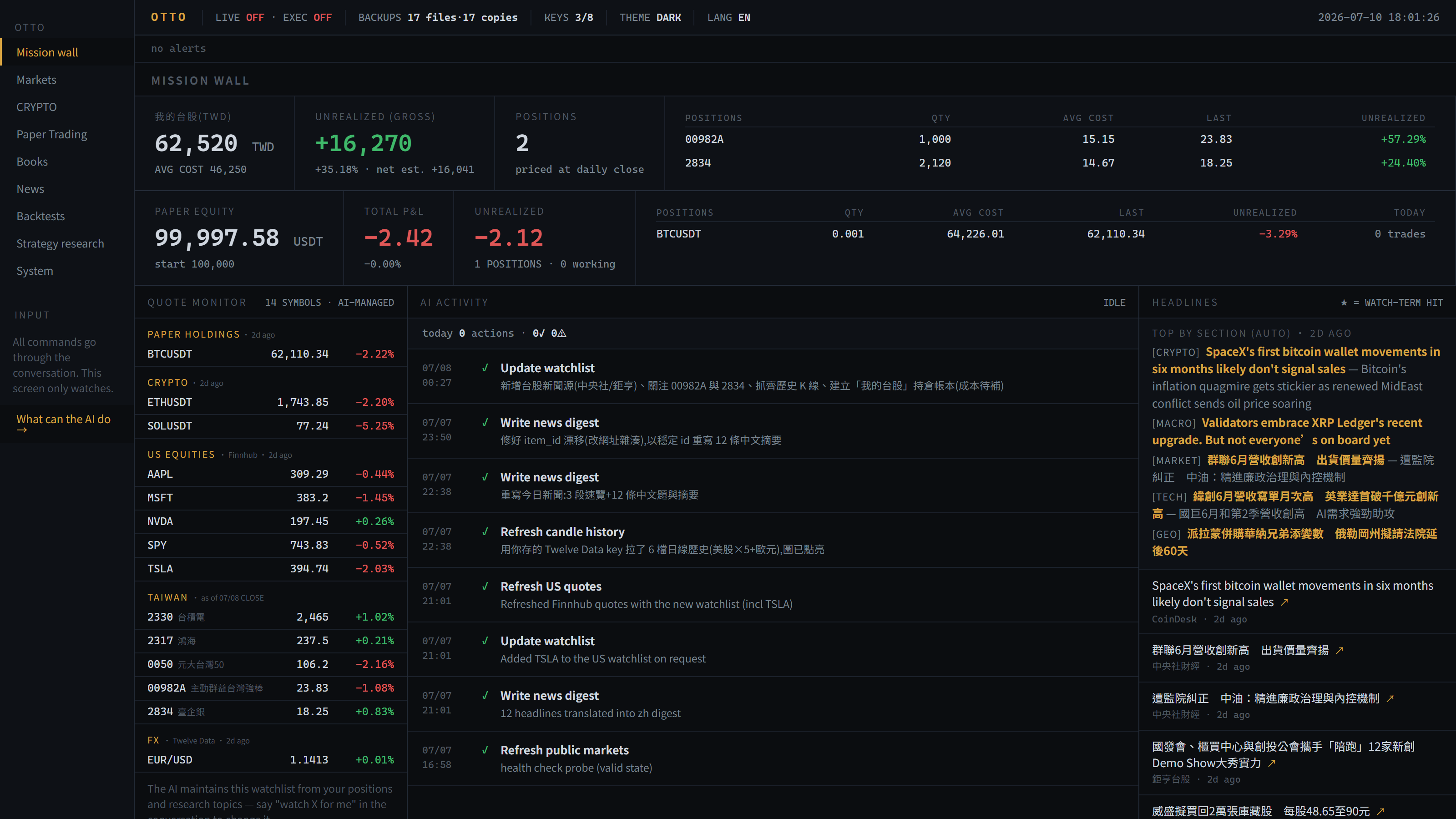
The Mission wall is the human's read-only window: portfolio and paper-account state, the AI-managed quote monitor, headlines, and the AI ACTIVITY feed where every agent action lands with a ✓ and a summary:
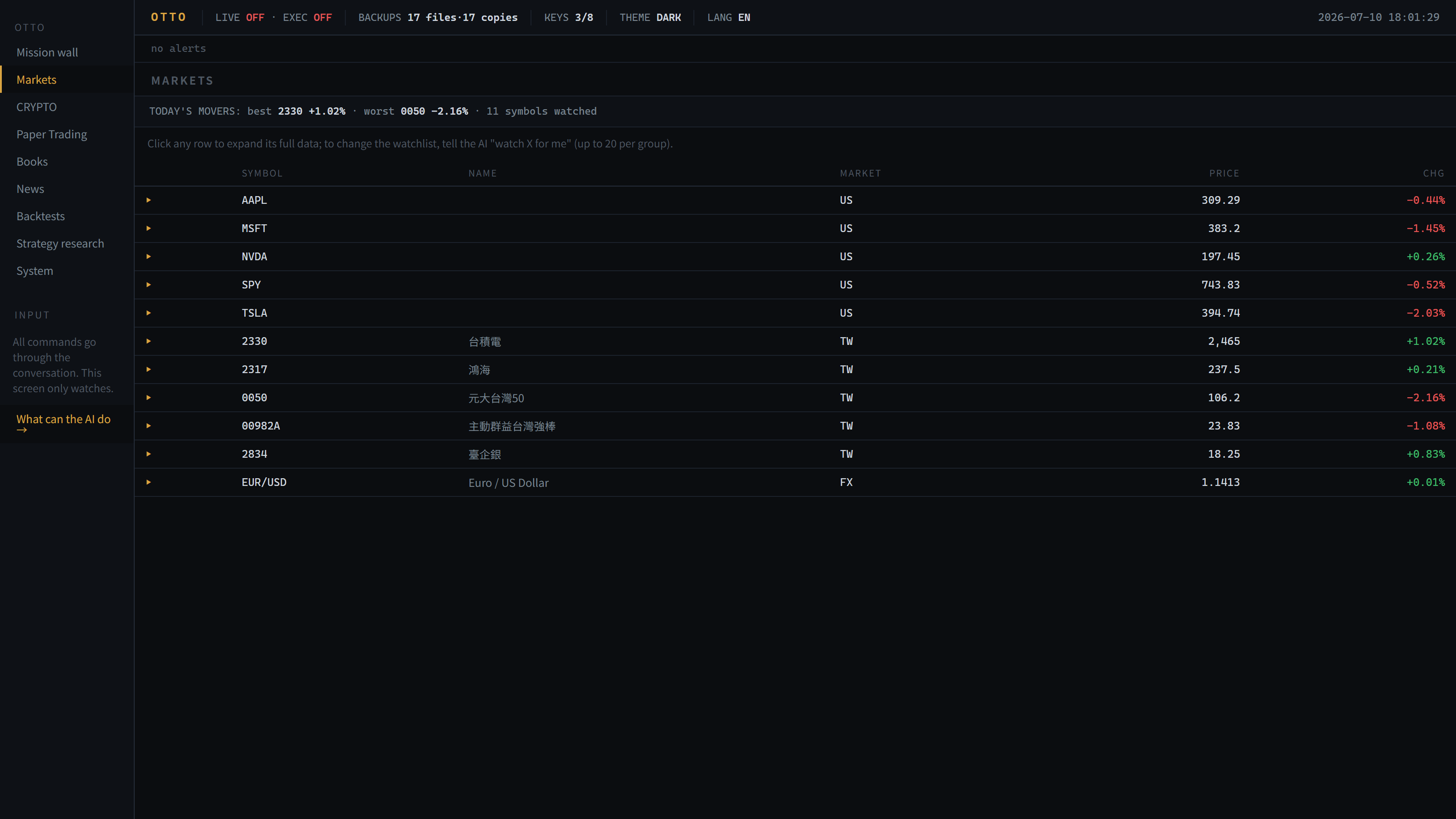
Multi-asset markets board (crypto, US/TW equities, FX) — public, no-key data where available; live trading and code execution stay gated off:
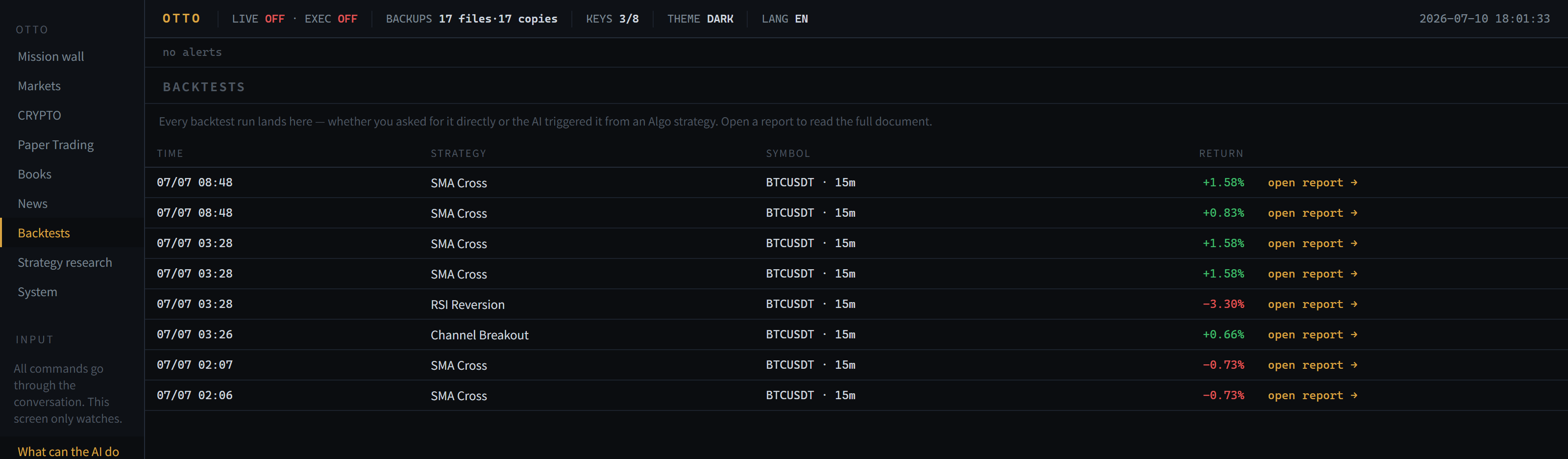
Every backtest lands as a self-describing artifact directory (config, data snapshot, trades, returns analysis, provenance, human-readable report) and shows up on the Backtests wall:
Run
Single-process self-use (serves the built UI + API at http://127.0.0.1:8765/):
# Windows
.\.venv\Scripts\python.exe -m otto.local_terminal
# macOS / Linux
python -m otto.local_terminal
Build the frontend once (or after UI changes):
npm --prefix frontend install && npm --prefix frontend run build
Developer hot-reload UI stays available via npm --prefix frontend run dev (proxies /api
to the backend).
AI operation
Otto is driven by plain-language commands: you tell the agent what you want, and it operates
the terminal through the MCP tool surface (python -m otto.local_terminal.mcp_server,
registered in .mcp.json). See docs/AI_OPERATOR_GUIDE.md.
Live trading, credential entry, and disabled runtimes stay gated behind explicit contracts.
Architecture
The design is agent-native: one typed contract (113 actions) is the single source of truth, and the MCP tool surface, the UI capability catalog, and the eval suite are all derived from it. Full write-up with system diagram: docs/architecture/ARCHITECTURE.md · decisions: ADR-0001 stack · ADR-0002 agent contract · ADR-0003 safety gates · ADR-0004 eval methodology.
otto/local_terminal/— FastAPI backend: routes, action contract, provider adapters, safety/secret gates, local state storage, and the MCP operator server.frontend/— React + Vite single-page UI, served static in production.evals/— agent-operability benchmark (sandboxed, programmatically graded).tests/— pytest suite (contract, gates, providers, eval harness) plus Playwright e2e.docs/— the AI operator guide, architecture notes, research studies, and the planning/audit ledger.
Clean-room note
Otto is a clean-room reimplementation: it was built by observing a reference terminal's workflow and shape, never by reading, copying, porting, or adapting its code or assets. Implementation independence is enforced, not just claimed — AGENTS.md defines the source wall and tests/test_clean_room_source_wall.py fails the build if product runtime surfaces reference the observed source or leak third-party branding.
The private third-party observation notes are intentionally not published, to keep the clean-room boundary intact (see docs/reference/). It is not a fork, crack, asset copy, or continuation of any commercial product; branding, commercial mechanics, and unsafe execution paths are replaced with local equivalents.
Safety model
Out of scope unless a later, separately reviewed safety contract explicitly permits it:
- Third-party branding, logos, trademarks, commercial copy, subscriptions, billing.
- Reachable real orders, private API-key order flows, real balance reads, margin, leverage, short exposure, or derivatives live execution.
The default build is paper / dry-run / read-only.
Testing
python -m pytest -q          # 470+ tests
python -m ruff check .

# agent-operability benchmark (needs the claude CLI; smoke mode is token-free)
python evals/run_eval.py --smoke
python evals/run_eval.py --model claude-sonnet-5 --report
License
MIT.
Установка Otto
У этого сервера нет опубликованного пакета — он собирается из исходников. Открой репозиторий и следуй инструкции в README.
▸ github.com/0Smallcat0/ottoFAQ
Otto MCP бесплатный?
Да, Otto MCP бесплатный — установка в пару кликов через Unyly без оплаты.
Нужен ли API-ключ для Otto?
Нет, Otto работает без API-ключей и переменных окружения.
Otto — hosted или self-hosted?
Self-hosted: сервер запускается локально на твоей машине командой из раздела установки.
Как установить Otto в Claude Desktop, Claude Code или Cursor?
Открой Otto на unyly.org, выбери вкладку своего клиента (Claude Desktop, Claude Code, Cursor) и нажми Install — конфиг сгенерируется автоматически, без правки JSON.
Похожие MCP
Fetch
Web content fetching and conversion for efficient LLM usage.
AWS KB Retrieval
Retrieval from AWS Knowledge Base using Bedrock Agent Runtime.
 автор: modelcontextprotocol
Spring AI MCP Server
Provides auto-configuration for setting up an MCP server in Spring Boot applications.
llm-analysis-assistant
A very streamlined mcp client that supports calling and monitoring stdio/sse/streamableHttp, and can also view request responses through the /logs page. It also
 автор: xuzexin-hz
Compare Otto with
Не уверен что выбрать?
Найди свой стек за 60 секунд
Автор?
Embed-бейдж для README
Похожее
Все в категории ai