
Pmq
БесплатноНе проверенFail-closed Polymarket CLOB V2 MCP server (Python). Read tools need zero credentials; trading tools exist only when the operator sets PMQ_MCP_LIVE=1, each order

Описание
Fail-closed Polymarket CLOB V2 MCP server (Python). Read tools need zero credentials; trading tools exist only when the operator sets PMQ_MCP_LIVE=1, each order capped by PMQ_MCP_MAX_USD and buys per day by PMQ_MCP_DAILY_USD. Keys never leave your process.
README
PyPI tests canary coverage gate typed OpenSSF Scorecard license
Fail-closed execution and market data for Polymarket CLOB V2, in Python,
built agent-first. Local signing (your keys never leave your process),
exchange-confirmed fills only, fee-correct math, deposit-wallet
(POLY_1271) support that actually works in production, order-attribution
registries (several bots can share one wallet, each with its own
exchange-truth accounting), and a bundled
MCP server: plug any LLM or agent framework that speaks MCP (Claude,
ChatGPT, LangChain, your own loop) on top and it can read every market and,
if and only if the operator enables it, trade under hard rails: tools that
do not exist until you create them, a cap per order, a daily buy budget.
The model cannot widen any of this from inside a session.
pip install pmquant # Python >= 3.10; distribution pmquant, import pmq
(PyPI's similarity check reserves the bare name; the module you import is
pmq, same pattern as beautifulsoup4/bs4.)
Try it in 30 seconds, no keys
Point any MCP client at uvx; it installs the MCP extra in an isolated
environment and starts pmq-mcp with one environment variable:
{
  "mcpServers": {
    "pmq": {
      "command": "uvx",
      "args": ["--from", "pmquant[mcp]", "pmq-mcp"],
      "env": { "PMQ_MCP_PAPER": "1" }
    }
  }
}
PMQ_MCP_PAPER=1 registers the same trading tools as live, but fills are
simulated against the real live order books using the displayed best
quote, venue minimums, and a documented crypto-rate fee estimate. The first
paper ledger starts at 1000 USD, configurable with PMQ_MCP_PAPER_USD; it
then persists locally across server restarts. No keys are needed and no order
can reach the exchange. A real session, captured 2026-07-04, quoted verbatim:
> find_markets(query="fed decision july")
    12 markets, among them "How many dissent at the July Fed meeting?"
> market(slug="will-no-one-dissent-the-july-fed-decision-20260616001928666")
    condition_id 0x50ba...7967, token ids for Yes and No, closes 2026-07-29
> book(token_id=<Yes>)
    bid 0.54 x 592.75 | ask 0.56 x 21 | min order 5 shares | tick 0.01
> fak_buy(token_id=<Yes>, price_cap=0.58, usd=10)
    paper fill: 17.8571 shares at 0.56 (the real ask, not the cap),
    fee 0.308, cash left 989.69
> account_collateral()
    989.69 paper USD
Five calls: discover, resolve, read the live book, buy with simulated
money at the real ask, check the balance. The same session rendered as a
step-by-step page: docs/demo.html (one self-contained
HTML file, no JavaScript, no external requests; download and open it).
Trading real money additionally requires keys and an explicit
PMQ_MCP_LIVE=1, under the rails in
the agents section.
As of 2026-07-03 this is, to our knowledge, the only maintained Python layer combining local CLOB V2 signing, an exchange-confirmed fill contract, and working deposit-wallet (POLY_1271) auth. That claim is dated and falsifiable: docs/comparison.md names the alternatives and what each does instead; open an issue if it goes stale.
Quickstart
Market data needs no keys:
import pmq

m = pmq.parse_market(pmq.get_market("btc-updown-15m-1783062000"))
book = pmq.get_book(m["token_a"])
bid, bid_sz, ask, ask_sz = pmq.best_bid_ask(book)
print(ask, pmq.band_ask_depth_usd(book, 0.90, 0.97))
print(pmq.fee(price=0.95, shares=100))          # taker fee in $, crypto rate
Execution (reads POLY_PRIVATE_KEY, POLY_FUNDER, POLY_SIG_TYPE from the
environment):
from pmq import PolymarketExecutor, OrderUncertain

ex = PolymarketExecutor()                        # signature_type=3 for the app's deposit wallet
ex.require_collateral(5.0)                       # fail fast, with a diagnostic that names sig_type

try:
    fill = ex.buy_fak(token_id=m["token_a"], price_cap=0.95, usd=5.00)
except OrderUncertain:
    ex.reconcile(m["condition_id"], m["token_a"])   # exchange truth before anything else
else:
    if fill:                                     # book ONLY what matched
        print(fill.matched_shares, "shares at", fill.price, "order", fill.order_id)
sell_fak and limit_gtc follow the same contract, and all three paths
have carried production volume: a FAK round trip (buy 5.149 @ 0.94, sell
back 5.14 @ 0.94, cross-checked via get_trades, 2026-07-03) and a GTC
maker fill (posted above the bid, matched as MAKER at zero fee,
2026-07-04, settlement tx in the production section below).
Scope, latency, requirements
Python 3.10 to 3.14 (the CI matrix runs all five). Plain REST round trips, measured 2026-07-04 (medians of 5, residential fiber, Western Europe): resolve a market 76 ms, fetch a book 85 ms, sign + POST an order and get the exchange's answer 73 ms. Sub-second everywhere, built for second-scale strategies (the maintainer's bot polls 15-minute windows every 2.5 s); it is not a microsecond market-making stack: no websockets, no co-location, one HTTP call per action.
Why this exists
Polymarket cut over to CLOB V2 on 2026-04-28. V1-signed orders are rejected in production, the fee schedule is decided at match time, and the official client examples leave several traps undocumented. Every line of pmq was paid for with a real error in live trading:
invalid amounts, the market buy orders maker amount supports a max accuracy of 2 decimals, taker amount a max of 4 decimals: the CLOB treats FAK/FOK buys as market orders and caps their signed amounts at 2 decimals (maker) / 4 decimals (taker) whatever the tick size. The official client's rounding table allows 5-6 taker decimals on markets whose tick is finer than 0.01 (any book trading past 0.96 or under 0.04), so market orders there are rejected wholesale (reported upstream: py-clob-client-v2#99). pmq clamps the signed pair to the exchange caps before signing and refuses at startup any client build that would still sign a rejectable pair, so the trap cannot reach your orders. Measurements in docs/rounding-study.md.no orders found to match with FAK order(HTTP 400, yet with anorderID): a clean no-fill, not an error. pmq returns an emptyFillinstead of crashing or, worse, retrying blindly.- CLOB shows
balance: 0while your pUSD sits on-chain: the balance endpoint ignores yourfunderparameter and derives the wallet from your EOA andsignature_type. Funds in the Polymarket app's default wallet (an ERC-1271 deposit wallet) are only visible withsignature_type=3.
The full write-up with reproduction details: docs/war-story.md.
Runs in production: my own money, daily
I built pmq for my own trading. It executes real volume with my funds every
day, and it has never booked a fill the exchange did not confirm. If you
want to see it on-chain, here is a settlement from one of my wallets
(2026-07-03):
0x387f5f09...100d88a8
on the CTF Exchange V2: a FAK market buy built by this library, matched and
settled, with the builder code visible in the calldata. The maker path has
its own receipt (2026-07-04): a limit_gtc posted one tick above the bid,
matched as MAKER at zero fee and settled in
0x1b60f19a...c35d09,
where the maker_orders slice accounting that release 0.4.6 encodes is
visible in the raw trade record. A weekly
canary workflow exercises the real endpoints
and the installed client surface, and opens an issue by itself if Polymarket
drifts.
pmq-doctor: diagnose your setup in one command
pip install pmquant && pmq-doctor --market <slug>
It checks, in order: the installed client surface (introspection), your
derived EOA, the funder wallet on-chain (owner() and bytecode: is it a
deposit wallet?), whether POLY_SIG_TYPE matches the wallet type, whether
the CLOB actually sees your collateral (and if not, WHICH sig_type does),
and the target market's minimum size and tick. Real output on a real
deposit-wallet account:
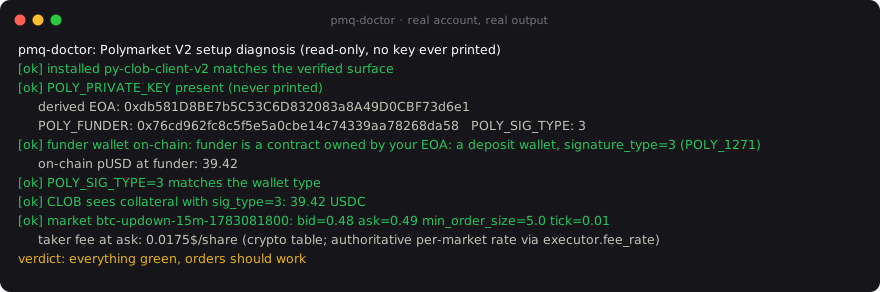
If you landed here from "the order signer address has to be the address of the API KEY" or a CLOB balance of 0 with funds on-chain: this is the tool.
The contract: nothing is booked without exchange confirmation
| Situation | What pmq does |
|---|---|
Response is a dict with orderID, not flagged failed |
Fill with the matched size read from the response |
Error dict on HTTP 200, string body, success: false |
Fill(rejected=True), zero booked |
| HTTP 4xx (incl. FAK no-match) | Fill(rejected=True), zero booked |
| Timeout, 5xx, exception after send | raises OrderUncertain: the order MAY exist. Call reconcile() before trading that market again |
| Unparseable matched amounts | zero booked (fail closed) |
reconcile(condition_id) cancels anything resting, verifies nothing stayed
open, and returns (shares, usd, fees) from get_trades: the exchange truth.
At startup pmq introspects the installed py-clob-client-v2 against the API surface it was verified on, and refuses to trade on drift instead of sending orders through changed semantics. The whole table is pinned by an executable test per row plus a hypothesis fuzz suite (hundreds of generated adversarial responses per run, including NaN/Infinity and negative amounts, which book zero).
Several bots, one wallet
get_trades is account-level: run two bots on the same wallet and each
one's exchange-truth totals silently include the other's fills. Since
0.5.0 every order-sender can keep an attribution registry: an
append-only file of its own order ids, written on every confirmed post.
ex = PolymarketExecutor(order_log="botA.orders",
                        foreign_order_logs=["botB.orders"])
# or per process: POLY_ORDER_LOG=botA.orders POLY_FOREIGN_ORDER_LOGS=botB.orders
With a registry configured, trades_totals() counts only trades whose
taker_order_id (taker role) or maker_orders[].order_id slice (maker
role) belongs to OUR registry (both fields verified present and populated
on real V2 trade records), and reconcile() additionally claims trades
unknown to EVERY registry, so a fill posted during an uncertainty window
is recovered by the bot that was uncertain and by nobody else. Sound only
if every sender on the wallet keeps a registry
(POLY_FOREIGN_ORDER_LOGS is colon-separated). The MCP server inherits
the registries through the same environment variables. Fully opt-in:
without POLY_ORDER_LOG the behavior is unchanged.
Streaming the resolution prices
The updown markets resolve on the Chainlink stream, and
wss://ws-live-data.polymarket.com republishes that exact stream (plus a
Binance spot mirror). pmq.stream.PriceStream consumes it with the
standard library only:
from pmq.stream import PriceStream

ps = PriceStream(assets=("btc", "eth")).start()
ps.last("btc")               # (unix_seconds, value) from the Chainlink feed
ps.age("btc")                # seconds since the freshest tick
ps.last("btc", "binance")    # the spot mirror, for comparison
Design note, measured 2026-07 from two unrelated egresses: the edge serves
the sustained push only to browser connections; a plain client gets the
initial tick batch after subscribing, then silence. PriceStream therefore
re-polls short connections (about one per second); the freshest tick is
typically 1.2 to 2.8 seconds old. Treat the feed as advisory and fail
closed on age(): the exchange resolves with its own copy.
The signature_type decoder table
signature_type |
Wallet | When it is yours |
|---|---|---|
| 0 | the EOA itself | you trade from a bare private key |
| 1 | POLY_PROXY |
email/Magic accounts (legacy) |
| 2 | POLY_GNOSIS_SAFE |
browser-wallet proxy |
| 3 | POLY_1271 deposit wallet |
the Polymarket app's default wallet |
If collateral() returns 0 while the funds are visible on-chain on your funder
address, your signature_type is wrong. Debug trick: eth_call owner()
(0x8da5cb5b) on the funder; if it returns your EOA and the wallet bytecode is
an ERC-1167 proxy, you want signature_type=3.
Alternatives
NautilusTrader if you want a full backtesting and trading framework; pmxt if you accept routing writes through a hosted backend; raw py-clob-client-v2 if you want no opinion layered on the official client. The dated feature-by-feature table (written by an interested party, every row checkable) lives in docs/comparison.md.
Builder code disclosure
pmq ships with the maintainer's public Polymarket builder code as default
attribution inside signed orders (pmq.executor.DEFAULT_BUILDER_CODE). Its
commission is set to 0/0: it never adds any fee to your orders. Attribution
feeds Polymarket's builder program and funds this project at zero cost to you.
Agents: the MCP server
For an installed server, run pip install "pmquant[mcp]" then pmq-mcp
(stdio). For a clean MCP-client configuration, use
uvx --from "pmquant[mcp]" pmq-mcp as in the paper example above. Listed in
the official MCP registry as
io.github.crp4222/pmq, it works with Claude Desktop or Code, ChatGPT,
LangChain, and a bare SDK loop.
What an agent can do, exactly:
| Tool | Needs | What it does |
|---|---|---|
pmq_status |
nothing | mode, registered trading surface, caps, daily headroom, and durable-state health without constructing a signer |
find_markets |
nothing | discover active markets, any category, full-text search |
event |
nothing | all binary markets of a multi-outcome event (elections, tournaments) |
market |
nothing | slug to condition id, outcome names, token ids, close time, winner |
market_snapshot |
nothing | resolve a market and read a top-of-book summary for every outcome in one call |
book |
nothing | real-time bid/ask with sizes, depth in a price range, exchange minimums |
order_preview |
nothing | non-mutating top-of-book FAK estimate with rails and a crypto-rate fee estimate; it never creates a signer, submits an order, or reserves budget |
taker_fee |
nothing | official fee formula per category, cost per share including fee |
account_collateral |
paper mode, or keys | paper cash or the CLOB-visible live balance with a sig_type diagnostic |
account_trades |
paper mode, or keys | paper totals or exchange-truth BUY totals on one market |
account_portfolio |
paper mode, or public wallet | durable paper positions, or public Data API positions for wallet or POLY_FUNDER |
fak_buy |
PMQ_MCP_PAPER=1, or keys plus PMQ_MCP_LIVE=1 |
open a position with a fill-and-kill buy; nothing rests |
fak_sell |
PMQ_MCP_PAPER=1, or keys plus PMQ_MCP_LIVE=1 |
close a position with a fill-and-kill sell under the same contract |
cancel_and_reconcile |
PMQ_MCP_PAPER=1, or keys plus PMQ_MCP_LIVE=1 |
cancel resting orders and return reconciliation truth; paper has nothing resting |
With PMQ_MCP_PAPER=1 (the 30-second demo
above) the same trading and account tools are registered keyless:
fills are simulated at the displayed best quote, capped by the displayed
size, refused under the exchange minimum, and the account tools report the
durable paper ledger. order_preview remains read-only in every mode.
Paper responses are flagged paper: true, and no order reaches the exchange.
The rails, all operator-set (server environment, invisible to and untouchable by the model):
| Variable | Effect | Default |
|---|---|---|
PMQ_MCP_LIVE |
unset: the three trading tools are never REGISTERED; an agent cannot call a tool that does not exist | read-only |
PMQ_MCP_PAPER |
trading tools simulate fills against the real live books, keyless, nothing sent to the exchange; wins over PMQ_MCP_LIVE when both are set |
off |
PMQ_MCP_PAPER_USD |
initial paper balance when a new state file is created | 1000 |
PMQ_MCP_MAX_USD |
hard cap per single order, live and paper alike | 10 |
PMQ_MCP_DAILY_USD |
durable cumulative BUY budget per UTC day; unknown live results retain their requested reservation through that UTC day | off |
PMQ_MCP_STATE_FILE |
local file for the durable paper ledger and daily budget | $XDG_STATE_HOME/pmq/mcp-state.json, otherwise ~/.local/state/pmq/mcp-state.json |
POLY_* keys |
omit them entirely for a data-only server | absent |
Structural rails on top: only FAK orders exist (nothing rests unattended on the book), every uncertain outcome is surfaced for reconciliation, and fills are booked only from exchange confirmations, never from optimism.
The state file contains paper cash, positions, fills, and the daily budget,
never key material. It is atomically replaced on update. Use a distinct state
file for each concurrently running server. A live buy reserves its requested
amount before the client call, then settles that reservation to an
exchange-confirmed amount. A clean rejection releases it; an unknown outcome
keeps the full reservation through the UTC day. pmq_status exposes state
health without exposing secrets. If a required durable write fails, the
affected buy is refused rather than proceeding without its rail.
{
  "mcpServers": {
    "pmq": {
      "command": "uvx",
      "args": ["--from", "pmquant[mcp]", "pmq-mcp"],
      "env": {
        "PMQ_MCP_LIVE": "1",
        "PMQ_MCP_MAX_USD": "10",
        "PMQ_MCP_DAILY_USD": "25",
        "POLY_PRIVATE_KEY": "...",
        "POLY_FUNDER": "0x...",
        "POLY_SIG_TYPE": "3"
      }
    }
  }
}
Remove PMQ_MCP_LIVE and the POLY_* variables entirely for a read-only
market-data server.
Bot template
bot-template/ is a complete bot minus the strategy, for ANY
market (politics, sports, crypto, culture): paper mode against real books
with real fees, per-market budgets with fee headroom, poisoned-market
reconciliation, consecutive-failure halt, disk-persisted daily loss halt, a
systemd unit with RestartPreventExitStatus=42 so halts stay halted, and a
lightweight phone dashboard. You implement watchlist() and decide(); the
shipped demo strategy is an API illustration meant to be replaced.
Security posture
- Keys are read from the environment, used to instantiate the signer, and never logged. No custody, no backend, no telemetry, zero network calls besides Polymarket endpoints.
- A documented wave of fake "polymarket bot" repositories steals private keys; pmq is deliberately small so the entire execution path stays readable in minutes by anyone who wants to look.
- Fund the trading wallet with what you can afford to lose. Nothing here is financial advice; prediction-market access is restricted in some jurisdictions and compliance is on you.
If you feel like checking any of it
None of the claims above require taking my word; each one comes with a handle you can pull, whenever you care to:
- Egress.
PMQ_CANARY=1 pytest tests/test_canary_live.py -k egress -srecords every DNS resolution during a full session (market data, auth derivation, one signed order) and fails on any host outsidepolymarket.com. Last observed list:clob.polymarket.com,gamma-api.polymarket.com, nothing else. The weekly canary prints that list in public CI logs. One designed exception:pmq-doctor's optional on-chain checks use the public Polygon RPCs named in its source. - Provenance. Releases carry a signed PEP 740 attestation (Sigstore,
via PyPI trusted publishing): click "provenance" next to any file on the
PyPI files page, or fetch it
raw from PyPI's integrity API. The signing identity is this repository's
publish.ymlworkflow. - Dependencies. Dependabot files weekly bump PRs (Python and
SHA-pinned GitHub Actions), and the weekly canary runs
pip-audit; a hit opens an issue by itself. - The source. Five small modules; the whole execution path reads in minutes. The grep targets that answer the important questions fastest are listed in SECURITY.md.
Stability and maintenance
Pre-1.0 SemVer with a written deprecation window and a stated bar for 1.0; one maintainer, trading his own money through this exact code daily. The operational rule worth knowing: if the canary badge goes red and stays red, treat the project as unmaintained and pin your last known-good version. Full policy and the precisely scoped help-wanted: docs/stability.md.
License
MIT
Установка Pmq
У этого сервера нет опубликованного пакета — он собирается из исходников. Открой репозиторий и следуй инструкции в README.
▸ github.com/crp4222/pmqFAQ
Pmq MCP бесплатный?
Да, Pmq MCP бесплатный — установка в пару кликов через Unyly без оплаты.
Нужен ли API-ключ для Pmq?
Нет, Pmq работает без API-ключей и переменных окружения.
Pmq — hosted или self-hosted?
Доступен hosted-вариант: Unyly запускает сервер в облаке, локальная установка не обязательна.
Как установить Pmq в Claude Desktop, Claude Code или Cursor?
Открой Pmq на unyly.org, выбери вкладку своего клиента (Claude Desktop, Claude Code, Cursor) и нажми Install — конфиг сгенерируется автоматически, без правки JSON.
Похожие MCP
GitHub
PRs, issues, code search, CI status
 автор: GitHub
Filesystem
Secure file operations with configurable access controls.
Memory
Knowledge graph-based persistent memory system.
Template MCP Server
A CLI tool to create a new Model Context Protocol server project with TypeScript support, dual transport options, and an extensible structure
 автор: mcpdotdirect
Compare Pmq with
Не уверен что выбрать?
Найди свой стек за 60 секунд
Автор?
Embed-бейдж для README
Похожее
Все в категории development