
Quantjobs
БесплатноНе проверенEnables conversational management of quant job search, tailored CV generation, and skill gap analysis through MCP tools. Allows Claude to search, ingest, score

Описание
Enables conversational management of quant job search, tailored CV generation, and skill gap analysis through MCP tools. Allows Claude to search, ingest, score jobs, and build/iterate LaTeX CVs.
README
A terminal app for hunting quant roles and managing a tailored LaTeX CV — with a Claude MCP server so you can drive the whole thing in conversation.
It does four things:
- Finds jobs — scrapes stable public job boards (Greenhouse/Lever) for London quant roles, or lets Claude web-search and ingest jobs for you via MCP.
- Scores & curates — a fit score (0–100) per job, bucketed into Strong match / Stretch / Long shot, plus star ★ and archive. The scorer is deliberately optimistic about skills you're learning, so genuine stretch roles surface instead of being filtered.
- Builds your CV — generates a LaTeX → PDF CV from a single source of truth
(
profile.yaml), either as your base CV or tailored to a specific job. Tailoring only reorders and selects your real experience — it never invents anything. If a job wants a skill you don't have, it adds a pending project (with an honest time estimate) and flags the skill to learn instead of fabricating a bullet. - Spots trends — aggregates skill demand across the jobs you're tracking and flags the in-demand skills you're missing (e.g. "C++ in 20% of roles — learn it").
Setup
Prereqs: uv and a LaTeX engine (latexmk/xelatex, e.g. MacTeX
or BasicTeX — already on this machine).
uv sync
uv run quantjobs init     # create the DB + seed your CV profile
uv run quantjobs scrape   # pull London quant jobs from the configured firms
uv run quantjobs          # launch the TUI
Data (DB, your editable profile.yaml, generated CVs) lives in ./data/ by default.
Override with QUANTJOBS_HOME=/some/path.
The TUI
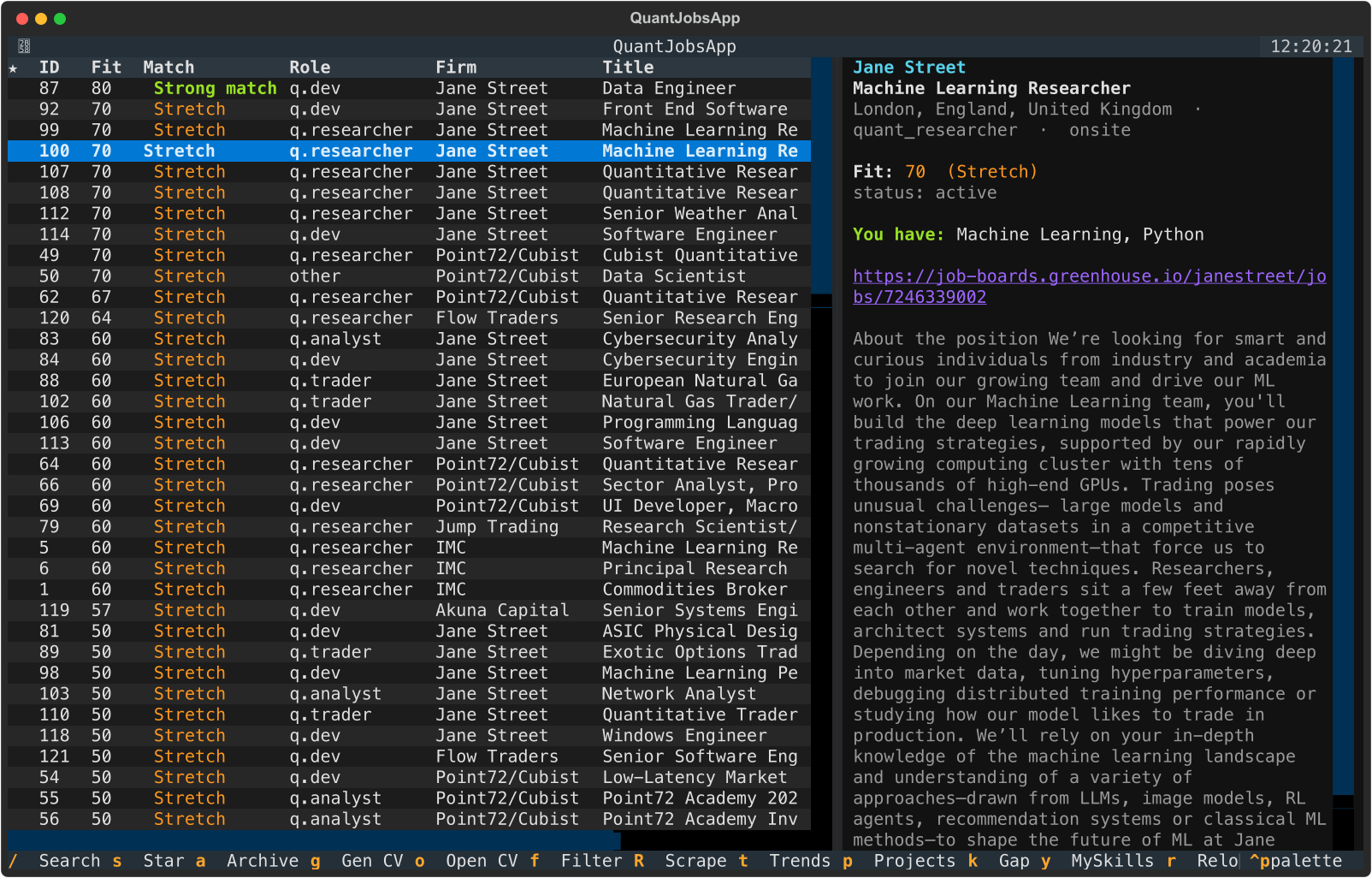
uv run quantjobs opens the dashboard. Left = job list, right = detail (fit %, the skills you
have vs miss, and the job description).
| Key | Action | Key | Action |
|---|---|---|---|
/ |
search (Enter apply, Esc clear) | t |
skill trends screen |
s |
star / unstar | p |
pending projects screen |
a |
archive | k |
skills gap screen |
g |
generate tailored CV for this job | y |
your skills profile |
o |
open the last generated CV (PDF) | f |
cycle filter (active/★/strong/stretch/all) |
R |
run the scrapers | r |
reload · q quit |
CV management
Your CV is defined entirely by data/profile.yaml (seeded from your current CV). Edit it to
change anything. The LaTeX template is quantjobs/cv/template.tex — drop your own .tex into
data/template.tex to override it.
uv run quantjobs cv --base                      # your standard CV
uv run quantjobs cv --job 42 --stretch aggressive --open
--stretch (conservative | balanced | aggressive) controls how hard the tailoring leans
into reach roles: it reorders bullets/skills to surface what the job asks for, and in
aggressive mode selects the strongest few bullets per role. It never adds experience you
don't have — missing skills become pending projects + flags. Generated CVs land in
data/output/. The template is a dense one-page modern-sans design (Helvetica Neue via xelatex).
Building a CV is best done as a conversation through the MCP (below): Claude drafts a tailored
CV for a job, you refine the bullets/order/summary together, then render — see cv_draft_* tools.
Adding job sources
Edit quantjobs/scrapers/firms.yaml (or data/firms.yaml to override). A firm's Greenhouse/Lever
token is the slug in its careers URL:
location_filter: London      # applied to every firm; set "" for all locations
firms:
  - {name: Jane Street, type: greenhouse, token: janestreet}
  - {name: DRW,         type: greenhouse, token: drweng}
  - {name: Some Fund,   type: lever,      token: somefund}
uv run quantjobs scrape --list                  # show configured sources
uv run quantjobs scrape --source "Jane Street"  # one firm
uv run quantjobs trends                          # skill demand + flags to learn
uv run quantjobs gap                             # missing skills + suggested projects
eFinancialCareers HTML scraping is included as a best-effort fallback (--source efc) but the
robust paths are the JSON boards above and Claude-driven ingestion below.
Talk to it: the Claude MCP server
Register the server so Claude can search, analyse and act on your job DB in conversation:
claude mcp add quantjobs -- uv run --directory "$(pwd)" quantjobs-mcp
Claude Desktop (JSON) config
{
  "mcpServers": {
    "quantjobs": {
      "command": "uv",
      "args": ["run", "--directory", "/absolute/path/to/quantjobs", "quantjobs-mcp"]
    }
  }
}
Note: Claude Desktop may not inherit your shell PATH; if CV compilation fails, ensure
/Library/TeX/texbin is on PATH for the server process.
Then just ask Claude things like:
- "Find London quant-developer roles and add them" → web search →
add_jobs - "What in-demand skills am I missing?" →
analyze_trends+skills_gap_report - "Which firms are hiring for C++?" →
run_query(read-only SQL over the DB) - "Star 42 and add a pending project to learn kdb+" →
star_job+add_pending_project - "I finished the order-book project — mark C++ as a skill I have" →
add_or_update_skill
Build a CV conversationally (the recommended way):
"Build my CV for job 107" →
cv_draft_create(Claude shows the proposed summary, the selected/reordered bullets, and the skills) → "tighten the second UBS bullet and lead with the ML one; drop the Excel bullet" →cv_draft_update(re-shows) → "render it" →cv_draft_render→ PDF. Drafts persist between messages, so you can iterate. Claude only rephrases your real experience (same facts/metrics) — it never invents anything.
29 tools are exposed. run_query is restricted to a single read-only SELECT/WITH on a
read-only connection, so Claude can freely explore patterns without being able to mutate data
except through the explicit, audited tools.
Useful tables for run_query: jobs, job_skills(job_id, skill), skills_profile,
pending_projects, skill_flags, cv_versions, saved_searches.
Development
uv run pytest            # test suite
uv run ruff check .      # lint
Layout: core data layer (db, repo, models, ingest, fit), cv/ (template +
generator + compile), scrapers/, analysis/ (trends, skills gap), tui/, mcp_server/.
Установить Quantjobs в Claude Desktop, Claude Code, Cursor
unyly install quantjobsСтавит в Claude Desktop, Claude Code, Cursor и VS Code — сам разбирается с npx, uvx и сборкой из исходников.
Впервые? Поставь CLI: curl -fsSL https://unyly.org/install | sh
Или настроить вручную
Выполни в терминале:
claude mcp add quantjobs -- uvx --from git+https://github.com/Kav-png/quantjobs quantjobsFAQ
Quantjobs MCP бесплатный?
Да, Quantjobs MCP бесплатный — установка в пару кликов через Unyly без оплаты.
Нужен ли API-ключ для Quantjobs?
Нет, Quantjobs работает без API-ключей и переменных окружения.
Quantjobs — hosted или self-hosted?
Self-hosted: сервер запускается локально на твоей машине командой из раздела установки.
Как установить Quantjobs в Claude Desktop, Claude Code или Cursor?
Открой Quantjobs на unyly.org, выбери вкладку своего клиента (Claude Desktop, Claude Code, Cursor) и нажми Install — конфиг сгенерируется автоматически, без правки JSON.
Похожие MCP
Fetch
Web content fetching and conversion for efficient LLM usage.
AWS KB Retrieval
Retrieval from AWS Knowledge Base using Bedrock Agent Runtime.
 автор: modelcontextprotocol
Spring AI MCP Server
Provides auto-configuration for setting up an MCP server in Spring Boot applications.
llm-analysis-assistant
A very streamlined mcp client that supports calling and monitoring stdio/sse/streamableHttp, and can also view request responses through the /logs page. It also
 автор: xuzexin-hz
Compare Quantjobs with
Не уверен что выбрать?
Найди свой стек за 60 секунд
Автор?
Embed-бейдж для README
Похожее
Все в категории ai