
Qwen Memory Agent
БесплатноНе проверенMCP-native persistent-memory agent that remembers user preferences across sessions, forgets superseded facts, and recalls relevant memories within a tight token

Описание
MCP-native persistent-memory agent that remembers user preferences across sessions, forgets superseded facts, and recalls relevant memories within a tight token budget.
README
A benchmarked, MCP-native persistent-memory agent built on Qwen Cloud (Alibaba Cloud / DashScope). Submitted to the Qwen Cloud Hackathon, Track 1 — MemoryAgent.
The agent itself decides — via Qwen function-calling — when to remember, recall, or forget. It carries user preferences across sessions, forgets superseded facts, and recalls the right memories inside a tight token budget — and proves it with numbers against naive baselines.
Why it's different
Most memory agents are "stuff everything into RAG and hope." This one treats memory as a measurable engineering problem, and every capability maps to a Track-1 requirement:
- Agentic memory via Qwen function-calling — the model invokes
remember/recall/forgettools through a real agent loop. It's an agent with memory, not a database with an LLM bolted on. - Supersession-aware forgetting (exact and semantic) — when a new fact contradicts an old one, the old record is retired. Exact
(subject, type)match handles the clean case; a cosine-similarity pass (configurableSUPERSEDE_THRESHOLD) also retires near-paraphrases the model filed under a different subject — the case that defeats exact matching in a real agent loop. - Semantic forget — "forget my anime preferences" works even when the model can't guess the stored subject string:
forget(query=...)embeds the description and deletes the closest matching memory above the threshold (the read-path twin of semantic supersession), with a recall→forget-by-id fallback when the first pass misses. Found by live conversational testing on the deployed box. - Graded, time-based decay + reinforce-on-recall —
effective_salience = salience · 0.5^(age / half_life)(per-type half-lives;preferencepinned). Recalling a memory refreshes it (access_count,last_accessed), so hot memories stay and cold ones fade — "timely forgetting of outdated information." - Typed retrieval — a second self-correcting layer — a type-aware ranking prior (a durable
preferenceoutranks a throwawayepisodicnote of equal cosine) plus a retrieval-time "one-active-per-(subject, type), keep-newest" veto that catches stale contradictions the write path can miss (e.g. records that arrive via import). "Recall the most critical memories under limited context." - Budget-constrained recall — retrieval scores memories by
α·cosine + β·recency + γ·effective_salience + δ·type_priorand greedily packs them until a configurable token budget is hit, so context stays small and relevant. - Portable memory (export / import) — the whole store round-trips as JSON or renders to Markdown. Vectors are preserved for the same embedder; if you swap embedders, mismatched records are detected and hidden until the explicit
POST /memory/reembedmaintenance pass spends credits to heal them. - Persistent across restarts — set
MEMORY_PERSIST_PATHand the store writes an atomic JSON snapshot on every change and reloads it on startup (rebuilding the vector index), so memories survive a full server restart — real persistence, not process-lifetime state. - The dreaming loop (propose → approve) — an out-of-band Qwen pass reviews the store and proposes consolidations (merge / forget / re-salience); a human approves, then only approved proposals are applied. It validates every proposal against live record ids, so it refuses to act on its own hallucinations. "Autonomously accumulate experience" — with a human in the loop.
- Model provenance — each memory can carry both the chat model that wrote it (
source_model) and the embedding model that produced its vector (embed_model), and export/import preserves those fields. Cryptographic signing is a future extension, not claimed here. - Token & model observability — every Qwen call's
usage(prompt / completion / total tokens, per model) is accumulated and exposed at/usage;/chatreports the per-request token delta. - A reproducible benchmark — synthetic multi-session personas, a held-out query set, and baselines (no-memory / full-history / naive-RAG / ours), scored on context recall (retrieval-level, model-free), staleness rate, and a context-efficiency curve.
- A live memory inspector at
/demo— a zero-dependency single-file UI: chat on the left, the live store on the right. You watch a contradicted fact strike through tosupersededin real time, and drive the dreaming loop's propose → approve → apply. - Fuzzed against its own store — 50 live conversational scenarios (casual corrections, forget phrasings, update chains, abstention, honesty edges) graded against store state, not the model's prose; findings + known limitations in docs/qa/conversational-fuzz-findings.md, harness in scripts/conversational_fuzz.py.
Architecture
flowchart TB
    U["MCP client / demo UI"]

    subgraph ecs["Alibaba Cloud ECS (Singapore)"]
        API["FastAPI backend<br/>/chat · /health · /usage · /demo<br/>/memory/export · /memory/import · /memory/reembed<br/>/dream · /dream/apply"]
        AGENT["MemoryAgent loop<br/>Qwen function-calling"]
        DREAM["Dreaming loop<br/>propose → approve consolidation"]
        MCP["FastMCP server<br/>remember / recall / forget / stats<br/>export / import / dream / dream_apply"]
        ENG["Memory Engine<br/>write · retrieve · exact + semantic supersession<br/>typed retrieval · decay + reinforce · dreaming loop<br/>token-budget packing"]
        QD[("Qdrant<br/>embedded vector store")]
        SNAP[("Disk snapshot<br/>memory.json · survives restart")]
    end

    DS["Qwen Cloud / DashScope-intl<br/>reasoning model + text-embedding-v3<br/>(usage metered per call)"]

    U -->|HTTP| API
    U -.->|MCP| MCP
    API --> AGENT
    API --> DREAM
    AGENT -->|"decides which tool to call"| ENG
    DREAM -->|"proposes / applies"| ENG
    MCP --> ENG
    AGENT <-->|"chat + tool specs"| DS
    DREAM <-->|"review memories"| DS
    ENG <-->|"embed"| DS
    ENG <--> QD
    ENG <-->|"save on write / load on start"| SNAP
The agent loop (/chat) lets Qwen choose tool calls; the same memory engine is also exposed directly over MCP for any MCP client, and the dreaming loop drives it as a maintenance pass. With MEMORY_PERSIST_PATH set, the engine snapshots to disk on every change and rehydrates on startup, so the store survives a restart. The Qwen client has bounded retry/backoff for resilience and meters token usage on every call.
HTTP + MCP surface
| HTTP route | MCP tool(s) | Purpose |
|---|---|---|
POST /chat |
memory.remember / recall / forget |
agent loop; Qwen picks memory tools |
GET /usage |
— | accumulated token usage (per model) |
GET /memory/export · POST /memory/import |
memory.export / memory.import |
round-trip the store (JSON + Markdown) |
POST /memory/reembed |
— | explicit credit-spending repair after an embedding-model swap |
POST /dream · POST /dream/apply |
memory.dream / memory.dream_apply |
propose consolidations, then apply approved ones |
GET /health |
memory.stats |
liveness / store counts, including embed-model mismatches |
GET /demo |
— | live memory inspector (chat + store table + dreaming loop UI) |
Stack
Python · FastAPI · Qwen function-calling agent loop · FastMCP · openai SDK → DashScope-intl · Qwen text-embedding-v3 · Qdrant · tiktoken (budget accounting).
Quickstart
uv sync
cp .env.example .env   # set DASHSCOPE_API_KEY + DASHSCOPE_BASE_URL
PYTHONPATH=src uv run --no-sync pytest -q tests/  # fully mocked — zero Qwen credit spend

# run the backend, then open the live memory inspector:
uv run uvicorn memory_agent.api:app --port 8000
open http://localhost:8000/demo
Benchmark results
Reproducible and fully offline — PYTHONPATH=src uv run --no-sync python -m benchmark.run uses a deterministic
bag-of-vocabulary embedder, so the harness measures the memory engine's ranking +
supersession logic (not embedding noise) and costs zero Qwen credits. All three systems
compete under the same shrinking token budget, so this is a fair context-efficiency test.
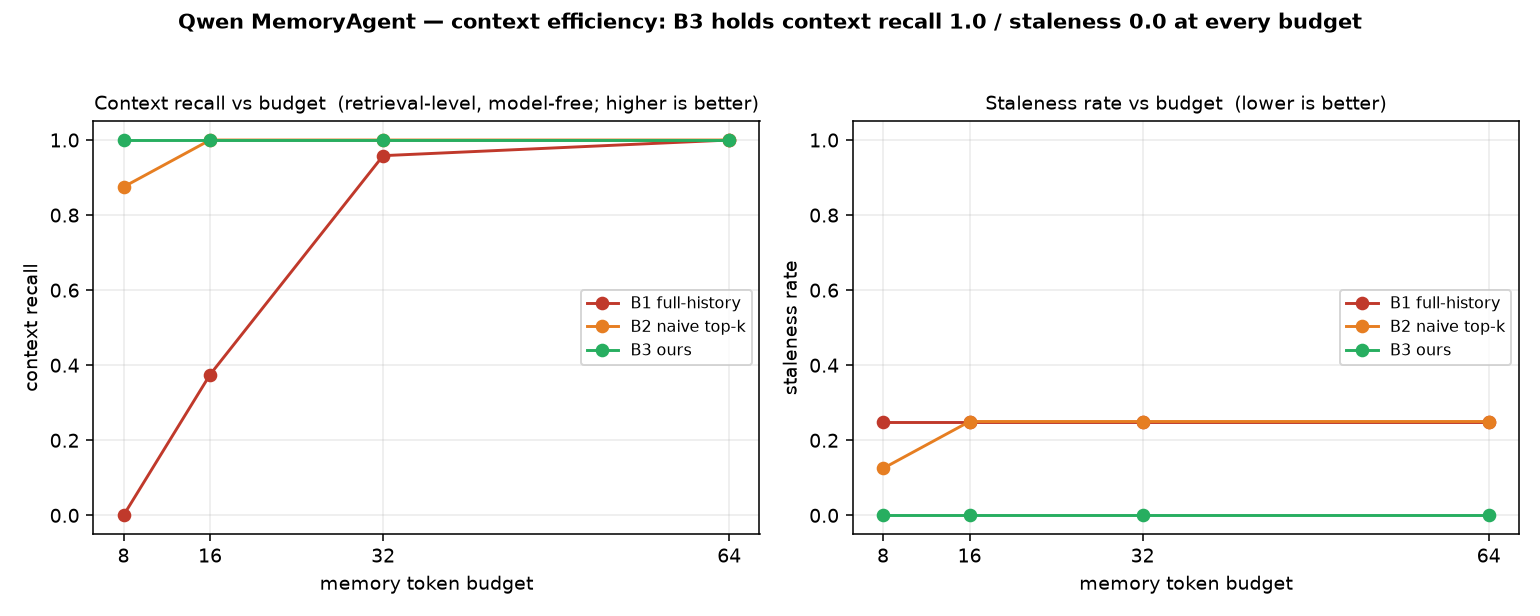
Context recall (retrieval-level, model-free) and staleness rate (fraction of retrieved contexts
containing a retired fact; lower is better) vs the memory token budget, over the six-persona,
24-query synthetic set in benchmark/generate.py. Token budgets use tiktoken's
gpt-4o-mini encoding as a consistent approximation for Qwen context accounting.
| Budget (tokens) | 8 | 16 | 32 | 64 |
|---|---|---|---|---|
| B1 full-history — context recall / staleness | 0.000 / 0.250 | 0.375 / 0.250 | 0.958 / 0.250 | 1.000 / 0.250 |
| B2 naive top-k — context recall / staleness | 0.875 / 0.125 | 1.000 / 0.250 | 1.000 / 0.250 | 1.000 / 0.250 |
| B3 ours — context recall / staleness | 1.000 / 0.000 | 1.000 / 0.000 | 1.000 / 0.000 | 1.000 / 0.000 |
B3 holds context recall 1.000 and staleness 0.000 at every budget — it's the only system that recalls the current facts and never re-surfaces retired ones. Two things the naive baselines can't do:
- B1 (dump history chronologically) wastes its budget on the oldest facts, so it needs a large budget just to recall the current answer — and it permanently carries the stale one.
- B2 (keyword top-k) gets staler as the budget grows: with no notion of "replaced," extra budget pulls retired facts back in, so its staleness climbs 0.125 → 0.250 and then plateaus.
Only supersession-aware forgetting + budget-constrained recall keeps the working set both correct and small.
The semantic supersession threshold is also checked against live DashScope text-embedding-v3
embeddings in docs/embedding-validation.md. That run did not produce a perfect validation:
supersession-pair cosines were 0.879-0.908, while unrelated distractors were 0.683-0.743. The
default SUPERSEDE_THRESHOLD=0.9 is therefore conservative and should be revisited with a larger
set rather than treated as a proven universal constant.
Active-use eval — does the agent use memory, or just recall it?
Passive recall benchmarks saturate (see the 1.000s above) while the same systems fail when a
memory from one session must gate a decision in a later one — MemoryArena
(arXiv 2602.16313) reports 40-60% task success for agents
that ace LoCoMo. benchmark/active_use.py tests exactly that: 10
multi-session scenarios (constraint seeded in one session, decision demanded in a later one,
including superseded-constraint chains), each graded by three independent oracles — decision
outcome, store state via /memory/export, and recall-before-decision in the tool-call trace, so
a lucky guess without consulting memory scores zero.
flowchart LR
    S["Sessions 1..N-1<br/>seed constraint(s)<br/>(incl. supersessions)"] -->|"new session id"| D["Final session<br/>decision turn"]
    D --> O1["outcome oracle<br/>decision reflects constraint,<br/>no violation tokens"]
    D --> O2["store oracle<br/>/memory/export:<br/>constraint active, stale retired"]
    D --> O3["process oracle<br/>recall in tool_calls_made<br/>before the decision"]
    O1 --> TS{"task_success<br/>= ALL three"}
    O2 --> TS
    O3 --> TS
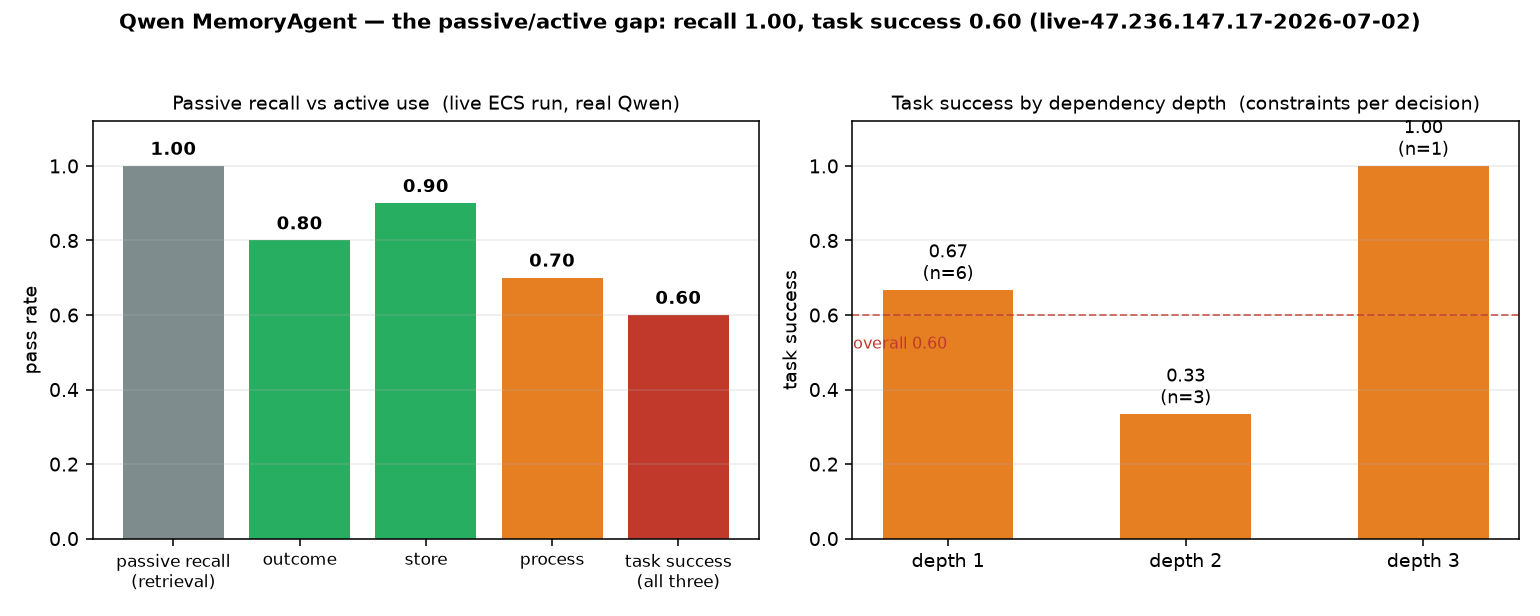
Live result on the deployed agent (real Qwen, fresh store): task_success 0.60 — outcome 0.80
· store 0.90 · process 0.70, benchmark/results/active_use.json. Our agent lands inside
MemoryArena's predicted band, and the eval caught three real defects the retrieval benchmark
structurally cannot see (decision turns skipping recall; a generic-subject collision where an
unrelated fact retired a dietary constraint; a missed cross-subject supersession). Full triage,
including the harness's own graded false-positives from run 1:
docs/qa/active-use-findings.md. We publish the 0.60 rather
than tuning the scenarios until it flatters — the gap between 1.000 recall and 0.60 active use
is the finding.
How this maps to 2026 memory research
- Forgetting as a first-class metric — our staleness rate measures what the Memora benchmark (arXiv 2604.20006) later named forgetting-aware accuracy.
- Memory as an auditable artifact — the fuzz + active-use oracles grade the store, never the model's prose, the evaluation stance of MEMPROBE (arXiv 2606.24595); our honesty rule (an answer implying "done" must match the store) is stricter than prose-grading.
- Honest baselines under a token budget — EvoMemBench (arXiv 2605.18421) shows long-context baselines beat most memory systems on raw accuracy; memory wins on accuracy at a budget. Our context-efficiency curve runs all baselines under identical token accounting for that reason.
- Active use over passive recall — the active-use eval above adopts the MemoryArena (arXiv 2602.16313) framing.
- Admission control, deliberately inverted — A-MAC
(arXiv 2603.04549) gates memories at write time and
discards rejects. We accept-then-retire instead: superseded records stay queryable
(
history(), temporal queries), because rejected memories are unauditable — the property post-hoc audit work like MemAudit (arXiv 2605.23723) depends on.
Future work
- Memory governance — designed in docs/design/memory-governance.md: domain-scoped writes + scoped retrieval, with the existing dreaming loop as the gated cross-domain promotion mechanism (propose → human approve → apply) — the primitives of governed shared memory (arXiv 2606.24535, Collaborative Memory, arXiv 2505.18279). Threat model: one poisoned observation persists cross-session (eTAMP, arXiv 2604.02623); quarantine-by-domain caps the blast radius, and the provenance we already stamp enables the audit. Two of the four primitives (temporal supersession, provenance) are already shipped.
- Supersession repair (from the active-use findings): require a cosine floor before exact-subject supersession acts (stops generic-subject collisions), and route the 0.7-0.9 cosine band to the dreaming loop for human-approved consolidation instead of silent action.
- Temporal knowledge graph for bi-temporal facts (Zep, arXiv 2501.13956); SLM-staged retrieval for latency (LightMem, arXiv 2604.07798); trained memory policies (MemTrain, arXiv 2606.03197).
License
MIT — see LICENSE.
Установка Qwen Memory Agent
У этого сервера нет опубликованного пакета — он собирается из исходников. Открой репозиторий и следуй инструкции в README.
▸ github.com/rduffyuk/qwen-memory-agentFAQ
Qwen Memory Agent MCP бесплатный?
Да, Qwen Memory Agent MCP бесплатный — установка в пару кликов через Unyly без оплаты.
Нужен ли API-ключ для Qwen Memory Agent?
Нет, Qwen Memory Agent работает без API-ключей и переменных окружения.
Qwen Memory Agent — hosted или self-hosted?
Доступен hosted-вариант: Unyly запускает сервер в облаке, локальная установка не обязательна.
Как установить Qwen Memory Agent в Claude Desktop, Claude Code или Cursor?
Открой Qwen Memory Agent на unyly.org, выбери вкладку своего клиента (Claude Desktop, Claude Code, Cursor) и нажми Install — конфиг сгенерируется автоматически, без правки JSON.
Похожие MCP
Fetch
Web content fetching and conversion for efficient LLM usage.
AWS KB Retrieval
Retrieval from AWS Knowledge Base using Bedrock Agent Runtime.
 автор: modelcontextprotocol
Spring AI MCP Server
Provides auto-configuration for setting up an MCP server in Spring Boot applications.
llm-analysis-assistant
A very streamlined mcp client that supports calling and monitoring stdio/sse/streamableHttp, and can also view request responses through the /logs page. It also
 автор: xuzexin-hz
Compare Qwen Memory Agent with
Не уверен что выбрать?
Найди свой стек за 60 секунд
Автор?
Embed-бейдж для README
Похожее
Все в категории ai