
Refract
БесплатноНе проверенMCP server for rendering responsive screenshots of URLs at multiple viewports. Enables agents to capture screenshots and detect visual issues like overflow, cli

Описание
MCP server for rendering responsive screenshots of URLs at multiple viewports. Enables agents to capture screenshots and detect visual issues like overflow, clipped elements, and missing alt text.
README

Refract
Agent-first responsive screenshots. Give a coding agent (or yourself) one primitive: render this URL at N viewports, return the images, and tell me what visually broke. Built on Playwright, shipped as an MCP server + CLI + Node library.
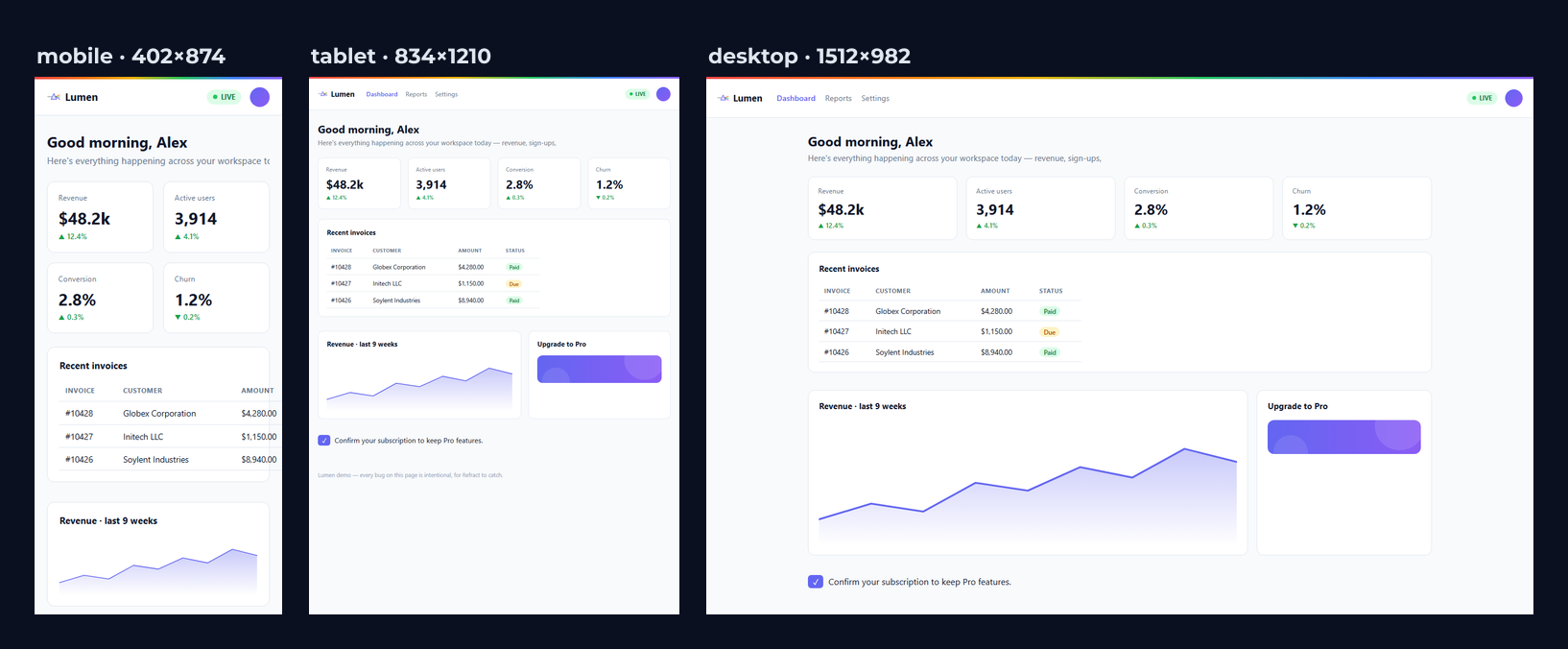
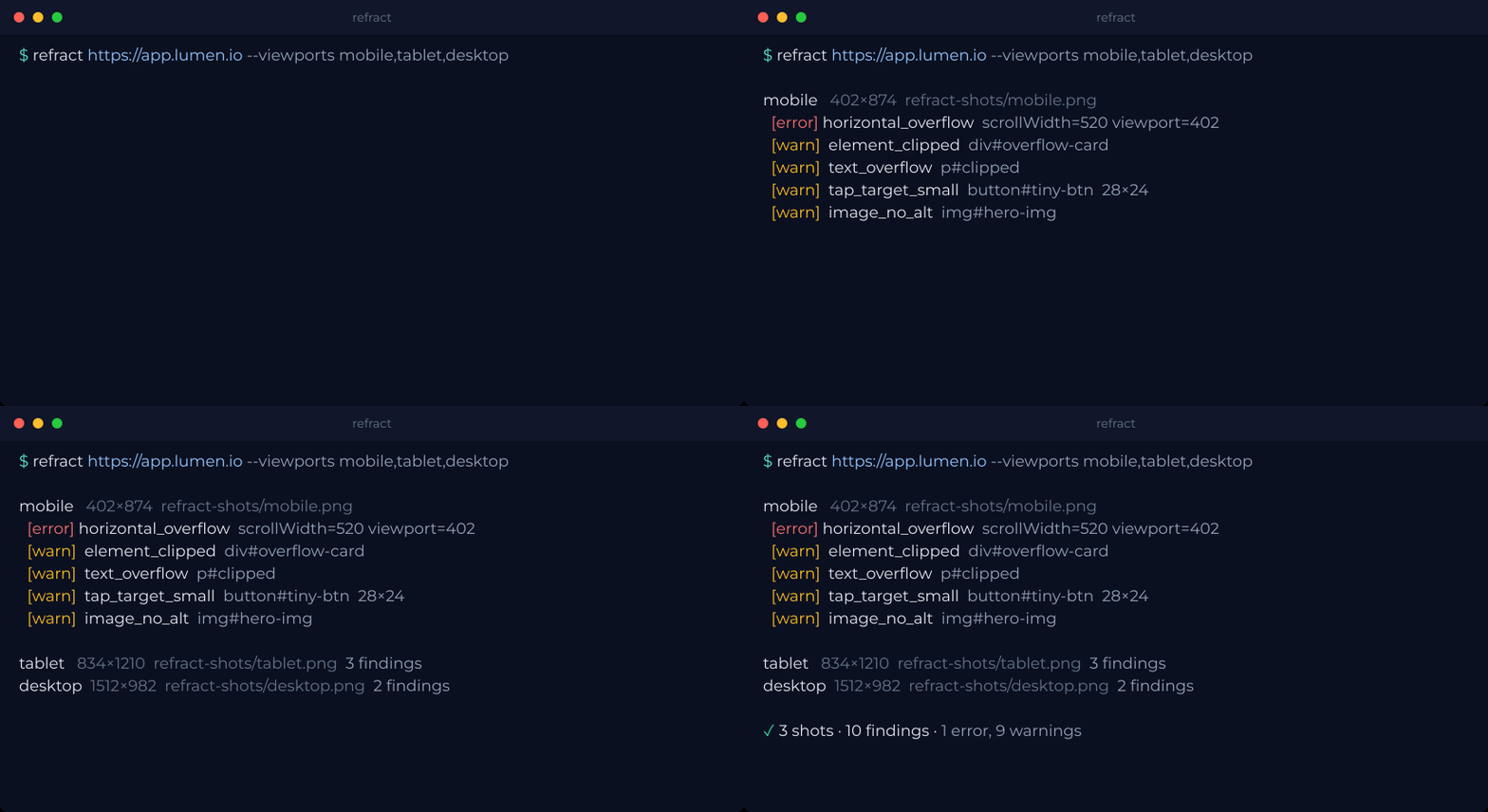
🚧 Pre-release. The engine, CLI, and MCP tool work; npm packages aren't published yet, so install from source (
pnpm install && pnpm build).
Install
pnpm add @getrefractjs/core        # library
pnpm add -g @getrefractjs/cli      # CLI
# one-time browser download (deferred until first render):
pnpm exec playwright install chromium
CLI quickstart
refract https://example.com --viewports mobile,tablet,desktop --out ./shots
Outputs ./shots/{preset}.png, one per viewport (full-page, not just the fold), and
prints findings under each.
Flags: --viewports, --out, --selector, --wait-for, --wait-for-function,
--wait-for-network-idle-ms, --freeze, --inject-css, --annotate, --dpr,
--concurrency, --storage-state, --engine.
Use --inject-css "#clock,.ad{visibility:hidden}" to hide dynamic or flaky elements
before capture — handy for clean, stable diffs (and the hidden elements stop showing
up as findings too).
--freeze makes shots deterministic by disabling CSS animations/transitions and
eager-loading images; it does not stop canvas, <video>, or JS-driven animation
(use --inject-css to hide those). Captures are full-page, so content that only
appears more than a few seconds after load should be gated with --wait-for.
Pass --annotate to draw outline boxes over the findings onto the screenshot (errors
red, warnings amber) — so the image itself shows what broke. Full-page only.
When the page is ready only after an app-specific signal, gate the capture with
--wait-for-function "window.__ready === true"; for slow pages, raise the
network-idle cap with --wait-for-network-idle-ms 30000 (it stays best-effort).
Viewports that render identically (e.g. iphone-17-pro and iphone-16-pro are both
402×874 @3) are rendered once and bundled into a single result, with the extra
device names listed as aliases — so "render every iPhone" doesn't shoot the same
pixels three times.
Library quickstart
import { render } from '@getrefractjs/core';

const shots = await render({ url: 'http://localhost:3000' });
for (const shot of shots) {
  console.log(shot.preset, shot.savedPath);
  for (const f of shot.findings) {
    console.log(`  [${f.severity}] ${f.type} ${f.detail}`);
  }
}
MCP config block
{
  "mcpServers": {
    "refract": {
      "command": "npx",
      "args": ["-y", "@getrefractjs/mcp"]
    }
  }
}
The server exposes two tools, each with a description that tells an agent exactly when and how to call it — no docs required:
render_responsive— one call returns a text manifest of absolute saved paths, structured findings as JSON (see below), and a downscaled preview image per viewport (≤800px wide, so it won't blow the agent's context window); full-resolution PNGs are written to disk.diff_responsive— visual regression in-band: renders, compares against a saved baseline, and returns a per-viewport status (unchanged/changed/…) with the % of pixels changed, a downscaled diff image for each changed viewport, and areport.htmlpath. First run withupdate: trueto save the baseline, then compare after a change.
Load failures come back as teaching errors the agent can act on.
Working in this repo? A committed .mcp.json registers the local server
(node packages/mcp/dist/index.js) — run pnpm build first and restart your
client so it picks the tool up.
Authenticated pages
Most real apps live behind a login. Refract renders logged-in pages by reusing a Playwright storage-state file (cookies + localStorage) — the standard format, nothing Refract-specific. Generate one once by logging in:
npx playwright codegen --save-storage=auth.json https://your-app.com/login
# log in in the window that opens, then close it
Then point any surface at it:
refract https://your-app.com/dashboard --storage-state ./auth.json
await render({ url: 'https://your-app.com/dashboard', storageState: './auth.json' });
render_responsive({ url: 'https://your-app.com/dashboard', storageState: './auth.json' })
Already have Playwright auth states from your e2e suite (e.g. e2e/.auth/*.json)?
Pass one straight through — no regeneration needed. The file's cookies are sent to
the URL, so don't pair an auth file from one origin with an untrusted URL.
Findings
Every render returns structured findings per viewport alongside the screenshots — agents act on these instead of eyeballing pixels:
{ preset: "mobile", findings: [
  { type: "horizontal_overflow", severity: "error", detail: "scrollWidth=480 viewport=402",
    selector: "div.card", rect: { x: 0, y: 120, width: 480, height: 90 } },
  { type: "tap_target_small", severity: "warn", selector: "button#tiny-btn", size: "28x24",
    rect: { x: 16, y: 540, width: 28, height: 24 } },
]}
Most findings carry a selector and a rect (the culprit's box in document pixels, so you
can zoom straight to what broke); horizontal_overflow names the element that causes it.
| type | severity | fires when |
|---|---|---|
horizontal_overflow |
error | the page scrolls wider than the viewport — from a wide element OR overflowing text (a long unbreakable URL/token); names the culprit, plus left-side overflow on dir="rtl". Also surfaces element_clipped for the offending element |
element_clipped |
warn | an element extends past the viewport edge (would be cut off / cause sideways scroll) |
text_overflow |
warn | text is hard-clipped with no ellipsis (scrollWidth > clientWidth; intentional text-overflow: ellipsis truncation is ignored) |
tap_target_small |
warn | an interactive element is small in both dimensions (under 44px) on mobile — wide-but-short links and inline text links are exempt |
text_too_small |
warn | body text under 12px on a mobile viewport (short labels/badges and aria-hidden subtrees are ignored) |
viewport_meta_missing |
error | the page has no <meta name="viewport"> (or it doesn't set width=device-width), so phones render it at a fixed/desktop width and scale down |
image_no_alt |
warn | an <img> is missing its alt attribute |
The checks descend into open Shadow DOM (web components); closed shadow roots are unreachable. The CLI prints findings under each shot; the MCP tool returns them as JSON keyed by preset.
Token footprint
Findings-first responses and downscaled previews aren't just nice-to-haves — they
keep the agent's context window alive. Measured on the demo-site (3 viewports), one
render_responsive response costs roughly:
| response shape | Claude | GPT-4o | Gemini |
|---|---|---|---|
| findings only (no images) | ~985 | ~985 | ~985 |
| downscaled previews (default) | ~4.8k | ~4.3k | ~4.1k |
| full-resolution images (naive) | ~21.9k | ~4.7k | ~11.1k |
So Refract's default is ~78% smaller than dumping full-res screenshots on Claude,
and the structured findings alone are a few hundred tokens. Re-run anytime with
pnpm bench; details + per-model formulas in benchmarks/RESULTS.md.
Visual diff
refract diff catches unintended visual change across viewports — the "did my
CSS tweak break another page" check. Baselines are just PNGs in a folder, so it's
git-agnostic and trivial to wire into CI.
# 1. Save a baseline (once, or to accept new changes)
refract diff https://example.com --update          # writes ./refract-baseline/{preset}.png

# 2. Later, compare a fresh render against it
refract diff https://example.com                   # exits 1 if anything changed
Each viewport is compared with pixelmatch.
Output per preset is unchanged, changed (with the % of pixels and a
{preset}.diff.png highlighting them), size_changed, or no_baseline. Alongside the
pixel diff, each preset reports a findings delta — which findings were fixed (gone
since the baseline) or regressed (new) — so you can confirm a fix landed without
introducing a new responsive issue. (The --update snapshot stores the findings too, in
findings.json; an older baseline without one just omits the delta.) A
report.html lands next to the shots with a baseline │ current │ diff grid.
The command exits non-zero when anything changed, so CI fails on a regression;
re-run with --update to accept the new look as the baseline. Flags: `--baseline
Use in CI
Commit your baselines (./refract-baseline/) and run refract diff against a
deployed preview on every PR — it exits non-zero on a regression, failing the job.
A ready-to-copy GitHub Actions workflow is in
examples/github-actions/visual-diff.yml:
it installs the CLI + Chromium, runs the diff, and uploads report.html + the diff
PNGs as an artifact when something changed. Refresh baselines by re-running with
--update and committing. (Agents working in an MCP client can do the same loop via
the diff_responsive tool.)
What this is not
- ❌ A browser extension or live-preview app (that's Responsively's job).
- ❌ A general-purpose browser-control MCP (that's
playwright-mcp's job). It renders URLs at viewports; it cannot click, type, or perform a login flow. It can reuse a saved auth state (--storage-state) to render a logged-in page, but it won't log in for you. - ❌ A visual-regression engine reinvented from scratch (it wraps
pixelmatch). - ❌ A real-device cloud. Playwright emulates viewport, DPR, UA, and touch, and
--engine webkitruns the real WebKit engine (close to iOS Safari) — but it's still desktop WebKit, not an actual iOS device or GPU. It does not replace BrowserStack.
Cross-browser
Renders on Chromium by default; pass --engine webkit (or engine: "webkit" in the
library / MCP) to render with the real Safari/WebKit engine — the closest local proxy
to iOS Safari, where a lot of responsive bugs actually show up.
npx playwright install webkit          # one-time, ~70MB
refract https://example.com --engine webkit
It works everywhere a render does (CLI, library, MCP render_responsive / diff_responsive).
For visual diffs, keep a separate baseline dir per engine (--baseline ./baseline-webkit)
since engines render slightly differently. Firefox isn't supported yet (it can't emulate
isMobile and ignores DPR) — open an issue if you need it.
Roadmap
Where Refract is headed — deeper findings, shareable reports, more device/engine coverage — is in docs/ROADMAP.md. It's directional, not a promise; real usage steers it.
Security
Refract loads any URL you give it — including file:// (local files) and
internal/private hosts (e.g. cloud metadata endpoints) — and returns the rendered
pixels. Treat it like curl: don't point it, or an agent driving the MCP server,
at untrusted or sensitive URLs. There is no URL allow/deny list by default. See
SECURITY.md to report a vulnerability.
License
MIT
Установка Refract
У этого сервера нет опубликованного пакета — он собирается из исходников. Открой репозиторий и следуй инструкции в README.
▸ github.com/valternunez/refractFAQ
Refract MCP бесплатный?
Да, Refract MCP бесплатный — установка в пару кликов через Unyly без оплаты.
Нужен ли API-ключ для Refract?
Нет, Refract работает без API-ключей и переменных окружения.
Refract — hosted или self-hosted?
Self-hosted: сервер запускается локально на твоей машине командой из раздела установки.
Как установить Refract в Claude Desktop, Claude Code или Cursor?
Открой Refract на unyly.org, выбери вкладку своего клиента (Claude Desktop, Claude Code, Cursor) и нажми Install — конфиг сгенерируется автоматически, без правки JSON.
Похожие MCP
GitHub
PRs, issues, code search, CI status
 автор: GitHub
Filesystem
Secure file operations with configurable access controls.
Memory
Knowledge graph-based persistent memory system.
Template MCP Server
A CLI tool to create a new Model Context Protocol server project with TypeScript support, dual transport options, and an extensible structure
 автор: mcpdotdirect
Compare Refract with
Не уверен что выбрать?
Найди свой стек за 60 секунд
Автор?
Embed-бейдж для README
Похожее
Все в категории development