
ReleaseGuard Server
БесплатноНе проверенProvides MCP tools for scanning, redacting, and packaging dataset/model directories for public release, leveraging Presidio for PII detection and generating Hug

Описание
Provides MCP tools for scanning, redacting, and packaging dataset/model directories for public release, leveraging Presidio for PII detection and generating Hugging Face cards and EU AI Act training-data summaries.
README
CI PyPI npm License: Apache 2.0 Python 3.10+
Install • Quickstart • CLI reference • Library API • Comparison • FAQ
Scan a dataset or model directory for PII and secrets with Presidio, redact what you find, and generate a public-release bundle, a Hugging Face dataset/model card plus an EU AI Act Art. 53(1)(d) training-data summary, in one command.

ReleaseGuard is not a PII detector. It's the glue between "I have a dataset I want to publish" and "I have a sanitized bundle with the paperwork already drafted." Detection is entirely Presidio's, an actively maintained open-source project with 10,000+ GitHub stars. ReleaseGuard chains Presidio's scan straight into redaction and into the two documents almost every public dataset/model release actually needs, instead of you writing a script to do it yourself.
Install
pip install releaseguard-cli
python -m spacy download en_core_web_sm   # Presidio's default NLP model (~13 MB, one-time)

# npm launcher (thin wrapper around the PyPI package, see "Why two registries" in FAQ)
npx releaseguard-cli --help
en_core_web_sm is spaCy's small English model and Presidio's own quickstart default. For higher-accuracy detection, install the larger model instead and pass --spacy-model:
python -m spacy download en_core_web_lg   # ~400 MB, Presidio's recommendation for production
releaseguard scan ./data --spacy-model en_core_web_lg
Quickstart
This is a real, unedited run against a two-row sample CSV, not a mockup:
$ releaseguard scan dataset --score-threshold 0.4
Scanned 1 file(s) under dataset
Total findings: 7

entity type                 count
URL                         3
PERSON                      2
EMAIL_ADDRESS               2
That URL: 3 line is a real Presidio quirk worth calling out rather than hiding: its regex-based URL recognizer also fires on the domain portion of an email address (example.com inside [email protected]), so email-heavy text double-counts as both EMAIL_ADDRESS and URL. This is Presidio's own recognizer behavior, unmodified, and it's worth noting entity counts can shift slightly between Presidio/spaCy versions since detection is NLP-based, not a fixed lookup table (this run used presidio-analyzer 2.2.364 with en_core_web_sm 3.8.0). Filter it out with --entities if you only care about email addresses:
releaseguard scan dataset --entities EMAIL_ADDRESS,PERSON,PHONE_NUMBER
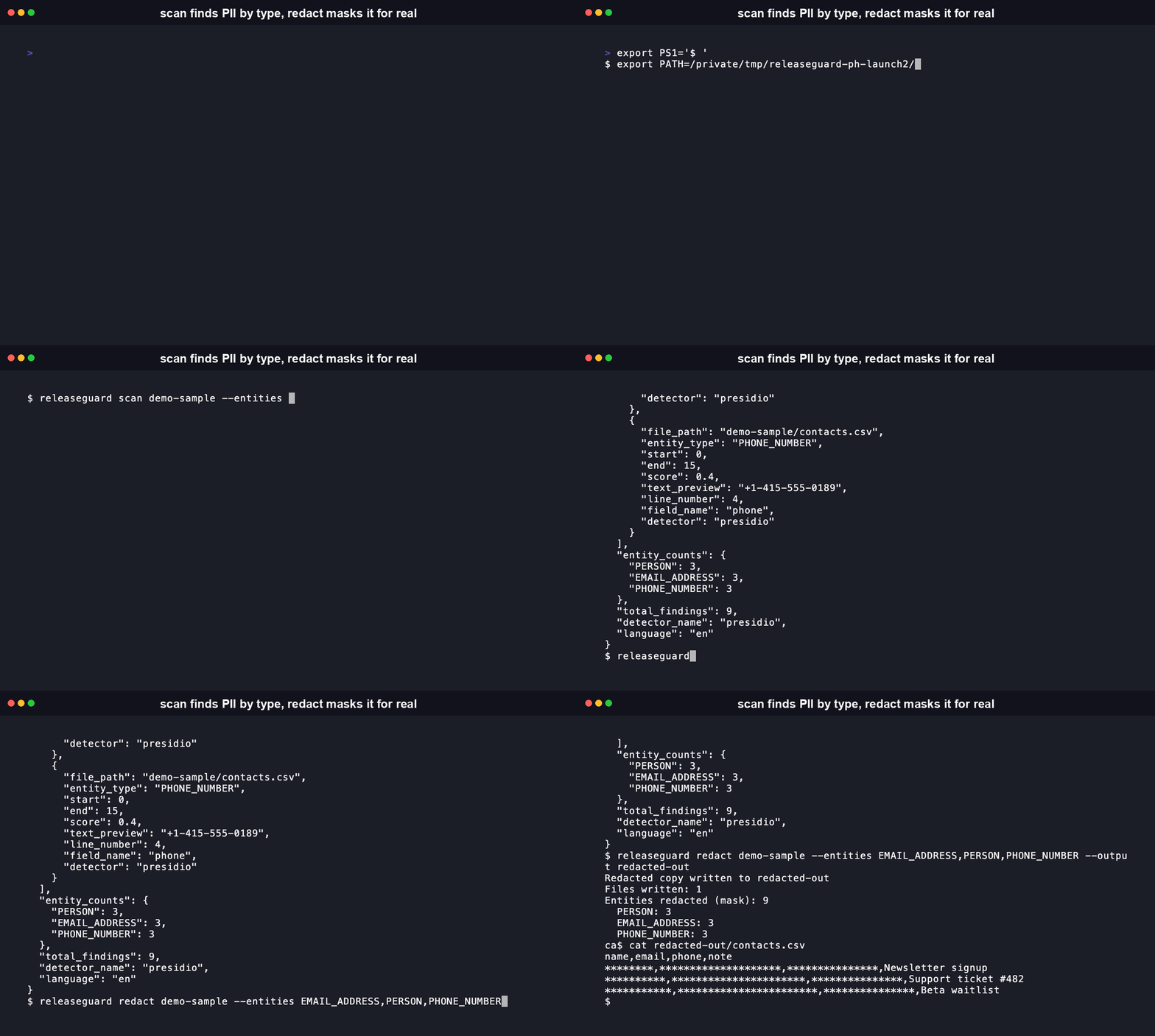
Redact, then package a release bundle in one command:
$ releaseguard package dataset --output bundle --score-threshold 0.4
Release bundle written to bundle
  dataset card: bundle/README-dataset-card.md
  EU AI Act Art. 53(1)(d) summary: bundle/eu-ai-act-training-summary.md
  redacted source: bundle-redacted-source
bundle/eu-ai-act-training-summary.md opens like this, real scan counts filled in, everything else left as an explicit placeholder for a human to complete:
# Training Data Summary (EU AI Act Art. 53(1)(d))

_Draft generated by ReleaseGuard... Based on the European Commission's
training-data-summary template, published 2025-07-24. This covers the
narrow, currently-binding categorical-summary requirement only -- it is
not a claim of full training-data disclosure._

## 4. Personal Data and PII Handling (from ReleaseGuard scan)

A Presidio-backed scan (detector: `presidio`) covered 1 file(s) under `dataset`.

| PII/secret category detected | Occurrences |
| --- | --- |
| `EMAIL_ADDRESS` | 2 |
| `PERSON` | 2 |
| `URL` | 3 |
--json on every command switches to machine-readable output for scripts and agents.
Quick summary
- Use it for: turning a Presidio scan into a redacted copy plus a dataset/model card and an EU AI Act Art. 53(1)(d) training-data summary, from one command instead of three separate tools and a hand-written template
- What it's not: a PII detector of its own, or a claim of "total transparency"/full training-data disclosure compliance. See What ReleaseGuard is not
- Runs entirely local. No dataset content, scan results, or redacted output is ever sent to a remote service.
CLI reference
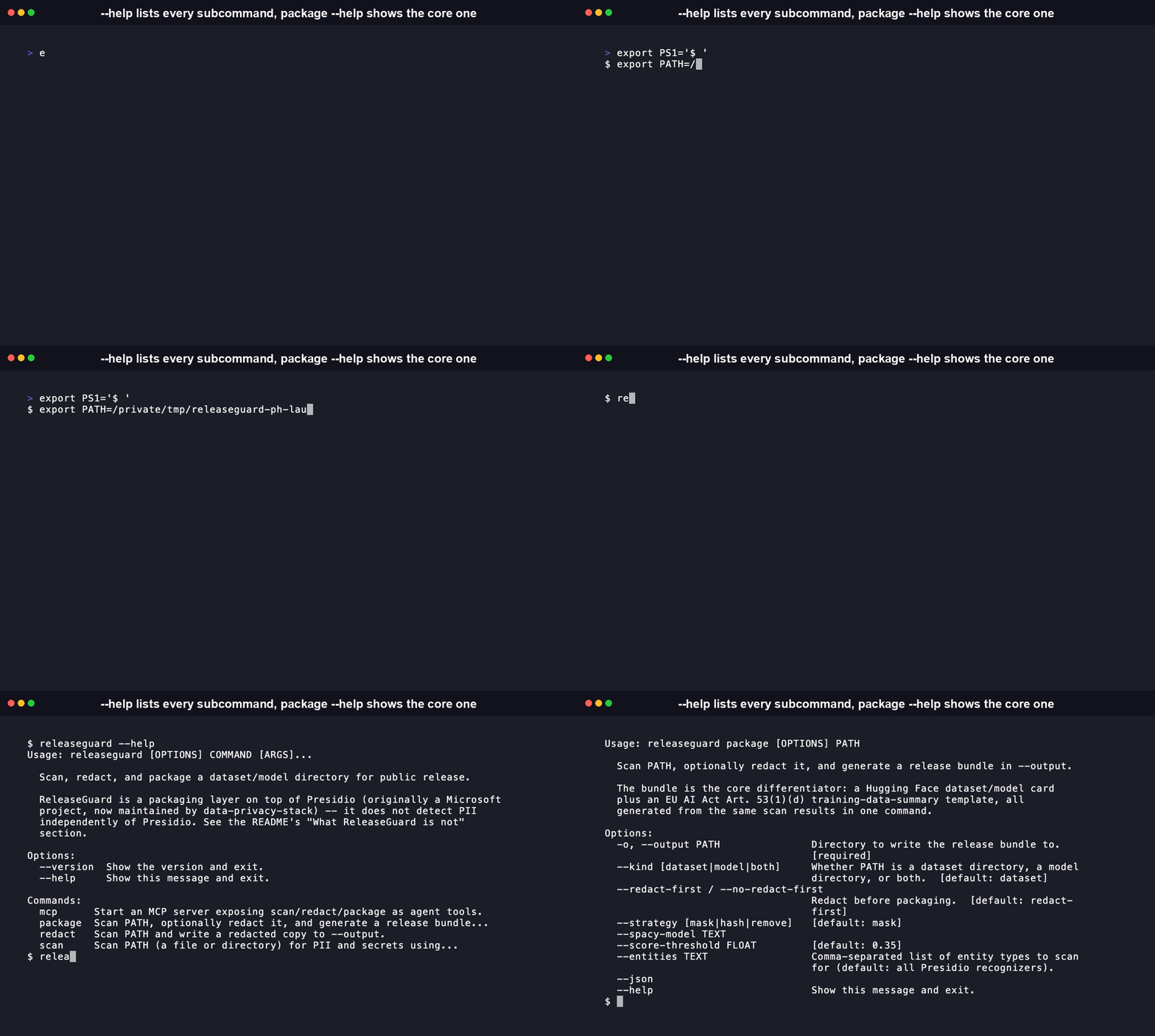
$ releaseguard --help
Usage: releaseguard [OPTIONS] COMMAND [ARGS]...

  Scan, redact, and package a dataset/model directory for public release.

  ReleaseGuard is a packaging layer on top of Presidio (originally a Microsoft
  project, now maintained by data-privacy-stack) -- it does not detect PII
  independently of Presidio. See the README's "What ReleaseGuard is not"
  section.

Options:
  --version  Show the version and exit.
  --help     Show this message and exit.

Commands:
  mcp      Start an MCP server exposing scan/redact/package as agent tools.
  package  Scan PATH, optionally redact it, and generate a release bundle...
  redact   Scan PATH and write a redacted copy to --output.
  scan     Scan PATH (a file or directory) for PII and secrets using...
| Command | Purpose |
|---|---|
scan PATH |
Scans a file or directory (CSV, JSON/JSONL, plain text) with Presidio. --entities, --score-threshold, --spacy-model, --json. |
redact PATH --output DIR |
Scans, then writes a redacted copy to DIR. Never touches PATH. --strategy mask|hash|remove, --overwrite. |
package PATH --output DIR |
Scans (and by default redacts first), then writes a Hugging Face dataset/model card plus the EU AI Act Art. 53(1)(d) summary to DIR. --kind dataset|model|both, --redact-first/--no-redact-first. |
mcp |
Starts an MCP server (stdio) exposing scan_directory_tool, redact_directory_tool, package_release_tool. Requires pip install "releaseguard-cli[mcp]" on Python 3.10+. |
Every command supports --json. Full flag reference: releaseguard <command> --help.
Library API
from releaseguard.detectors import get_detector
from releaseguard.scanner import scan_directory
from releaseguard.redactor import redact_directory
from releaseguard.packager import build_release_bundle
from releaseguard.types import RedactionStrategy

detector = get_detector("presidio", score_threshold=0.4)
scan_result = scan_directory("dataset/", detector)

redaction_result = redact_directory(
    scan_result, "dataset-redacted/", strategy=RedactionStrategy.MASK
)

bundle = build_release_bundle(
    scan_result, "bundle/", redaction_result=redaction_result, source_kind="dataset"
)
print(bundle.eu_ai_act_summary_path)
PIIDetector (releaseguard.detectors.base) and FileReader (releaseguard.readers.base) are the two extension points. Presidio is currently the only detector shipped; CSV, JSON/JSONL, and plain text are currently the three readers shipped. Both are registries, not hardcoded calls, specifically so a new format or a second detection backend is a scoped addition later. See CONTRIBUTING.md.
MCP Server
ReleaseGuard ships a Model Context Protocol server so an AI agent (Claude, Cursor, or any MCP-compatible client) can scan, redact, and package a dataset or model directory directly, without a human invoking the CLI by hand.
Install the extra:
pip install "releaseguard-cli[mcp]"
Start it directly with the mcp subcommand:
releaseguard mcp
Add it to your MCP client's config (for Claude Desktop, claude_desktop_config.json). The server
is started via a subcommand of the published releaseguard console script, not a separate
console script of its own:
{
  "mcpServers": {
    "releaseguard": {
      "command": "uvx",
      "args": ["--from", "releaseguard-cli", "releaseguard", "mcp"]
    }
  }
}
Transport is stdio, so there is nothing to host: the MCP client spawns the server as a local subprocess. Source: src/releaseguard/mcp_server.py.
The server exposes three tools, each returning the same JSON shape as the matching CLI --json
output:
| Tool | Purpose |
|---|---|
scan_directory_tool(path, spacy_model=None, score_threshold=0.35) |
Scan a directory for PII and secrets with Presidio. |
redact_directory_tool(path, output, strategy="mask", overwrite=False) |
Scan, then write a redacted copy to output. Never mutates path. strategy is "mask", "hash", or "remove". |
package_release_tool(path, output, kind="dataset", redact_first=True, strategy="mask") |
Scan, optionally redact, and write a release bundle (dataset/model card plus the EU AI Act Art. 53(1)(d) summary) to output. |
A real example call:
scan_directory_tool(path="./dataset", score_threshold=0.4)
-> {"files_scanned": 1, "root_path": "./dataset", "findings": [...], "entity_counts": {"URL": 3, "PERSON": 2, "EMAIL_ADDRESS": 2}}
Every tool checks that path exists before doing anything else and returns a structured error,
{"error": "Path '<path>' does not exist.", "error_type": "PathNotFound"}, instead of a silent,
misleading "0 files scanned" success result. Earlier versions of this server skipped that check
and let a bad path slip straight into scan_directory, which returned a false success instead
of an error; every tool handler is also now wrapped so an unexpected exception comes back as
{"error": ..., "error_type": ...} rather than crashing the server. A .well-known/agent.json
manifest is shipped at the repo root for A2A-style discovery, listing both the CLI and MCP
interfaces and the packages that provide them.
Comparison
| ReleaseGuard | Presidio | huggingface_hub card tooling | pii-lib |
|
|---|---|---|---|---|
| Detects PII/secrets | No, wraps Presidio | Yes (its own job) | No | Yes (regex + NER, code-training-data scoped) |
| Redacts detected entities | Yes (via presidio-anonymizer) |
Yes (library-level) | No | Yes |
| Generates a Hugging Face dataset/model card | Yes, from real scan results | No | Yes (manual fields, no scan integration) | No |
| Generates an EU AI Act Art. 53(1)(d) summary | Yes, from real scan results | No | No | No |
| One command, scan through release bundle | Yes | No (library only, you write the glue) | No (library only) | No |
| GitHub stars (checked 2026-08) | New in 2026 | ~10,300 | ~3,800 | 16 |
Star counts checked live against the GitHub API on 2026-08-03: data-privacy-stack/presidio (originally microsoft/presidio; the project moved organizations, same codebase), huggingface/huggingface_hub, bigcode-project/pii-lib. pii-lib's low star count is itself informative: it is the closest prior attempt at PII redaction scoped to a training-data release workflow, and it has not gained meaningful adoption. ReleaseGuard does not assume that outcome will be different here; see the FAQ entry on demand.
Enterprise data-governance platforms (Databricks Unity Catalog, Credo AI, BigID, and others) already offer PII classification and redaction as part of broader paid platforms aimed at large organizations. ReleaseGuard is a free, single-purpose, open-source alternative for a team that just wants the scan-redact-package workflow for one release, not a governance suite.
What is ReleaseGuard, and why does it exist
ReleaseGuard is an open-source CLI, Python library, and MCP server that chains three steps, PII/secret detection (via Presidio), redaction, and public-release documentation, into one command. Each step already exists as a separate tool: Presidio detects, presidio-anonymizer redacts, huggingface_hub has card-generation helpers, and the European Commission publishes a training-data-summary template as a document you fill in by hand. Nothing before ReleaseGuard chained a real scan directly into a filled-in template.
It exists because publishing a dataset or model responsibly involves running a PII scan, redacting what it finds, and then writing up two documents almost by hand, a card and (for general-purpose AI model providers) an EU AI Act training-data summary. ReleaseGuard automates the second half of that workflow so the resulting documents reflect what was actually scanned, not what someone remembered to write down afterward.
EU AI Act Art. 53(1)(d), stated precisely: this article requires providers of general-purpose AI (GPAI) models to publish a "sufficiently detailed summary" of training content, using the template the European Commission's AI Office published on 2025-07-24 (in force for new models from 2025-08-02, transitional deadline 2027-08-02 for models already on the market, enforcement checks from the AI Office starting 2026-08-02). It requires a categorical summary of data sources and modalities. It does not require raw training samples, full training recipes, or model weights, and it applies specifically to GPAI model providers, not to every dataset publisher. ReleaseGuard's generated summary is a starting draft for that narrow, real requirement, never a claim of broader "total transparency" compliance.
What ReleaseGuard is not
- Not a PII detector. Every entity type, confidence score, and detection decision comes from Presidio. ReleaseGuard adds no NLP model, no recognizer, and no accuracy claim of its own. If Presidio misses something or overcounts (see the
URL/email overlap in the Quickstart above), ReleaseGuard inherits that behavior unmodified. - Not a hosted service. Everything runs locally. No scan target, scan result, or redacted output is transmitted anywhere. See SECURITY.md's scope section.
- Not proof of legal compliance. The generated EU AI Act summary is a draft that still needs a human to fill in licensing, data-source, and copyright sections ReleaseGuard cannot infer from a scan. Running
releaseguard packagedoes not, by itself, satisfy Art. 53(1)(d) or any other regulation. - Not evidence of demand beyond what's cited above. The closest prior attempt at this same workflow,
pii-lib, sits at 16 GitHub stars. ReleaseGuard does not claim to have solved the adoption problem that project ran into; it claims to fill a real, narrow, independently-verified gap (no existing open-source tool chains a Presidio scan directly into an Art. 53(1)(d) template), and lets real usage decide the rest.
FAQ
Does ReleaseGuard detect PII more accurately than Presidio?
No. It cannot, since it calls Presidio's own AnalyzerEngine for every detection decision. Any accuracy question is a Presidio question; see Presidio's own documentation and presidio-research for its evaluation methodology.
Why does scan need a spaCy model download?
Presidio's AnalyzerEngine requires a spaCy language model for context-aware detection (recognizing that "John Smith" is a name from surrounding text, not just a capitalized word). spaCy models ship as their own installable packages, not as a pip dependency, so python -m spacy download en_core_web_sm is a required one-time step, the same as it is for anyone using Presidio directly.
Does ReleaseGuard work on Windows, macOS, and Linux?
It's pure Python with no OS-specific code path, and the npm launcher shim picks where or which per platform to locate the installed CLI (npm-shim/bin/releaseguard-cli.js). CI currently runs on ubuntu-latest only, across Python 3.10 and 3.12, so macOS and Windows aren't yet covered by an automated test matrix. Treat them as expected to work, not CI-verified, until that matrix expands.
Is the EU AI Act Art. 53(1)(d) summary legally sufficient on its own? No. It is a structurally correct starting draft populated with real scan data where ReleaseGuard can verify it (the PII/secrets section) and an explicit placeholder everywhere it can't (data sources, licensing, copyright status). A human, ideally with legal review, has to fill in the placeholders before publishing it as a compliance artifact.
Does this only apply if I'm training a GPAI model?
The Art. 53(1)(d) summary specifically targets general-purpose AI model providers under the EU AI Act, a narrow buyer set. The scan, redact, and Hugging Face card-generation parts of ReleaseGuard are useful for any dataset or model release, regardless of whether Art. 53(1)(d) applies to you.
Why two registries?
ReleaseGuard's implementation is Python, since Presidio itself is Python (presidio-analyzer/presidio-anonymizer); wrapping it in another language would mean re-shelling out or reimplementing bindings. The npm package (releaseguard-cli) is a thin launcher, not a reimplementation. It locates and execs the real releaseguard binary installed from PyPI, so npx releaseguard-cli works for npm-first agent tooling without duplicating Presidio's detection logic in two languages.
What license is ReleaseGuard under, and can I use it commercially? Apache 2.0, the same license Presidio itself uses. It permits commercial use, modification, and redistribution, including inside a proprietary product, subject to the standard Apache 2.0 terms: keep the license and copyright notice, and state any changes made to the source. See LICENSE for the full text.
Does anyone actually need this, or is it "glue code nobody asked for"? Honestly stated: no organic demand signal (an HN/Reddit thread describing this exact workflow as a lived pain point) had surfaced as of this project's initial research. The independently verifiable fact is narrower and more defensible: no existing open-source tool chains a Presidio scan directly into an Art. 53(1)(d) template or a combined HF card, in one command, from one scan. Whether that gap turns into real usage is an open, falsifiable question this project tracks rather than assumes the answer to.
What happens to files ReleaseGuard can't parse (images, model weight files, Parquet without the extra)?
scan and redact skip them (listed under files_skipped in --json output); redact copies them through to the output directory unchanged rather than silently dropping them from the release bundle. They are not scanned for PII, so review them separately before publishing.
Contributing
See CONTRIBUTING.md. Security issues: see SECURITY.md.
License
Установка ReleaseGuard Server
У этого сервера нет опубликованного пакета — он собирается из исходников. Открой репозиторий и следуй инструкции в README.
▸ github.com/RudrenduPaul/ReleaseGuardFAQ
ReleaseGuard Server MCP бесплатный?
Да, ReleaseGuard Server MCP бесплатный — установка в пару кликов через Unyly без оплаты.
Нужен ли API-ключ для ReleaseGuard Server?
Нет, ReleaseGuard Server работает без API-ключей и переменных окружения.
ReleaseGuard Server — hosted или self-hosted?
Self-hosted: сервер запускается локально на твоей машине командой из раздела установки.
Как установить ReleaseGuard Server в Claude Desktop, Claude Code или Cursor?
Открой ReleaseGuard Server на unyly.org, выбери вкладку своего клиента (Claude Desktop, Claude Code, Cursor) и нажми Install — конфиг сгенерируется автоматически, без правки JSON.
Похожие MCP
Fetch
Web content fetching and conversion for efficient LLM usage.
Roblox Studio
Enables AI coding tools to control Roblox Studio for workspace exploration, instance manipulation, and script management. It provides tools for playtesting, sce
 автор: paralov
Opencode Omniroute Plugin
OpenCode plugin for the OmniRoute AI Gateway. Drives dynamic model discovery, /connect auth flow, and multi-instance OmniRoute providers via the official @openc
 автор: GitHub Actions
AWS KB Retrieval
Retrieval from AWS Knowledge Base using Bedrock Agent Runtime.
 автор: modelcontextprotocol
Spring AI MCP Server
Provides auto-configuration for setting up an MCP server in Spring Boot applications.
llm-analysis-assistant
A very streamlined mcp client that supports calling and monitoring stdio/sse/streamableHttp, and can also view request responses through the /logs page. It also
 автор: xuzexin-hz
MCP-Agent
A simple, composable framework to build agents using Model Context Protocol by [LastMile AI](https://www.lastmileai.dev)
 автор: lastmile-ai
Spring AI MCP Client
Provides auto-configuration for MCP client functionality in Spring Boot applications.
mcp.natoma.ai
A Hosted MCP Platform to discover, install, manage and deploy MCP servers by [Natoma Labs](https://www.natoma.ai)
MCPHub
Website to list high quality MCP servers and reviews by real users. Also provide online chatbot for popular LLM models with MCP server support.
Compare ReleaseGuard Server with
Не уверен что выбрать?
Найди свой стек за 60 секунд
Автор?
Embed-бейдж для README
Похожее
Все в категории ai