
Rubin
БесплатноНе проверенA minimal MCP server that composes MIDI, loads Logic Pro factory patches (including Alchemy), and drives transport, turning Logic Pro into an AI-playable instru

Описание
A minimal MCP server that composes MIDI, loads Logic Pro factory patches (including Alchemy), and drives transport, turning Logic Pro into an AI-playable instrument.
README
A minimal, dependency-free MCP server that turns Logic Pro into an AI-playable instrument: compose MIDI, load any factory patch (Alchemy included), and drive the transport.
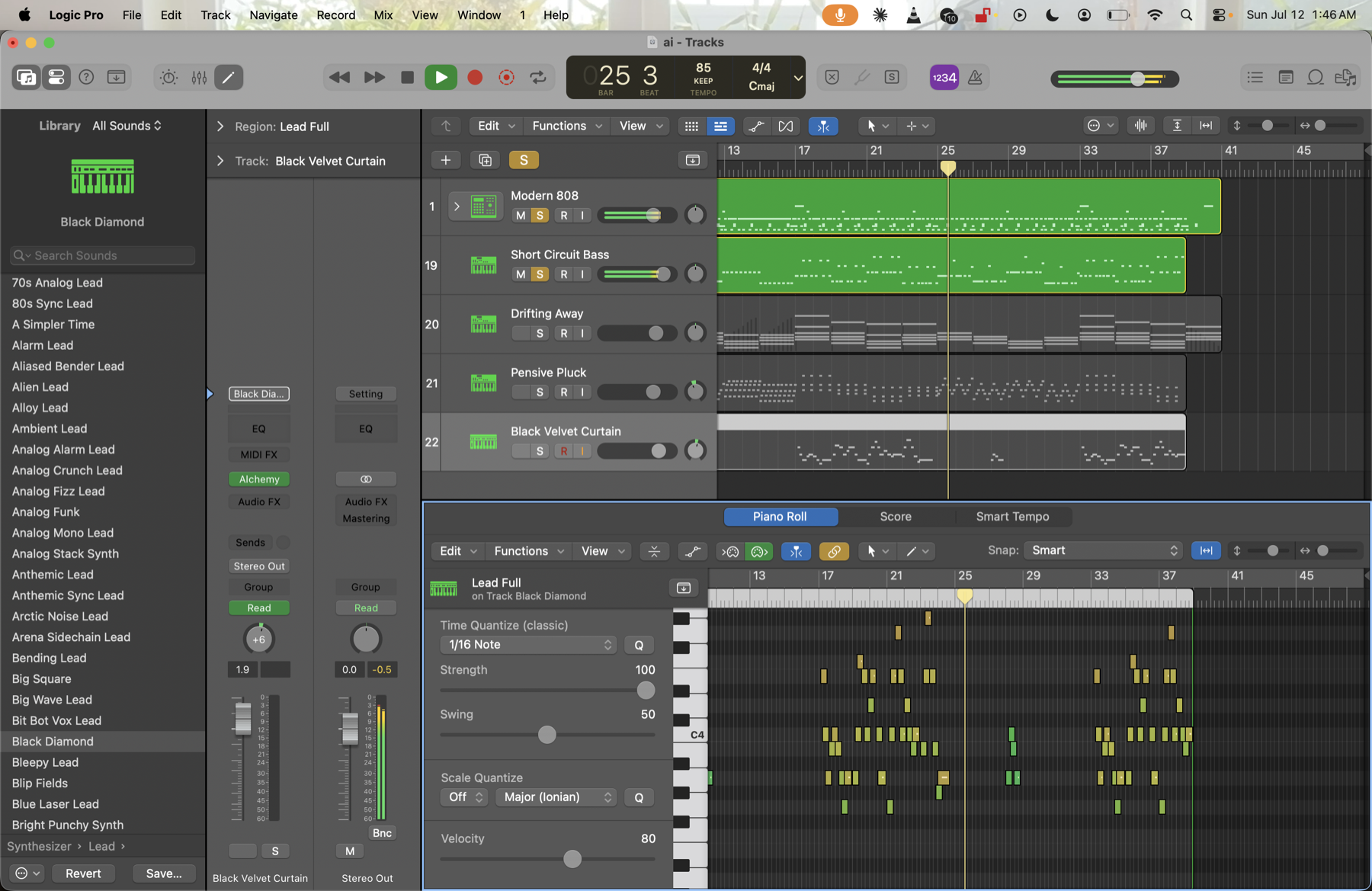
Everything in this screenshot was placed by rubin: the five tracks and their regions (composed as a Standard MIDI File), the Alchemy patches on each channel strip (loaded through the Library), tempo, and key.
Why it works
UI-automation-first tools (clicking Logic's interface for every note) fail silently and read garbage state. rubin flips the approach:
- Composition is a file, not clicks. Notes, CC automation, pitch bends, tempo, and time signature are written into a real Standard MIDI File — deterministic, testable, no UI involved. Logic maps each track's GM program to a software instrument on import.
- Patch discovery is a disk read, not a guess. Logic's ~6,000 factory
patches live on disk with the synth engine recorded inside each bundle;
find_patchesfilters them by name, category, or engine (Alchemy,Retro Synth,ES2,Sculpture...). - UI scripting is a last resort, and verified. Only patch loading,
import, and transport touch the UI — anchored to stable accessibility
landmarks (the Library's "Search Sounds" field, track-header fields), with
list_tracksreading real state back so nothing fails silently.
Tools
| Tool | What it does |
|---|---|
compose_midi |
Write a .mid from notes / CC / bends / volume / pan per track |
open_midi_as_project |
Open a .mid in Logic as a new project (no dialogs, most reliable) |
import_midi |
File > Import > MIDI File into the open project at bar 1 |
compose_and_import |
Both steps in one call |
transcribe_audio |
Audio → MIDI via basic-pitch, content-hash cached |
list_transcriptions |
Browse the transcription cache |
analyze_midi |
Full analysis: key/swing/chord detection, density contour, warnings, per-track stats |
describe_midi |
The same, as one readable paragraph |
suggest_accompaniment |
Analysis → ready compose_midi args that fit a source file (registers, key, feel) |
cut_samples |
Cut/arrange WAV sample slices on a tempo grid into a rendered song (no DAW) |
render_midi_audio |
Bounce a .mid to WAV with the built-in synth (mix MIDI arrangements with sample cuts) |
analyze_audio |
RMS energy contour of a WAV — 'see' a render's dynamics without hearing it |
catalog_samples |
Report each sample's pitch, key, and kind (pitched/sub/noise) |
reveal_in_finder |
Reveal a file/folder in Finder, ready to drag onto a track |
import_audio |
Reveal + drag guidance (Logic audio import isn't scriptable) |
find_patches |
Search the on-disk factory patch index (name / category / engine) |
find_surge_presets |
Discover installed Surge XT presets (load via Surge's browser) |
find_channel_strips |
Discover factory FX-chain settings (.cst) — names for the Setting menu; not Library-loadable |
select_track |
Select track N (1-based) |
load_patch |
Load a Library patch onto the selected track; returns the loaded name |
list_tracks |
Read back [{name, patch}] from the open project |
save_project |
Save the project (Cmd+S); reports the sheet if the project is unnamed |
transport |
play / stop / record / go_to_beginning |
answer_dialog |
Click through a Logic sheet/dialog (e.g. tempo-import prompt) |
logic_status |
Is Logic running + front window title |
Note format: {start, dur, pitch, vel} — start/dur in beats, pitch 0–127
(60 = middle C), velocity 1–127. Channel 9 is GM drums (36 kick, 38 snare,
39 clap, 42 closed hat, 46 open hat). Tracks also accept cc
({beat, controller, value}), bends ({beat, value} −8192…8191),
program, volume, pan. Compositions accept time_sig ([3, 4]),
key ("Am", "Eb", "F#m"), tempo_changes ([{beat, bpm}]), and
swing (50 = straight, ~62 = MPC feel; swing_unit 0.5/0.25 for
8th/16th swing; per-track override supported). Tracks can declare a
progression ({chords: ["Am", "F", "Cmaj7", "E7"]}) instead of raw
notes — voicings are generated (styles: pad / bass / arp / melody — the
latter writes a hook: chord tones on strong beats, one peak, resolves to
the root), with repeat
and start_bar for staged entrances; drums: {pattern: "half_time"}
generates a full groove. analyze_midi reads the same chord names back.
Example: a full backing track from declarations
compose_midi {tempo: 85, key: "Am", name: "sketch", tracks: [
  {name: "Pad",   channel: 1, progression: {chords: ["Am","F","C","E"], repeat: 2}},
  {name: "Drums", channel: 9, drums: {pattern: "half_time", bars: 12, start_bar: 4}},
  {name: "Bass",  channel: 0, progression: {chords: ["Am","F","C","E"], style: "bass", start_bar: 4}},
  {name: "Arp",   channel: 2, progression: {chords: ["Am","F","C","E"], style: "arp", start_bar: 8}},
]}
describe_midi {path: "~/Desktop/sketch.mid"}
  → 4 track(s), 283 notes, ~16 bars at 85 BPM. key Am (82% confident).
    progression Am-F-C-E... dynamic arrangement (density 0.4-6.7 notes/beat). ...
Staged entrances (start_bar) give the arrangement a real build; the
analyzer verifies its own output — key, chords, contour, and warnings for
register clashes or robotic velocities.
Example: an Alchemy pad in three calls
find_patches {category: "Synthesizer/Pad", plugin: "Alchemy"}
  → [{"name": "Drifting Away", ...}, ...]
select_track {index: 3}
load_patch {query: "Drifting Away"}
  → Loaded patch 'Drifting Away' on the selected track
Genre starting points (stock Logic, index-verified)
| Role | Patches (exact load_patch names) |
|---|---|
| Future-bass chord stabs | Massive Stack, Chicago Stack, Sparkle Chord (category EDM Chord) |
| Vocal-chop feel | Breathy Vox, Starlight Vox, Rhythmic Vox |
| Sub bass | Deep Sub Bass, Full Sub, Super Sub 808 Bass |
| Wobble bass (CC1 = wobble) | Mega Wobble Bass, FM Wobble Bass, Sharp Wobble Bass |
| Dark pads | Drifting Away (Alchemy) |
| Trap/808 kits | Modern 808; dub: Dub Machine |
| Punk/rock | SoCal+ kit, Hard Rock guitar, Punchy Bottom bass |
rubin's CC automation maps onto these: cc 1 drives the wobble patches'
filter, cc 11 fakes sidechain pump on stabs, bends do scoops and slides.
Ears: audio in, MIDI out
transcribe_audio turns any recording — a hummed melody, a guitar take, a
sample — into MIDI with Spotify's basic-pitch, cached by content hash under
~/.cache/rubin/midi so repeat calls are free. analyze_midi then reads the
result back (rubin has its own SMF parser) and reports what the instrument
plays: pitch range, note density, polyphony. That loop — hear it, read it,
compose against it — is how rubin learns what source material sounds like.
Cut samples into a song
rubin edits audio the way it composes MIDI — as a deterministic file
operation, never through a DAW's region UI. cut_samples loads WAV files
(16/24/32-bit), slices/pitches/reverses/fades them, and arranges the chops
on a tempo grid into a rendered mix:
catalog_samples {folder: "~/Music/Samples/dubstep"}
  → Evil_1: sub, key E · Down_Growl: noise · ...
cut_samples {tempo: 140, out_path: "~/Desktop/drop.wav", events: [
  {file: ".../Evil_1.wav", at_beat: 0, repeat: {times: 8, every: 4}},        # E sub every bar
  {file: ".../Down_Growl.wav", at_beat: 0, end: 0.2, pitch: 3,
   repeat: {times: 32, every: 0.5}},                                          # growl chops
]}
catalog_samples first tells you each sample's pitch and whether it's tonal
or texture, so you can tune and place them. Output is a standard WAV any DAW
imports (or drag it in via reveal_in_finder). limit: true soft-clips
dense stacks so one loud hit doesn't thin the mix.
Install
# from a clone (development)
claude mcp add --scope user rubin -- /usr/bin/python3 ~/dev/rubin/server.py

# or installed as a package
pip install git+https://github.com/mrcolo/rubin
claude mcp add --scope user rubin -- rubin-mcp
python3 server.py --check   # environment health: Logic, indexes, AUs, transcription
python3 server.py --verify song.mid   # pre-flight: analysis + warnings, exit 1 if dirty
# optional, for transcribe_audio:
cd ~/dev/rubin && python3 -m venv .venv-bp && .venv-bp/bin/pip install basic-pitch
Requires macOS Accessibility + Automation permissions for the host app
(Claude / terminal) — only for the UI-touching tools. compose_midi,
find_patches, and open_midi_as_project need no permissions at all.
Test & demo
python3 -m unittest discover -s tests   # 76 tests, no Logic needed for most
python3 server.py --demo                # compose + open a demo beat in Logic
python3 server.py --demo --write-only   # just write the .mid
python3 server.py --cut-demo demo.wav   # render a from-scratch sample cut (no external files)
Files
server.py— MCP stdio server (hand-rolled JSON-RPC, no SDK)midi.py— Standard MIDI File writermidi_read.py— SMF parser + per-track analyzertranscribe.py— basic-pitch wrapper + content-addressed cachewave_edit.py— zero-dependency WAV slicer/arranger (the audio counterpart to midi.py)patches.py— factory patch index readerlogic_ctl.py— the minimal AppleScript/AX layerdemo_beat.py— 8-bar dark R&B demo (85 BPM, Am–F–C–E)tests/— unit + protocol tests
See CHANGELOG.md for the full arc.
Known limits
import_audiois best-effort and often aborts: Logic imports audio through a Browser pane, not a file dialog. It is hardened to NEVER type a path into the arrange window (a path's letters fire as key commands —rstarts a recording — which once damaged a live session). Drag audio from Finder for reliability.import_midiandimport_audioboth confirm a file panel is frontmost before typing a path, and abort with Escape otherwise — they never leak a path into the arrange window.import_midi's happy path is live-verified;import_audiousually aborts (audio import is a Browser pane).Patch loading, track selection, and import drive Logic's UI; they're anchored to stable AX landmarks (bounded subtree scans, never the whole window — real projects have thousands of AX elements) but a future Logic redesign could move them.
list_tracksexists so failures are visible, not silent.Logic auto-renames a track to its patch name after
load_patchunless the track was named manually first.Track-header patch labels can sit in an off-screen column and read stale — header text is NOT a reliable patch readback (this once produced a false "loading is broken" diagnosis). The selected track's channel-strip name in the inspector is ground truth;
load_patchverifies against it and returns VERIFIED or FAILED accordingly.Tested on Logic Pro X 10.x/11 ("Logic Pro X.app" and "Logic Pro.app" are both handled), macOS 14+.
Установка Rubin
У этого сервера нет опубликованного пакета — он собирается из исходников. Открой репозиторий и следуй инструкции в README.
▸ github.com/mrcolo/rubinFAQ
Rubin MCP бесплатный?
Да, Rubin MCP бесплатный — установка в пару кликов через Unyly без оплаты.
Нужен ли API-ключ для Rubin?
Нет, Rubin работает без API-ключей и переменных окружения.
Rubin — hosted или self-hosted?
Self-hosted: сервер запускается локально на твоей машине командой из раздела установки.
Как установить Rubin в Claude Desktop, Claude Code или Cursor?
Открой Rubin на unyly.org, выбери вкладку своего клиента (Claude Desktop, Claude Code, Cursor) и нажми Install — конфиг сгенерируется автоматически, без правки JSON.
Похожие MCP
Fetch
Web content fetching and conversion for efficient LLM usage.
AWS KB Retrieval
Retrieval from AWS Knowledge Base using Bedrock Agent Runtime.
 автор: modelcontextprotocol
Spring AI MCP Server
Provides auto-configuration for setting up an MCP server in Spring Boot applications.
llm-analysis-assistant
A very streamlined mcp client that supports calling and monitoring stdio/sse/streamableHttp, and can also view request responses through the /logs page. It also
 автор: xuzexin-hz
Compare Rubin with
Не уверен что выбрать?
Найди свой стек за 60 секунд
Автор?
Embed-бейдж для README
Похожее
Все в категории ai