
SecureOps
БесплатноНе проверенA secure, modular MCP server for file operations and code review using Gemini.

Описание
A secure, modular MCP server for file operations and code review using Gemini.
README
SecureOps MCP is a secure, modular Model Context Protocol (MCP) implementation built using the FastMCP Python framework. The project exposes secure file manipulation tools, directory/file resources, and code-analysis prompt templates. It includes a decoupled client CLI orchestrating a Gemini 2.5 Flash agent capable of performing autonomous tool-use loops.
Key Features
- Autonomous Tools:
write_file: Dynamically creates parent folders and writes files usingutf-8encoding (with real-time progress logging).delete_file: Safely deletes files from the project directory, with explicit type checking.
- Local Resources:
dir://.: Lists the entire workspace structure along with file metadata (size, last modified).file:///{file_name}: Directly reads file contents via the standard URI scheme.
- Prompt Templates:
code_review: Automatically extracts and packages source code files into structured prompts for comprehensive quality reviews.documentation_generator: Generates technical documentation prompts for target source files.
- Path Traversal Security:
- Every file operation is validated through a secure path resolver that restricts reads, writes, and deletions to the base workspace directory.
- Decoupled Architecture:
- Separates the technical stdio communication layer (
MCPClient) from the LLM cognitive layer (GeminiAgent), enabling clean modular testing.
- Separates the technical stdio communication layer (
Installation & Setup
- Create and Activate Virtual Environment:
python -m venv .venv .venv\Scripts\activate - Install Dependencies:
pip install -r requirements.txt - Configure API Key:
Create a file named
.envin the root folder and add your Gemini API key:GEMINI_API_KEY=your_actual_gemini_api_key_here
1. Running via the Interactive CLI Client (With LLM Logic)
To converse with the model, perform code reviews, or generate documentation using the actual Gemini 2.5 Flash model, you must run the client CLI.
Run Command:
.venv\Scripts\python.exe -m mcp_client.main mcp_server/main.py
Menu Options & Example Testing Inputs:
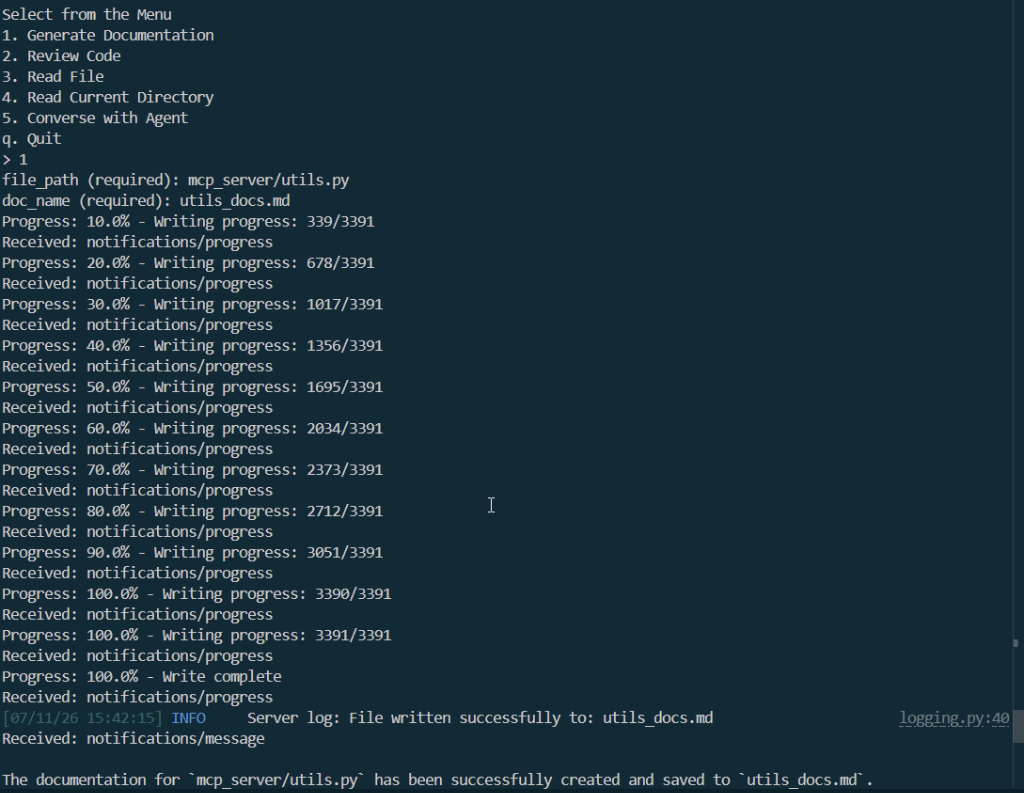
Option 1: Generate Documentation
- Selection:
1 - Input (
file_path):mcp_server/utils.py - Input (
doc_name):utils_docs.md - What happens: The server packages
utils.pyinto a template. Gemini generates a markdown documentation file and writes it to disk. - Progress Screenshot:
Option 2: Review Code
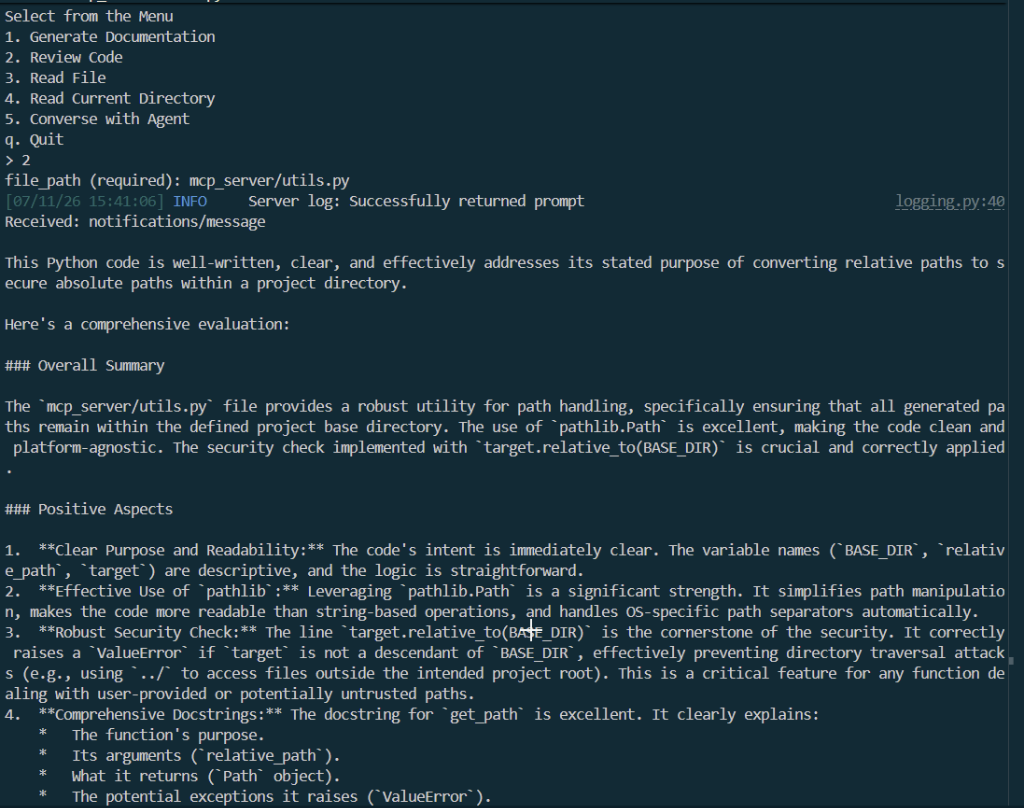
- Selection:
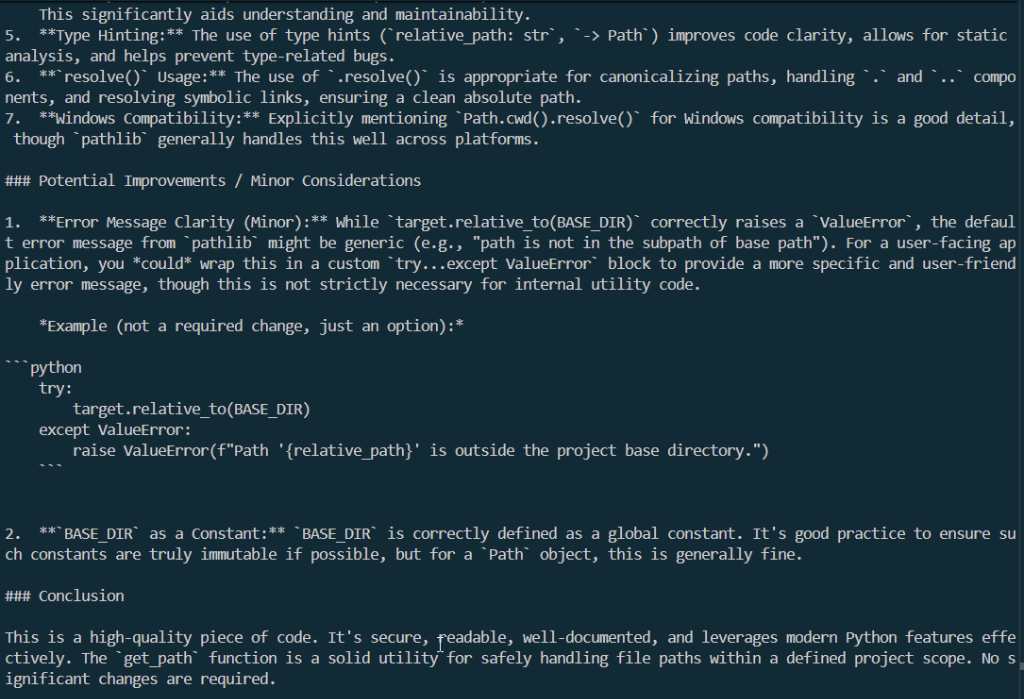
2 - Input (
file_path):mcp_server/utils.py - What happens: Gemini performs a deep code-review of the path security helper and lists findings directly in your terminal.
- Code Review Output Screenshots:
Option 3: Read File
- Selection:
3 - Input (
file_path):requirements.txt - What happens: The client directly queries the server's resource handler to load and print the file.
Option 4: Read Current Directory
- Selection:
4 - What happens: Prints a formatted terminal table showing all directories and files in your workspace.
Option 5: Converse with Agent (Autonomous Tool Use)
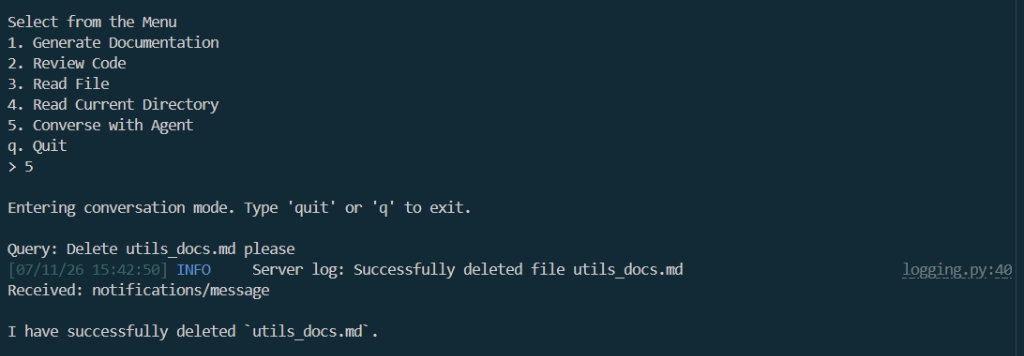
- Selection:
5 - Input Query:
Delete utils_docs.md please - What happens: Gemini reads your text, identifies that it needs to run a tool, calls
delete_fileon the MCP server, and prints the result. - Tool Execution Screenshot:
2. Running via the FastMCP Web Inspector (Interface Testing)
The MCP Inspector is a browser-based developer dashboard used to test and validate your server's exposed tools, resources, and prompts in isolation.
[!IMPORTANT] No LLM Responses in the Inspector: The web interface only tests that the MCP server's schemas are correct and compiles prompts successfully. To see the actual AI-generated responses, you must run it via the CLI client (Method 1).
Run Command:
.venv\Scripts\fastmcp dev mcp_server/main.py
This command starts the local dev server and prints a URL (e.g., http://localhost:5173).
Configuration in the Browser:
In the left pane, set up the connection parameters:
- Command:
.venv\Scripts\fastmcp.exe(or your absolute path to the executable) - Arguments:
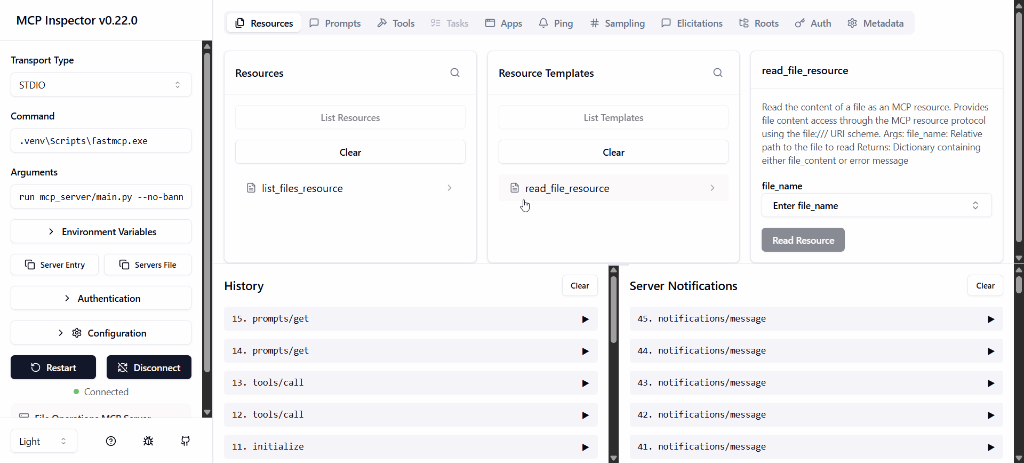
run mcp_server/main.py --no-banner - Click the Connect button.
How to Test Features in the Web UI:
Tools Tab: Select
write_file, enter a path (e.g.,test.txt) and content, then click Run to execute the local file write.Resources Tab: Click
list_files_resource(dir://.) orread_file_resourceto view raw JSON listings and text from the local folder.Prompts Tab: Select
code_review, enter a path (e.g.,mcp_server/utils.py), and click Run to see the fully compiled prompt template including your source code.Interface Screenshot:
Установка SecureOps
У этого сервера нет опубликованного пакета — он собирается из исходников. Открой репозиторий и следуй инструкции в README.
▸ github.com/roheth286/SecureOpsFAQ
SecureOps MCP бесплатный?
Да, SecureOps MCP бесплатный — установка в пару кликов через Unyly без оплаты.
Нужен ли API-ключ для SecureOps?
Нет, SecureOps работает без API-ключей и переменных окружения.
SecureOps — hosted или self-hosted?
Self-hosted: сервер запускается локально на твоей машине командой из раздела установки.
Как установить SecureOps в Claude Desktop, Claude Code или Cursor?
Открой SecureOps на unyly.org, выбери вкладку своего клиента (Claude Desktop, Claude Code, Cursor) и нажми Install — конфиг сгенерируется автоматически, без правки JSON.
Похожие MCP
GitHub
PRs, issues, code search, CI status
 автор: GitHub
Filesystem
Secure file operations with configurable access controls.
Memory
Knowledge graph-based persistent memory system.
Template MCP Server
A CLI tool to create a new Model Context Protocol server project with TypeScript support, dual transport options, and an extensible structure
 автор: mcpdotdirect
Compare SecureOps with
Не уверен что выбрать?
Найди свой стек за 60 секунд
Автор?
Embed-бейдж для README
Похожее
Все в категории development