
ServiceNow Incident Copilot
БесплатноНе проверенEnables conversational triage of ServiceNow incidents via Claude Desktop, automatically classifying and routing them based on company knowledge.

Описание
Enables conversational triage of ServiceNow incidents via Claude Desktop, automatically classifying and routing them based on company knowledge.
README
CI Python 3.12 Code style: ruff
Zero-touch L1 incident triage: new incidents are automatically classified by Azure OpenAI, grounded in company knowledge embeddings, and routed to the right enterprise team in ServiceNow — no manual effort. Exposed as both a FastAPI service and an MCP server (connect it to Claude Desktop and triage incidents conversationally).
Live demo
▶ Live app: https://servicenow-incident-copilot.onrender.com/docs — interactive API docs (free tier; first load may take ~50s if asleep, then it's instant)
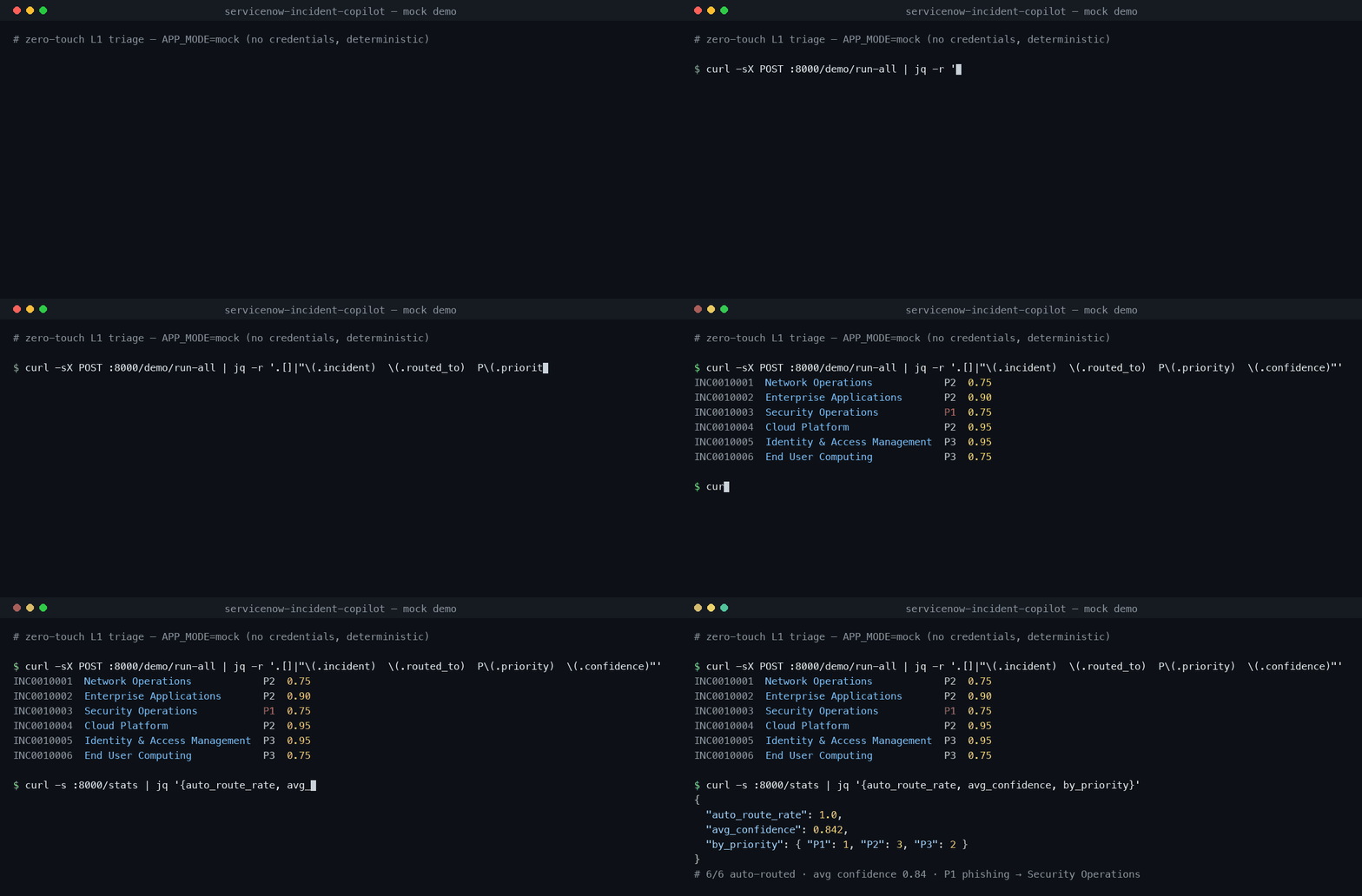
The recording above is the real APP_MODE=mock pipeline — deterministic, credential-free, and exactly what CI runs.
Deployed in mock mode — the entire pipeline runs offline with a deterministic LLM and an in-memory ServiceNow, so no credentials are needed and nothing sensitive is exposed. Try it:
- `/docs` — interactive Swagger UI; click "Try it out" on
POST /demo/run-allto auto-triage six incidents - `/stats` — live routing-accuracy dashboard (JSON)
Hosted on Render's free tier, which sleeps after inactivity — the first request may take ~50s to wake, then it's instant. The GIF above is the same output with no wait.
Why I built this
I'm drawn to the intersection of ServiceNow and applied AI, and I wanted to see what "AI integration" should really look like inside an ITSM platform — not a chatbot bolted onto the side, but AI wired into the operational flow where it removes genuine toil. L1 triage is the ideal target: high-volume, repetitive, and every misroute burns an SLA. So instead of a demo snippet, I built the entire zero-touch loop the way I'd want to run it in production — webhook in, RAG-grounded decision, write-back with an audit note — and pushed on the parts that are easy to hand-wave and hard to get right:
- It runs with zero credentials. The offline
APP_MODE=mockstack implements the exact same interfaces as the live one (in-memory ServiceNow + a rule-based LLM double), so the pipeline can't tell the difference — and neither canpytest. I wanted anyone to be able to clone it and see it work in 60 seconds, and I wanted CI to exercise the real orchestration, not a stub. - The AI is accountable, not magic. The model can only route to teams in the catalog; a hallucinated team name zeros the confidence; anything under the threshold parks in a human queue with the full reasoning written to the incident's work note. I care more about trustworthy automation than a flashy accuracy number.
- It's provider- and infra-agnostic on purpose. Swapping the LLM (Azure OpenAI ↔ OpenAI) or the vector store (in-memory ↔ ChromaDB ↔ Azure AI Search) is one env var, because everything depends on a protocol, not a concrete class. That's the difference between a proof-of-concept and something a team could actually adopt.
I built it in visible phases (see the commit history) — mock-first, then observability, then a second vector backend, then the MCP surface — because that's how I like to work: get a thin end-to-end slice running, then deepen it one honest layer at a time.
How the zero-touch pipeline works
 ServiceNow                    Incident Copilot (FastAPI)                ServiceNow
┌───────────┐  Business Rule  ┌─────────────────────────────────┐  PATCH  ┌───────────┐
│ Incident   │───(webhook)───▶│ 1. Fetch incident (Table API)     │───────▶│ assignment │
│ created    │                │ 2. Embed & retrieve:              │        │ _group set │
└───────────┘                │    • company KB articles           │        │ + priority │
                              │    • similar past incidents        │        │ + category │
                              │      (with historical routing)     │        │ + AI work  │
                              │ 3. Azure OpenAI triage             │        │   note     │
                              │    (forced function calling →      │        └───────────┘
                              │     Pydantic-validated output)     │
                              │ 4. Confidence gate:                │
                              │    ≥ 0.7 → auto-route              │
                              │    < 0.7 → park in L1 queue        │
                              └─────────────────────────────────┘
Design decisions worth noting:
- One
IncidentServicelayer serves both the REST API and the MCP tools — no duplicated logic. - The LLM tool schema is generated from the
TriageResultPydantic model, so the AI contract and app contract can't drift. - Guardrails, not vibes: the LLM can only route to teams in the catalog; hallucinated team names zero the confidence; low confidence falls back to a human queue with full reasoning in the work note.
- Feedback loop:
POST /learn/{sys_id}indexes resolved incidents back into the vector store, so routing accuracy improves with history.
Stack
FastAPI · Pydantic v2 · httpx (async) · OAuth 2.0 · ServiceNow Table API · Azure OpenAI (chat + embeddings, standard OpenAI fallback) · ChromaDB (swappable for Azure AI Search) · MCP (FastMCP) · Docker Compose · pytest + respx · GitHub Actions · structured JSON logging
Quick start
60-second demo, zero credentials (mock mode)
pip install -r requirements.txt
APP_MODE=mock uvicorn app.main:app --port 8000
curl -X POST localhost:8000/demo/run-all | jq
Six realistic incidents get triaged and routed instantly by a deterministic offline stack (in-memory ServiceNow + rule-based LLM double) that implements the exact same interfaces as the live one — the pipeline can't tell the difference.
Live mode (real PDI + Azure OpenAI)
cp .env.example .env          # fill in PDI + OpenAI credentials
pip install -r requirements.txt -r requirements-dev.txt
python -m scripts.seed_data --snow   # index KB + history, create demo incidents
uvicorn app.main:app --reload
Zero-touch setup: create the Business Rule + Outbound REST Message from
integration/servicenow_business_rule.js (use ngrok http 8000 locally).
Now every new incident routes itself.
Manual demo without the webhook:
curl -X POST localhost:8000/triage/<sys_id> | jq
Observability
Every request gets a correlation ID (honored from an inbound X-Correlation-ID
header — e.g. propagated from MuleSoft — or minted fresh) that tags every log
line in that incident's journey and is echoed back in the response header. Grep
one cid to trace a single incident end to end.
GET /stats returns a live routing dashboard:
{
  "processed": 6, "auto_routed": 6, "auto_route_rate": 1.0,
  "low_confidence_fallbacks": 0, "avg_confidence": 0.84,
  "by_group": { "Network Operations": 1, "Security Operations": 1, ... },
  "by_priority": { "P1": 1, "P2": 3, "P3": 2 },
  "avg_stage_ms": { "retrieval": 0.6, "triage": 1.0, "writeback": 0.1 }
}
The auto_route_rate and per-group distribution are the metrics you'd watch to
tune the confidence threshold. Counters map 1:1 onto Prometheus if real scraping
is needed.
Swappable vector backend
Three implementations satisfy one VectorStore protocol (app/services/vector_store.py):
| Backend | VECTOR_BACKEND |
Used for |
|---|---|---|
| In-memory (cosine) | (mock mode) | zero-credential demo & tests |
| ChromaDB | chroma (default) |
local live dev |
| Azure AI Search | azure_ai_search |
production (HNSW vector search) |
Switching is one env var — IncidentService never changes, because it depends on
the protocol, not a concrete store. The Azure backend creates its indexes
idempotently on startup and pushes our own text-embedding-3-small vectors, so
retrieval quality is identical across backends. A test asserts all three expose
the same method signatures.
MCP server (Claude Desktop)
Copy integration/claude_desktop_config.example.json into your Claude Desktop
config (set the absolute cwd). With "APP_MODE": "mock" it works with zero
credentials — flip to live once the PDI is wired.
Then ask Claude: "Triage the incident about the CEO gift card email and explain your routing" or "What are the routing stats for this session?"
A full 3-minute recording script lives in integration/DEMO_SCRIPT.md.
Docker
docker compose up --build
Tests
pytest -v # ServiceNow mocked with respx, LLM mocked — no credentials needed
Enterprise topology (MuleSoft)
See integration/MULESOFT_DESIGN.md — API-led
connectivity design with a servicenow-sapi System API owning credentials and
policies. The client here is a one-file swap away from pointing at CloudHub.
Roadmap
Azure AI Search backend✅ done — seeVECTOR_BACKEND=azure_ai_search- Multi-turn clarification: agent asks the caller for missing details via chat/email
- Routing accuracy dashboard (auto-routed vs. reassigned rate)
Установка ServiceNow Incident Copilot
У этого сервера нет опубликованного пакета — он собирается из исходников. Открой репозиторий и следуй инструкции в README.
▸ github.com/akashreddi/servicenow-incident-copilotFAQ
ServiceNow Incident Copilot MCP бесплатный?
Да, ServiceNow Incident Copilot MCP бесплатный — установка в пару кликов через Unyly без оплаты.
Нужен ли API-ключ для ServiceNow Incident Copilot?
Нет, ServiceNow Incident Copilot работает без API-ключей и переменных окружения.
ServiceNow Incident Copilot — hosted или self-hosted?
Доступен hosted-вариант: Unyly запускает сервер в облаке, локальная установка не обязательна.
Как установить ServiceNow Incident Copilot в Claude Desktop, Claude Code или Cursor?
Открой ServiceNow Incident Copilot на unyly.org, выбери вкладку своего клиента (Claude Desktop, Claude Code, Cursor) и нажми Install — конфиг сгенерируется автоматически, без правки JSON.
Похожие MCP
Fetch
Web content fetching and conversion for efficient LLM usage.
AWS KB Retrieval
Retrieval from AWS Knowledge Base using Bedrock Agent Runtime.
 автор: modelcontextprotocol
Spring AI MCP Server
Provides auto-configuration for setting up an MCP server in Spring Boot applications.
llm-analysis-assistant
A very streamlined mcp client that supports calling and monitoring stdio/sse/streamableHttp, and can also view request responses through the /logs page. It also
 автор: xuzexin-hz
Compare ServiceNow Incident Copilot with
Не уверен что выбрать?
Найди свой стек за 60 секунд
Автор?
Embed-бейдж для README
Похожее
Все в категории ai