
Slint Ui Dev
БесплатноНе проверенDevelopment binaries for slint-ui, enabling system-testing and MCP support. Install alongside slint-ui in development environments.

Описание
Development binaries for slint-ui, enabling system-testing and MCP support. Install alongside slint-ui in development environments.
README


Build Status REUSE status Discussions
Slint is an open-source declarative GUI toolkit for building native user interfaces for embedded systems, desktops, and mobile platforms.
Write your UI once in .slint, a simple markup language. Connect it to business logic written in Rust, C++, JavaScript, or Python.
Why Slint?
The name Slint is derived from our design goals:
- Scalable: Slint should support responsive UI design, allow cross-platform usage across operating systems and processor architectures and support multiple programming languages.
- Lightweight: Slint should require minimal resources, in terms of memory and processing power, and yet deliver a smooth, smartphone-like user experience on any device.
- Intuitive: Designers and developers should feel productive while enjoying the GUI design and development process. The design creation tools should be intuitive to use for the designers. Similarly for the developers, the APIs should be consistent and easy to use, no matter which programming language they choose.
- Native: GUI built with Slint should match the end users' expectations of a native application irrespective of the platform - desktop, mobile, web or embedded system. The UI design should be compiled to machine code and provide flexibility that only a native application can offer: Access full operating system APIs, utilize all CPU and GPU cores, connect to any peripheral.
Beyond the design goals, here’s what makes Slint stand out:
- Independent UI Design: Use a declarative language to separate your UI from business logic. Designers can work in parallel with developers.
- Tooling: Iterate quickly with our Live Preview & editor integrations. Integrate from Figma with the Figma to Slint plugin.
- Stable APIs: Slint follows a stable 1.x API. We evolve carefully without breaking your code.
See what others have built: #MadeWithSlint
Examples
Embedded
| RaspberryPi | STM32 | RP2040 |
|---|---|---|
| Video of Slint on Raspberry Pi | Video of Slint on STM32 | Video of Slint on RP2040 |
Desktop
| Windows | macOS | Linux |
|---|---|---|
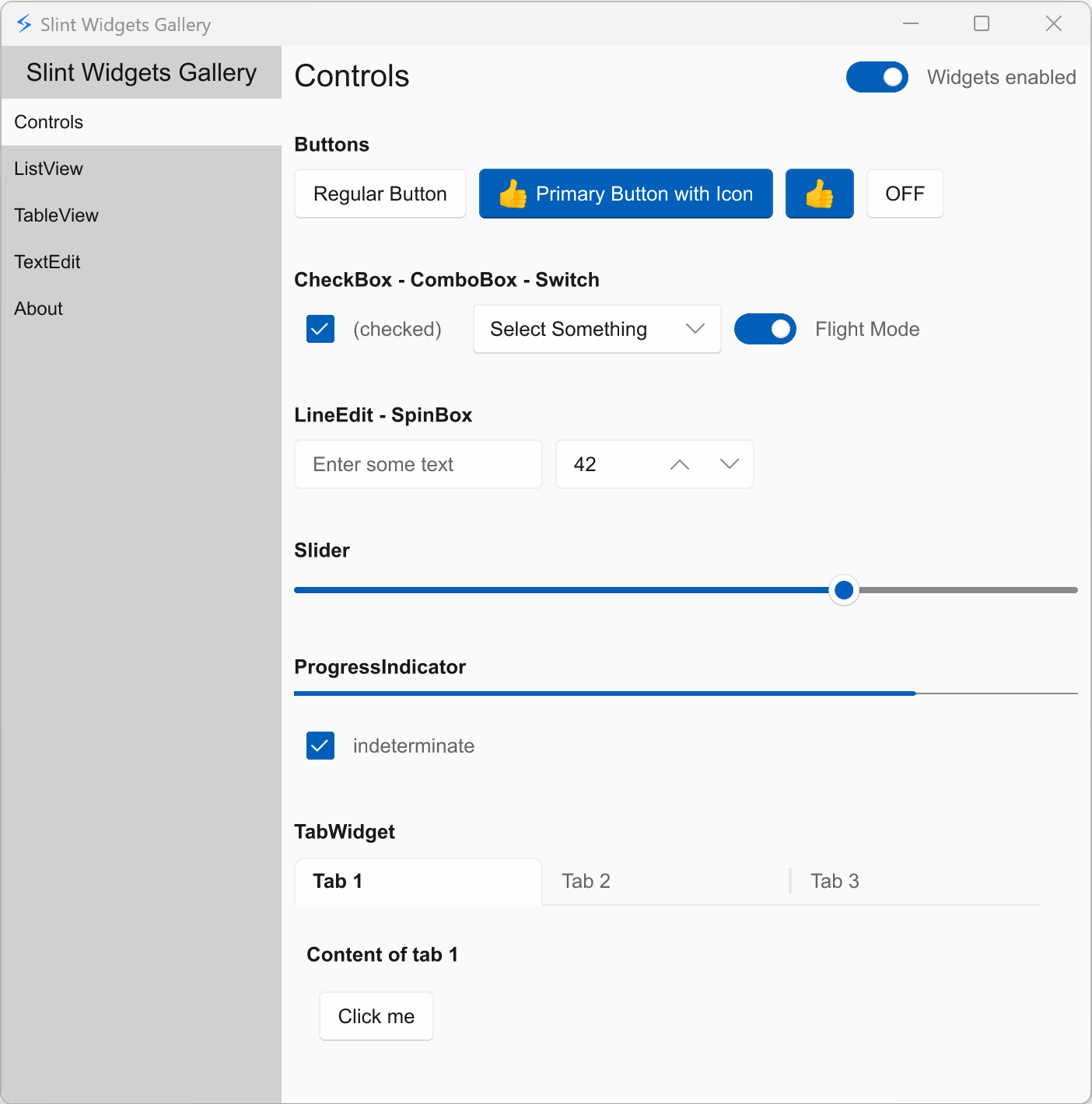 |
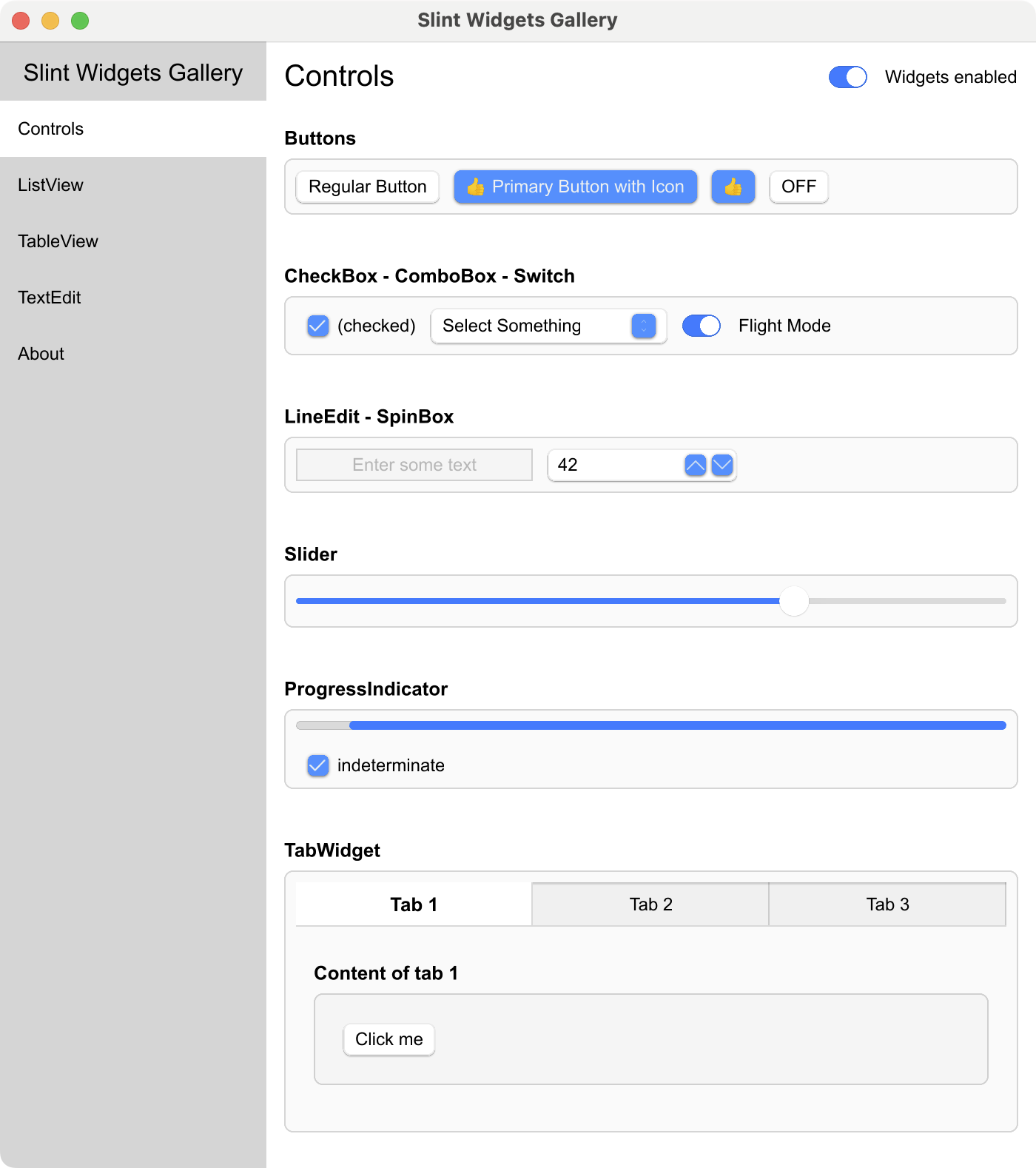 |
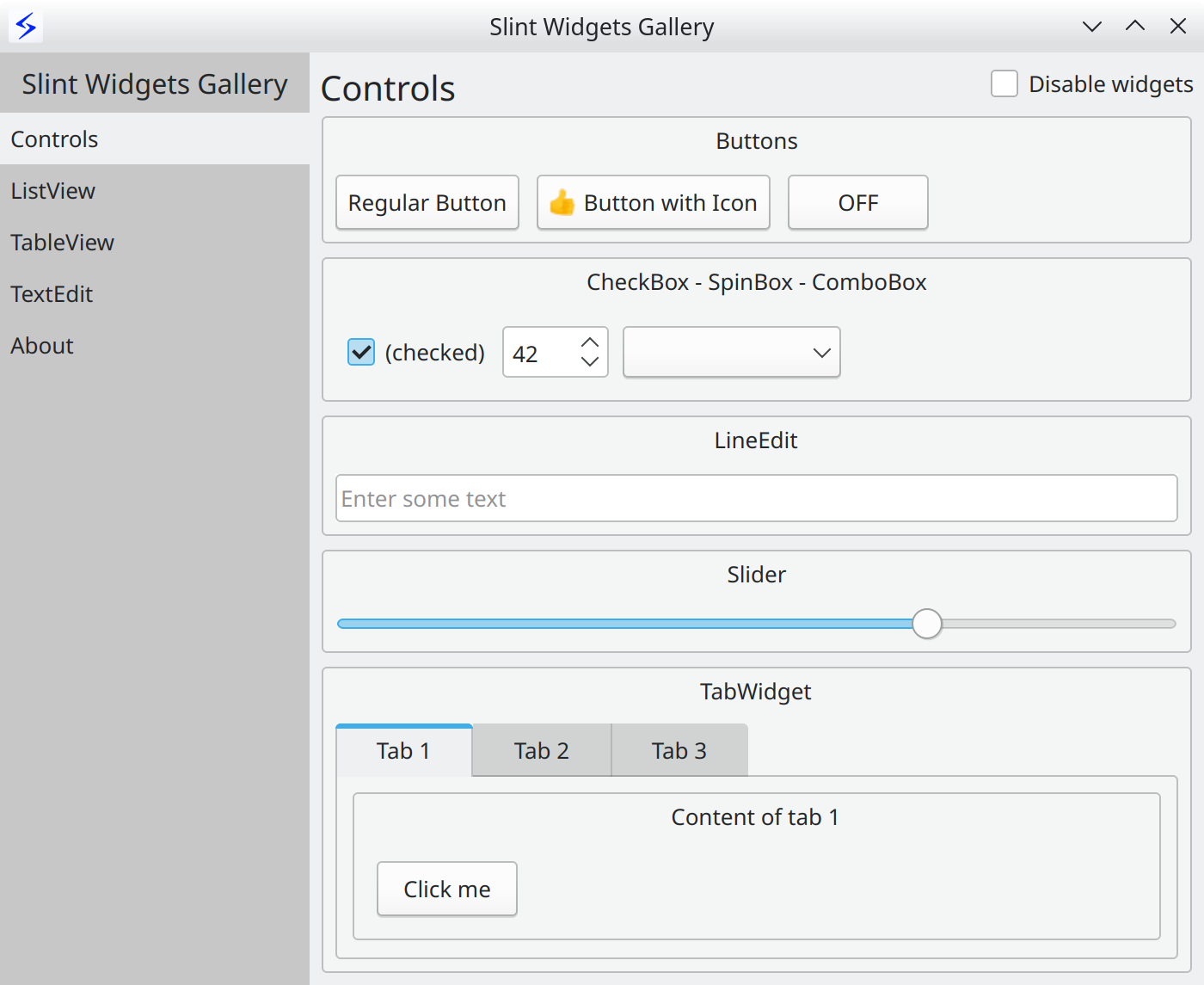 |
Web using WebAssembly
| Printer Demo | Slide Puzzle | Energy Monitor | Widget Gallery | Weather demo |
|---|---|---|---|---|
| Screenshot of the Printer Demo | Screenshot of the Slide Puzzle | Screenshot of the Energy Monitor Demo | Screenshot of the Gallery Demo | Screenshot of the weather Demo |
More examples and demos in the examples folder
Get Started
Hello World
The UI is defined in a Domain Specific Language that is declarative, easy to use, intuitive, and provides a powerful way to describe graphical elements, their placement, their hierarchy, property bindings, and the flow of data through the different states.
Here's the obligatory "Hello World":
export component HelloWorld inherits Window {
    width: 400px;
    height: 400px;

    Text {
       y: parent.width / 2;
       x: parent.x + 200px;
       text: "Hello, world";
       color: blue;
    }
}
Documentation
For more details, check out the Slint Documentation.
The examples folder contains examples and demos, showing how to use the Slint markup language and how to interact with a Slint user interface from supported programming languages.
The docs folder contains a lot more information, including
build instructions, and
internal developer docs.
Refer to the README of each language directory in the api folder:
- C++ (Documentation | Getting Started Template)
- Rust Crates.io (Documentation | Tutorial Video | Getting Started Template)
- JavaScript/NodeJS (Beta) npm (Documentation | Getting Started Template)
- Python (Beta) pypi (Documentation | Getting Started Template)
Architecture
An application is composed of the business logic written in Rust, C++, Python, or
JavaScript and the .slint user interface design markup, which is compiled to
native code.
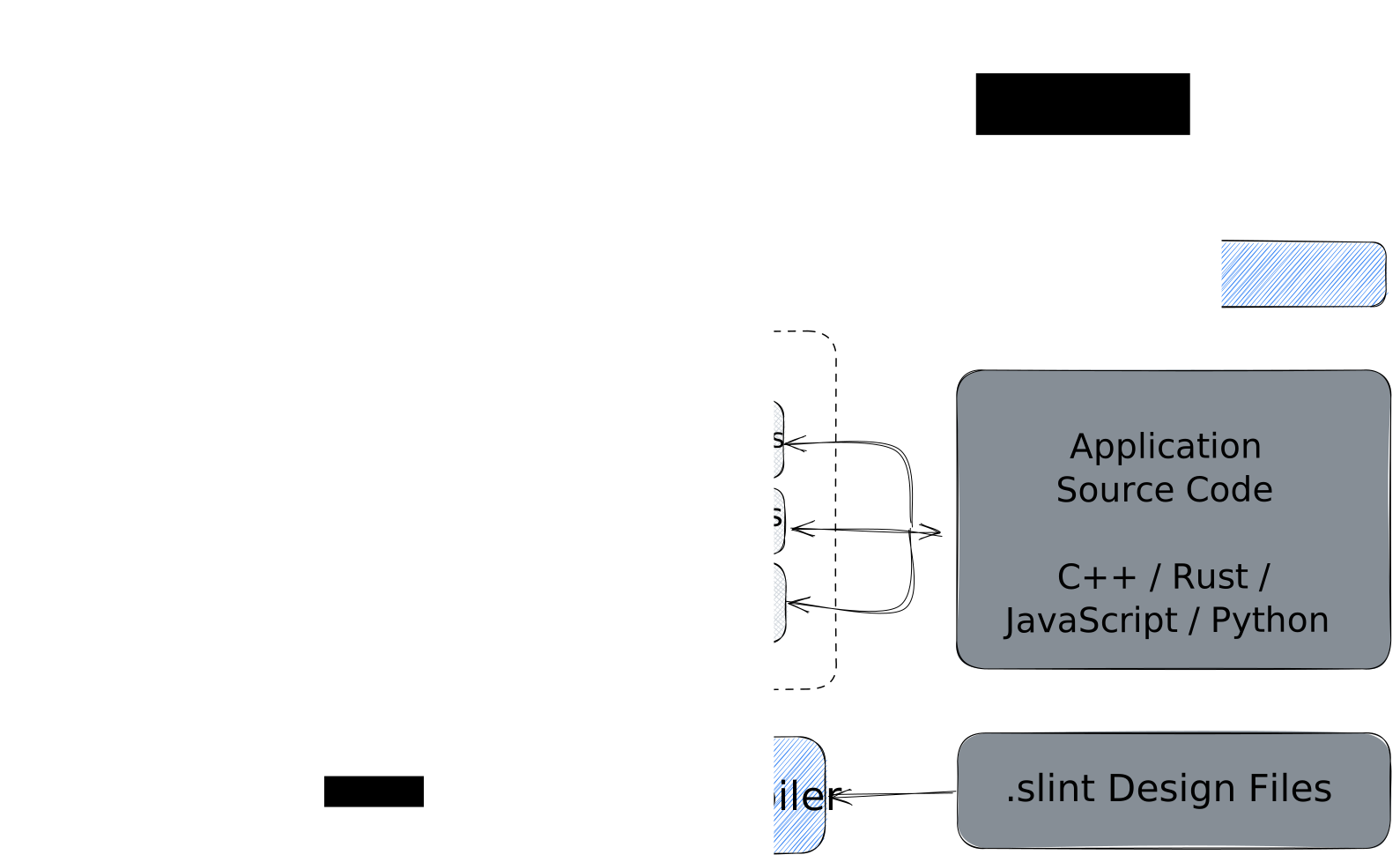
Compiler
The .slint files are compiled ahead of time. The expressions in the .slint
are pure functions that the compiler can optimize. For example, the compiler
could choose to "inline" properties and remove those that are constant or
unchanged.
The compiler uses the typical compiler phases of lexing, parsing, optimization, and finally code generation. It provides different back-ends for code generation in the target language. The C++ code generator produces a C++ header file, the Rust generator produces Rust code, and so on. An interpreter for dynamic languages is also included.
Runtime
The runtime library consists of an engine that supports properties declared in
the .slint language. Components with their elements, items, and properties are
laid out in a single memory region, to reduce memory allocations.
Rendering backends and styles are configurable at compile time:
- The
femtovgrenderer uses OpenGL ES 2.0 for rendering. - The
skiarenderer uses Skia for rendering. - The
softwarerenderer uses the CPU with no additional dependencies.
NOTE: When Qt is installed on the system, the qt style becomes available,
using Qt's QStyle to achieve native looking widgets.
Tooling
We have a few tools to help with the development of .slint files:
- A LSP Server that adds features like auto-complete and live preview of the .slint files to many editors.
- It is bundled in a Visual Studio Code Extension available from the market place.
- A slint-viewer tool which displays the .slint files. The
--auto-reloadargument makes it easy to preview your UI while you are working on it (when using the LSP preview is not possible). - SlintPad, an online editor to try out .slint syntax without installing anything (sources).
- A Figma to Slint plugin.
Please check our Editors README for tips on how to configure your favorite editor to work well with Slint.
License
See LICENSE.md for the licensing terms of the whole repository, including documentation and examples.
You can use Slint under any of the following licenses, at your choice:
- Build proprietary desktop, mobile, or web applications for free with the Royalty-free License,
- Build open source embedded, desktop, mobile, or web applications for free with the GNU GPLv3,
- Build proprietary embedded, desktop, mobile, or web applications with the Commercial license.
See the Slint licensing options on the website and the Licensing FAQ.
Contributions
We welcome your contributions: in the form of code, bug reports or feedback. For contribution guidelines see CONTRIBUTING.md.
Frequently Asked Questions
Please see our separate FAQ.
About us (SixtyFPS GmbH)
We are passionate about software - API design, cross-platform software development and user interface components. Our aim is to make developing user interfaces fun for everyone: from Python, JavaScript, C++, or Rust developers all the way to UI/UX designers. We believe that software grows organically and keeping it open source is the best way to sustain that growth. Our team members are located remotely in Germany, Finland, and US.
Stay up to date
- Follow @slint_ui on X/Twitter.
- Follow @[email protected] on Mastodon.
- Follow @slint-ui on LinkedIn.
- Follow @slint.dev on Bluesky
- Subscribe to our YouTube channel
Contact us
Feel free to join Github discussions for general chat or questions. Use Github issues to report public suggestions or bugs.
We chat in our Mattermost instance where you are welcome to listen in or ask your questions.
You can of course also contact us privately via email to [email protected].
Установить Slint Ui Dev в Claude Desktop, Claude Code, Cursor
unyly install slint-ui-devСтавит в Claude Desktop, Claude Code, Cursor и VS Code — сам разбирается с npx, uvx и сборкой из исходников.
Впервые? Поставь CLI: curl -fsSL https://unyly.org/install | sh
Или настроить вручную
Выполни в терминале:
claude mcp add slint-ui-dev -- npx -y slint-ui-devFAQ
Slint Ui Dev MCP бесплатный?
Да, Slint Ui Dev MCP бесплатный — установка в пару кликов через Unyly без оплаты.
Нужен ли API-ключ для Slint Ui Dev?
Нет, Slint Ui Dev работает без API-ключей и переменных окружения.
Slint Ui Dev — hosted или self-hosted?
Self-hosted: сервер запускается локально на твоей машине командой из раздела установки.
Как установить Slint Ui Dev в Claude Desktop, Claude Code или Cursor?
Открой Slint Ui Dev на unyly.org, выбери вкладку своего клиента (Claude Desktop, Claude Code, Cursor) и нажми Install — конфиг сгенерируется автоматически, без правки JSON.
Похожие MCP
LibreOffice Tools
Enables AI agents to read, write, and edit Office documents via LibreOffice with token-efficient design. Supports multiple formats including DOCX, XLSX, PPTX, a
 автор: passerbyflutter
dannote/figma-use
Full Figma control: create shapes, text, components, set styles, auto-layout, variables, export. 80+ tools.
 автор: dannote
Logo.dev
Search and retrieve company logos by brand or domain. Customize size, format, and theme to match your design needs. Accelerate design, prototyping, and content
 автор: NOVA-3951
PIX4Dmatic
Enables GUI automation for controlling PIX4Dmatic on Windows through MCP. Supports launching, focusing, capturing screenshots, sending hotkeys, clicking UI elem
 автор: jangjo123
Compare Slint Ui Dev with
Не уверен что выбрать?
Найди свой стек за 60 секунд
Автор?
Embed-бейдж для README
Похожее
Все в категории design