
TaskForge
БесплатноНе проверенMCP server that enables AI agents to manage tasks, boards, lists, and comments on a Kanban-style project management system through JSON-RPC methods.

Описание
MCP server that enables AI agents to manage tasks, boards, lists, and comments on a Kanban-style project management system through JSON-RPC methods.
README
A multi-user task tracker built for humans and AI agents to collaborate on the same boards.
TaskForge is a full-stack task management application with three interfaces — REST API, MCP Server (for AI agents), and a Kanban SPA — all running in a single NestJS backend. It's designed so that any MCP-compatible agent (Claude Code, Cursor, GitHub Copilot, etc.) can do everything a human can: create boards, move tasks, assign work, comment, search, and more.
Features
- Authentication — Email/password login, session tokens, invite-only signup, bot tokens for agents, admin/member roles
- Onboarding — First-run setup creates the admin account and instance title
- Kanban Board — Drag-and-drop columns with Backlog → To Do → In Progress → Review → Done
- List View — Table view for quick scanning across all lists
- Task Detail — Edit title, description, priority, assignee, due date, labels; dedicated route per task
- Sub-tasks — Nest tasks under a parent task
- Task Relations — Link tasks with
blocks/related_torelationships - Per-board Task Numbers — Each task gets a sequential board-scoped id (e.g.
TF-12) - Comments — Threaded discussion on any task, attributed to the authenticated user
- Labels — Color-coded tags per board, assignable to tasks
- Activity Log — Full audit trail per task and per board
- Real-time Updates — WebSocket events push changes to all connected clients instantly (auth-required)
- Full-text Search — Search across task titles and descriptions, or by task number
- MCP Protocol — AI agents connect via the Streamable HTTP transport to do everything humans can
- Priority System — Low / Medium / High / Urgent with visual indicators
- WIP Limits — Optional per-list work-in-progress limits
- Soft Delete — Tasks archive instead of hard-deleting
- Single Container — Everything (API + SPA + WebSocket) in one Docker image
Screenshots
| Home Page | Kanban Board |
|---|---|
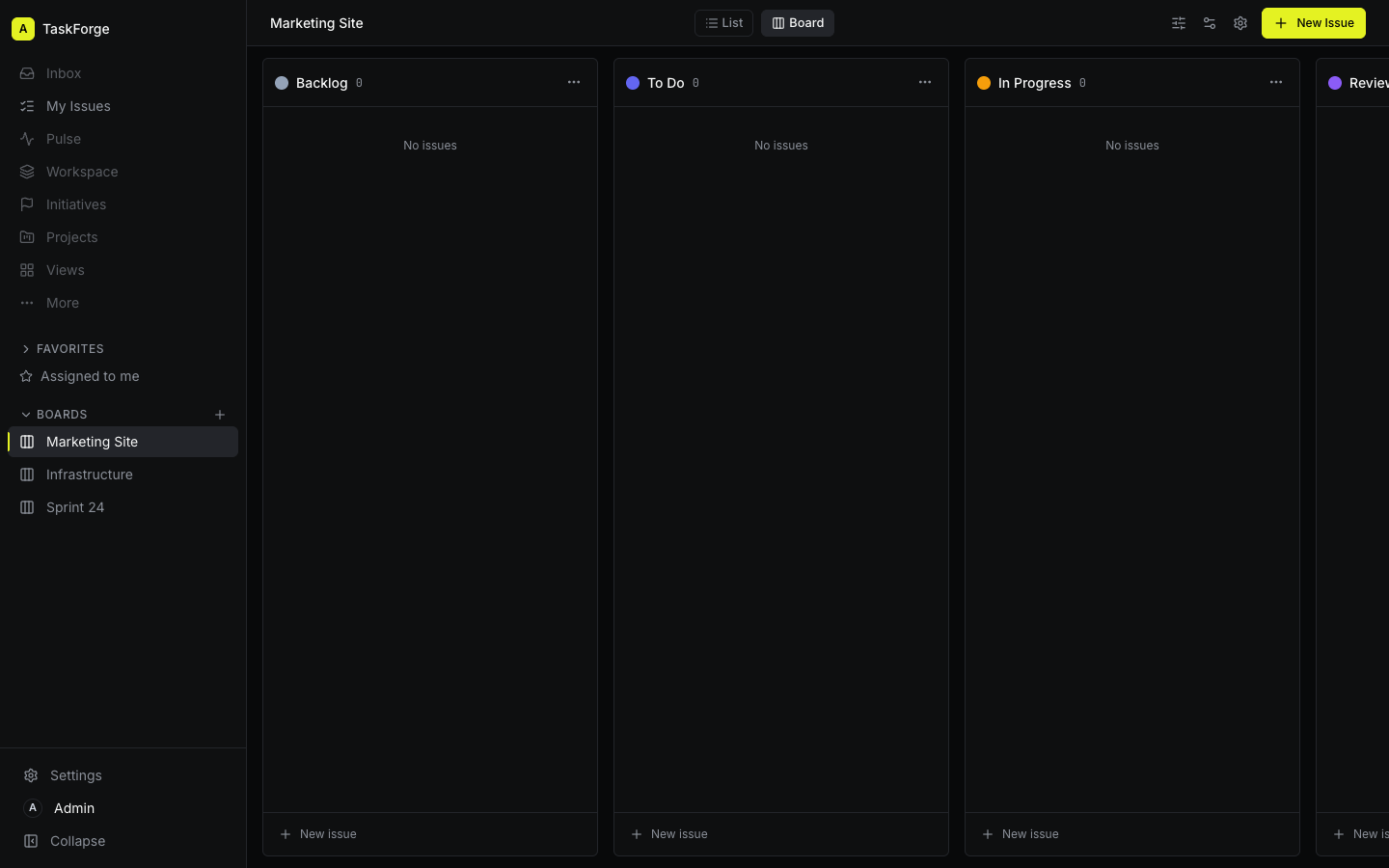 |
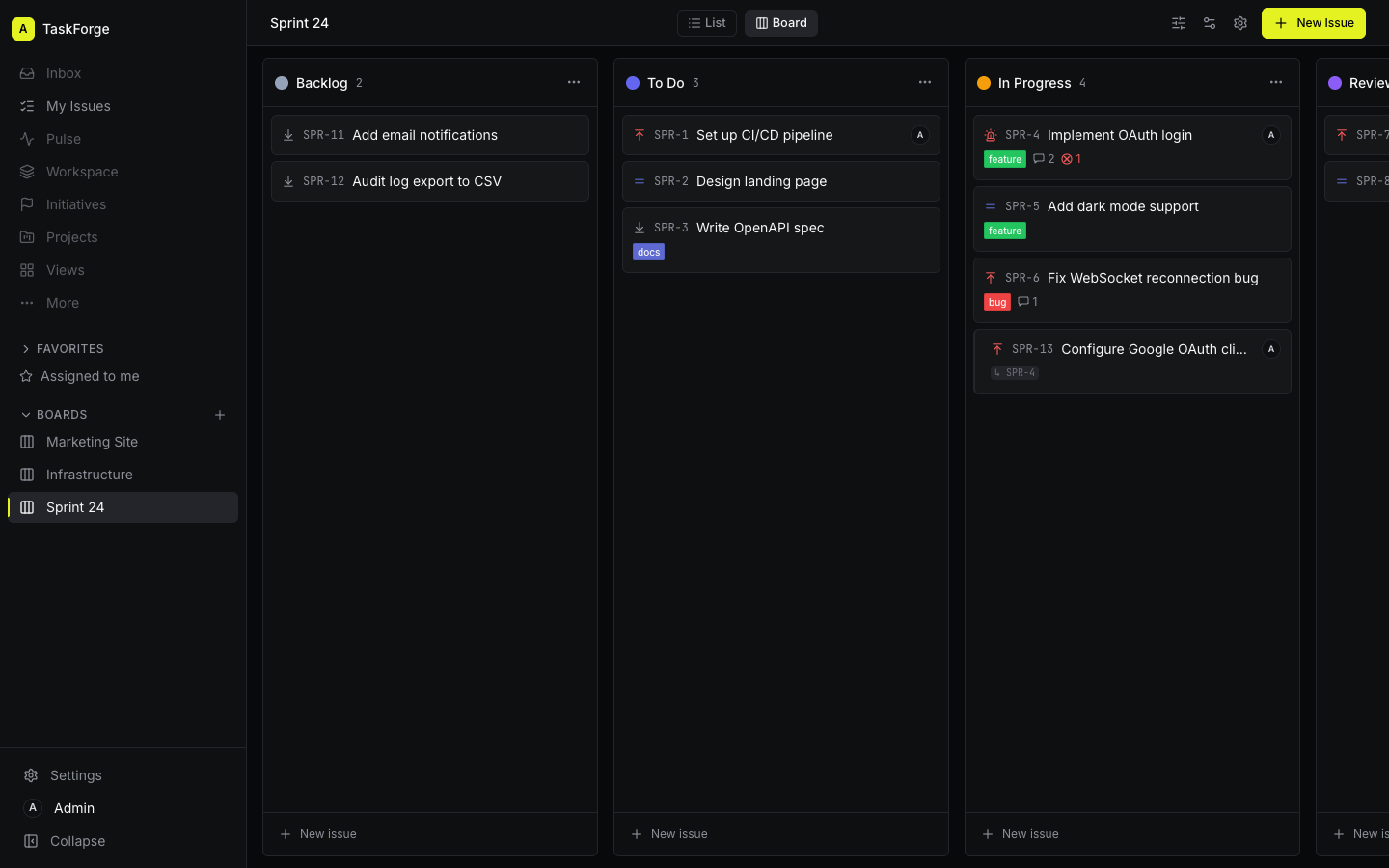 |
| List View | Task Detail |
|---|---|
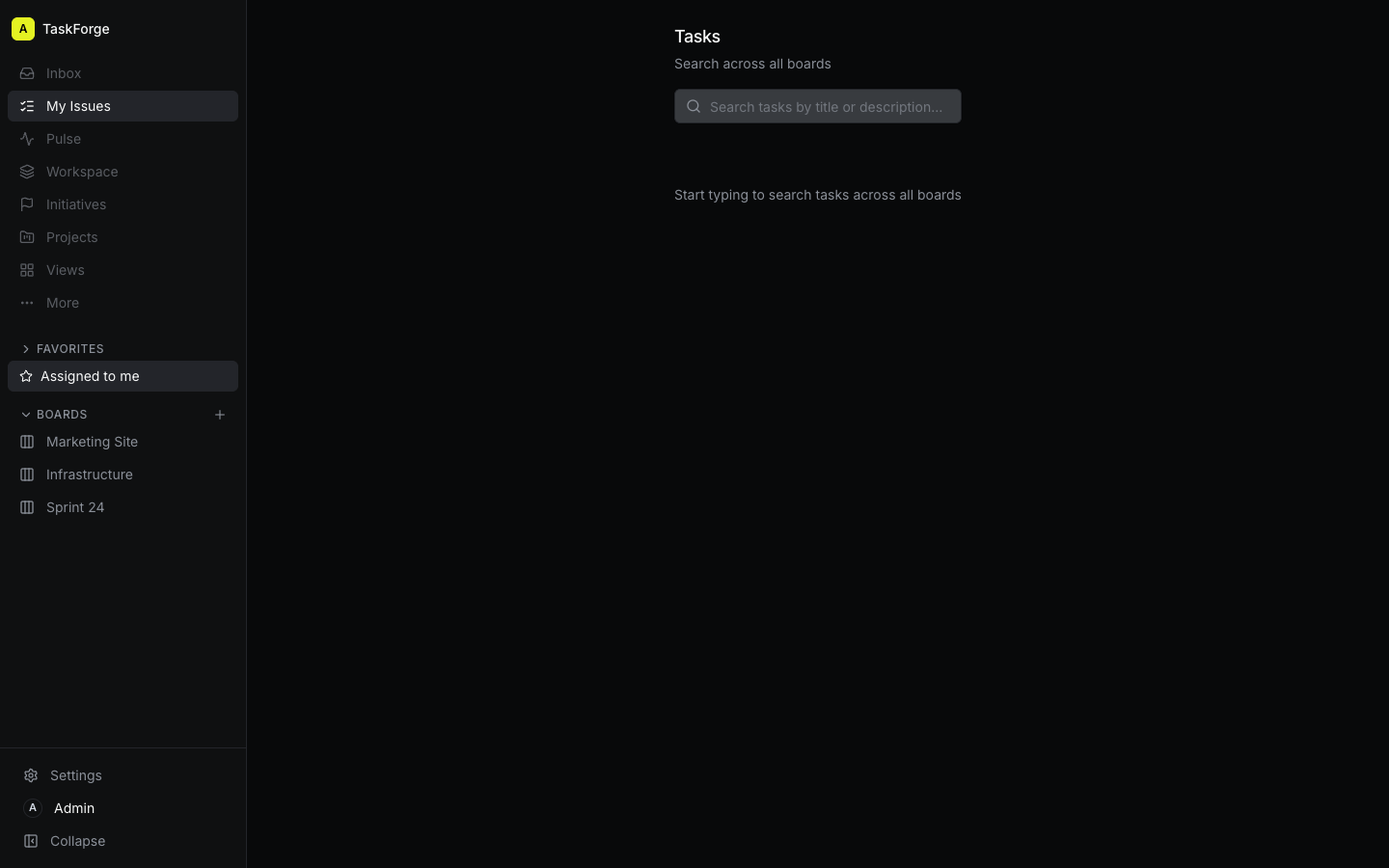 |
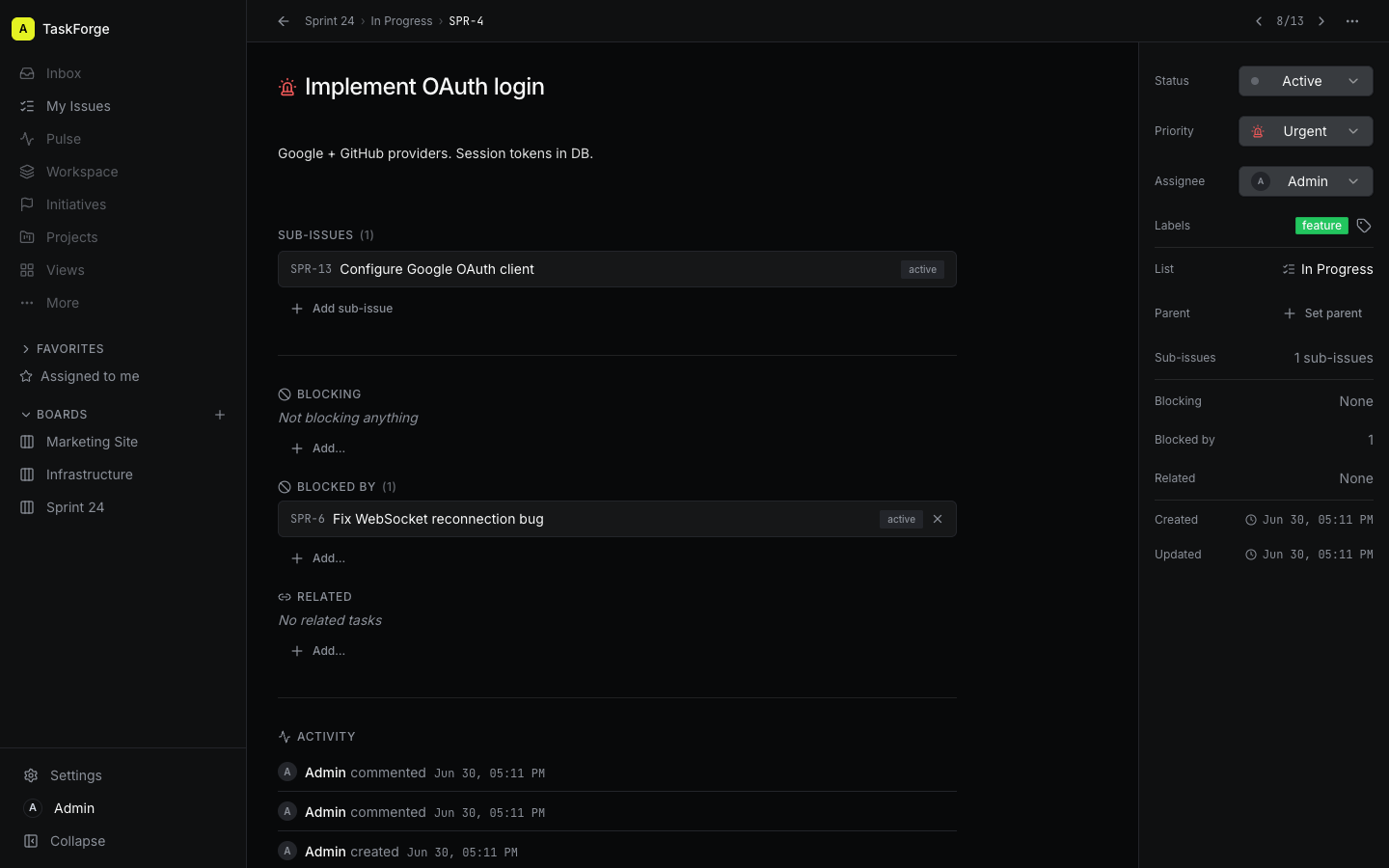 |
Architecture
┌─────────────────────────────────────────────────────┐
│                   TaskForge Container               │
│                                                      │
│  ┌──────────────────────────────────────────────┐   │
│  │              NestJS Backend (:3000)            │   │
│  │                                               │   │
│  │  ┌──────────┐  ┌──────────┐  ┌────────────┐  │   │
│  │  │ REST API │  │ MCP API  │  │ WebSocket  │  │   │
│  │  │ /api/*   │  │ /api/mcp │  │ /ws        │  │   │
│  │  └──────────┘  └──────────┘  └────────────┘  │   │
│  │                                               │   │
│  │  ┌──────────────────────────────────────────┐ │   │
│  │  │  AuthGuard (Bearer session tokens,        │ │   │
│  │  │  @Public exceptions, @Admin routes)        │ │   │
│  │  └──────────────────────────────────────────┘ │   │
│  │                                               │   │
│  │  ┌──────────────────────────────────────────┐ │   │
│  │  │         Prisma ORM → SQLite              │ │   │
│  │  └──────────────────────────────────────────┘ │   │
│  │                                               │   │
│  │  ┌──────────────────────────────────────────┐ │   │
│  │  │  React SPA (served as static assets)    │ │   │
│  │  └──────────────────────────────────────────┘ │   │
│  └──────────────────────────────────────────────┘   │
└─────────────────────────────────────────────────────┘
Data Model
User
  ├── Sessions (Bearer tokens; bot sessions flagged)
  ├── InviteTokens (created by admin, single-use)
  └── Memberships (per-board role: admin/member/viewer)

Settings (singleton — instance title, onboarded flag)

Board
  ├── identifier (3-letter prefix for task numbers, e.g. TF)
  ├── nextTaskNum (sequential counter)
  ├── Lists (ordered by position)
  │    ├── Tasks (ordered by position, board-scoped number)
  │    │    ├── Comments (attributed to a User)
  │    │    ├── Activity (audit log, attributed to a User)
  │    │    ├── Labels (many-to-many via TaskLabel)
  │    │    ├── Sub-tasks (self-relation via parentId)
  │    │    └── Relations (blocks / related_to via TaskRelation)
  │    └── WIP Limit (optional)
  ├── Labels (board-level)
  └── Members (board-level)
Quick Start
Prerequisites
- Node.js >= 20
- pnpm >= 10 (install with
corepack enable && corepack prepare [email protected] --activate)
Docker (fastest)
docker run -d --name taskforge -p 3000:3000 -v taskforge-data:/data emreyc/taskforge:latest
Open http://localhost:3000 and follow the onboarding prompt to create the admin account. The SQLite database is persisted in the taskforge-data volume at /data/taskforge.db.
Local Development
# Clone
git clone https://github.com/emreycolakoglu/taskforge.git
cd taskforge

# Install dependencies
pnpm install

# Generate Prisma client and apply migrations
cd apps/api
pnpm prisma:generate
pnpm prisma:migrate
cd ../..

# Start development servers (API on :3000, Web on :5173 with proxy)
pnpm dev
The API runs on http://localhost:3000 and the Vite dev server on http://localhost:5173 (proxied to the API). On first visit the SPA redirects to /onboarding to create the admin account.
Docker (Production, from source)
# Build and run (exposes :4321 by default via docker-compose)
docker compose up --build

# Or build manually
docker build -t taskforge .
docker run -p 3000:3000 -v taskforge-data:/data taskforge
Then open http://localhost:4321 (compose) or http://localhost:3000 (manual run) in your browser. The first visit triggers onboarding.
Configuration
All configuration is via environment variables:
| Variable | Default | Description |
|---|---|---|
PORT |
3000 |
HTTP server port |
DATABASE_URL |
file:./prisma/dev.db |
SQLite database path. In Docker, use file:/data/taskforge.db for persistence |
CORS_ORIGIN |
* |
Allowed CORS origin(s) |
MCP_ALLOWED_ORIGINS |
http://localhost:3000,http://localhost:5173,http://127.0.0.1:3000,http://127.0.0.1:5173 |
Comma-separated origins allowed for browser MCP requests (DNS-rebinding protection) |
MCP_REQUIRE_ORIGIN |
1 |
Set to 0 to skip origin checks entirely |
NODE_ENV |
development |
Set to production for production mode |
.env file
PORT=3000
DATABASE_URL=file:./prisma/dev.db
CORS_ORIGIN=*
Authentication
All REST endpoints (except a few @Public ones) require a Authorization: Bearer <token> header. Sessions are UUID tokens stored in the DB with a 90-day expiry (365 days for bot tokens).
Auth Endpoints (/api/auth)
| Method | Endpoint | Auth | Description |
|---|---|---|---|
GET |
/api/auth/status |
Public | Whether instance is onboarded + instance title |
POST |
/api/auth/onboard |
Public | First-run setup; creates admin user + settings |
POST |
/api/auth/login |
Public | Login with email/password, returns session token |
POST |
/api/auth/logout |
Authenticated | Revokes current session |
POST |
/api/auth/invite |
Admin | Create a single-use invite token (7-day expiry) |
POST |
/api/auth/signup/:token |
Public | Sign up via invite token; returns session |
POST |
/api/auth/bot-token |
Admin | Create a long-lived bot session token for agents |
GET |
/api/auth/me |
Authenticated | Current user |
PATCH |
/api/auth/me |
Authenticated | Update display name / change password |
GET |
/api/auth/users |
Admin | List all users |
GET |
/api/auth/invites |
Admin | List all invite tokens |
DELETE |
/api/auth/invites/:id |
Admin | Revoke an invite token |
Settings Endpoints (/api/settings)
| Method | Endpoint | Auth | Description |
|---|---|---|---|
GET |
/api/settings |
Admin | Full settings |
GET |
/api/settings/initialized |
Public | { initialized } (used by health check) |
GET |
/api/settings/title |
Public | Instance title |
PUT |
/api/settings |
Admin | Update settings |
REST API
All endpoints are under /api and require a Bearer token (see Authentication). Request and response bodies are JSON.
Boards
| Method | Endpoint | Description |
|---|---|---|
GET |
/api/boards |
List all boards |
GET |
/api/boards/:id |
Get board with lists and labels |
GET |
/api/boards/:id/full |
Get board with lists, tasks, labels, members |
POST |
/api/boards |
Create a board (auto-creates 5 default lists) |
PUT |
/api/boards/:id |
Update board name/slug/identifier/description |
DELETE |
/api/boards/:id |
Delete board and all its data |
Create a board:
{ "name": "My Project", "slug": "my-project", "identifier": "MYP", "description": "Optional" }
identifieris a 3-letter uppercase prefix used for per-board task numbers (e.g.MYP-1).
Lists
| Method | Endpoint | Description |
|---|---|---|
GET |
/api/lists/board/:boardId |
List all lists in a board |
GET |
/api/lists/:id |
Get a single list |
POST |
/api/lists |
Create a list |
PUT |
/api/lists/:id |
Update list name/color/wipLimit/position |
PUT |
/api/lists/reorder |
Reorder lists |
DELETE |
/api/lists/:id |
Delete list and its tasks |
Create a list:
{ "boardId": "...", "name": "In Progress", "color": "#f59e0b", "wipLimit": 5 }
Tasks
| Method | Endpoint | Description |
|---|---|---|
GET |
/api/tasks/board/:boardId |
List tasks in a board (?include=all|top|sub, ?parentId=) |
GET |
/api/tasks/list/:listId |
List tasks in a specific list (same query params) |
GET |
/api/tasks/search?q=query |
Full-text search across tasks (also matches task numbers like TF-12) |
GET |
/api/tasks/:id |
Get task with comments, activity, labels, sub-tasks, relations |
POST |
/api/tasks |
Create a task |
PUT |
/api/tasks/:id |
Update task fields |
PUT |
/api/tasks/:id/move |
Move task to another list |
PUT |
/api/tasks/reorder |
Reorder tasks within a list |
POST |
/api/tasks/:taskId/labels/:labelId |
Attach a label to a task |
DELETE |
/api/tasks/:taskId/labels/:labelId |
Detach a label from a task |
DELETE |
/api/tasks/:id |
Archive a task (soft delete) |
Create a task:
{
  "listId": "...",
  "title": "Implement login page",
  "description": "Add email/password and OAuth login",
  "priority": "high",
  "assigneeId": "user-id",
  "dueDate": "2026-07-01T00:00:00Z",
  "parentId": "parent-task-id",
  "labelIds": ["label-id-1", "label-id-2"],
  "metadata": "any JSON string"
}
Move a task:
{ "listId": "new-list-id", "position": 0 }
Task Relations
Relations are scoped under a task. blocks is directed; related_to is undirected (canonicalized).
| Method | Endpoint | Description |
|---|---|---|
GET |
/api/tasks/:taskId/relations |
List relations for a task |
POST |
/api/tasks/:taskId/relations |
Create a relation |
DELETE |
/api/tasks/:taskId/relations/:relationId |
Delete a relation |
Create a relation:
{ "otherTaskId": "other-task-id", "type": "blocks", "direction": "source" }
direction: "source"means the path task blocks the other;"target"means the path task is blocked by the other. Defaults to"source". Ignored forrelated_to.
Comments
| Method | Endpoint | Description |
|---|---|---|
GET |
/api/comments/task/:taskId |
List comments on a task |
POST |
/api/comments |
Add a comment (attributed to the authenticated user) |
DELETE |
/api/comments/:id |
Delete a comment |
Add a comment:
{ "taskId": "...", "body": "Looks good to me!" }
Labels
Labels are nested under a board for creation/listing.
| Method | Endpoint | Description |
|---|---|---|
GET |
/api/boards/:boardId/labels |
List labels on a board |
POST |
/api/boards/:boardId/labels |
Create a label |
PATCH |
/api/labels/:id |
Update label name/color |
DELETE |
/api/labels/:id |
Delete a label |
Create a label:
{ "name": "bug", "color": "#ef4444" }
Activity
| Method | Endpoint | Description |
|---|---|---|
GET |
/api/activity/task/:taskId |
Activity log for a task |
GET |
/api/activity/board/:boardId |
Activity log for an entire board |
MCP Server (AI Agent Interface)
TaskForge implements the MCP (Model Context Protocol) over the Streamable HTTP transport (2025-03-26 spec) at POST /api/mcp. Any MCP-compatible agent (Claude Code, Cursor, GitHub Copilot, opencode, etc.) can connect and perform all the same operations a human can.
Authentication
The MCP endpoint is behind the global AuthGuard. Agents must send a Bearer session token. The token can be:
- A user session token (from
POST /api/auth/login) - A bot token created by an admin via
POST /api/auth/bot-token(365-day expiry, recommended for agents)
# Admin creates a bot token
curl -X POST http://localhost:3000/api/auth/bot-token \
  -H "Authorization: Bearer <admin-token>"
# → { "id": "...", "token": "bot-uuid", "expiresAt": "..." }
How Agents Connect
Claude Code / Cursor / Copilot — Add to your MCP config:
{
  "mcpServers": {
    "taskforge": {
      "url": "http://localhost:3000/api/mcp",
      "headers": { "Authorization": "Bearer <bot-token>" }
    }
  }
}
The Streamable HTTP transport requires an initialize handshake that returns an Mcp-Session-Id header; subsequent requests must include that header. Most MCP clients handle this automatically.
Available MCP Tools
Boards
| Tool | Params | Description |
|---|---|---|
boards_list |
{} |
List all boards with list and member counts |
boards_get |
{ id } |
Get board with lists, tasks, labels |
boards_create |
{ name, slug, identifier?, description? } |
Create board with 5 default lists |
boards_delete |
{ id } |
Delete board |
Lists
| Tool | Params | Description |
|---|---|---|
lists_list |
{ boardId } |
List all lists in a board |
lists_create |
{ boardId, name, position?, color?, wipLimit? } |
Create a list |
lists_update |
{ id, name?, color?, wipLimit? } |
Update a list |
lists_delete |
{ id } |
Delete a list |
Tasks
| Tool | Params | Description |
|---|---|---|
tasks_list |
{ boardId?, listId?, assigneeId?, status?, parentId?, include?, limit? } |
List tasks with filters |
tasks_get |
{ id } |
Get task with comments, activity, labels, sub-tasks, relations |
tasks_search |
{ query } |
Full-text search or task-number lookup (e.g. TF-12) |
tasks_create |
{ listId, title, description?, priority?, assigneeId?, dueDate?, parentId?, labelIds?, position?, metadata? } |
Create a task (assignee defaults to caller) |
tasks_update |
{ id, title?, description?, priority?, status?, assigneeId?, dueDate?, listId?, position?, parentId?, labelIds? } |
Update a task (parentId: null un-nests) |
tasks_move |
{ id, listId, position? } |
Move task to another list |
tasks_delete |
{ id } |
Archive a task |
Comments
| Tool | Params | Description |
|---|---|---|
comments_list |
{ taskId } |
List comments on a task |
comments_create |
{ taskId, body } |
Add a comment (attributed to caller) |
Labels
| Tool | Params | Description |
|---|---|---|
labels_list |
{ boardId } |
List labels on a board |
labels_create |
{ boardId, name, color? } |
Create a label |
labels_delete |
{ id } |
Delete a label |
Activity
| Tool | Params | Description |
|---|---|---|
activity_list |
{ taskId?, boardId?, limit? } |
Get activity log |
Relations
| Tool | Params | Description |
|---|---|---|
relations_list |
{ taskId } |
List blocking/blockedBy/relatedTo relations for a task |
relations_create |
{ taskId, otherTaskId, type, direction? } |
Create a blocks or related_to relation |
relations_delete |
{ relationId } |
Delete a relation |
Example: Agent Creates a Board and Tasks
// 1. Create a board
→ {"method":"tools/call","params":{"name":"boards_create","arguments":{"name":"Sprint 24","slug":"sprint-24","identifier":"SPR"}},"id":1}
← {"jsonrpc":"2.0","id":1,"result":{...}}

// 2. Create a task in the "To Do" list
→ {"method":"tools/call","params":{"name":"tasks_create","arguments":{"listId":"...","title":"Design API schema","priority":"high","assigneeId":"alice-id"}},"id":2}
← {"jsonrpc":"2.0","id":2,"result":{...}}

// 3. Move task to "In Progress"
→ {"method":"tools/call","params":{"name":"tasks_move","arguments":{"id":"...","listId":"in-progress-list-id"}},"id":3}
← {"jsonrpc":"2.0","id":3,"result":{...}}

// 4. Search for tasks
→ {"method":"tools/call","params":{"name":"tasks_search","arguments":{"query":"API"}},"id":4}
← {"jsonrpc":"2.0","id":4,"result":[{...}]}
WebSocket Events
The WebSocket server at /ws pushes real-time events to connected clients. Authentication is required — clients must emit an auth message with a session token within 5 seconds of connecting:
const ws = new WebSocket('ws://localhost:3000/ws');
ws.onopen = () => {
  ws.send(JSON.stringify({ event: 'auth', data: { token: '<session-token>', boardId: 'board-123' } }));
};
ws.onmessage = (event) => {
  const { event: name, data } = JSON.parse(event.data);
  console.log(name, data);
};
On success the server emits auth_success; on failure it emits auth_error and disconnects. Providing boardId joins the board's event room.
Event Types
| Event | Payload | When |
|---|---|---|
board:created |
Board object | A new board is created |
board:updated |
Board object | A board is renamed/updated |
board:deleted |
{ id } |
A board is deleted |
list:created |
List object | A new list is added |
list:updated |
List object | A list is renamed/recolored |
list:reordered |
Reorder result | Lists are reordered |
list:deleted |
{ id } |
A list is deleted |
task:created |
Task object | A new task is created |
task:updated |
Task object | A task is edited |
task:moved |
Task object | A task is moved to another list |
task:deleted |
{ id } |
A task is archived |
task.label.attached |
Task object | A label is attached to a task |
task.label.detached |
Task object | A label is detached from a task |
comment:created |
Comment object | A comment is added |
comment:deleted |
{ id } |
A comment is deleted |
label:created |
Label object | A new label is created |
label:updated |
Label object | A label is renamed/recolored |
label:deleted |
{ id } |
A label is deleted |
relation:created |
Relation object | A task relation is created |
relation:deleted |
{ id } |
A task relation is deleted |
Frontend (SPA)
The React SPA is served by the NestJS backend in production. In development, Vite proxies API and WebSocket requests to the backend.
Routes
| Route | View |
|---|---|
/onboarding |
First-run admin setup |
/login |
Login form |
/signup/:token |
Invite-based signup |
/ |
Home — board list with create/delete |
/board/:id |
Kanban board with task cards, labels, priority indicators, assignees |
/board/:id/settings |
Board settings (labels, members) |
/board/:boardId/task/:taskId |
Task detail page (edit fields, activity log, comments, sub-tasks, relations) |
/tasks |
List view — sortable table across all tasks |
/settings |
Admin settings |
/account |
Account settings (display name, password) |
Tech Stack
- React 19 + TypeScript (strict)
- React Router 7
- Vite 6 (dev server with proxy)
- Tailwind CSS 4 + shadcn/ui (Radix primitives)
- TanStack Query (server state)
@hello-pangea/dnd(drag and drop)- Socket.IO client (real-time events)
- Sonner (toasts), Lucide icons
The SPA follows a dark "midnight command deck" design system with a single Acid Lime accent. See design.md before any frontend change.
Docker
Building
# Using docker-compose (recommended — exposes :4321)
docker compose up --build

# Manual build
docker build -t taskforge .
The Dockerfile uses multi-stage builds:
- base — Node 23 Alpine + pnpm
- deps — Install all dependencies
- builder — Generate Prisma client, build API and SPA
- runner — Minimal production image with SQLite persistence at
/data
Volumes
Data loss warning: The SQLite database lives at
/data/taskforge.dbinside the container. Without a persistent volume mounted at/data, every redeploy recreates the container and wipes the database. This is true fordocker run,docker compose up, Coolify, and any container orchestrator.
Mount a volume at /data to persist the SQLite database:
volumes:
  - taskforge-data:/data
The Dockerfile declares VOLUME ["/data"] so anonymous Docker storage is created automatically on docker run without -v — but anonymous volumes are per-container and do not survive docker rm or image redeploys. For real persistence, use a named volume or a bind mount:
# Named volume (recommended)
docker run -d --name taskforge -p 3000:3000 -v taskforge-data:/data emreyc/taskforge:latest

# Bind mount (for backups / host access)
docker run -d --name taskforge -p 3000:3000 -v /opt/taskforge-data:/data emreyc/taskforge:latest
Health Check
The container includes a health check that pings GET /api/settings/initialized every 30 seconds.
Migrations on Startup
docker-entrypoint.sh runs prisma migrate deploy before starting the app, so schema changes ship with the image. To ship a schema change: run pnpm --filter @taskforge/api prisma:migrate -- --name <desc> locally, commit the new migration file, and push.
Development
Project Structure
taskforge/
├── apps/
│   ├── api/                       # NestJS backend (CommonJS)
│   │   ├── prisma/
│   │   │   ├── schema.prisma      # Database schema
│   │   │   └── migrations/        # Prisma migrations
│   │   ├── docker-entrypoint.sh   # Runs migrations then starts node
│   │   └── src/
│   │       ├── main.ts            # Entry (SPA serving + CORS + validation)
│   │       ├── app.module.ts       # Root module
│   │       ├── prisma/            # Prisma client service (@Global)
│   │       ├── auth/              # Users, sessions, invites, bot tokens, AuthGuard
│   │       ├── settings/          # Instance settings (singleton)
│   │       ├── boards/            # Boards module (REST)
│   │       ├── lists/             # Lists module (REST)
│   │       ├── tasks/             # Tasks module (REST)
│   │       ├── relations/         # Task relations (blocks / related_to)
│   │       ├── comments/          # Comments module (REST)
│   │       ├── labels/            # Labels module (REST)
│   │       ├── activity/          # Activity log module (REST)
│   │       ├── events/            # WebSocket gateway + event bus
│   │       └── mcp/               # MCP Streamable HTTP server + tool defs
│   └── web/                       # React SPA (ESM, strict)
│       └── src/
│           ├── app.tsx            # Routes
│           ├── contexts/          # AuthContext
│           ├── pages/             # Route components
│           ├── components/        # KanbanBoard, TaskCard, TaskDetail, dialogs, UI primitives
│           ├── hooks/             # api.ts, use-auth, use-socket, use-tasks, use-relations, ...
│           ├── lib/               # constants, utils
│           └── types/             # TypeScript interfaces
├── Dockerfile
├── docker-compose.yml
├── package.json                   # Root workspace config
├── pnpm-workspace.yaml
└── turbo.json                     # Turborepo pipeline
Commands
pnpm dev              # Start both API and web in dev mode
pnpm build            # Build both apps
pnpm lint             # Lint all apps (note: eslint not installed — see AGENTS.md)
pnpm clean            # Clean build artifacts

# Database
pnpm db:generate      # Generate Prisma client
pnpm db:migrate       # Run Prisma migrations (add -- --name <desc> to create one)

# Tests
pnpm --filter @taskforge/api test    # API (Jest)
pnpm --filter @taskforge/web test    # Web (Vitest)

# Docker
pnpm docker:build     # Build Docker image
pnpm docker:run       # Run Docker container
Adding a New Module
- Create
apps/api/src/<module>/with controller, service, module, and DTO files - Register the module in
apps/api/src/app.module.ts - Add MCP tool definitions in
apps/api/src/mcp/tool-definitions.tsand handlers inmcp.service.ts - Add API client methods in
apps/web/src/hooks/api.ts - Add WebSocket event handling in
apps/web/src/hooks/use-socket.ts
Use Cases
Solo Developer
Run locally with SQLite. Use the SPA for daily work, the MCP server to let your AI coding agent create and manage tasks automatically via a bot token.
Small Team
Deploy on a single VPS with Docker. Admins create invite tokens; members sign up and use the SPA. CI/CD pipelines use the REST API (via bot tokens) to create release tasks. AI agents join standups and update boards.
Agent-First Workflow
Your AI agent manages the entire board. The agent creates tasks from PR descriptions, moves them through review stages, assigns reviewers, links blockers, and archives completed work — all via MCP. Humans check in via the SPA when needed.
Hybrid
Humans use the Kanban board. AI agents use MCP to:
- Create tasks from bug reports
- Move tasks through pipeline stages
- Assign work based on team capacity
- Search and report on task status
- Add comments with analysis results
- Link blocking relationships
FAQ
Q: Can I use a different database?
A: Yes. Change the provider in prisma/schema.prisma from sqlite to postgresql or mysql, update DATABASE_URL, and run pnpm db:migrate. Prisma handles the rest.
Q: How do agents authenticate?
A: An admin creates a bot token via POST /api/auth/bot-token (365-day expiry). The agent sends it as Authorization: Bearer <token> on every REST and MCP request, and in the auth WebSocket message. User session tokens (90-day expiry) also work.
Q: Can I deploy to Fly.io / Railway / Render?
A: Yes. The Docker image is self-contained. Set DATABASE_URL to a persistent volume path. For SQLite, ensure the volume persists across restarts. For production, consider PostgreSQL.
Q: How do I add custom fields to tasks?
A: Use the metadata field — it's a JSON string that accepts arbitrary data. Parse it in your frontend or agent logic.
Q: Can multiple agents connect simultaneously? A: Yes. The MCP endpoint is session-based and handles concurrent requests. WebSocket events broadcast to all connected clients.
Q: How are task numbers assigned?
A: Each board has an identifier (3-letter prefix) and a nextTaskNum counter. Every new task gets the next number (e.g. TF-1, TF-2), displayed and searchable as TF-12.
License
MIT
Contributing
- Fork the repository
- Create a feature branch (
git checkout -b feature/amazing) - Commit your changes (
git commit -m 'Add amazing feature') - Push to the branch (
git push origin feature/amazing) - Open a Pull Request
Установка TaskForge
У этого сервера нет опубликованного пакета — он собирается из исходников. Открой репозиторий и следуй инструкции в README.
▸ github.com/emreycolakoglu/taskforgeFAQ
TaskForge MCP бесплатный?
Да, TaskForge MCP бесплатный — установка в пару кликов через Unyly без оплаты.
Нужен ли API-ключ для TaskForge?
Нет, TaskForge работает без API-ключей и переменных окружения.
TaskForge — hosted или self-hosted?
Self-hosted: сервер запускается локально на твоей машине командой из раздела установки.
Как установить TaskForge в Claude Desktop, Claude Code или Cursor?
Открой TaskForge на unyly.org, выбери вкладку своего клиента (Claude Desktop, Claude Code, Cursor) и нажми Install — конфиг сгенерируется автоматически, без правки JSON.
Похожие MCP
Fetch
Web content fetching and conversion for efficient LLM usage.
AWS KB Retrieval
Retrieval from AWS Knowledge Base using Bedrock Agent Runtime.
 автор: modelcontextprotocol
Spring AI MCP Server
Provides auto-configuration for setting up an MCP server in Spring Boot applications.
llm-analysis-assistant
A very streamlined mcp client that supports calling and monitoring stdio/sse/streamableHttp, and can also view request responses through the /logs page. It also
 автор: xuzexin-hz
Compare TaskForge with
Не уверен что выбрать?
Найди свой стек за 60 секунд
Автор?
Embed-бейдж для README
Похожее
Все в категории ai