
Thermal Agent
БесплатноНе проверенTool using agent and physics simulator that recommends thermal drift mitigation strategies for deep space photonic instruments across material and environment c

Описание
Tool using agent and physics simulator that recommends thermal drift mitigation strategies for deep space photonic instruments across material and environment combinations. Runs on AWS Bedrock or a self-hosted open-weight model, grounded in a 40K scenario knowledge store and an XGBoost classifier.
README
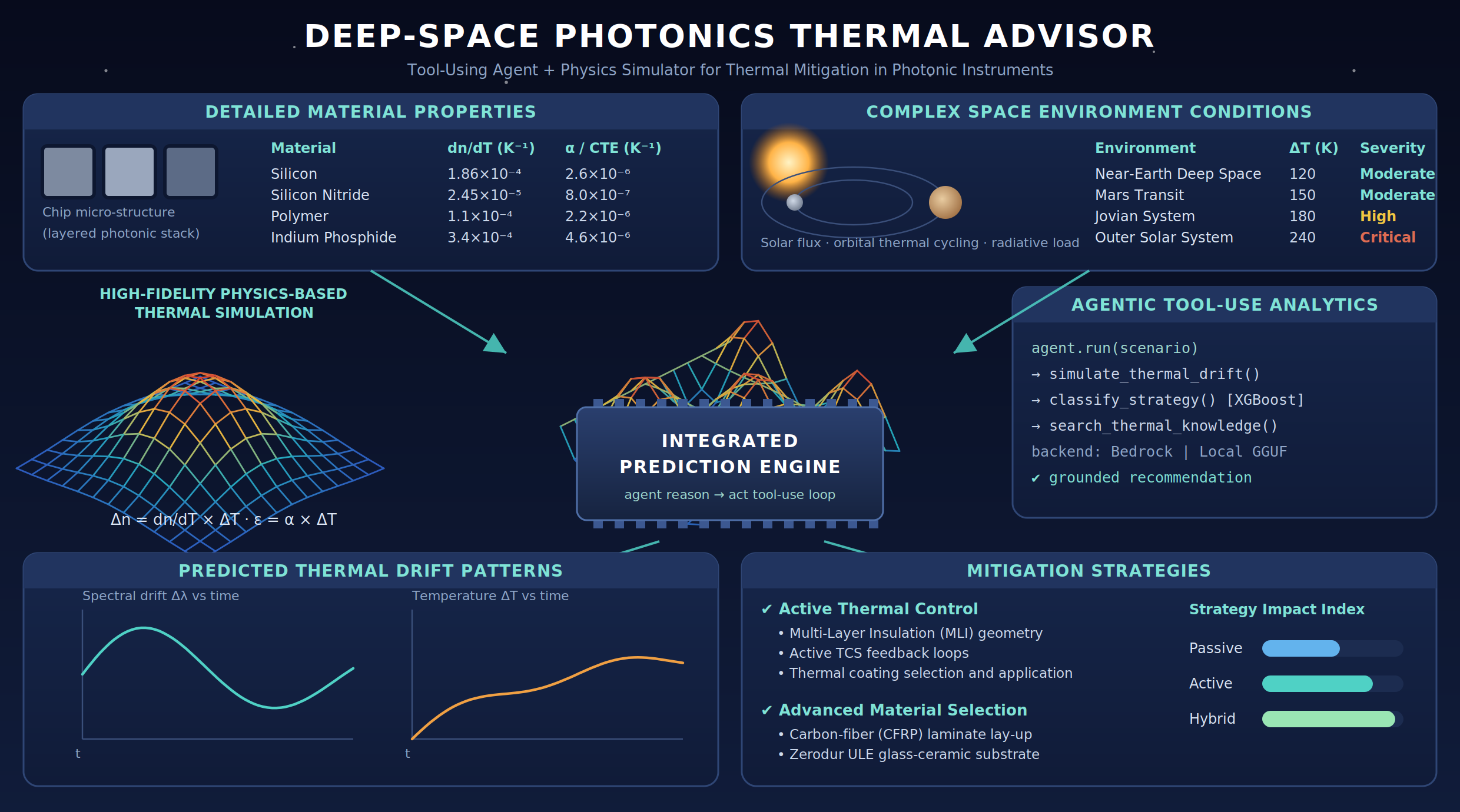
🛸 Deep Space Photonics Thermal Advisor
CI Python 3.10+ AWS Bedrock HuggingFace Dataset — 40K rows Streamlit XGBoost Open Weights — QLoRA + GGUF License: CC BY 4.0 Contact A Taylor
A tool-using agent + physics simulator for recommending thermal mitigation strategies in deep space photonic instruments — runs on managed AWS Bedrock or a self-hosted, fine-tuned open-weight model
Physics simulation · Agentic tool use · Scenario retrieval · XGBoost classification · QLoRA + GGUF open-weight fine-tuning · Streamlit demo
💡 The Problem
Photonic Integrated Circuits (PICs) are the backbone of next generation space probe instruments that operate in deep space — spectrometers, laser communication terminals, waveguide sensor arrays, and photonic signal processors. But space is brutal:
- 🌡️ Spectral drift — temperature swings shift refractive indices, pushing resonant wavelengths off-target and corrupting measurements
- 📐 Waveguide misalignment — differential thermal expansion between chip layers destroys optical coupling, killing signal throughput
- 💥 Mechanical cracking — repeated thermal cycling fatigues bonding interfaces and dielectric layers until catastrophic failure
A spectrometer on a Jovian probe faces 180 K temperature swings. An optical link in the outer solar system endures 240 K. The wrong mitigation strategy means mission failure.
✨ The Solution
This project pairs deterministic physics with an agent that reasons over a knowledge data store — no fine-tuning required. A Bedrock foundation model decides which tools to call for any instrument-material-environment combination, then synthesizes a grounded recommendation:
| Layer | What It Does | Status |
|---|---|---|
| 🔬 Physics Simulator | Computes Δn and strain from first principles | ✅ Live |
| 🤖 Tool-Using Agent | Reasons over the scenario and calls tools via a pluggable backend | ✅ Live |
| ☁️ Bedrock Backend | Managed foundation model via the Converse API | ✅ Live |
| 🧠 Open-Weight Backend | Self-hosted Llama 3.3 / Qwen2.5 fine-tuned with QLoRA, served as GGUF | ✅ Live |
| 📚 Scenario Data Store | Retrieves similar prior cases from the 40K-scenario knowledge base | ✅ Live |
| 📊 XGBoost Classifier | Fast Passive / Active / Hybrid prediction with calibrated probabilities | ✅ Live |
| 🖥️ Streamlit App | Interactive two-mode demo (physics + agentic advisor) | ✅ Live |
| 🧪 CI Pipeline | Automated pytest across Python 3.10–3.12 on every push and PR | ✅ Live |
Knowledge vs. behavior — two different jobs
- Knowledge stays out of the weights. The data store holds the facts; updating it means re-indexing, not re-training. Every recommendation cites real simulator output, classifier probabilities, and retrieved scenarios.
- Behavior can be baked into the weights — for open-weight models. You don't fine-tune to teach facts; you fine-tune so an open-weight model reliably emits this stack's tool calls without babysitting it with a giant system prompt. See Open-Weight Fine-Tuning.
- Composable — the simulator, classifier, and data store are independent tools the model orchestrates on demand, regardless of backend.
🏗️ Architecture
Runtime — agentic tool-use loop
                 ┌──────────────────────────────────────┐
                 │        Streamlit Interactive App      │
                 │   (Physics Simulator · Agentic Advisor)│
                 └──────────────────────────────────────┘
                                   │
                                   ▼
                 ┌──────────────────────────────────────┐
                 │              ThermalAgent             │
                 │       reason → act tool-use loop      │
                 └──────────────────────────────────────┘
                                   │
                   ┌───────────────┴───────────────┐
                   ▼                               ▼
        ┌────────────────────┐         ┌────────────────────────┐
        │   Bedrock backend  │         │      Local backend     │
        │   (managed FM via  │         │  (fine-tuned GGUF via  │
        │    Converse API)   │         │ OpenAI-compatible EP)  │
        └────────────────────┘         └────────────────────────┘
                   └───────────────┬───────────────┘
                                   ▼
                 ┌──────────────────────────────────────┐
                 │             ToolDispatcher            │
                 └──────────────────────────────────────┘
                     │              │               │
                     ▼              ▼               ▼
            ┌──────────────┐ ┌──────────────┐ ┌──────────────────┐
            │  simulate_   │ │  classify_   │ │ search_thermal_  │
            │  thermal_    │ │  strategy    │ │ knowledge        │
            │  drift       │ │  (XGBoost)   │ │ (data store)     │
            └──────────────┘ └──────────────┘ └──────────────────┘
                     │              │               │
                     ▼              ▼               ▼
            ┌──────────────┐ ┌──────────────┐ ┌──────────────────┐
            │ ThermalDrift │ │  Strategy    │ │ ThermalDataStore │
            │  Simulator   │ │  Classifier  │ │ TF-IDF · 40K rows│
            └──────────────┘ └──────────────┘ └──────────────────┘
The agent runs a tool-use loop: the model requests a tool, the ToolDispatcher executes it against the simulator, classifier, or data store, the result is fed back, and the loop repeats until the model returns a final recommendation. The model backend is pluggable — the same loop runs against managed Bedrock or a self-hosted fine-tuned open-weight model (the LocalToolBackend translates Bedrock Converse ↔ OpenAI tool-calling). The data store is likewise backend-agnostic — the local TF-IDF index can be swapped for Amazon Bedrock Knowledge Bases in production without changing the agent or tools.
Offline — open-weight fine-tuning pipeline (feeds the Local backend)
   HuggingFace          training_data.py         finetune.py        quantize.py
   40K dataset    ──▶    SFT trace builder   ──▶  QLoRA 4-bit   ──▶  merge + GGUF   ──▶  GGUF
                        (real Strategy            (LoRA adapter)     (Q4_K_M)            served by
                         Classifier +                                                    Local backend
                         ThermalDataStore →
                         grounded tool traces)
The SFT builder runs the real StrategyClassifier and ThermalDataStore to ground each training trace in genuine tool outputs (with synthesized fallbacks for unseen inputs), so the fine-tuned open-weight model learns this stack's exact tool-calling dialect — not synthetic proxies.
📦 Dataset
40,000 synthetic thermal scenarios — Taylor658/deep-space-optical-chip-thermal-dataset
The dataset is the agent's knowledge store: scenarios are indexed for retrieval and used to train the XGBoost classifier.
Chip Materials
| Material | dn/dT (K⁻¹) | α — Thermal Expansion (K⁻¹) | Sensitivity |
|---|---|---|---|
| Silicon | 1.86 × 10⁻⁴ | 2.6 × 10⁻⁶ | High |
| Silicon Nitride | 2.45 × 10⁻⁵ | 8.0 × 10⁻⁷ | Low |
| Polymer | 1.1 × 10⁻⁴ | 2.2 × 10⁻⁶ | Moderate |
| Indium Phosphide | 3.4 × 10⁻⁴ | 4.6 × 10⁻⁶ | Very High |
Environments
| Environment | Expected ΔT (K) | Severity |
|---|---|---|
| Near Earth Deep Space | 120 | ⚠️ Moderate |
| Mars Transit | 150 | ⚠️ Moderate |
| Jovian System | 180 | 🔴 High |
| Outer Solar System | 240 | 🔴 Critical |
Coverage
- 4 instruments — Spectrometer, Laser Communication Terminal, Waveguide Sensor Array, Photonic Signal Processor
- 3 strategy types — Passive, Active, Hybrid
🚀 Quick Start
# Clone
git clone https://github.com/ATaylorAerospace/Thermal-Agent.git
cd Thermal-Agent

# Install
pip install -r requirements.txt

# Configure
cp .env.example .env
# → Edit .env with your AWS credentials (Bedrock access)

# Build the agent's knowledge artifacts:
#   - scenario data store (vector index)
#   - XGBoost strategy classifier
bash scripts/build_index.sh

# Run the interactive app
streamlit run app/streamlit_app.py
🔮 Usage Examples
1. Physics Simulation — Compute Thermal Risk
from src.simulator import ThermalDriftSimulator

sim = ThermalDriftSimulator()

# Evaluate Indium Phosphide on a Jovian mission
result = sim.evaluate("Indium Phosphide", "Jovian System")

print(f"Δn = {result['delta_n']:.6f}")       # Δn = 0.061200
print(f"Strain = {result['strain']:.2e}")     # Strain = 8.28e-04
print(f"Risk: {result['risk']}")              # Risk: Critical
print(f"Strategy: {result['recommended_strategy_hint']}")  # Strategy: Hybrid
2. Scenario Retrieval — Query the Data Store
from src.datastore import ThermalDataStore

store = ThermalDataStore.from_huggingface()  # or .load("results/thermal_datastore.pkl")

for hit in store.query("Indium Phosphide spectrometer Jovian spectral drift", top_k=3):
    print(f"{hit['similarity']:.3f}  {hit['instrument']} → {hit.get('strategy_type')}")
3. XGBoost Strategy Prediction
from src.strategy_classifier import StrategyClassifier

clf = StrategyClassifier()
clf.load("results/strategy_classifier.pkl")

proba = clf.predict_proba(
    material="Silicon",
    instrument="Spectrometer",
    environment="Mars Transit",
    thermal_effect="Spectral Drift",
)
print(proba)
# {'Active': 0.12, 'Hybrid': 0.61, 'Passive': 0.27}
4. The Agent — Tool-Grounded Recommendation
from src.agent import ThermalAgent

# Loads the data store and classifier from config/agent_config.yaml if present
agent = ThermalAgent.from_config()

result = agent.run(
    "Instrument: Laser Communication Terminal\n"
    "Material: Indium Phosphide\n"
    "Environment: Outer Solar System\n"
    "Thermal Effect: Waveguide Misalignment\n"
    "What thermal mitigation strategy should be used and why?"
)

print(result["answer"])        # the grounded recommendation
print(result["tool_calls"])    # every tool the agent invoked, with inputs + results
5. Build the Knowledge Artifacts
# One command — build the data store index and train the classifier
bash scripts/build_index.sh
🧠 Open-Weight Fine-Tuning (QLoRA → GGUF)
Run the same agent against a self-hosted, fine-tuned open-weight model instead of Bedrock. The point isn't to teach the model facts (the data store does that) — it's to make a raw open-weight model a reliable, low-overhead tool-caller for this exact stack:
- Close the out-of-the-box gap — off-the-shelf Llama 3.3 / Qwen2.5 are capable but loose at strict tool-call formatting. QLoRA bakes the call format in.
- Teach your dialect — the SFT traces encode these tool schemas and call patterns, so the model speaks your infrastructure natively.
- Own your unit economics — with the behavior in the weights you can strip the giant tool-description system prompt, cutting input-token overhead per inference.
Pipeline
# Heavy deps on a GPU host (kept out of core requirements / CI)
pip install -r requirements-finetune.txt

# 1) Build agentic tool-calling SFT data  2) QLoRA fine-tune  3) merge + GGUF quantize
bash scripts/finetune_pipeline.sh
| Stage | Module | Output |
|---|---|---|
| Build SFT traces | src/training_data.py |
data/finetune/{train,validation}.jsonl |
| QLoRA fine-tune | src/finetune.py |
LoRA adapter in results/thermal-agent-lora/ |
| Merge + quantize | src/quantize.py |
results/thermal-agent.Q4_K_M.gguf |
Base model, LoRA rank, 4-bit quantization, and the GGUF quant type are all set in config/finetune_config.yaml (defaults: Llama 3.3 70B, nf4 4-bit, Q4_K_M).
Serve and switch the agent to it
Serve the GGUF behind any OpenAI-compatible endpoint (llama.cpp server, Ollama, or vLLM), then flip the provider in config/agent_config.yaml:
agent:
  provider: local        # bedrock | local
local:
  model: thermal-agent
  base_url: http://localhost:8000/v1
ThermalAgent.from_config() now routes through LocalToolBackend — the rest of the agent loop is unchanged.
📁 Repository Structure
Thermal-Agent/
├── .github/
│   └── workflows/
│       └── ci.yml                   # GitHub Actions CI — pytest on 3.10–3.12
├── app/
│   └── streamlit_app.py             # Interactive two-tab demo
├── config/
│   ├── agent_config.yaml            # Agent provider, data store, classifier paths
│   └── finetune_config.yaml         # QLoRA + GGUF fine-tuning settings
├── docs/
│   └── thermals.png                 # Hero banner image
├── notebooks/
│   ├── 01_eda.ipynb                 # Exploratory data analysis
│   ├── 02_agent_walkthrough.ipynb   # End-to-end agent walkthrough
│   └── 03_open_weight_finetuning.ipynb  # QLoRA → GGUF walkthrough
├── results/                         # Model, index & adapter artifacts (gitignored)
├── scripts/
│   ├── build_index.sh               # Build data store + train classifier
│   └── finetune_pipeline.sh         # Build SFT data → QLoRA → GGUF
├── src/
│   ├── __init__.py                  # Public API exports
│   ├── agent.py                     # Tool-use agent (pluggable backend)
│   ├── backends.py                  # Local open-weight (OpenAI-compatible) backend
│   ├── tools.py                     # Tool specs + dispatcher
│   ├── datastore.py                 # Scenario retrieval (knowledge store)
│   ├── training_data.py             # Agentic SFT data builder
│   ├── finetune.py                  # QLoRA fine-tuning (Llama 3.3 / Qwen2.5)
│   ├── quantize.py                  # Adapter merge + GGUF quantization
│   ├── simulator.py                 # Physics-based thermal drift engine
│   └── strategy_classifier.py       # XGBoost Passive/Active/Hybrid
├── tests/
│   ├── __init__.py                  # Test package init
│   ├── test_agent.py                # Agent loop tests (mocked backend)
│   ├── test_backends.py             # Local backend translation tests
│   ├── test_tools.py                # Tool dispatch tests
│   ├── test_datastore.py            # Data store retrieval tests
│   ├── test_training_data.py        # SFT data builder tests
│   ├── test_classifier.py           # Classifier tests
│   └── test_simulator.py            # Physics simulator tests
├── .env.example                     # Credential / endpoint template
├── .gitignore
├── conftest.py                      # Pytest path configuration
├── CONTRIBUTING.md                  # Development setup & PR guidelines
├── README.md
├── requirements.txt                 # Core dependencies (agent + tests)
└── requirements-finetune.txt        # Heavy, optional fine-tuning dependencies
🧩 Components
🔬 Physics Simulator (src/simulator.py)
Computes refractive index shift (Δn = dn/dT × ΔT) and mechanical strain (ε = α × ΔT) for any material-environment pair. Classifies risk as Low → Moderate → High → Critical and maps to a strategy hint. Exposed to the agent as the simulate_thermal_drift tool.
📚 Scenario Data Store (src/datastore.py)
Indexes the 40K HuggingFace scenarios with TF-IDF and retrieves the most similar prior cases by cosine similarity. Backend-agnostic — swappable for Amazon Bedrock Knowledge Bases in production. Exposed as the search_thermal_knowledge tool.
🛠️ Agent Tools (src/tools.py)
Bedrock Converse tool specifications plus a ToolDispatcher that routes each tool call to the simulator, classifier, or data store. Tools backed by a missing artifact degrade gracefully.
🤖 Thermal Agent (src/agent.py)
A tool-using agent that runs a reason-act loop — requesting tools, feeding results back, and iterating — until it returns a grounded recommendation along with the full trace of tool calls. The model backend is pluggable (provider: bedrock | local).
🧠 Open-Weight Backend & Fine-Tuning (src/backends.py, src/training_data.py, src/finetune.py, src/quantize.py)
LocalToolBackend runs a self-hosted, QLoRA-fine-tuned Llama 3.3 / Qwen2.5 model (exported to GGUF) behind an OpenAI-compatible endpoint, translating Bedrock Converse ↔ OpenAI tool-calling so it drops straight into the agent loop. The fine-tuning trio builds agentic SFT traces, runs 4-bit QLoRA, and merges + quantizes the adapter to GGUF.
📊 Strategy Classifier (src/strategy_classifier.py)
XGBoost classifier predicting Passive / Active / Hybrid strategies with calibrated probability estimates. Exposed as the classify_strategy tool and usable standalone.
🧪 Testing
Tests run automatically via GitHub Actions CI on every push and pull request against Python 3.10, 3.11, and 3.12.
# Run all tests locally
pytest tests/ -v

# Run a single suite
pytest tests/test_agent.py -v
The agent tests use a scripted fake Bedrock client, so the full tool-use loop is exercised without any AWS calls.
🤝 Contributing
See CONTRIBUTING.md for development setup, testing instructions, and pull request guidelines.
📜 License
This work is licensed under CC BY 4.0.
Copyright (c) 2026 A Taylor
📬 Contact
Have questions, ideas, or want to collaborate? Reach out directly:
Установка Thermal Agent
У этого сервера нет опубликованного пакета — он собирается из исходников. Открой репозиторий и следуй инструкции в README.
▸ github.com/ATaylorAerospace/Thermal-AgentFAQ
Thermal Agent MCP бесплатный?
Да, Thermal Agent MCP бесплатный — установка в пару кликов через Unyly без оплаты.
Нужен ли API-ключ для Thermal Agent?
Нет, Thermal Agent работает без API-ключей и переменных окружения.
Thermal Agent — hosted или self-hosted?
Self-hosted: сервер запускается локально на твоей машине командой из раздела установки.
Как установить Thermal Agent в Claude Desktop, Claude Code или Cursor?
Открой Thermal Agent на unyly.org, выбери вкладку своего клиента (Claude Desktop, Claude Code, Cursor) и нажми Install — конфиг сгенерируется автоматически, без правки JSON.
Похожие MCP
Fetch
Web content fetching and conversion for efficient LLM usage.
AWS KB Retrieval
Retrieval from AWS Knowledge Base using Bedrock Agent Runtime.
 автор: modelcontextprotocol
Spring AI MCP Server
Provides auto-configuration for setting up an MCP server in Spring Boot applications.
llm-analysis-assistant
A very streamlined mcp client that supports calling and monitoring stdio/sse/streamableHttp, and can also view request responses through the /logs page. It also
 автор: xuzexin-hz
Compare Thermal Agent with
Не уверен что выбрать?
Найди свой стек за 60 секунд
Автор?
Embed-бейдж для README
Похожее
Все в категории ai