
TokenSkein
БесплатноНе проверенProvides compression, retrieval, and statistics for local context-economy when interacting with GPT/Codex, enabling efficient token usage and exact recovery of

Описание
Provides compression, retrieval, and statistics for local context-economy when interacting with GPT/Codex, enabling efficient token usage and exact recovery of compacted content.
README
TokenSkein is a local context-economy gateway for GPT clients and Codex. It combines the useful ideas behind pxpipe, Headroom, RTK, and Caveman-style output discipline without pretending that every optimization helps every request.
The name combines token with skein: schemas, recovered text, image pages, shell output, style, and reasoning are separate strands managed as one measured bundle.
The working MVP can:
- proxy OpenAI Responses API requests;
- compact tool schemas and older tool outputs;
- archive every compacted output locally so exact text remains retrievable;
- expose compression, retrieval, and statistics over MCP;
- route reasoning effort from task complexity;
- inject a concise-output policy with safety exceptions;
- optionally encode very dense text as PNG pages when an explicit economic gate passes;
- optionally place a safe output filter after RTK for recognized read-only shell commands.
Status: working experimental MVP. Text compaction, storage, MCP, routing, proxying, and the shell adapter are implemented and tested. The vision lane is implemented but disabled by default until model-specific A/B evaluation establishes its real cost and quality.
Why this exists
Context cost has several different causes, so one trick is not enough:
- repeated schemas waste input tokens;
- large logs and JSON consume context even when only a few lines matter;
- verbose responses consume output tokens;
- easy tasks do not always need high reasoning effort;
- dense visual text can sometimes cost fewer model tokens than raw text, but can also damage exactness or cost more;
- lossy compression becomes dangerous when the omitted detail is later needed.
TokenSkein treats those as separate lanes with separate gates. Its core rule is: compact what is replaceable, retain what is exact, and keep the original recoverable.
Architecture
flowchart LR
    C[Codex or GPT client]
    U[OpenAI Responses API]
    D[(Protected local context store)]
    E[(Metrics JSONL)]
    N[(Usage JSONL)]

    subgraph L[TokenSkein]
      P[Responses proxy]
      Q[Request policy pipeline]
      M[MCP server]
      H[Codex hook and shell filter]
      A[Economics usage recorder]
      K[Dated price catalog]
      V[Dashboard server]
    end

    C -->|Responses request| P
    P --> Q
    Q -->|optimized request| U
    U -->|stream or response| P
    P --> C

    Q -->|archive exact originals| D
    C <-->|compress, retrieve, stats| M
    M <--> D
    C -->|safe read command| H
    H -->|optional RTK rewrite| H
    H -->|archive large output| D
    Q --> E
    M --> E
    H --> E
    P -->|provider usage| A
    K -->|cache-aware cost| A
    A --> N
    V -->|read| E
    V -->|read| N
Inside the request policy pipeline, operations run in this order:
- remove non-operational tool-schema metadata;
- inject the concise style policy when enabled;
- select reasoning effort unless the caller already chose one;
- leave the recent input tail intact;
- compact eligible older
function_call_outputitems; - optionally append PNG pages only when model allowlisting and the profitability estimate both pass;
- forward the transformed request to the configured upstream.
A freeform editable copy lives at docs/architecture.excalidraw; the mermaid block above is the source of truth and may be ahead of it.
Module map
| Module | Responsibility |
|---|---|
src/proxy.ts |
HTTP/SSE forwarding, local endpoints, request overrides |
src/optimize.ts |
Ordered Responses request policy pipeline |
src/compact/ |
Tool-schema, recoverable-text, and PNG transforms |
src/store.ts |
Content-addressed archive, TTL, search, cleanup |
src/mcp.ts |
skein_compress, skein_retrieve, and skein_stats |
src/shell.ts |
Opt-in Codex hook, RTK delegation, shell-output archive |
src/routing.ts |
Prompt-complexity effort selection |
src/metrics.ts |
Content-free optimization event aggregation |
src/economics.ts |
Provider usage parsing (SSE and JSON) and usage JSONL recording |
src/pricing.ts |
Dated per-model price catalog and cache-aware cost computation |
src/dashboard.ts + src/dashboard/ |
Loopback dashboard server and metrics/usage aggregation |
src/config.ts |
Config loading, validation, and environment overrides |
src/install.ts |
Transactional Codex install, uninstall, and verify |
src/codex.ts |
Non-mutating Codex integration snippets |
src/cli.ts |
User-facing command dispatcher |
Architecture rationale
- Responses proxy for broad coverage. Request-level savings should not depend on the model remembering to call a tool.
- MCP for exact recovery. A short
skein:<hash>reference is useful only if omitted context can be fetched on demand. - Local-first storage. Exact tool output stays on the machine, gzip-compressed with
0700directories and0600files. This is access protection, not encryption. - Recent-tail preservation. New observations are more likely to affect the immediate next action and are left untouched.
- Text lane before vision lane. Text remains searchable and exact. Vision is a model-dependent optimization, so it is opt-in and has a break-even gate.
- Deterministic transforms first. Schema cleanup, line selection, identifier retention, and routing are inspectable and testable. Semantic summarization can be added later behind evaluation gates.
- Strict shell allowlist. Hook rewriting is limited to recognized read/verification commands. Destructive, compound, redirected, or ambiguous commands are not rewritten or auto-approved.
- Measurement without inflated claims. Savings statistics are tokenizer-based estimates. Dollar figures use provider-reported usage priced through a dated per-model catalog with cache-aware input rates; models absent from the catalog report cost as unknown instead of guessing.
Dashboard
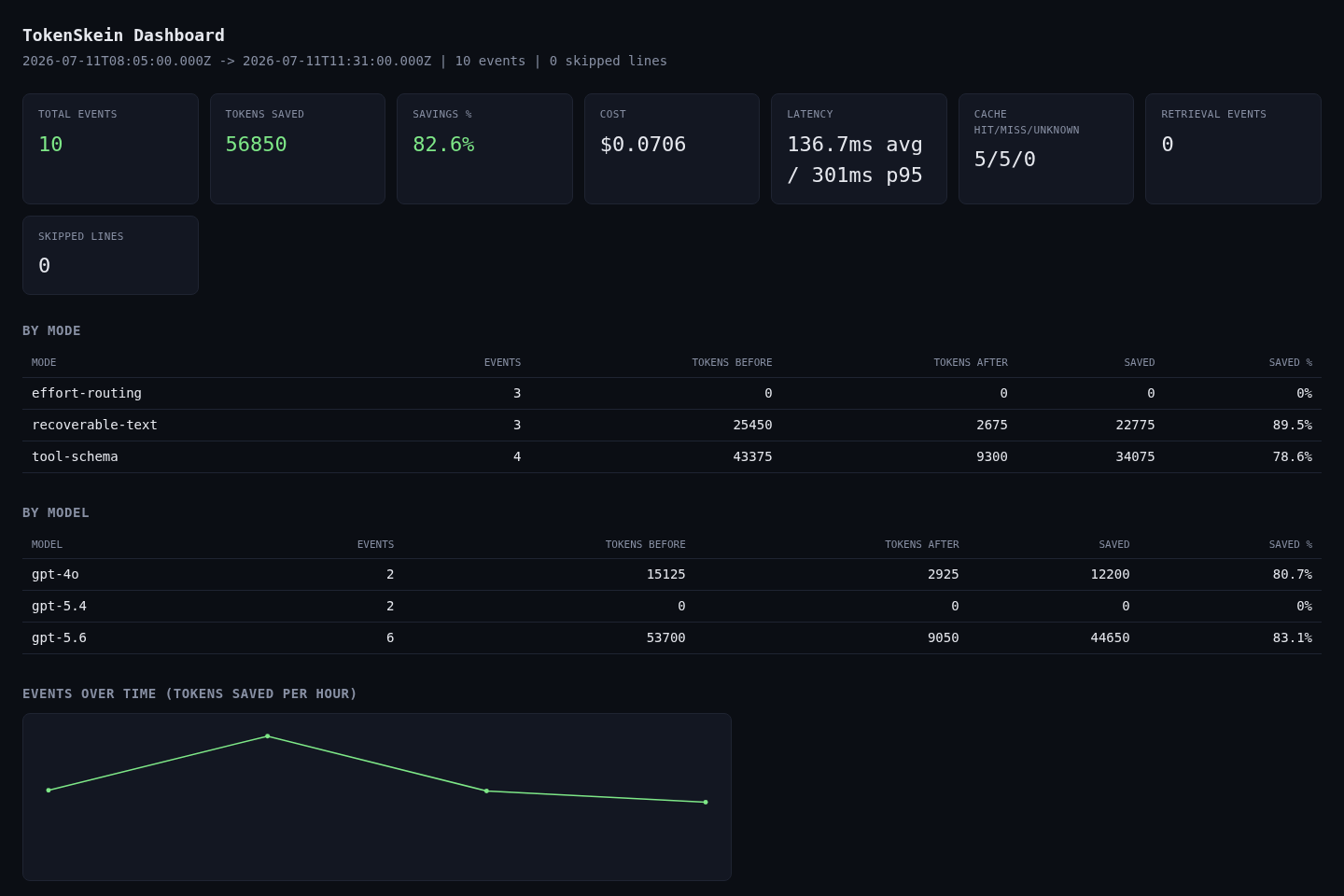
The dashboard reads the metrics JSONL used by token-skein stats plus the provider usage JSONL, and renders estimated token savings, provider-reported cost and latency where recorded, cache hit/miss counts, and an hourly series, broken down by optimization mode and model. Start it with bun run dashboard (equivalent to bun run src/dashboard.ts); it listens on 127.0.0.1:8790 by default, overridable with TOKEN_SKEIN_DASHBOARD_PORT. It binds to loopback only and is not reachable over the network.
What was ported
The implementation is a TypeScript/Bun reimplementation of selected concepts, not a concatenation of the original projects.
| Source | Useful idea | TokenSkein status |
|---|---|---|
| pxpipe | Render dense text into image pages | Implemented, opt-in |
| pxpipe | Model allowlist and profitability threshold | Implemented |
| pxpipe | Preserve a recent exact-text tail | Implemented for Responses input items |
| Headroom | Compress-cache-retrieve lifecycle | Implemented with content-addressed local storage |
| Headroom | TTL, cleanup, targeted retrieval, stats | Implemented |
| Headroom | Compact verbose tool schemas | Implemented recursively |
| Headroom | MCP compression/retrieval interface | Implemented with structured output |
| RTK | Rewrite supported commands before execution | Implemented as optional rtk rewrite delegation |
| RTK | Reduce noisy shell output | Implemented with exact archive recovery |
| Caveman | Short answers without losing technical substance | Implemented as a configurable instruction |
| Caveman | Bypass terse style for safety and irreversible actions | Preserved in the style policy |
| Global Claude setup | Progressive disclosure and task-based model effort | Implemented as recovery-on-demand plus effort routing |
| Global Claude setup | Durable global instruction layer | Optional Codex AGENTS.md fragment included |
The optional prompt fragment lives at integrations/codex/AGENTS.token-skein.md. It is intentionally small: moving a large global CLAUDE.md wholesale would spend the context this project is meant to save.
Planned ports and extensions
The prioritized backlog is tracked in PLAN.md. The main planned work is:
- build a repeatable A/B harness for correctness, exact identifiers, latency, and cost;
- add streaming-aware response accounting without buffering SSE;
- add session-aware history compaction instead of only item-age rules;
- tune visual pages per model and reject OCR-hostile or exactness-critical content;
- add native shell reducers so RTK remains optional rather than required;
- add MCP resources and indexed retrieval for large archives;
- evaluate other provider protocols only after the Responses path is stable.
Quick start
Requirements: Bun 1.3+ and an OpenAI API key for the default upstream.
cd ~/projects/token-skein
bun install
bun run check
bun run proxy
The default proxy listens on http://127.0.0.1:8788 and forwards to https://api.openai.com. It does not copy or store API keys; authorization headers are forwarded in memory.
For a generic Responses client, point its OpenAI base URL at:
http://127.0.0.1:8788/v1
Codex integration
Print integration snippets without changing global configuration:
bun run src/cli.ts codex-snippet
Then:
- merge the provider and MCP blocks into
~/.codex/config.toml; - select
model_provider = "token_skein"globally or in the profile where it should run; - merge the hook block into
~/.codex/hooks.jsononly if the experimental shell lane is wanted; - after reviewing its strict allowlist, set
shell.enabledtotruefor that opt-in lane; - start
bun run proxybefore starting that Codex profile; - ensure
OPENAI_API_KEYis available to Codex.
This path uses OpenAI API-key billing. It does not claim to tunnel ChatGPT/Codex subscription authentication through a custom provider. WebSocket Responses transport is currently disabled; HTTP and SSE are forwarded.
The Codex hook adapter targets the Bash PreToolUse shape. Codex builds that expose shell execution only through another tool name will still benefit from the proxy and MCP lanes, but will not use the shell rewrite until an adapter for that tool shape is added.
Optional global instruction fragment
Review integrations/codex/AGENTS.token-skein.md, then merge only the rules you want into ~/.codex/AGENTS.md. TokenSkein never edits that global file automatically.
Configuration
The default config path is ~/.config/token-skein/config.json. Start from token-skein.config.example.json. Nested values are merged over defaults.
Environment overrides:
| Variable | Purpose |
|---|---|
TOKEN_SKEIN_CONFIG |
Alternate JSON config path |
TOKEN_SKEIN_HOST |
Proxy bind host |
TOKEN_SKEIN_PORT |
Proxy port |
TOKEN_SKEIN_UPSTREAM |
Upstream API origin |
TOKEN_SKEIN_STORE_DIR |
Local archive directory |
TOKEN_SKEIN_EVENTS_PATH |
Metrics JSONL path |
TOKEN_SKEIN_BIN |
Exact command used by the hook wrapper |
TOKEN_SKEIN_DASHBOARD_PORT |
Dashboard bind port (default 8790), read directly by bun run dashboard |
The archive quota is a config file field, not an environment variable: archive.maxBytes (default 200 MiB) caps the local context store, and once exceeded the least-recently-touched entries are evicted first.
Request-level controls:
| Header | Accepted values | Effect |
|---|---|---|
x-token-skein-bypass |
true / false |
Skip all request transforms |
x-token-skein-vision |
true / false |
Override the vision switch for this request |
x-token-skein-style |
true / false |
Override concise-style injection |
x-token-skein-effort |
low, medium, high, xhigh |
Explicit reasoning effort |
Vision defaults to off. Enabling it is only a request to evaluate the lane: content must still exceed minimumBytes, the model must match vision.models, and estimated text tokens divided by estimated image tokens must exceed minimumSavingsRatio.
CLI
token-skein proxy                 start the local Responses proxy
token-skein mcp                   start the stdio MCP server
token-skein hook codex            process a PreToolUse event from stdin
token-skein shell --encoded DATA  execute a hook-approved command and filter output
token-skein stats                 show estimated savings and archive statistics
token-skein cleanup               remove expired archive entries
token-skein codex-snippet         print Codex integration snippets
token-skein install               install the Codex integration (transactional)
token-skein uninstall             remove the Codex integration
token-skein doctor                check prerequisites for the Codex integration
token-skein verify                validate an existing install without mutating anything
token-skein config                print active configuration
Until the package is linked globally, replace token-skein with bun run src/cli.ts.
The dashboard (bun run dashboard) and the license scanner (bun run license-scan) are separate Bun scripts, not token-skein subcommands.
MCP tools
skein_compress: archive exact content and return a compact view plus reference;skein_retrieve: fetch the exact original or matching lines with context;skein_stats: aggregate optimization and archive metrics.
The MCP server uses stdio and emits protocol traffic only on stdout; diagnostics go to stderr.
Data and security boundaries
- Archive objects contain original tool output and may contain secrets. They are local, gzip-compressed, permission-restricted, and TTL-bound, but not encrypted.
- Compacted views redact common API-key, authorization, token, secret, and password forms. The exact archive intentionally retains the original for recovery.
- Metrics record sizes, token estimates, mode, model, references, and non-content metadata; they do not intentionally record request or output bodies.
- The proxy binds to loopback by default. Binding it to a network interface requires your own authentication and transport controls.
- The shell hook is disabled by default. When explicitly enabled, it never rewrites commands containing destructive patterns, command chaining, redirects, heredocs, command substitution, dangerous reducer flags, or newlines. A non-match falls back to normal Codex behavior.
Known limitations
- Savings are estimates from an
o200ktokenizer, not invoice-grade measurements. - Image token cost varies by model, image detail policy, page density, and pricing. PNG can be cheaper, equal, or more expensive than text.
- Text-in-image is lossy for exact punctuation and identifiers. The text sidecar and archive reduce that risk but do not make vision exact.
- Only older
function_call_outputstrings are compacted automatically; arbitrary conversation history is not yet rewritten. - Visual pages are capped. Omitted material remains available through the archive.
- The current effort router is heuristic and English-biased.
- The proxy has no distributed store, encryption-at-rest, or multi-user isolation.
Verification
bun run typecheck
bun test
Tests cover storage and expiry, recoverable text compaction, tool-schema compaction, effort routing, vision gating, shell safety, and end-to-end proxy transformation through a mock upstream.
License and attribution
TokenSkein is licensed under Apache-2.0. It adapts concepts from pxpipe (MIT), Headroom (Apache-2.0), RTK (Apache-2.0), and the user's global Claude workflow. See NOTICE and LICENSES/README.md.
Установка TokenSkein
У этого сервера нет опубликованного пакета — он собирается из исходников. Открой репозиторий и следуй инструкции в README.
▸ github.com/flaviomartil/token-skeinFAQ
TokenSkein MCP бесплатный?
Да, TokenSkein MCP бесплатный — установка в пару кликов через Unyly без оплаты.
Нужен ли API-ключ для TokenSkein?
Нет, TokenSkein работает без API-ключей и переменных окружения.
TokenSkein — hosted или self-hosted?
Self-hosted: сервер запускается локально на твоей машине командой из раздела установки.
Как установить TokenSkein в Claude Desktop, Claude Code или Cursor?
Открой TokenSkein на unyly.org, выбери вкладку своего клиента (Claude Desktop, Claude Code, Cursor) и нажми Install — конфиг сгенерируется автоматически, без правки JSON.
Похожие MCP
Fetch
Web content fetching and conversion for efficient LLM usage.
AWS KB Retrieval
Retrieval from AWS Knowledge Base using Bedrock Agent Runtime.
 автор: modelcontextprotocol
Spring AI MCP Server
Provides auto-configuration for setting up an MCP server in Spring Boot applications.
llm-analysis-assistant
A very streamlined mcp client that supports calling and monitoring stdio/sse/streamableHttp, and can also view request responses through the /logs page. It also
 автор: xuzexin-hz
Compare TokenSkein with
Не уверен что выбрать?
Найди свой стек за 60 секунд
Автор?
Embed-бейдж для README
Похожее
Все в категории ai