
Trip2g
БесплатноНе проверенSelf-hosted knowledge mesh with built-in MCP server enabling AI agents to search and retrieve notes across federated hubs.

Описание
Self-hosted knowledge mesh with built-in MCP server enabling AI agents to search and retrieve notes across federated hubs.
README
Publish your Obsidian vault as a website. Self-hosted MCP memory for AI agents.
Write in Obsidian, press Sync, your notes are live. The same self-hosted hub serves readers a website and serves agents an MCP endpoint, publishes to Telegram, and gates paid content. Under the hood it is a Markdown Operating System: every note is a file, and one note is both a web page for a human and a tool call for an agent.
CI License: MIT Release GitHub stars Go
Why trip2g
- Your notes work twice. One markdown file renders as a page for readers and answers
search/note_htmlcalls from any MCP client. No export step, no copy of your knowledge locked in a vector store you can't read. - Your data stays yours. Plain markdown, a git-cloneable vault, every edit a readable diff. No SaaS in the middle, and you can move out any time with
git clone. - One process to run. A single Go binary on SQLite. It starts the same on a laptop, a small VM, or a container. MIT licensed.
Quickstart
See it work in 30 seconds. Add the public knowledge hub to any MCP client and ask it a question. It searches all connected bases and answers with sources:
{
  "mcpServers": {
    "trip2g": {
      "url": "https://trip2g.com/_system/mcp"
    }
  }
}
Run your own hub:
git clone https://github.com/trip2g/trip2g && cd trip2g/quickstart
docker compose up
Open http://localhost:8081, sign in with [email protected] and code 111111, and download the preconfigured Obsidian vault from the home page. One container, files on local disk, full-text search — no other services needed.
Prefer no terminal? Get a free cloud instance. All the options (single binary, Docker Compose behind TLS, fly.io) are in the self-host guide.
Docs · Getting started · MCP tools · Self-host · Contributing
Everything is a note
Unix made everything a file. trip2g makes everything a note.
One global namespace, path-addressed, shared by humans and agents. A note is a markdown file: the frontmatter is its metadata, the body is its content. The same note is served as a web page (the display server) and over MCP (the agent's syscall surface), and every edit is snapshotted into note_versions and mirrored to git. So the history is a readable diff, not a binary blob.
   human A           human B           human C
      │                 │                 │
      ▼                 ▼                 ▼
   agent A           agent B           agent C
      │                 │                 │
      ▼                 ▼                 ▼
  ┌────────┐  MCP  ┌────────┐  MCP  ┌────────┐
  │ hub A  │ ◄───► │ hub B  │ ◄───► │ hub C  │
  └────────┘       └────────┘       └────────┘
       ▲                 ▲                 ▲
       └─── humans browse · agents query ──┘
The same hub serves the human (a website with subscriptions, RSS, Telegram) and the agent (MCP). Your data stays in plain markdown you can move out any time.
The map
trip2g borrows the operating-system vocabulary because the primitives line up. Each row is tagged by how real it is: shipped is running code on main, branch is running code on feat/agent-runtime, planned is a design doc.
| OS concept | trip2g primitive | Status |
|---|---|---|
| Filesystem | one path-addressed note namespace, humans and agents share it | shipped |
| Files | notes: markdown frontmatter (metadata) + body (content) | shipped |
| Overlay filesystem | frontmatter patches (Jsonnet) override notes without touching the source | shipped |
| Snapshots | note_versions + DB-canonical git mirror (gitapi) |
shipped |
| Filesystem over git | git clone/pull/push the vault over Smart HTTP (/_system/git) |
shipped |
| Syscalls | MCP tools: search, note_html, similar, federated_* |
shipped |
| Network stack | federation: fan one query out to peer hubs | shipped |
| Virtual hosts | per-domain routing via route/routes frontmatter |
shipped |
| Scheduler | cron webhooks (next_run_at) + goqite worker pools |
shipped |
| Process dispatch | webhook delivery: note create/update/remove → POST | shipped |
| IPC | notes as an event bus: one agent's write fires the next | shipped |
| Display server | website rendering: default + Jet templates, mermaid, datachart | shipped |
| Page cache | anonymous rendered-page cache, version-keyed | shipped |
| Output target | publish notes to a Telegram channel, links preserved | shipped |
| Standard input | forms in frontmatter, submissions stored per note | shipped |
| Permissions (users) | subgraphs + subscription ACLs, admins, API keys | shipped |
| Auth providers | email magic-link, Google/GitHub OAuth, OIDC SSO | shipped |
| Permissions (agents) | per-webhook read_patterns/write_patterns in a scoped token |
shipped |
| Credential store | encrypted secrets / federation_secrets (AES-256-GCM) |
shipped |
| Capability ticket | HAT: signed short-TTL token, ae=true admin elevation |
shipped |
| Control surface | kanban board note (layout: kanban) |
shipped (layout), branch (agent wiring) |
| Kernel config | feature flags, validated at boot (panics on missing dep) | shipped |
| Process executor | internal LLM run loop (agentruntime), tool allowlist + caps |
branch |
| Package manager | role-as-note: drop a note, fleet registers the agent |
branch |
| Resource limits | non-overridable token + step caps per run | branch |
Syscalls: the MCP server
Built into every hub. An agent never touches the database directly. It calls a small set of tools over MCP, and access is scoped to the caller's subscription.
| Tool | Purpose |
|---|---|
search |
Hybrid full-text + semantic search |
note_html |
Read a note (or a section) by id, path, or match |
similar |
Notes similar to a given note |
federated_search / federated_similar / federated_note_html |
Same, fanned out to peer hubs |
instructions |
Author-defined prompt for the agent |
Custom tools can be defined in note frontmatter (mcp_method:).
Network stack: federation
graph LR
    O[Obsidian vault] --> H[your hub]
    T[Telegram]       --> H
    H <-->|MCP federation| H2[peer hub]
    H2 --> B[their bases]
    H -->|/_system/mcp| A[agent]
    H2 -->|/_system/mcp| A
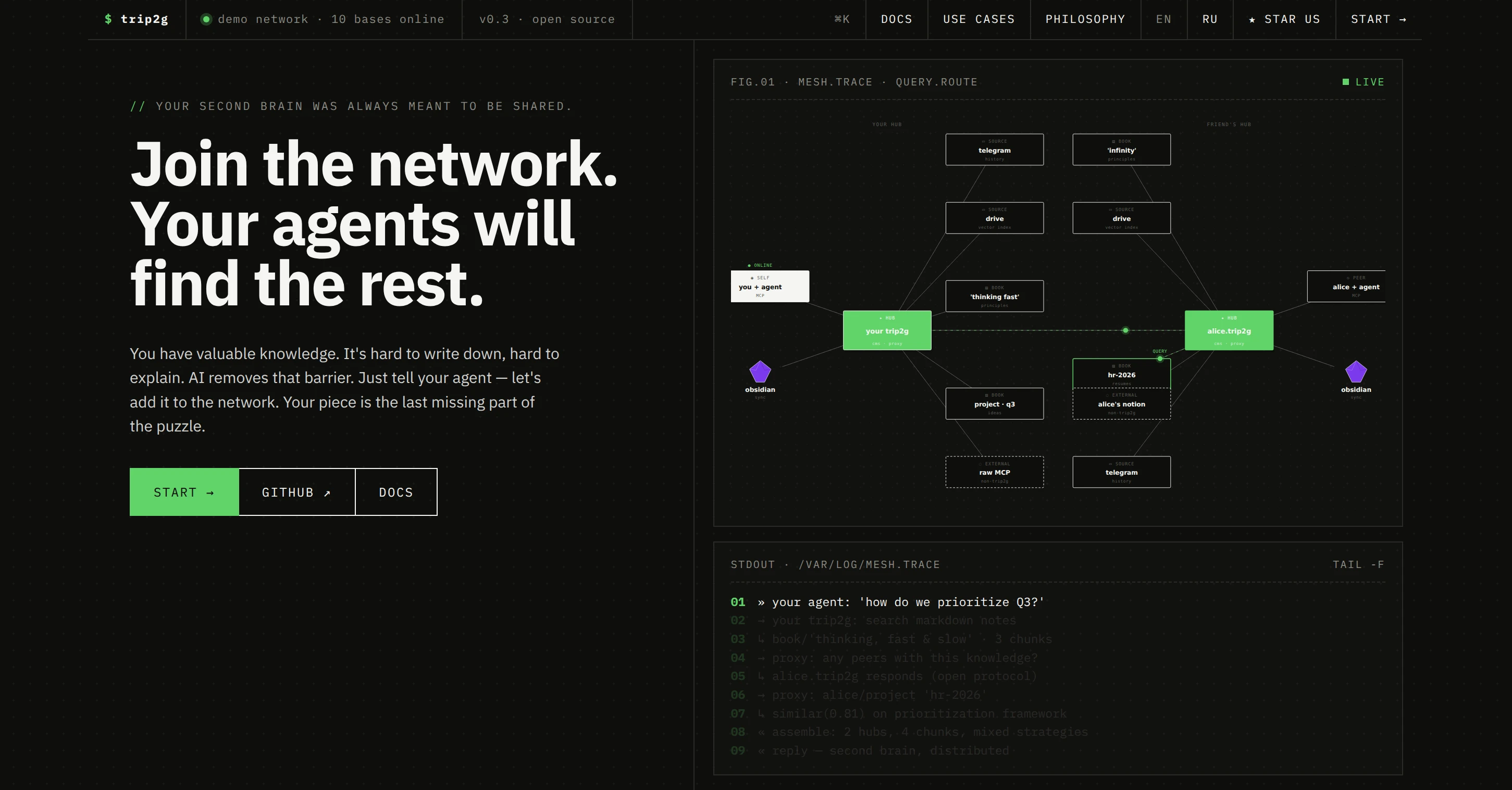
Peer hubs with trusted people or orgs. Each hub controls access per base. One agent question reaches the union of all connected knowledge. Loops are bounded the way IP packets are: each hub enforces max_depth against a per-hop counter (the X-MCP-Federation-Depth header), and every call carries a short-expiry, HMAC-signed token.
Each hub is itself a Markdown OS, so the network is a mesh between operating systems, the way the internet is a network between computers. The rows below are common shapes, not the only ones. The protocol does not assume a topology, so you can build any of them.
| Topology | Setup | Result |
|---|---|---|
| Solo | One hub, many bases | All your notes, books, courses in one query |
| Friends | Each person runs a hub, hubs peer | Union of everyone's knowledge |
| Company | Central hub + per-employee hubs | Tribal knowledge and docs, queryable |
| B2B | Two star topologies, one bridge | Shared knowledge without merging systems |
Process dispatch & scheduler: webhook agents
The kernel-side mechanism that runs an agent. Shipped on main.
- Change webhooks. A note create/update/remove POSTs to an agent, and the agent writes notes back via the API. Glob filtering picks which notes fire it, HMAC signs the delivery, and
max_depthstops recursion. - Cron webhooks. Run an agent on a schedule (
0 9 * * *). Anext_run_atcolumn plus a per-minute system cron drive it, and goqite worker pools give per-queue concurrency and priority. Sync or async, with optional instruction context.
The agent itself can live anywhere. These webhooks just deliver the event and accept note writes back.
Userland: the agent fleet
In development on
feat/agent-runtime, not yet onmain.
The core idea: a note edit spawns a scoped, server-side agent run. Unlike a local editor or a static builder, the agent runs on the hub, scoped to the note's glob patterns, not on your laptop.
An agent is a note. Its frontmatter is the config: model, tools, read_patterns/write_patterns, trigger_on, for_each, max_depth, timeout_seconds. Its body is the instruction, a Jet template that can reference the changed note(s). A fleet daemon watches an agents folder, parses each role note, and registers it as a change webhook pointed back at itself. Drop a note to install an agent, remove the note to uninstall it.
graph LR
  E[note edited] --> W[change webhook fires]
  W --> F[fleet /deliver]
  F --> R[agentruntime loop]
  R -->|search / read_note| KB[(knowledge base)]
  R -->|write_note / patch_note| KB
  KB -.re-trigger.-> E
When a watched note changes, trip2g fires the webhook and the fleet runs a scoped loop (agentruntime): the model gets the instruction plus in-scope context and calls search / read_note / write_note / patch_note. Reads and writes are enforced against the role's glob patterns, a non-overridable token-and-step cap limits the run, and max_depth breaks re-trigger loops. trip2g stays a plain event source. The instruction, scope, and triggers all live in the note.
The plumbing this rides on (change/cron webhooks, scoped tokens, delivery jobs) is shipped on main. The in-note LLM executor (agentruntime) and the fleet reconciler (internal/fleet, cmd/fleet) are what feat/agent-runtime adds.
Control surface: the kanban board
A board is a note with layout: kanban, and cards are lines like - ship the docs @status:doing @assigned:bob. Editing a card is a note edit, so the same trigger that drives any agent can drive a triage agent that reads the board and patch_notes cards in place. The note is both how a human directs work and the agent's input and output.
The kanban layout (docs/_layouts/kanban.html) and the standalone kanban_template ship on main. Wiring a board to the fleet is part of feat/agent-runtime.
Display server: templates and renderers
Two paths, pick one per knowledge base.
A. Default template (no code, frontmatter only). Compose pages from widgets and content blocks:
---
header: "[[Navigation]]"
left_sidebar: [TOC, inlinks]
content: [selfcontent, magazine]
magazine_include_files: "blog/**/*.md"
footer: "[[Footer]]"
---
Rendered through quicktemplate. Notes can also render as HTML, JSON, or RSS via content_type frontmatter.
B. Custom Jet templates (full control). Drop your own .html files into a layouts folder and switch via layout: path/to/template. Templates get the markdown AST, so you can iterate sections, render specific parts, and customize down to HTML. Built on the Jet template engine.
On top of either path sit renderer extensions that the backend loads per note, only when a note asks for them: mermaid diagrams and a datachart widget that turns a referenced CSV into a chart (via ECharts). A note declares what it needs, and the page ships only those scripts.
Telegram: notes become channel posts
The same notes publish to a Telegram channel, on a schedule or instantly. trip2g keeps the links intact: a wikilink to a note that has its own post points at that post, and a note that is not posted yet falls back to its page on the website, so nothing dangles. Edit the note and re-sync, and the channel post updates itself. Full guide →
Forms: structured input
A note can collect input, not just show it. Put a form: block in the frontmatter and trip2g renders a form on the page, accepts submissions through the GraphQL API, and stores each one against the note.
---
title: Say hello
form:
  fields:
    - name: email
      type: email
      required: true
    - name: message
      type: text
      max_length: 2000
---
Field types and validators live in the frontmatter, Cloudflare Turnstile guards public forms by default, and can_submit limits who may post. Submissions land in the admin panel and a GraphQL API, and each one emails the vault admins. Define a spec once and reuse it with form_ref:, or attach a form to a whole folder with frontmatter patches. In OS terms, this is the note's standard input. Full guide →
Git: the vault is a repo
trip2g serves the whole knowledge base over git Smart HTTP at /_system/git. Clone it, pull it, and push to it like any repository. The database is canonical; the git tree is not a checkout sitting on disk, gitapi materializes it on demand at the moment you interact with the endpoint, and a push is applied back into the notes. So you can back up the vault with git clone (the full history comes down with it) and script changes with a commit instead of the API.
Monetization
Group notes into paid products with subgraph paywalls, while free notes stay public. Payments go through crypto (NowPayments), Patreon, or Boosty.
Sources
| Source | Status |
|---|---|
| Obsidian | ready: vault stays local, two-way sync |
| Telegram | ready: channel publish + history mirror |
| RSS output | ready: every base exposes feeds |
| Notion | planned |
| Google Drive | planned |
| Linear, Slack archive, RSS import | planned |
Self-host
cd quickstart && docker compose up
trip2g runs as one process on SQLite, with no database server to stand up, so a hub starts the same on a laptop, a small VM, or a container. When you need high availability, add read-only replicas that scale reads horizontally while a single leader takes the writes (on the feat/read-replica branch).
Full guide → · MIT · runs on SQLite alone; semantic search needs an embeddings API (OpenAI or any compatible endpoint), while full-text search works offline.
Tech stack
| Backend | Go, FastHTTP, gqlgen (GraphQL) |
| Database | SQLite + Litestream for streaming backup |
| Search | bleve (full-text) + embeddings via any OpenAI-compatible API (semantic) |
| Markdown | Goldmark: wikilinks, frontmatter |
| Templates | quicktemplate (default) + Jet (custom) |
| Charts & diagrams | mermaid, ECharts (datachart) |
| Frontend | $mol, TypeScript |
| Assets | S3-compatible (MinIO for dev) |
Inspiration
The OS framing is adapted from Markdown as an Operating System and from Unix's everything is a file. Three lines we took to heart:
- Markdown is the universal substrate. One file every tool and every model already reads; render the website, the feed, and the git history from it.
- The file is the interface between processes. An agent writing a note fires the next agent, so coordination needs no separate queue API.
- Human-readable diffs are the audit log. Every edit is a
note_versionand a commit you can read in five seconds and revert.
License
MIT
Установка Trip2g
У этого сервера нет опубликованного пакета — он собирается из исходников. Открой репозиторий и следуй инструкции в README.
▸ github.com/trip2g/trip2gFAQ
Trip2g MCP бесплатный?
Да, Trip2g MCP бесплатный — установка в пару кликов через Unyly без оплаты.
Нужен ли API-ключ для Trip2g?
Нет, Trip2g работает без API-ключей и переменных окружения.
Trip2g — hosted или self-hosted?
Self-hosted: сервер запускается локально на твоей машине командой из раздела установки.
Как установить Trip2g в Claude Desktop, Claude Code или Cursor?
Открой Trip2g на unyly.org, выбери вкладку своего клиента (Claude Desktop, Claude Code, Cursor) и нажми Install — конфиг сгенерируется автоматически, без правки JSON.
Похожие MCP
Fetch
Web content fetching and conversion for efficient LLM usage.
AWS KB Retrieval
Retrieval from AWS Knowledge Base using Bedrock Agent Runtime.
 автор: modelcontextprotocol
Spring AI MCP Server
Provides auto-configuration for setting up an MCP server in Spring Boot applications.
llm-analysis-assistant
A very streamlined mcp client that supports calling and monitoring stdio/sse/streamableHttp, and can also view request responses through the /logs page. It also
 автор: xuzexin-hz
Compare Trip2g with
Не уверен что выбрать?
Найди свой стек за 60 секунд
Автор?
Embed-бейдж для README
Похожее
Все в категории ai