
Unofficial Davinci
БесплатноНе проверенLets AI agents drive DaVinci Resolve for video editing, including beat-synced cuts, color matching, and loudness normalization, with both live Resolve Studio co

Описание
Lets AI agents drive DaVinci Resolve for video editing, including beat-synced cuts, color matching, and loudness normalization, with both live Resolve Studio control and file-based interchange for the free edition.
README

Wasserman's Unofficial DaVinci MCP
Let any AI agent run DaVinci Resolve for you — Claude Code, Codex, Cursor, Hermes, or any MCP client. Cut clips to the beat, match a reference look, tighten dialogue, hit a loudness spec, and build timelines — either by driving Resolve Studio live, or by generating clean import files for the free edition.




A flat log-ish grade (BEFORE) matched to a warm reference frame (REFERENCE) → the MATCHED result, baked to a 33-point .cube LUT. Real output from the color_match engine on a single desert-dance frame.
You describe the edit in plain language; your agent calls the tools. The server does the deterministic, numeric work an LLM shouldn't guess at — beat grids, LUT math, EBU R128 loudness, FCPXML — and hands back files and plans you can trust. No cloud rendering, no black boxes: every engine is stdlib + numpy + ffmpeg, and every mutating tool previews before it touches anything.
Two tiers, auto-detected
The server detects at startup whether it can drive a running DaVinci Resolve Studio (verified on Studio 21) or should fall back to interchange files. resolve_capabilities tells you which tier you're in and why.
| Capability | Resolve Studio — live | Free Resolve / not running — interchange |
|---|---|---|
| How it works | Drives the running app via the scripting API | Writes files you import in one action |
| Build & edit timelines | Directly in the app | FCPXML 1.9 / EDL → File ▸ Import ▸ Timeline |
| Markers | Inserted live | Marker CSV, or embedded in the FCPXML |
| Color grades & LUTs | Applied per clip via the API | Bake a .cube LUT and drop it on the node |
| Renders | Queue and start jobs | Use Resolve's own export |
| Probe, beat grid, music cut, dialogue tighten, loudness, mix | ✅ engines run either way | ✅ engines run either way |
| External scripting | ✅ Studio only | ❌ not available in free Resolve |
Being honest about it: external scripting is a DaVinci Resolve Studio feature. On the free edition the live tools can't reach the app — but every creative engine still runs, and the interchange writers give you a timeline, LUTs, markers, and a premix you import in a single step. Nothing about the free path is a stub.
Quick start
Install straight from GitHub:
pip install "git+https://github.com/wassermanproductions/unofficial-davinci-mcp.git"
Optional extras — beat-tracking (librosa) and the push-to-talk voice bridge:
pip install "unofficial-davinci-mcp[beats] @ git+https://github.com/wassermanproductions/unofficial-davinci-mcp.git"
pip install "unofficial-davinci-mcp[voice] @ git+https://github.com/wassermanproductions/unofficial-davinci-mcp.git"
Or clone and install editable:
git clone https://github.com/wassermanproductions/unofficial-davinci-mcp.git
cd unofficial-davinci-mcp
pip install -e .
You also need ffmpeg on your PATH (brew install ffmpeg, or your distro's package). That's the only non-Python dependency.
Wire it into your agent
Claude Code — one line:
claude mcp add davinci -- unofficial-davinci-mcp
Any MCP client (generic mcpServers JSON):
{
  "mcpServers": {
    "davinci": {
      "command": "unofficial-davinci-mcp"
    }
  }
}
Hermes — ~/.hermes/config.yaml:
mcpServers:
  davinci:
    command: unofficial-davinci-mcp
If the console script isn't on your PATH, use python -m davinci_mcp as the command instead. Then ask your agent to call resolve_capabilities first — it reports your tier, Resolve version, ffmpeg, and optional dependencies.
What it can do
Reference color matching
Point color_match at a reference still (or a graded frame) and the shots you want to match. It samples both in CIE Lab, computes a per-shot transform (Reinhard mean/std, or a firmer Lab-histogram match), and bakes a Resolve-loadable 33-point .cube LUT — plus a before/after preview strip and the numeric ΔE convergence. The hero strip above is a real run: a flat grade pulled to a warm reference, ΔE 43.9 → 3.2. On Studio it can apply the LUT for you; on free Resolve you get the file to drop on a node.
A worked example, end to end
"Cut these clips to the music, give it a warm look, and set dialogue at −16 LUFS."
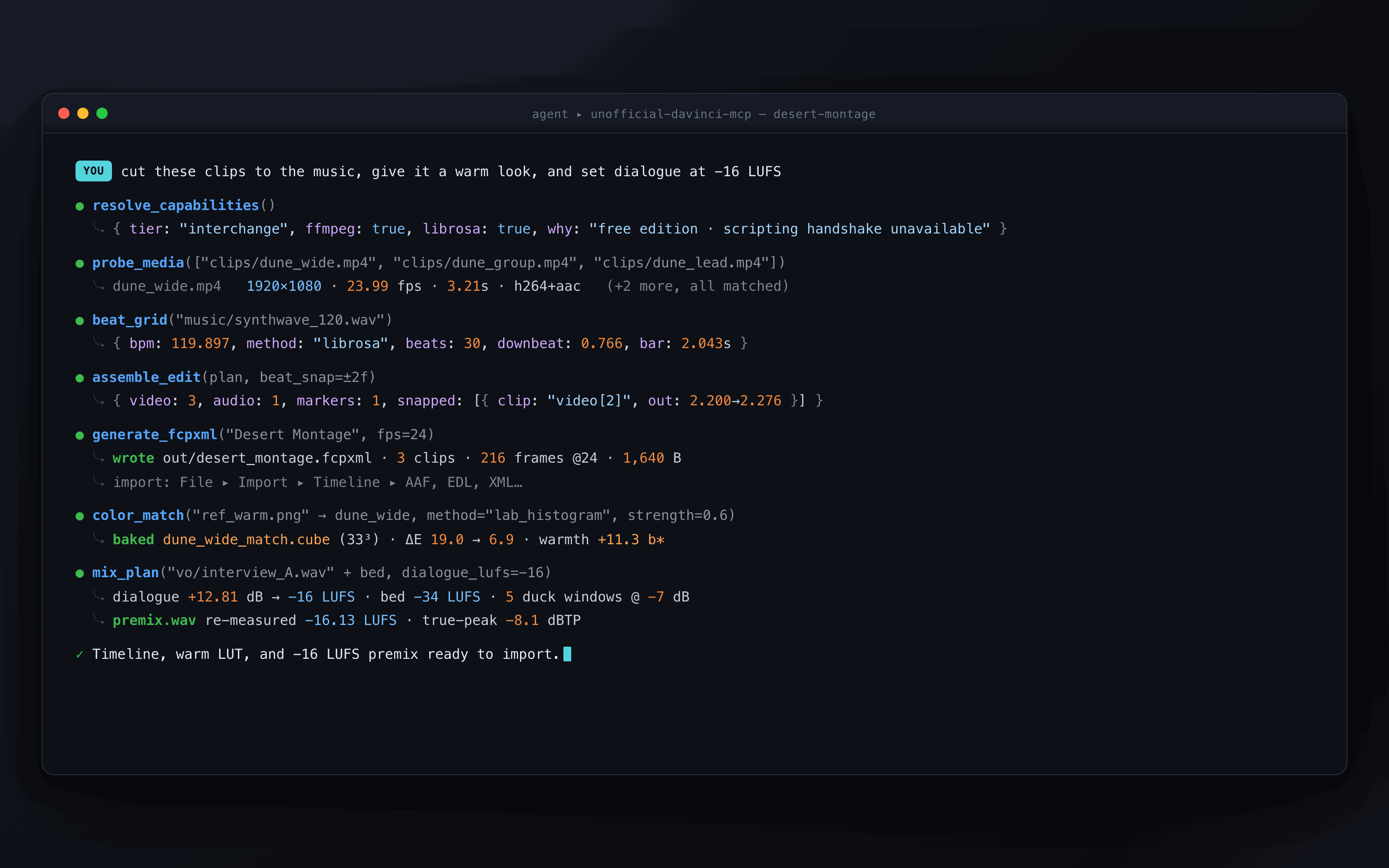
One request, seven tool calls: read the tier, probe the media, find the tempo, assemble a beat-snapped edit, write an FCPXML, bake a warm LUT, and plan the mix — every number above is real output from the running server.
Beat-aware music cutting
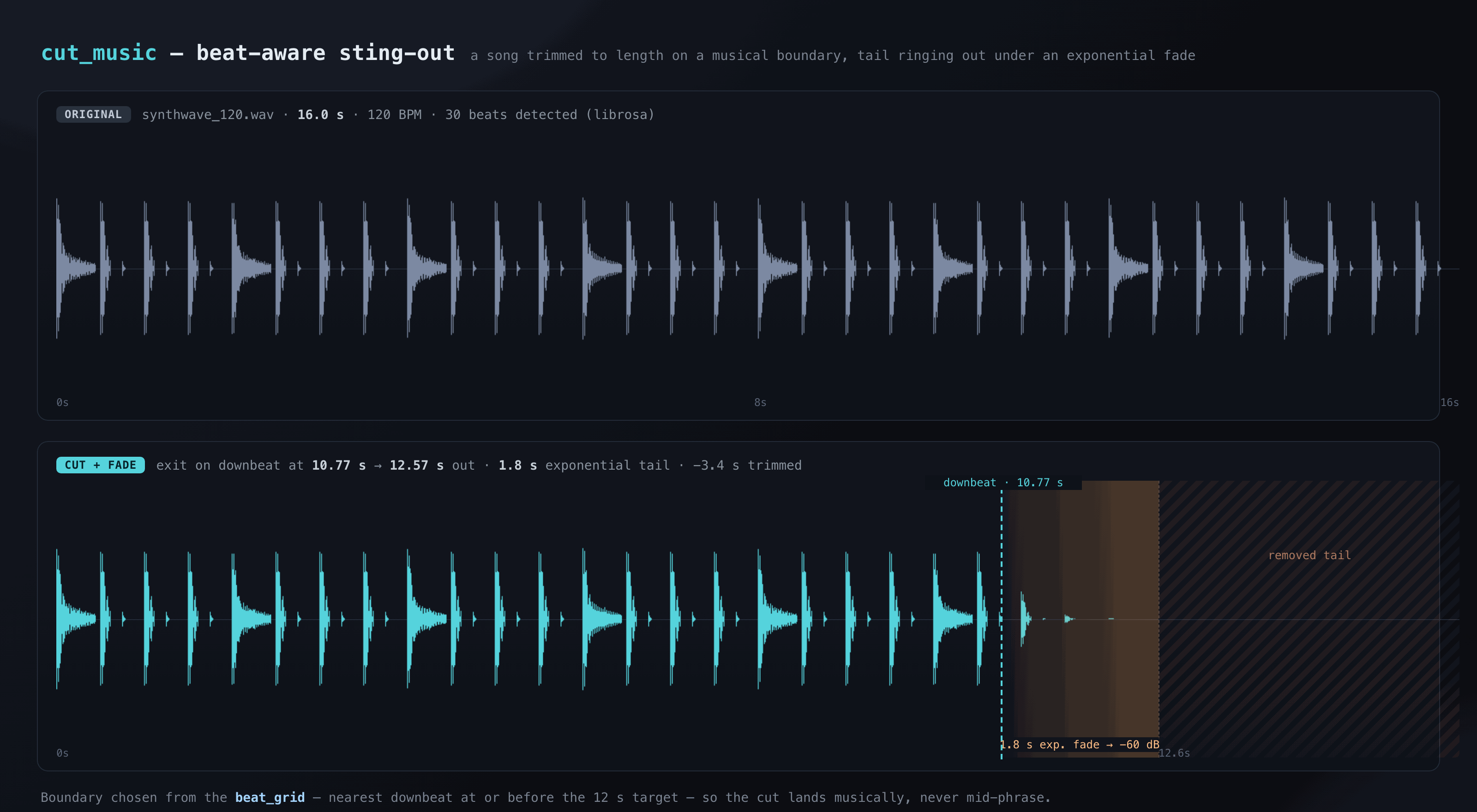
beat_grid finds the tempo, beats, downbeat, and onset strengths (librosa when installed, an energy-envelope fallback when not). cut_music uses that grid to trim a track to a target length on a musical boundary, then rings the tail out under an exponential fade — or lands on a hit with a "button" ending. No cuts mid-phrase.
Dialogue, loudness, and the mix
tighten_dialoguedetects dead air in a talking clip and returns a keep-range cut plan (with head/tail handles) — apply it live, or export the tightened edit as FCPXML.measure_loudnessreports EBU R128 integrated LUFS, loudness range, and true-peak per file.mix_plannormalizes dialogue to your delivery spec, sets the music bed under it, derives ducking windows from speech, and renders a re-measured premix so you can trust the number.
Build the timeline
assemble_edit validates an edit plan against your probed media and snaps cuts to a beat grid. Then generate_fcpxml writes an FCPXML 1.9 timeline that imports cleanly into Resolve 19/20, generate_edl writes a CM3600 cut list, and generate_marker_csv writes a marker manifest. On Studio, resolve_create_timeline / resolve_append_to_timeline build it in the app directly.
The 37 tools
Every mutating tool defaults to dry_run=true and returns a plan; re-run with dry_run=false and confirm=true to apply it. Tier both = works in free or Studio; live = requires DaVinci Resolve Studio.
| Tool | Tier | What it does |
|---|---|---|
resolve_capabilities |
both | Report the active tier, Resolve version, ffmpeg, and optional deps. Call first. |
get_editing_knowledge |
both | Serve editorial knowledge (color, beat, dialogue, music, mixing) with concrete numbers. |
probe_media |
both | ffprobe files: duration, fps, resolution, codecs, audio channels/rate, timecode. |
scan_media_folder |
both | Scan a folder and probe every media file, in stable sorted order. |
beat_grid |
both | Estimate tempo (BPM), beat times, a downbeat guess, and onset strengths. |
cut_music |
both | Cut a song to length on a musical boundary with a smooth sting-out. |
color_match |
both | Match clips/stills to a reference; bake a 33-point .cube LUT with a preview. |
measure_loudness |
both | Measure EBU R128 integrated LUFS, loudness range, and true-peak per file. |
mix_plan |
both | Plan dialogue-normalize + music bed + ducking; render a re-measured premix. |
tighten_dialogue |
both | Detect dead air in a talking clip; return a keep-range cut plan. |
assemble_edit |
both | Validate an edit plan against probed media; snap cuts to a beat grid. |
generate_fcpxml |
both | Write an FCPXML 1.9 timeline that imports cleanly into Resolve. |
generate_edl |
both | Write a CM3600 EDL cut list for round-tripping. |
generate_marker_csv |
both | Write a marker manifest CSV (frame, timecode, name, color, note). |
resolve_project_summary |
live | Read the current project, timelines, active-timeline fps and markers. |
resolve_render_status |
live | Check render progress and the render queue. |
resolve_import_media |
live | Import media into the project media pool. |
resolve_create_timeline |
live | Create a timeline seeded from a clip plan, music, and markers. |
resolve_append_to_timeline |
live | Append clips (with source/record ranges) to the active timeline. |
resolve_add_markers |
live | Add markers to the active timeline. |
resolve_apply_lut |
live | Apply a .cube LUT to clips on a timeline video track. |
resolve_set_grade |
live | Set ASC CDL slope/offset/power/saturation on clips. |
resolve_render |
live | Configure and start a render job for the current timeline. |
It knows editing, not just buttons
Operating the app is half the job; knowing what a good edit is is the other half. get_editing_knowledge serves the same editorial playbook the tools were built around — written like a seasoned editor briefing an assistant, with numbers your agent can act on:
- Loudness by destination. Dialogue sits at −16 LUFS for web / −23 LUFS for broadcast; the music bed rides 4–8 dB under it; ducking is −6 to −8 dB with a 0.3 s attack / 0.5 s release; the master limiter caps at −1 dBTP.
mix_plantakes these as parameters. - Cut to the energy, not the metronome. At 120 BPM a beat is 12 frames — so cut a moving shot 1–2 frames early and the motion lands on the beat perceptually; hold 8–16 shots per 8 bars in the chorus and only 1–3 in the intro.
assemble_edit's beat-snap tolerance tightens to ±2 frames for the drop. - Match, don't invent. For teal-and-orange, reference a warm-skin/cool-shadow frame with
method="lab_histogram"at strength 0.5–0.65, and always re-check skin last. Never bake exposure or white balance into a look LUT.
Topics: color-looks, beat-cutting, dialogue-editing, music-editing, mixing.
One-command workflows
Four headline tools chain the engines above into a single call. Each one plans first (dry_run=true) and returns a plan you can inspect before it writes anything.
Auto-edit to music
Scan a footage folder, beat-grid the song, cut it to length, and lay a beat-synced edit whose cut density tracks the song's energy — long holds in the intro, 1–2 beat cuts in the chorus — with a no-adjacent-same-source variety rule. Every cut carries a rationale, and the plan exports as FCPXML or feeds resolve_create_timeline live.
auto_edit(music="track.wav", media_dir="./footage", target_seconds=30, style="music_video")
Search footage by what's said
Transcribe every clip once (cached), then search the spoken words by phrase, all-words, or regex. Hits come back with timestamps and context; build_selects=true cuts them into a selects timeline with 0.5 s handles.
find_in_footage(query="let's go", media="./interviews", mode="phrase", build_selects=true)
Captions and chapters
Turn a transcript into broadcast-sane SRT/VTT captions (line-length, duration, and orphan-word rules, speech-snapped timing, optional karaoke), and derive YouTube chapters from the speech's own topic shifts.
generate_captions(media="talk.mp4", format="srt") # youtube_chapters(media="talk.mp4")
Grade a timeline to a reference
Match every clip to a reference frame with one auto-tuned LUT each: the loop reads the quality report and lowers strength (down to a 0.5 floor) until the grade passes its gates, flagging any clip it can't as needs_human. Returns per-clip LUTs plus a live/interchange apply manifest.
grade_timeline(reference_image="look.png", clips=[{"path": "a.mov", "in": 0, "out": 4}])
Talk to your editor
An optional macOS push-to-talk voice bridge lets you hold a key, speak, and drop the transcript straight into your agent terminal — hands on the footage, not the keyboard.
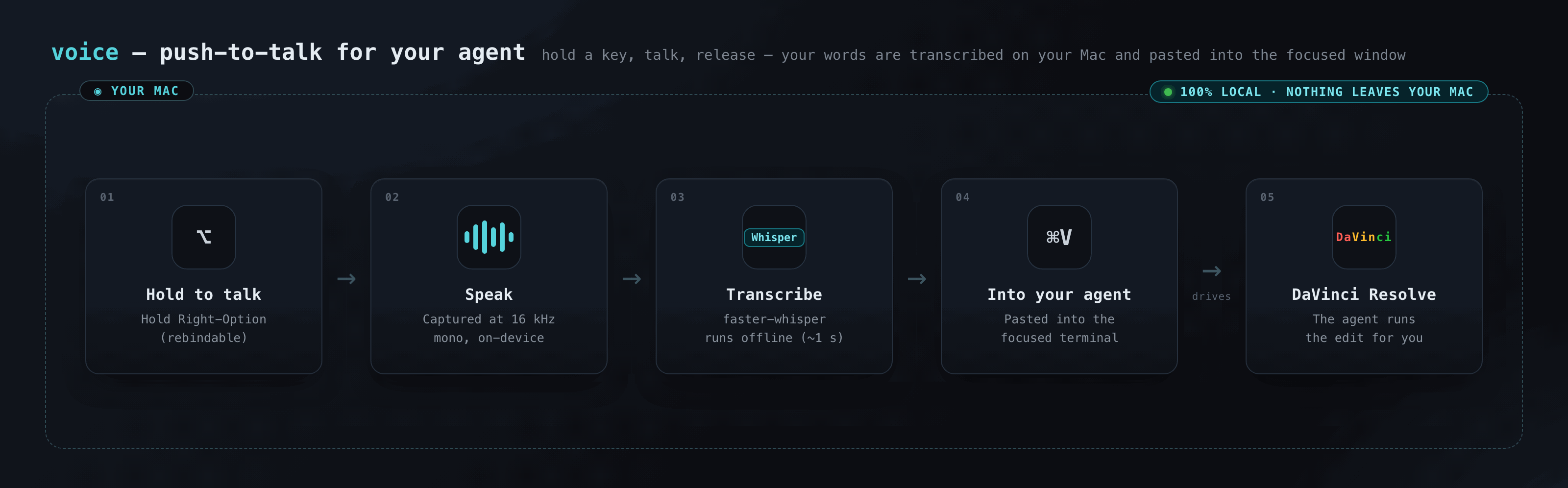
It runs entirely on your Mac: faster-whisper transcribes locally, nothing is sent to the cloud, and editing jargon (LUFS, J-cut, sting, FCPXML) is biased into the model so it transcribes cleanly. Setup, permissions, and configuration are in voice/README.md.
pip install "unofficial-davinci-mcp[voice] @ git+https://github.com/wassermanproductions/unofficial-davinci-mcp.git"
python -m voice
Requirements & troubleshooting
- Python ≥ 3.10, numpy, and ffmpeg on your PATH (checked in
/opt/homebrew/bin,/usr/local/bin,/usr/binas fallbacks). Install ffmpeg withbrew install ffmpegon macOS or your distro's package manager on Linux. librosais an optional extra ([beats]) for tempo-tracked beat grids; without it,beat_griduses an energy-envelope fallback that still works.- Studio vs free. Live tools need DaVinci Resolve Studio, running, with external scripting enabled (Preferences ▸ System ▸ General ▸ External scripting using: Local). If you're on the free edition or Resolve isn't running, the server drops to interchange automatically —
resolve_capabilitiesexplains why. - "Studio required" / handshake failed. The scripting module loaded but couldn't reach the app: confirm Resolve is open, you're on Studio, and scripting is enabled. Everything in the interchange tier still works regardless.
- The voice bridge needs Microphone + Accessibility permissions — see voice/README.md for the walkthrough.
Disclaimer
Unofficial. This project is not affiliated with, authorized by, or endorsed by Blackmagic Design. "DaVinci Resolve" is a trademark of Blackmagic Design Pty Ltd. This is an independent, community tool that talks to Resolve through its public scripting API and standard interchange formats.
Support
A few people asked if they could send tips to support my work developing open source tools. So I set up an optional way in case anyone wants to.
No pressure at all. Using the apps, sharing them, starring the repositories, and contributing code all help too. Thank you.
License & credits
Apache License 2.0 — see LICENSE. Free to use, modify, fork, and build on, commercially or otherwise.
Attribution required: per the NOTICE file (Apache 2.0 §4(d)), any use, fork, or redistribution must retain the NOTICE file and credit Sam Wasserman (wassermanproductions.com) in its documentation and about/credits surface.
Created by Sam Wasserman — wassermanproductions.com · wasserman.ai.
Установка Unofficial Davinci
У этого сервера нет опубликованного пакета — он собирается из исходников. Открой репозиторий и следуй инструкции в README.
▸ github.com/wassermanproductions/unofficial-davinci-mcpFAQ
Unofficial Davinci MCP бесплатный?
Да, Unofficial Davinci MCP бесплатный — установка в пару кликов через Unyly без оплаты.
Нужен ли API-ключ для Unofficial Davinci?
Нет, Unofficial Davinci работает без API-ключей и переменных окружения.
Unofficial Davinci — hosted или self-hosted?
Self-hosted: сервер запускается локально на твоей машине командой из раздела установки.
Как установить Unofficial Davinci в Claude Desktop, Claude Code или Cursor?
Открой Unofficial Davinci на unyly.org, выбери вкладку своего клиента (Claude Desktop, Claude Code, Cursor) и нажми Install — конфиг сгенерируется автоматически, без правки JSON.
Похожие MCP
Omni Video
An MCP server that transforms LLM-enabled IDEs into professional video editors by pre-processing footage into text proxies, generating motion graphics via HTML/
 автор: buildwithtaza
ARA
Generate images, video and audio from any AI agent — one connector.
 автор: ARA
YouTube
Transcripts, channel stats, search
 автор: YouTube
EverArt
AI image generation using various models.
 автор: modelcontextprotocol
Compare Unofficial Davinci with
Не уверен что выбрать?
Найди свой стек за 60 секунд
Автор?
Embed-бейдж для README
Похожее
Все в категории media