
Vibe Codr
БесплатноНе проверенA model-agnostic CLI coding agent for the terminal — any provider, local or cloud, with plan/execute/yolo modes, subagent orchestration, and long-term memory.

Описание
A model-agnostic CLI coding agent for the terminal — any provider, local or cloud, with plan/execute/yolo modes, subagent orchestration, and long-term memory.
README
CI npm license: MIT Buy Me a Coffee
A model-agnostic CLI coding agent for the terminal — in the
class of Claude Code / Codex / opencode, but able to drive coding and agentic
tasks on any model: the complete generated models.dev provider registry
(the same breadth source used by OpenCode), Hermes-compatible provider ids and
credential files, local models through Ollama and LM Studio, and native
AWS Bedrock, Google Vertex, and Azure OpenAI routes. Arbitrary named
custom providers cover additional Chat Completions or Responses-compatible
endpoints. Model
context windows, pricing, capabilities, and catalog-only model listings come from
models.dev (24h cache; /models refresh to force the
latest), with a small published fallback for brand-new APIs not yet in the
catalog (e.g. Meta Muse Spark 1.1).
Status: feature-complete. Multi-provider agent loop, live model catalog, plan / execute / yolo modes (Shift+Tab to cycle) with a permission layer, a live task list, an observable prompt queue, an interactive slash-command menu, skills / plugins,
/goal+/loop, checkpoints/undo, self-verify, cache-aware cost tracking, and session persistence with context-aware compaction. On top of that:
- Long-term memory — hybrid recall (BM25 + optional on-device semantic embeddings, fused with reciprocal-rank fusion) over saved facts and past sessions, a deduplicating
save_memorywrite-path with auserscope that grows the always-injected globalUSER.md, and default-on proactive recall + cross-session digests (digests only for interactive sessions — headless-pruns never pay an extra call). Fully offline; degrades to lexical when no embedder is present.- Engine-owned build intelligence — deterministic repo recon (your real build/typecheck/test/lint commands, injected into every agent — no guessing), a parsed
run_check(PASS 142/142, not log spew), an automatic green-gate after mutating turns with bounded fix rounds, green checkpoints (commit-on-green that never touches your branch), an adversarial diff review + deterministic stub scan, optional browser verification (screenshot + click every control, flag dead ones), and multi-language diagnostics in the loop on every edit — in-process TypeScript plus an LSP client that lazy-spawns whatever server is on yourPATH(pyright, gopls, rust-analyzer, clangd, jdtls, ruby-lsp, …), deadline-bounded so a slow server never wedges an edit and advisory-only so a crash degrades to nothing, never a false "clean".- Multi-agent orchestration — parallel subagents with exclusive per-file write ownership, a typed coordination blackboard, a tree-global adaptive concurrency limiter, and a default-ON deterministic task-DAG scheduler (
spawn_tasks) with structured handoffs, aread_reporttool, model tiers (cheap/strong), executable verify→retry against the real checks, git-worktree isolation for parallel writers (opt-in best-of-N ensembles), a journaled resume, and live per-child activity — plus subagent continuation (continue_subagentresumes a finished child's full context), schema-validated structured output (anoutputSchemathe child's answer must satisfy, or it returns the errors — never a fabricated object), and detached background spawns (detach:true+check_task).- Research — keyless web search that fans out across DuckDuckGo + Bing and quality-ranks the deduped merge (TinyFish optional), with deep-mode passage enrichment (fetches the top pages and quotes dated passages), zero-result query reformulation, a bounded
crawl_docssite crawler, a per-session source ledger with[n]citations (/sources), a ranked import-graphrepo_map, and hardenedwebfetch(SSRF-guarded with DNS-rebinding-safe IP pinning, per-redirect revalidation, charset-aware markdown extraction, paywall-shell detection, Wayback recovery, PDF extraction with a deflate-bomb guard, cache-through with request coalescing).- Safety — a glob-based allow/deny/ask permission layer (deny is an absolute kill-switch; rules match every equivalent path spelling) with, underneath it, opt-in OS sandboxing — a macOS Seatbelt / Linux bubblewrap backstop that confines writes to your workspace and can cut network, with a fail-closed
dangerouslyUnsandboxedescape hatch.- MCP — stdio + Streamable-HTTP/SSE transports, tools, resources, prompts, OAuth 2.1, and auto-reconnect +
tools/list_changed.- Planning — an interactive plan-approval modal (accept & execute, revise, or keep planning) that seeds the task list from the plan.
- Extensibility — declarative shell/HTTP hooks, project + global skills/commands, and per-agent tool allowlists.
- Ships as a product — prebuilt standalone binaries (darwin/linux × arm64/x64, checksummed) and an npm/bun package, a tag-driven release pipeline,
vibe upgrade+ a quiet opt-out update check, and crash visibility (redacted crash log + terminal restore, no telemetry).A full slash-command surface (
/status/cost/config/diff/recall/mcp/review/doctor/export…) makes every setting and bit of session state reachable. All covered by 1800+ tests (including mock-model integration tests of the agent loop with zero network) plus a TUI render smoke test and a compiled-binary check.The terminal command is
vibecodr(vibeworks as an alias).
Screenshots
An opencode-inspired terminal UI on vibe-codr's own engine, with a deliberate
color language: a near-black graphite background with filled panel cards
and a thin left rail on every block (no box-drawing borders — they gap into
dashes on terminals with line spacing). The chrome is monochrome white-first:
the VIBE CODR wordmark, panel titles, markdown headings, the user-message
rail, the active task/step, menu selection, and the input caret all read in
near-white body chrome — hierarchy comes from weight and surface, not a
default purple stroke. The input's mode label, rail + caret (AGENT ❯ follows
the live accent · PLAN ❯ green · YOLO ❯ red) make switching mode unmistakable
without repainting the screen. Swap the accent in one word — /accent blue,
or purple, orange, ember, amber, green, teal, violet, rose,
white, or any /accent <hex> — the swatch submenu previews each hue live, and
the wordmark fade, markers, and input rail all follow it (/theme opencode
keeps the classic peach look). Functional colors stay reserved — green/red on
diffs with subtle background tints, amber on warnings, teal on tools, and one
calm muted tone for tool-step / subagent rails. The layout is a single,
centered chat column (ChatGPT-style): it fills a narrow terminal and centers
on a wide one, with a right sidebar on wide terminals (tasks · subagents ·
thinking) and no top header. A fresh screen shows a centered VIBE CODR
wordmark; once you start, the column is the scrolling transcript, live
status panels when the sidebar is off, and the input itself: a raised filled
block with the mode-hued rail. All the details sit under the input — cwd ·
git, then model · changed-files · context · cost, plus key hints and the goal.
Each user turn sits in a filled card on the accent rail (tap your message to
fold the whole exchange under it); assistant replies render as real
Markdown — prose through the native markdown renderable, blockquotes with a
rail bar, and code blocks + tables as clean native primitives; tool calls read
as a distinct icon + action and condense to one line you click to expand; a
rainbow braille spinner shows live work; the slash menu docks flush to the
input as one connected control and drills into rich submenus (model picker,
clickable toggles).
| Chat + tool calls | Live diff |
|---|---|
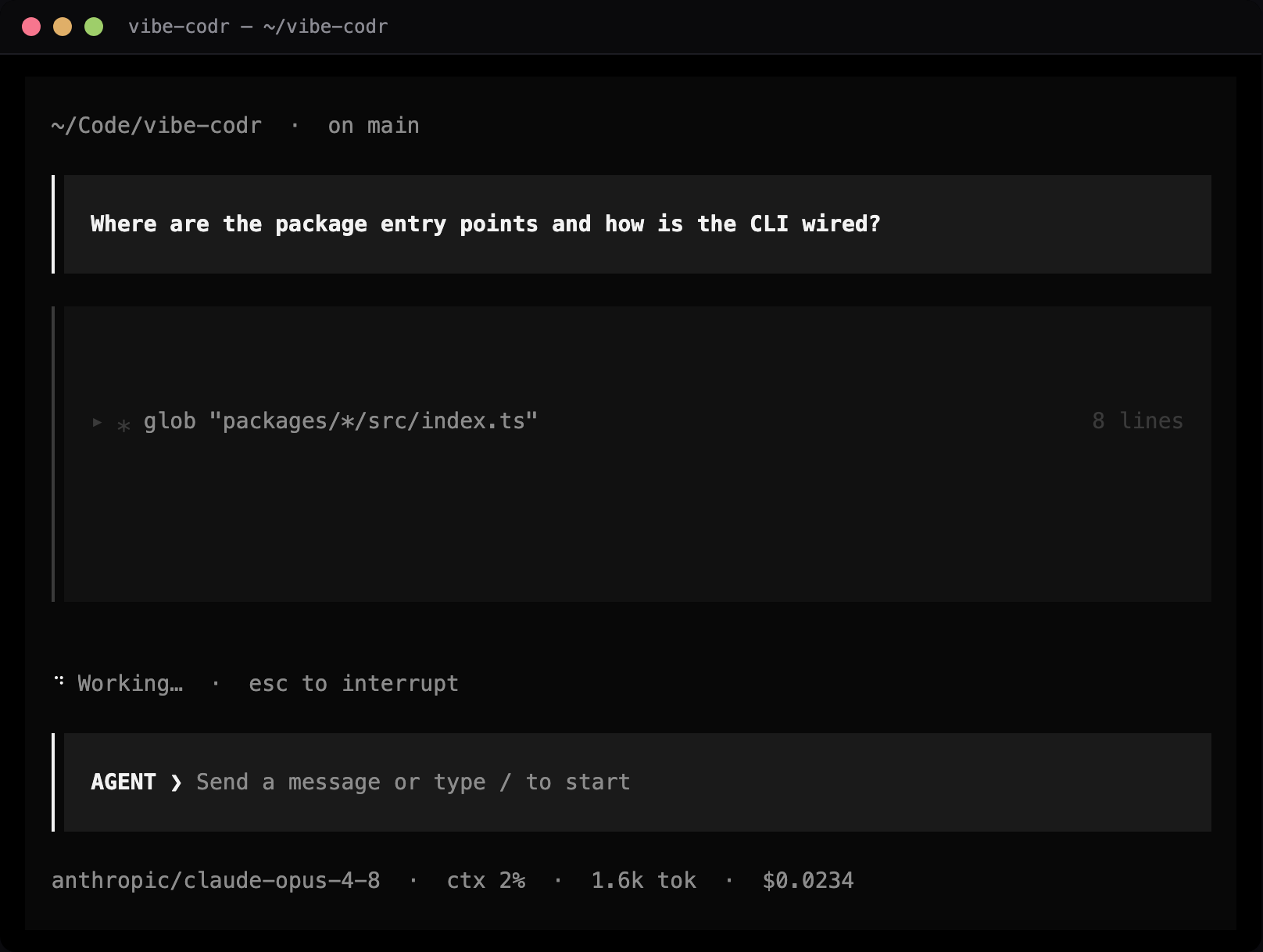 |
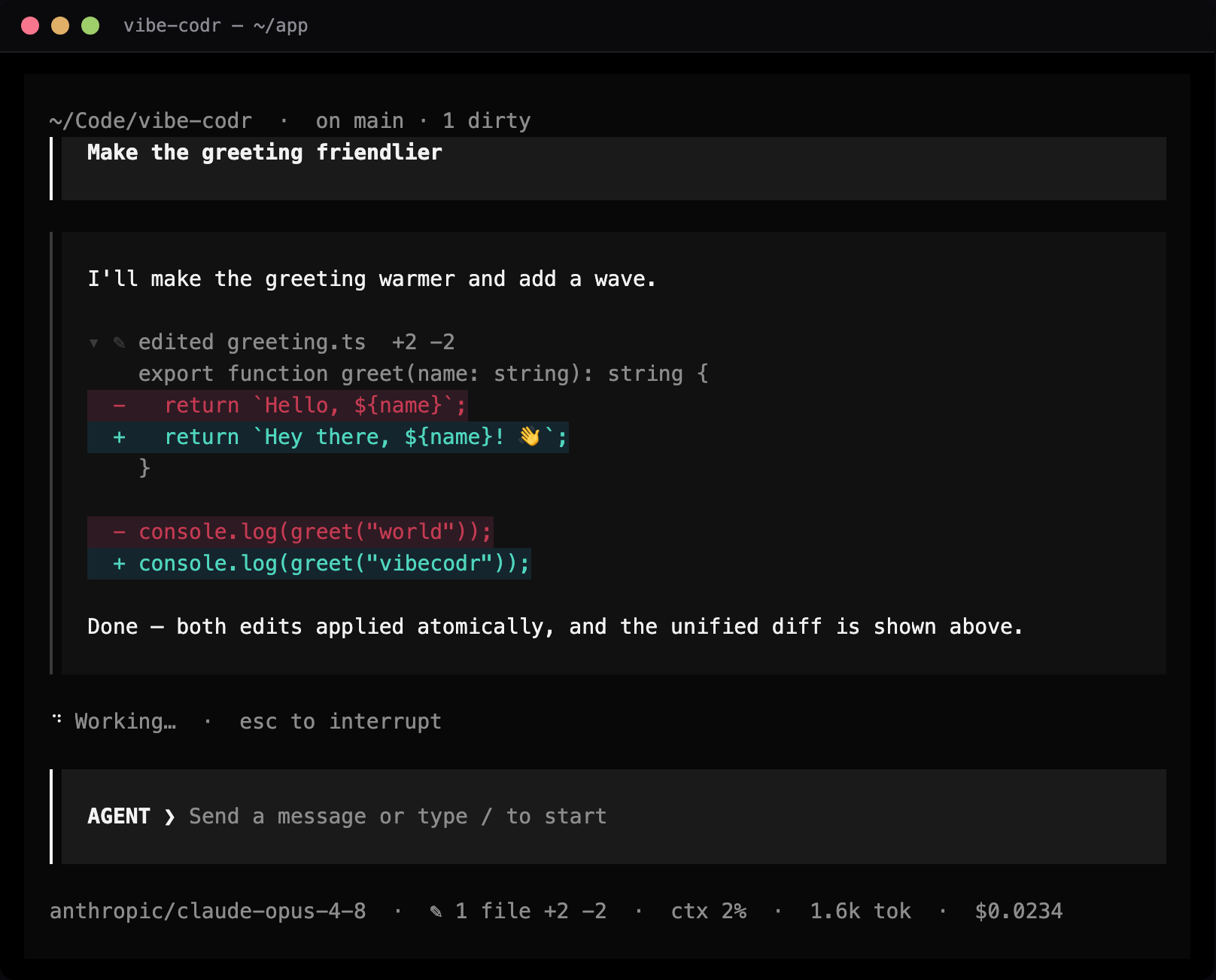 |
| Plan mode | Task list + subagents panels |
|---|---|
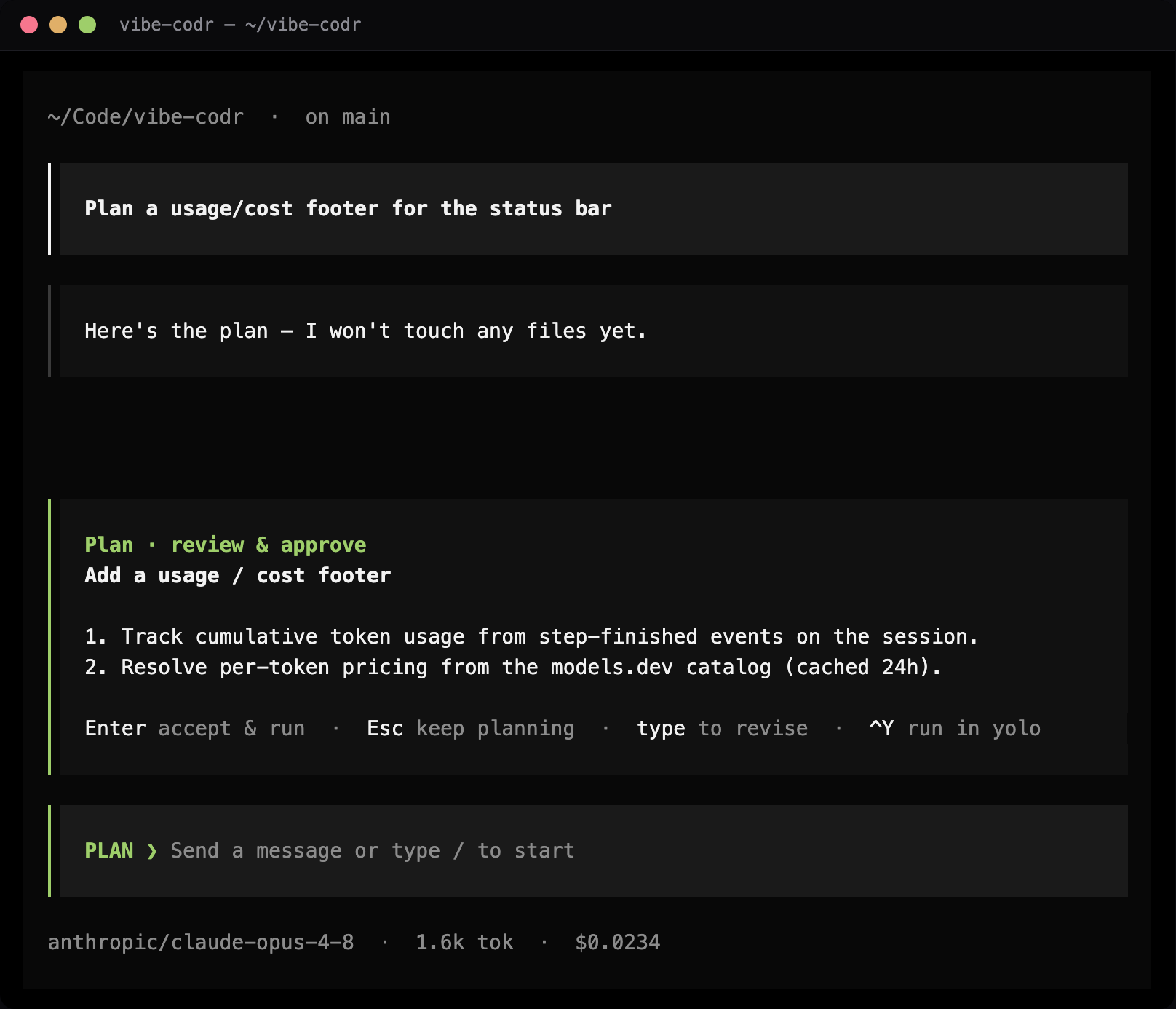 |
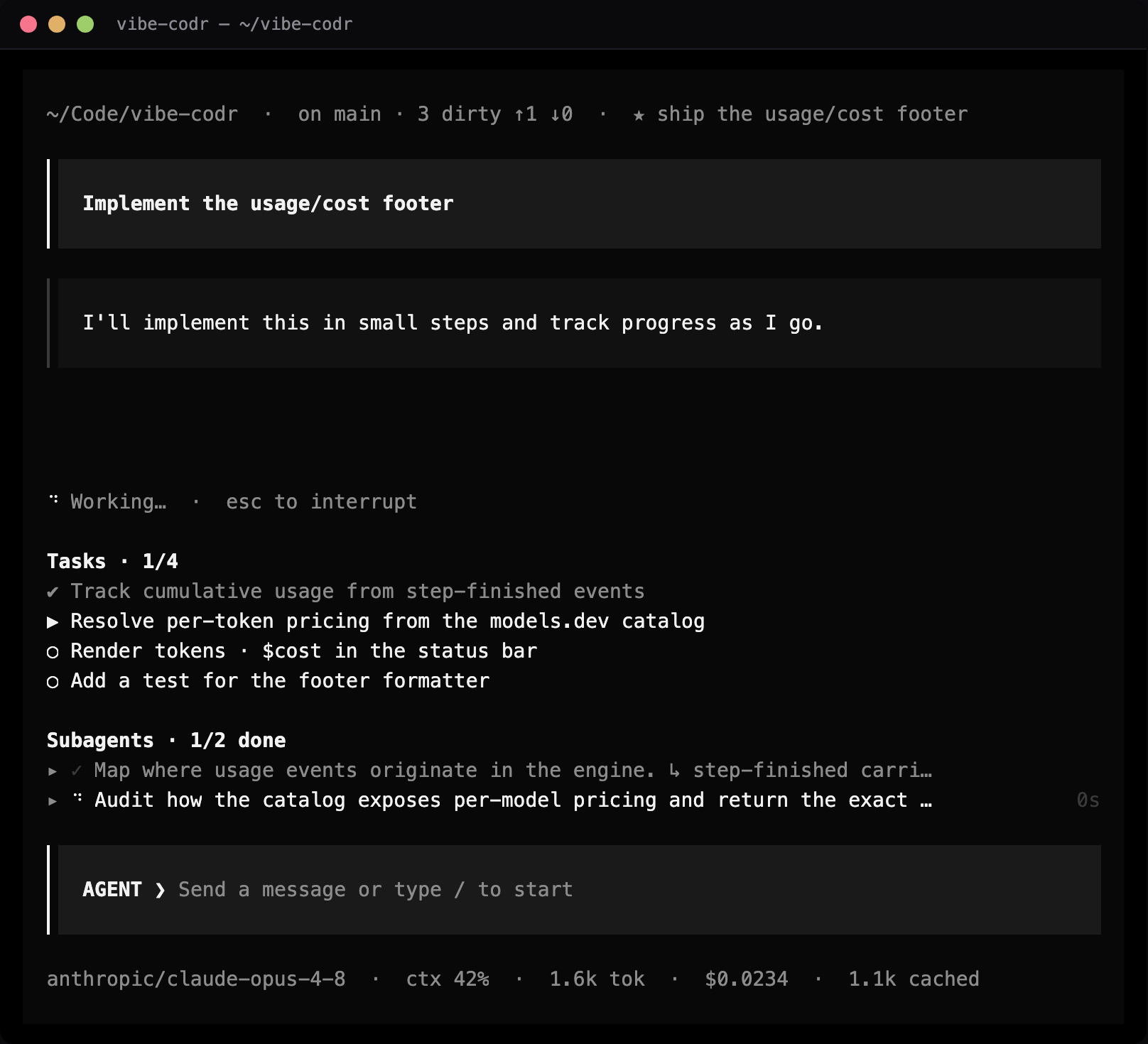 |
| Permission card | Slash-command menu |
|---|---|
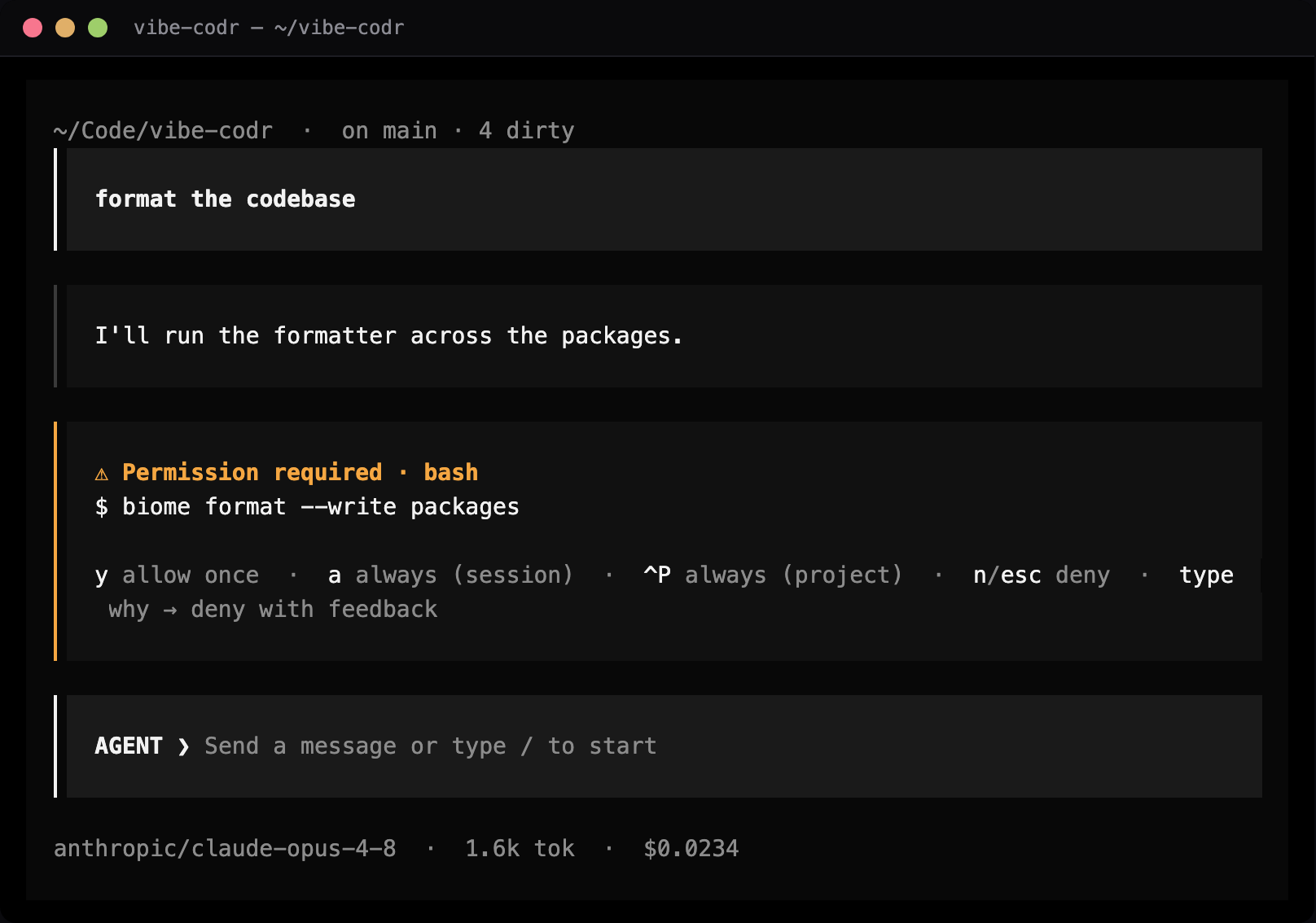 |
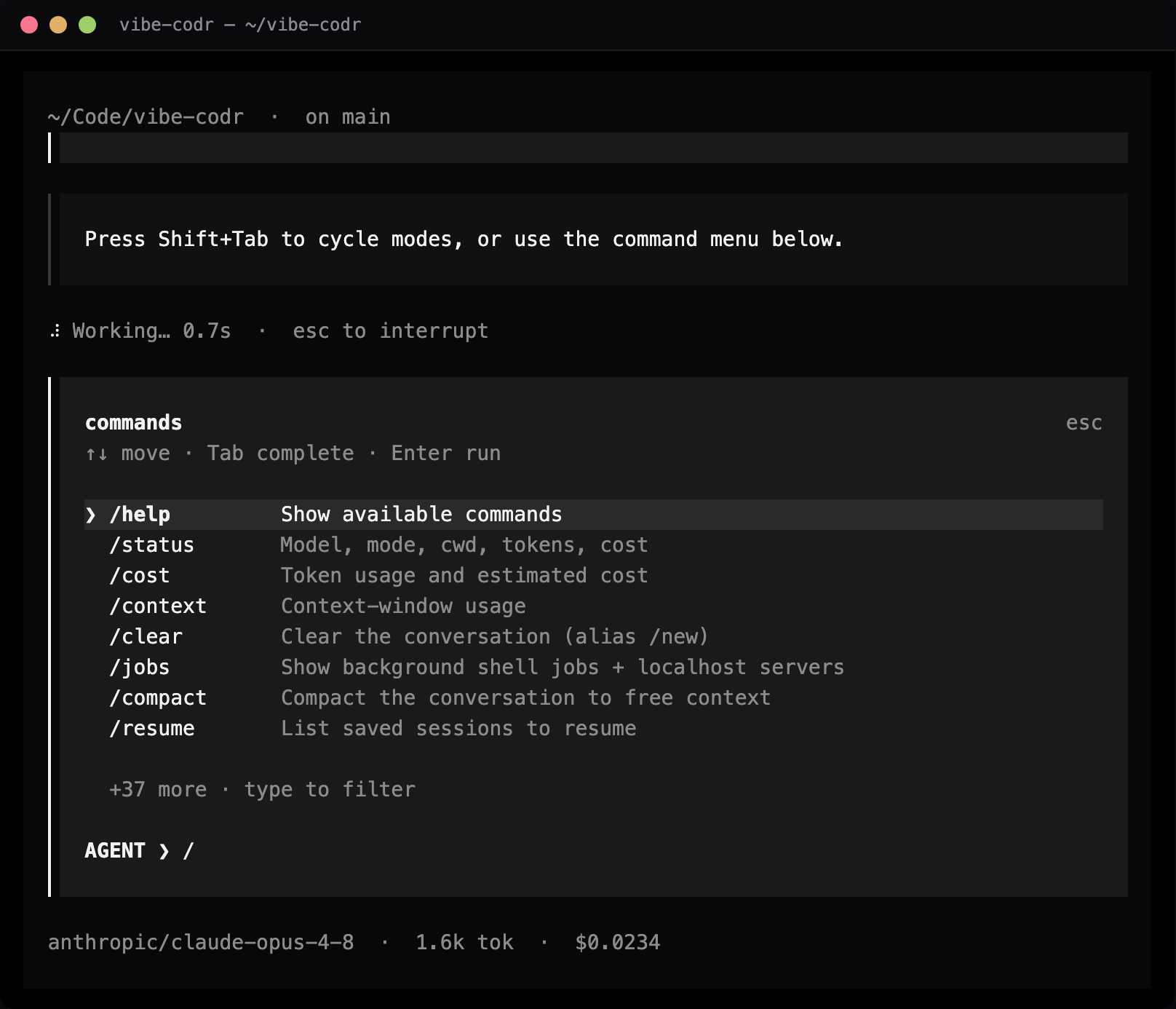 |
/accent orange — one word recolors the chrome |
The /accent swatch submenu |
|---|---|
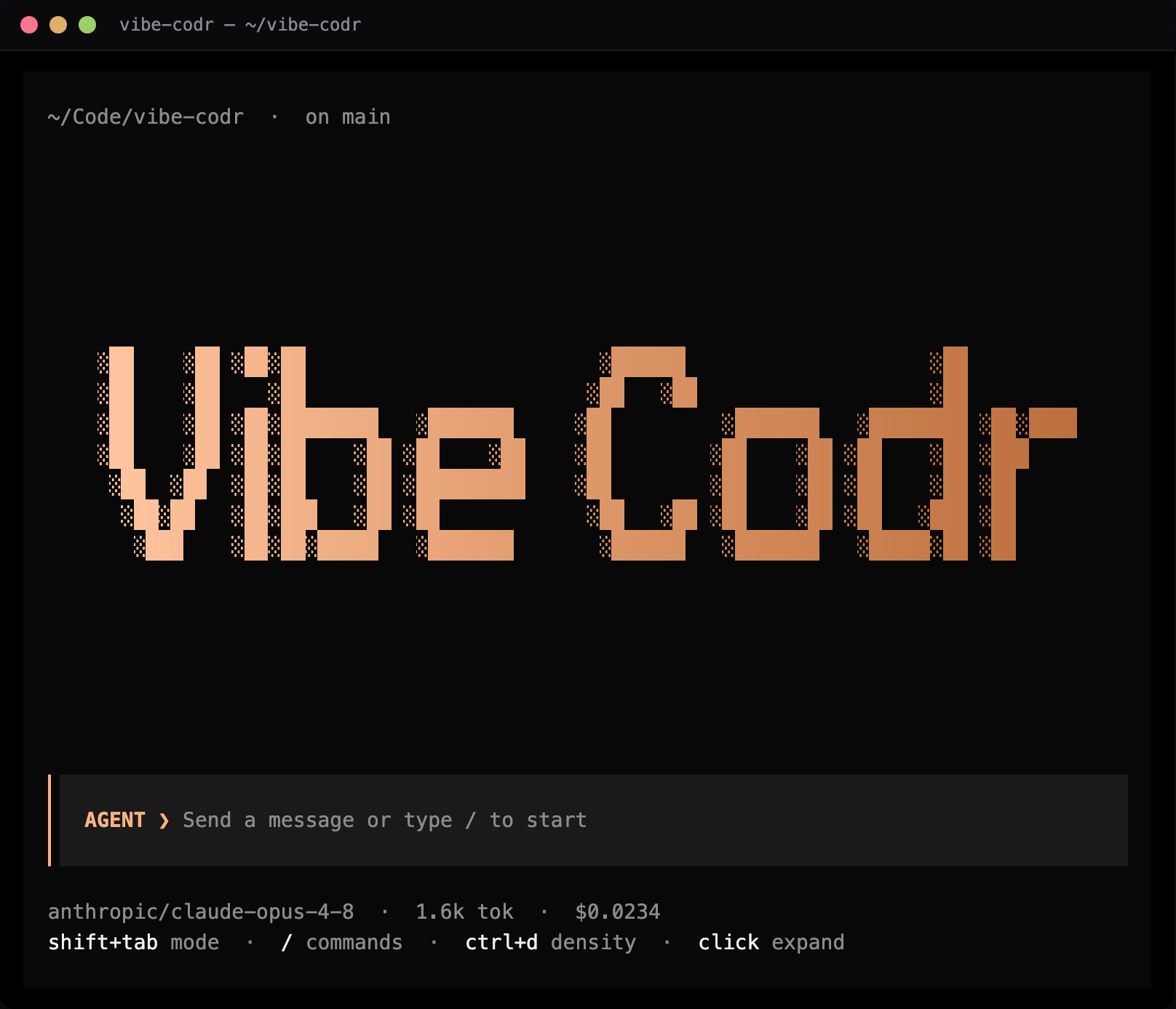 |
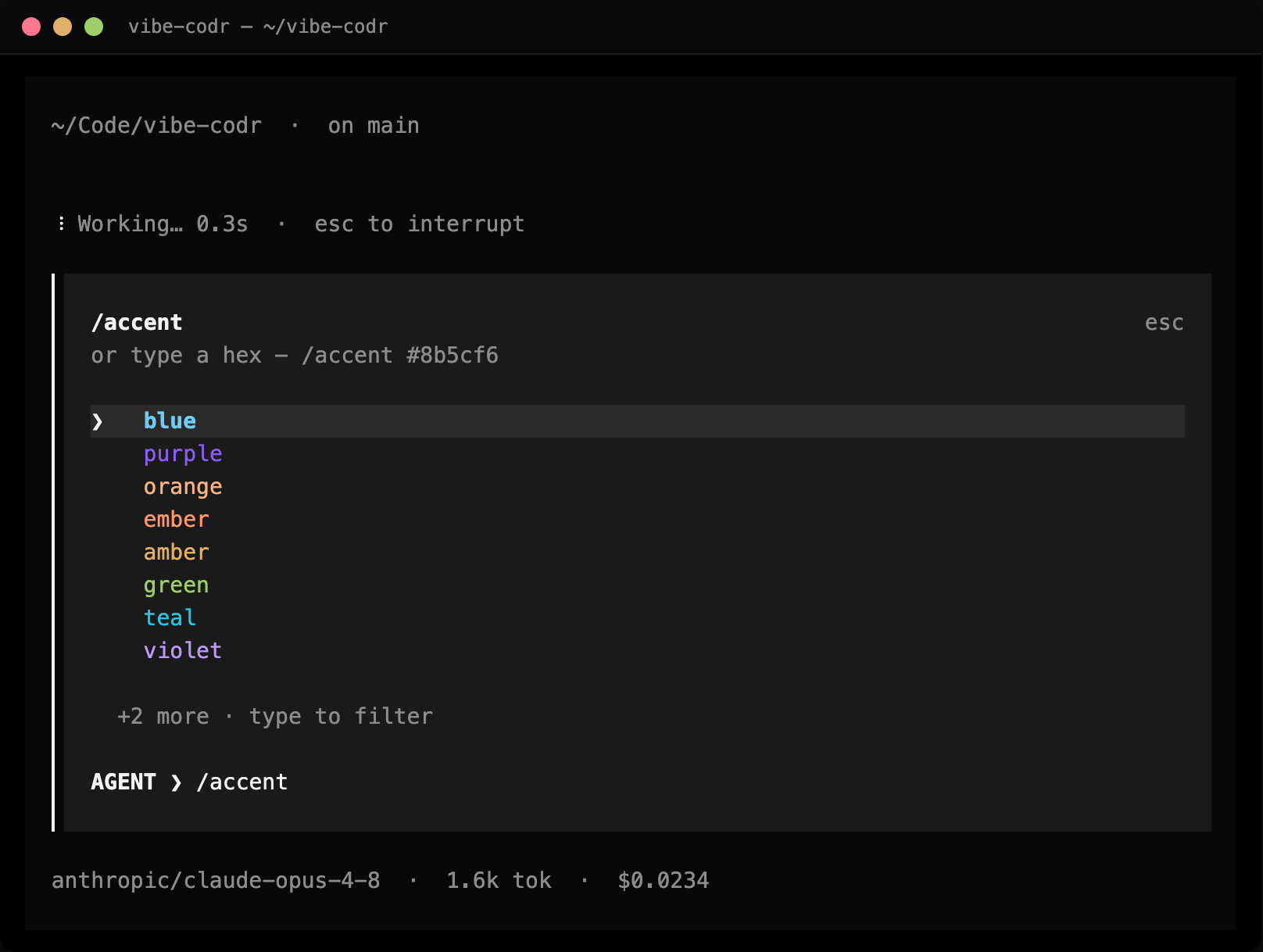 |
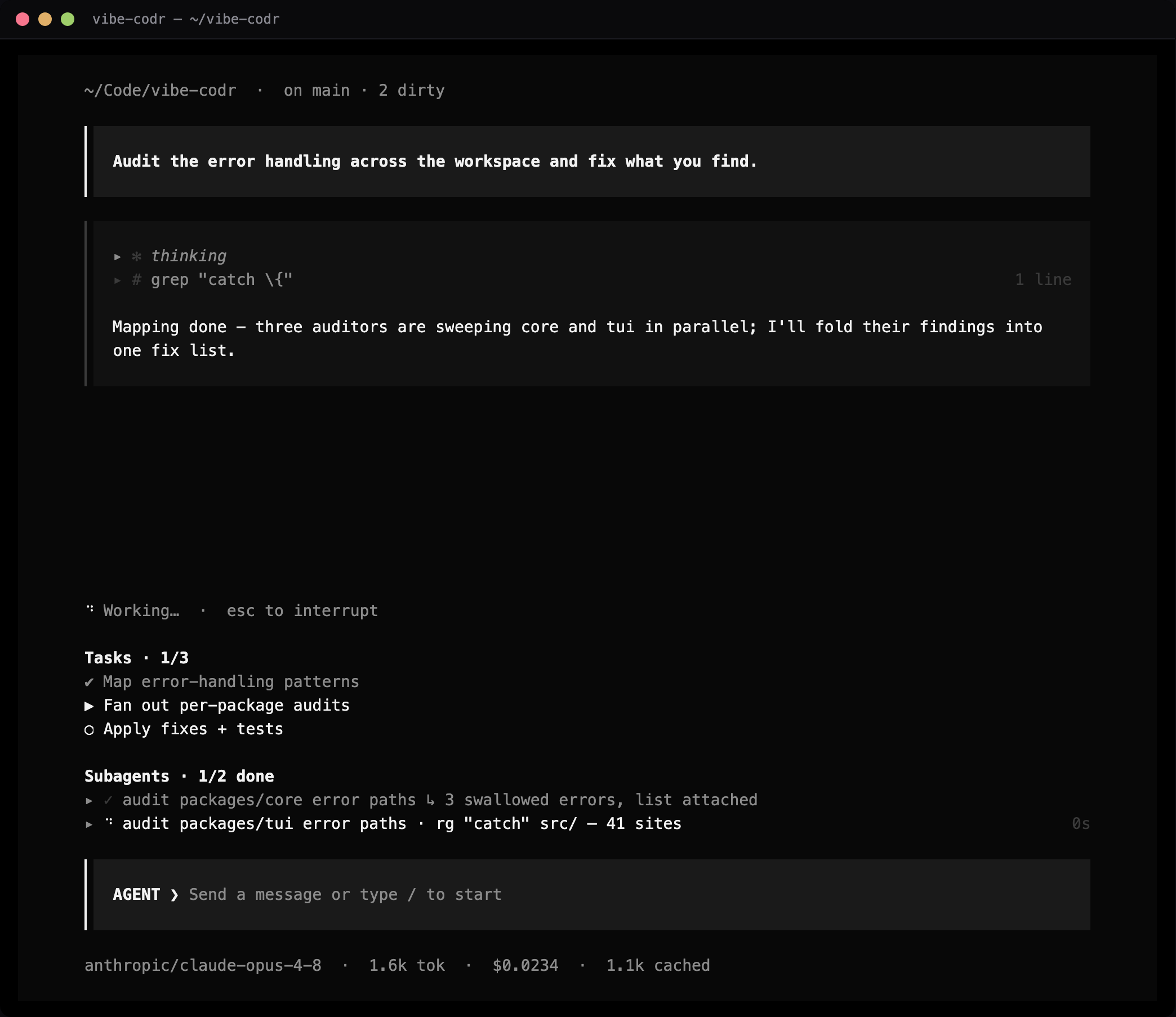
| Wide terminal — a session card (the block wordmark over dir · model · git · usage), Tasks, Subagents, and reasoning-only Thinking move to a right sidebar (tool work stays in the chat) |
|---|
 |
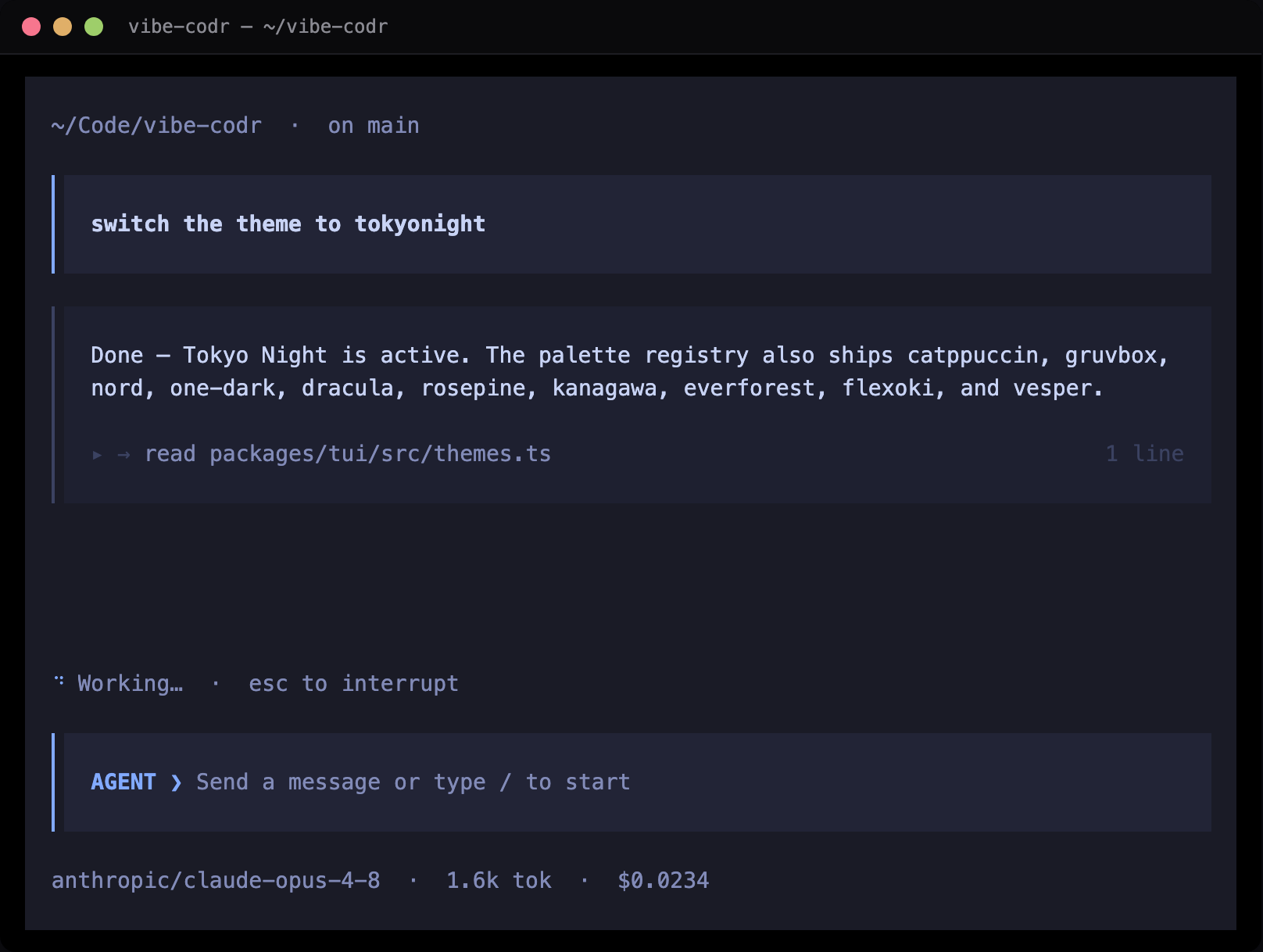
Ported classic themes (/theme tokyonight, catppuccin, gruvbox, …) |
|---|
 |
Regenerate with bun packages/tui/scripts/screenshot.ts docs/screenshots
(renders the real OpenTUI app and rasterizes its actual cell grid — bundled
Playwright Chromium; pixel-for-pixel what the live UI paints).
Stack
- Runtime: TypeScript + Bun (workspaces + Turbo).
- Models: Vercel AI SDK v5 (
streamText+tool()+stopWhen: stepCountIs) as a unified, always-current provider abstraction. - Catalog: live provider
/v1/modelsmerged with the models.dev capability/pricing catalog — never hardcoded. - TUI: OpenTUI (Solid) for the interactive UI, with a guaranteed readline + headless fallback.
Architecture
A hard core/TUI boundary: the engine emits a typed UIEvent stream and
accepts EngineCommands; no UI type leaks into core, so the UI is swappable and
the engine is fully testable headless.
| Package | Owns |
|---|---|
@vibe/shared |
Contracts: UIEvent, Message/Part, ToolDefinition, EngineClient, errors, logger |
@vibe/config |
Zod config schema, file discovery + deep-merge, auth resolution |
@vibe/providers |
ProviderRegistry, resolveModel, CatalogService (models.dev + /v1/models) |
@vibe/tools |
Built-in tools with readOnly flags + the AI-SDK tool() adapter / Toolset |
@vibe/core |
Agent loop (Session.run), mode gating, subagent fork, event bus, Engine |
@vibe/plugins |
HookBus, PluginApi, slash-command + skill runtimes; config hooks accept stdout logs only before a final-line JSON directive |
@vibe/tui |
OpenTUI app + headless/REPL renderers |
@vibe/macos-bridge |
Runtime-validated NDJSON stdio host for the SwiftUI and Electron desktop shells (bun run macos-bridge / build:macos-bridge) |
@vibe/cloud-agentd |
Authenticated cloud host multiplexer for the unchanged NDJSON engine, reconnectable PTYs, file transfer, previews, and capability events |
@vibe/cli |
bin/vibe entrypoint (argv, config, headless -p vs TUI) |
Install
Two channels — pick one:
Standalone binary (no runtime to install). Grab the build for your platform
from the latest release,
verify it against SHA256SUMS, then drop it on your PATH:
# macOS arm64 shown; swap in darwin-x64 / linux-x64 / linux-arm64
curl -sSL -o vibecodr https://github.com/robzilla1738/vibe-codr/releases/latest/download/vibecodr-darwin-arm64
curl -sSL -o SHA256SUMS https://github.com/robzilla1738/vibe-codr/releases/latest/download/SHA256SUMS
shasum -a 256 -c SHA256SUMS --ignore-missing   # verify before trusting the binary
chmod +x vibecodr && sudo mv vibecodr /usr/local/bin/
npm / bun (requires Bun ≥ 1.2 on your PATH — vibe-codr
runs on the Bun runtime):
bun add -g vibe-codr        # or: npm install -g vibe-codr
vibecodr                    # `vibe` is an alias
Provider SDKs, the rich TUI (OpenTUI), MCP, and on-device embeddings are declared as optional dependencies, so the install pulls what it can and the CLI degrades gracefully when one is missing.
Windows — native Windows support is experimental and currently untested
(no maintainer runs Windows yet; the CI Windows job is advisory, not a merge
gate). A native vibecodr-windows-x64.exe is published on the
releases page, but
the recommended path is WSL2: inside your WSL distro use the linux-x64
binary or bun add -g vibe-codr and run it as an ordinary Linux install.
One caveat to know before running the native .exe: the OS sandbox is
unavailable on native Windows. There is no Seatbelt/bubblewrap backstop there —
resolveSandboxPolicy reports available:false and commands run unsandboxed,
so the glob-based permission layer is the only enforcement layer on native
Windows. WSL2 restores the Linux bubblewrap sandbox (when bwrap is installed
and unprivileged user namespaces are enabled).
Upgrade — vibe upgrade prints the right steps for how you installed (a
bun add -g line for the package channel, the Releases URL for the binary):
vibe upgrade
Update check — the interactive CLI does a quiet, cached (24h) check for a
newer release at startup and prints a one-line hint when one exists. It sends no
user data. Turn it off with update.check: false in config, or
VIBE_NO_UPDATE_CHECK=1.
Quick start
bun install
# Install the providers you'll use + the rich TUI (optional peer deps):
bun add -D @ai-sdk/anthropic @ai-sdk/openai @opentui/core @opentui/solid solid-js
bun link                      # makes `vibecodr`/`vibe` available on your PATH

# interactive — on first run, a guided setup lets you pick a provider
# (Anthropic, OpenAI, Ollama Cloud, …), keys you already have in your env are
# auto-detected, and it fetches the live model list so you just pick one.
# Saved to ~/.config/vibe-codr/config.json. Re-run it anytime with `vibe setup`.
vibecodr

# one-shot (headless / pipeable)
vibecodr -p "list the TS files and read package.json" \
  --model anthropic/claude-opus-4-8

# machine-readable output (for scripting) and prompt-from-stdin
vibecodr -p "summarize this" --output-format json
cat task.md | vibecodr -p -            # read the prompt from stdin
cat task.md | vibecodr -p ""           # empty -p also reads stdin (no onboarding)
# Headless exits non-zero on engine error, so `vibecodr -p … && next` is safe in CI.

# other entry points
vibecodr setup                # (re)run the guided provider/model setup (alias: login)
vibecodr models               # list models for configured providers
vibecodr --continue           # resume the most recent session
vibecodr --resume <id>        # resume a specific session

# (without linking, run from source: `bun packages/cli/bin/vibecodr.ts ...`)
Ollama Cloud (subscription)
Run big open models on ollama.com with your subscription — no local GPU:
export OLLAMA_API_KEY=...      # from https://ollama.com/settings/keys
vibecodr setup                 # pick "Ollama Cloud" (it's preselected when the key is set)
# or skip setup and go straight in:
vibecodr --model ollama/gpt-oss:120b
With a key set, vibecodr automatically targets https://ollama.com/v1. Run
vibecodr models to list the exact ids your subscription exposes (e.g.
ollama/glm-5.2, ollama/kimi-k2.7-code, ollama/deepseek-v4-pro,
ollama/gpt-oss:120b).
OpenAI Codex (built-in ChatGPT sign-in)
The desktop app signs in with ChatGPT directly using the official Codex PKCE flow. The engine also reuses an existing official Codex CLI login when Vibe has no stored credential:
codex login                    # once, with the official OpenAI Codex CLI
vibecodr setup                 # pick "OpenAI · Codex (ChatGPT login)" — it's auto-detected
vibecodr --model openai-codex/gpt-5.3-codex
Vibe-owned tokens are stored in ~/.vibe-codr/auth.json with user-only
permissions, refresh automatically, and route Responses calls to the Codex
subscription backend with the required account identity. Use
openai-codex/gpt-5.3-codex; availability and quota depend on the signed-in
plan. See providers and subscription authentication.
xAI subscription and Grok Build
The desktop app can connect an eligible xAI subscription using browser sign-in
or a device code. Use xai-oauth/grok-build-0.1 for Grok Build. API-key users
can continue to use xai/<model> with XAI_API_KEY.
Any compatible endpoint (arbitrary provider IDs)
Add as many named gateways or self-hosted endpoints as needed. Each can select
openai-compatible or openai-responses transport and declare models when it
does not expose /models:
"providers": {
  "my-gateway": {
    "transport": "openai-compatible",
    "baseURL": "https://my-endpoint/v1",
    "apiKey": "…",
    "models": ["my-model-id"]
  }
}
Keeping models current
Model metadata (context window, pricing, capabilities) is fetched live from
models.dev and cached 24h. New models appear automatically;
run /models refresh (in-session) to force-pull the very latest right away.
In-session commands
Type / to open the command menu — it filters as you type, ↑/↓ to
highlight, Tab to complete, Enter to run, Esc to dismiss. Commands with a
fixed set of values (/approvals, /reasoning, /theme) drill into a second
menu so you can pick the value. Or type /help for the full, grouped list.
Highlights:
- Session —
/status(model, mode, cwd, context %, tokens, cost),/cost,/context(window usage + compaction threshold),/clear(alias/new),/compact,/resume,/recall <text>(search past sessions),/export [path],/init,/exit. - Model & mode —
/model(opens a live, searchable picker; or/model <id>,/model sub <id>for a dedicated subagent model,/model key <provider> <key>— all persisted),/models(/models refreshforce-pulls the latest),/plan,/execute,/yolo,/approvals <ask|auto>,/reasoning <low|medium|high|off>,/details quiet|normal|verbose(Ctrl+D) for transcript density,/keysfor the shortcut card,/mouse on|offto toggle mouse capture, and/theme <name>(default, light, contrast, opencode, tokyonight, catppuccin, gruvbox, nord, one-dark, dracula, rosepine, kanagawa, everforest, flexoki, vesper),/accent <name|hex>(a live swatch submenu — orange, blue, ember, …). Press Shift+Tab to cycle the mode (the coloredMODE ❯label + rail on the input): plan → execute → yolo → plan. - Steering —
/goal <text>(sets the north star and starts an autonomous plan→execute→verify run toward it; bare/goalshows the run's live state,/goal resumere-arms a paused run,/goal clearstops it;/goal max 15//goal plan first offconfigure bounds in natural language),/loop [interval] <prompt> [--until <cond>] [--max N] [--unlimited](default max 12;/loop stop;/loop default max 20sets the default),/queue(/queue clear). - Code & safety —
/diff,/review,/verify,/undo [index|id](rewind one step, or multiple by the index/id shown in/checkpoints),/redo(re-apply the last undo),/checkpoints(numbered, newest = 1, with relative age). - Extensions & config —
/config(effective settings, secrets masked; or natural language:/config goal max rounds 15,/config loop default max 20,/config plan min code touches 5,/config show goal),/memory(loaded project/global notes),/permissions,/tools,/agents,/skills(searchable menu),/skill <name> [task](run a skill by name — never shadowed by a built-in or custom command, and the only spelling that reaches a skill whose name contains a space),/commands,/mcp,/doctor(environment health check).
Custom commands live in .vibe/commands/*.md, skills in .vibe/skills/*/SKILL.md,
named subagents in .vibe/agents/*.md, and plugins are listed in config.
Skill frontmatter supports invocation control (Claude Code / VS Code Agent Skills
parity): disable-model-invocation: true makes a skill user-only (/name or
/skill name — the model cannot auto-load it via use_skill; use this for
conversation-taking workflows like a design director); user-invocable: false hides
a skill from the / menu while still allowing the model to load it as background
knowledge. In plan mode, present_plan is the only approval path: free-form chat
plans do not arm the approval card; the engine nudges once if research ran without a
present; after a successful present, further tools are disabled that turn until
the user accepts (plan card Enter or /execute) or revises.
Features
opencode-inspired terminal UI — built on vibe-codr's own engine, with a deliberate color language: a near-black graphite background with filled panel cards and a thin left rail on every block (no box-drawing chrome borders), monochrome white-first chrome (titles, headings, menu selection, wordmark — no default purple stroke), and a live accent that recolors the wordmark fade, markers, and input rail when you set one; the input's mode label, rail + caret (
AGENT ❯follows the accent /PLAN ❯green /YOLO ❯red) carry the mode; green/red/amber stay reserved for diffs and warnings, teal for tools, and one calm muted tone for tool-step / subagent rails. Swap the accent in one word —/accent blue(or purple, ember, amber, green, teal, violet, rose, white, orange, or any hex) — the swatch submenu previews each hue and the wordmark fade, markers, and input rail follow. A single, centered chat column (ChatGPT-style — no sidebar, no top header) fills a narrow terminal and centers on a wide one: a fresh screen shows the wordmark, then the scrolling transcript, the task list (windowed around the active task — finished work collapses into a✔ N donecount) and live subagents (one line each with a ticking elapsed, live activity while running and a↳ resultglimpse when done; tap to expand) in panels above the input, the input as a raised filled block on the mode-hued rail, and all the details under it (cwd · git / model · changed · ctx · cost, plus hints + goal). The user rail, the calm step rails, and the input all align on one left edge. User turns render in a filled card on the accent rail (tap your message to fold the whole exchange); assistant replies render as real Markdown — prose through OpenTUI's native Markdown (inline bold/italic/code concealed), with headings in the accent, blockquotes with a rail bar, and code blocks + GFM tables as clean native primitives (aligned columns, accent header row); tool calls read as a distinct icon + action label ($bash,→read,←edit/write,✱glob/grep,◈websearch,±git,✦subagent…) and condense to one line you click to expand — a running step spins and streams the live tail of its output (a longbun testscrolls line by line instead of sitting dead), a failed step opens expanded with its error text, slow steps show their duration in the meta column, edits fold into a single diff row with the hunk beneath it and search steps expand to clean source cards. Streamed text is coalesced so long replies stay smooth. A rainbow braille spinner (hue-cycling) with elapsed time shows live work (Esc interrupts the turn), with a live✻ thinkingstack while the model reasons — its last few lines stream under the spinner, newest brightest — and each finished reasoning burst lands as a quiet✻ thoughtrow you can expand later (click it, or Ctrl+T to expand/collapse every thought at once), so the thinking that led to each step stays reviewable instead of evaporating. On a wide terminal (≥140 cols) the live work moves into a right sidebar, headed by a session card — the block wordmark scaled down (the tiny half-block face, same brand family as the splash) over bare, label-free lines for the session's vitals: working dir, model, git branch + dirty count, live tokens/cost. While the card is up it owns those facts — the chat column's top context line and under-input status stop double-printing them — then the Tasks panel, the Subagents fan-out — one row per child (spinner while it runs, ✓ when done, a right-aligned elapsed) with a live activity line under a running child ("· rg "catch" src/") that folds into its result glimpse ("↳ 3 swallowed errors") once it finishes — and a reasoning-only Thinking block when the model thinks: the whole turn's chain-of-thought as one scrolling stream (it survives past turn end instead of vanishing as each action starts). Tool work is not mirrored in the sidebar — scannable tool rows (icon + short path/command, expand for output/diff) live only in the chat transcript, so the sidebar stays value-dense (session · tasks · subagents · thinking) without a second activity log. All are drawn as the same filled panel blocks as the chat column, spanning exactly its height (top block level with the transcript, bottom edge level with the input); on narrow panes everything falls back inline. The transcript itself stays fast at any length — only the newest turns are laid out, older ones fold behind a tappable▸ N earlier turnsrow (full history is always kept for/exportand--resume), and heavy event bursts paint at most once per frame, so a scaffold generator spewing hundreds of tool steps can't freeze typing. Verify results,/loopiterations, and/undoreverts land as transcript notices (info muted, warnings amber, errors red). Ctrl+C exits cleanly (runs the session digest + teardown like/exit; a second press forces). The slash menu docks flush to the input as one connected control, matches fuzzily (prefix first, then name substring, then descriptions —/sessionsfinds/resume), and drills into real, configurable settings:/modelis one searchable picker that sets both agents (Tab flips Main ⇄ Subagents, current marked);/providerslists every provider with ✓ configured / ○ needs-a-key and lets you paste a key in-session;/agentslists your named subagents with their model + mode and lets you set a per-agent model or scaffold a new one (/agents new <name>) — so you can run as many distinct subagents as you like, each on its own model/provider. Plus clickable theme/approvals/reasoning toggles. Permission prompts surface as a bordered card that shows what you're actually approving — the full command, an edit's-/+preview, a write's content head — answerable withy(once) /a(always — logged to the transcript so a durable grant is never invisible) /n/Esc (deny), or type a reason: any other text denies AND travels to the model as the deny reason (denied by user — use staging instead), so a denial steers the next attempt instead of leaving the model guessing. Fifteen themes ship —default(monochrome white chrome on graphite),light,contrast,opencode(the classic graphite + peach look), and ported classics:tokyonight,catppuccin,gruvbox,nord,one-dark,dracula,rosepine,kanagawa,everforest,flexoki(burnt orange),vesper(peach).Plan / execute / yolo — three modes, cycled with Shift+Tab (or
/plan,/execute,/yolo). Plan exposes only read-only tools and runs a grounded research pipeline (the agentswarm shape): triage (does this plan depend on an external target, a current event, or fast-moving stack choices? — trivial work skips straight to presenting), gather (parallelweb_searchwith recency +webfetchof authoritative docs,package_infofor the actual latest versions — never from memory, read-only subagent scouts for wide codebase questions), ground (verified facts with sources and real dates — the system prompt injects today's date so "yesterday" is never presented as "today"; unverified needs are marked inferred — verify, never asserted), and an adversarial self-critique ("what does the real thing have that this plan is missing?") beforepresent_plan. The pipeline is code-enforced, not just prompted: a deterministic triage decides what evidence the request needs, and the engine rejects an ungroundedpresent_plan(with concrete "run web_search / read these files" instructions, up to twice, then presents it stamped ⚠ ungrounded) — so even a weak local model is bounced back into research instead of shipping a 20-second hallucinated plan. Web grounding countswebfetchandcrawl_docs, not justweb_search. Cited sources are verified against the session's source ledger: a URL the research never actually surfaced (a hallucinated citation) cannot ground a plan. When the model callspresent_planyou get an interactive approval card — Enter accepts & executes (seeding an id-addressed task list from the plan's checklist — a plan longer than 12 steps seeds a catch-all tail task for the remainder rather than silently dropping steps), Ctrl+Y accepts and runs in yolo (unattended), typing revises the plan, Esc keeps planning.present_planis terminal: free-form chat plans do not open the card; non-trivial research without a present gets one engine nudge to call the tool; after a successful present, further tools are disabled that turn (toolChoice: "none"+ execute hard-gate) until the user accepts or revises. Only an explicit start approves — plan-card Enter or/executebegins implementation; Shift+Tab alone does not silently accept a waiting plan (the chip stays honest and the engine notices how to approve). Execute allows edits/commands, each gated by a glob-based allow/deny/ask permission layer that can also scope by CONTENT —{"tool":"bash","match":"git push*", "action":"deny"}— with deny-beats-allow semantics; network tools honor rules too, so egress is governable. A rule can match content literally withmatchExactinstead ofmatch(no glob semantics — a*is an asterisk, not a wildcard); this is what a persisted always (project) grant writes for a command/URL, so approvingrm build/*allows exactly that string and never a glob-broadenedrm build/../secret.env. Yolo runs side-effecting tools without prompting. Every real mode transition re-gates approvals toaskin the engine itself, so leaving plan can never silently inherit a lingering YOLO — YOLO is always an explicit choice, and entering it via/yololeaves a warn notice in the transcript. The mode chip on the input's top border is color-coded (AGENT white / PLAN green / YOLO red) so the active mode is unmistakable, while the rest of the chrome stays neutral.Resilience & git/process tools — provider calls retry transient failures (network / 429 / 5xx) with exponential backoff (
retryconfig) and surface a notice instead of failing silently. Structuredgit_status/git_diff/git_log/git_commit/git_pushtools avoid hand-parsing porcelain and let the agent commit and publish to GitHub end-to-end;git_diffcan target a commit, branch, or range (ref:"HEAD","main","main...HEAD") so the agent can review its whole session's committed work, not just the working tree. Andbash background:truestarts long-running commands you poll withjob_status/ stop withjob_kill. For richer GitHub workflows (issues, PRs, reviews), connect the official GitHub MCP server undermcp.servers(see the MCP example below).@filementions & images — reference files inline (summarize @src/app.ts) and their contents are injected as context; image mentions (@shot.png) are attached for vision models. Vision relay (/visioncommand orvision.relayin config) lets non-multimodal models (e.g. Ollama GLM, local Llama, cloud text-only endpoints) "see" images by captioning them via a separate vision-capable relay model (e.g.openai/gpt-4o,google/gemini-2.5-flash,ollama/llama3.2-vision) and injecting the text description into the prompt. Off by default;/vision on+/vision model <provider>/<model>to enable. Ctrl+V pastes a clipboard image (macOSpngpaste/osascript, Linuxwl-paste/xclip) — it lands as an@-mention of a temp PNG that flows through the usual image pipeline and is cleaned up on exit (text paste is untouched). Ctrl+G opens the current draft in$VISUAL/$EDITORand reads it back on save (an empty save keeps the draft). The REPL supports multi-line input (end a line with\) and Ctrl-C aborts the current turn instead of killing the process. Assistant text renders Markdown (headings, bold/italic, code, lists) in the interactive UI.Surgical edits with live diffs — the
edittool replaces exact text (replaceAllfor non-unique matches) and accepts aneditsarray applied atomically (all-or-nothing); everyedit/writereturns a unified diff and emits afile-changedevent, so the UI shows what changed in green/red as it happens. Mutating tools are serialized within a step — when a model emits parallel tool calls (most do), edits/writes/bash to the same files can't race; read-only tools still run concurrently.Task list — for any multi-step request the agent maintains a live checklist via the
update_taskstool (pending / in-progress / completed), rendered in the UI and persisted with the session so it survives--resume. The list can be seeded while planning and carries into execution.Prompt queue — type-ahead while a turn is running; submitted prompts form a visible, ordered backlog that drains one at a time so history stays consistent.
/queueshows it,/queue clear(or aborting) drops what's waiting.Web search & context gathering —
web_searchworks keyless by default, fanning out across DuckDuckGo + Bing in parallel and quality-ranking the deduped merge (no API key); a TinyFish key (TINYFISH_API_KEY/search.apiKey) is an optional higher-quality booster that joins the fan-out. The HTML parsers keep snippets paired to their local result row, so malformed/skipped rows do not shift later snippets. Disable withsearch.enabled: false. The model follows up withwebfetch(SSRF-guarded with DNS-rebinding-safe IP pinning, wall-clock timeout, streaming size cap, PDF extraction, optional Readability, cache-through). Search depth is adaptive and model-controlled — a quick fact is answered straight from the snippets (one query, no fetch), while a hard question goes deep (deepquery fan-out, full-page fetches, cross-checking).Code intelligence — a
repo_maptool returns a ranked file→symbol map (exports, functions, classes, types) so the model can orient on an unfamiliar repo or subsystem in one cheap call before blind glob/grep.Dependency currency — a
package_infotool returns the authoritative latest version + metadata from npm or PyPI, the fast, reliable way to check whether a project's stack is up to date (read the manifest, then compare against the real latest) instead of scraping blog posts. No key required.MCP client — connect Model Context Protocol servers under
mcp.serversover stdio, Streamable HTTP, or SSE (transport: "http" | "sse"for a URL). Server tools register asmcp__<server>__<tool>(honoringreadOnlyHint), resources are reachable viaread_mcp_resource, and prompts viaget_mcp_prompt;/mcpshows live per-server status.read_mcp_resourceandget_mcp_promptare network-flagged, so deny/ask permission rules govern them like any other egress. Connect-time strings (command,args,env,url,headers) support${VAR}and${VAR:-default}env expansion — a migrated Claude Code entry can reference secrets by env var instead of inlining them; an unresolved${VAR}with no default is left literal and warned about (never silently blanked). Remote servers support OAuth 2.1 (authorization-code + PKCE, tokens persisted and auto-refreshed) and staticheaders; a dropped connection auto-reconnects with backoff, andtools/list_changedre-registers the server's tools live —resources/promptslist_changednotifications refresh their catalogs live too. Servers connect in parallel with a timeout so one slow server can't block startup, and support per-serverenabled/timeoutMs/cwd. Requires the optional@modelcontextprotocol/sdkpeer dep; failures are skipped, not fatal.Interactive permissions — side-effecting tools prompt for approval (allow once / always (session) / always (project) / deny) under
approvalMode: "ask"(the default).alwaysis remembered for the session; always (project) (Ctrl+P, or typep/project+ Enter) persists a scoped allow rule into the project config so it survives restarts. Command, URL, and path scopes all persist as amatchExactrule (literal match — an approved command or filename containing*is never broadened into a glob); path grants are stored symlink-resolved, so a grant under/tmp//varon macOS still matches next session. Headless runs auto-allow.automode or explicit allow/deny rules skip the prompt.Checkpoints, undo & redo — in a git repo, the workspace is snapshotted before each edit turn (a hidden
refs/vibecodr/*ref — your branch/history untouched);/checkpointslists them numbered (newest = 1) with relative age./undorolls back the latest — or pass an index or id to rewind multiple steps at once — and stashes the skipped work on a redo stack./redore-applies the most recent undo, restoring both the files and the conversation — position-aware: the conversation tail is re-appended only if no/clearor intervening turn moved the context (files still restore, with an honest notice, otherwise). Any new snapshot clears the redo stack.Self-verify — set
verify.command(e.g."bun run typecheck && bun test") and run it with/verify; withverify.auto, failures after an edit turn are fed back so the agent self-corrects (capped byverify.maxRetries).Live token & cost tracking — cumulative input/output tokens and an estimated USD cost are tracked every step and shown in the status bar / footer. Prices come from the live catalog (models.dev); override or pin a rate per model in config under
pricing(USD per 1M tokens). Cached input tokens are surfaced when the provider reports them.Prompt caching, reasoning & spend guard — the stable system prefix is sent with Anthropic cache markers by default (
caching.enabled) so repeated turns reuse it;reasoning.budgetTokens/reasoning.effortdrive extended thinking per provider;budget.limitUSDwarns (or, withonExceed: "stop", halts the turn) when a session's cost crosses the cap.Subagents / multi-agent coding —
spawn_subagentforks an isolated child with its own context that returns only its final answer. The model is coached (in the execute-mode system prompt) on when to fan out, writing self-contained child prompts, disjoint-file ownership, and consolidating + verifying results. Three coding agents ship by default —explore(read-only research),review(adversarial code review),test(write/run tests) — and the roster is injected into the prompt so the model can route by capability;.vibe/agents/*.mdadd or override them by name. Planning can fan out too — while in plan mode every subagent is coerced read-only, so you get parallel codebase exploration before converging on a plan, with no risk of a write (spawn_taskswhile planning is scout-only —worktree/hard/check/verifyare rejected until execute). Fan-out is bounded bysubagent.maxParallel(default 8) and recursion bysubagent.maxDepth(default 3). A tree-wide exclusive-ownership file lock hard-rejects a concurrent write to a file another subagent owns (instead of silently clobbering it); a shared blackboard (post_note/read_notes) lets parallel agents coordinate; and a tree-global adaptive concurrency limiter keeps a wide fan-out from stampeding the provider. Set a default subagent model withsubagent.model. Resume a finished child withcontinue_subagent(keeps full context; cost is folded honestly per run). Background work:detach:true+check_task— Esc stops background children as well as the foreground turn.Deterministic orchestration (default-on) —
spawn_tasks([{objective, deps, files, verify, check, tier, worktree, hard, agent}]): the model submits a whole dependency-ordered plan and the engine schedules it — independent tasks run in parallel, dependents unlock as inputs complete (receiving each dependency's structured handoff:key_facts/files_touched/open_questions, with the full report oneread_reportaway), a task whose dependency failed is skipped,check:trueruns the repo's REAL checks before any LLM review (and the reviewer sees the actual diff),tierroutes tasks to cheap/strong models,worktree:trueisolates parallel writers in git worktrees (squash-merged on success), andhard:truecan fan into a best-of-N ensemble (build.ensemble.n, off by default). Task events are journaled, so a re-submitted plan re-runs only unfinished tasks./goal <text>sets a north-star (injected into every system prompt) and drives an autonomous plan→execute→verify pipeline toward it. PLAN: a dedicated read-only turn investigates the repo, produces a step-by-step checklist, and seeds it as the task list (the engine parses the plan text itself if the model forgets — the run always has a task spine). EXECUTE: the task list is driven to completion turn by turn under the same contract the plan→execute handoff uses; unfinished tasks are a deterministic "not done" (no model judgment spent). VERIFY: once the list is complete, the engine self-assesses the goal with a structured model call (fed the task list, the diff, and the gate outcome — a red gate can never pass), and only finishes after the model claims done and survives a dedicated adversarial verify turn (2 consecutive clean passes). One unified budget bounds everything (goal.maxRounds, default 10; raise for large migrations;goal.planFirst: falserestores the single blended turn). The run is legible while it works: the ★ header carries a live suffix (· planning,· 3/10,· paused,· met), each engine-driven round renders as one compact★ goal — …line instead of a wall of repeated directive text, and bare/goalreports exactly where the run stands. Typing mid-run steers the run (the round budget refreshes — and says so); Esc, an errored turn, a stuck-red gate, or exhausting the budget pauses it with the reason (★ stays) and/goal resumere-arms it at the same phase with fresh runway;/goal clearstops it;/clearpauses it and a later resume re-plans on the clean slate; replacing the goal mid-run sweeps the old run's queued turns first. A live run survives--resume— it picks up at the same round and phase./goalfrom plan mode auto-switches to execute (approvals preserved)./loopreruns a prompt on an interval until a--untilcondition (checked with a structured model call),--max(default 12), or--unlimitedis reached. Goal / loop / plan bounds are also tunable in natural language:/config goal max rounds 15,/goal max 15,/goal plan first off,/loop default max 20,/config plan min code touches 5,/config show goal(persisted to the user-global config).Persistence & compaction — every turn is saved under the project's global state dir (
~/.vibe/state/<cwd-hash>/sessions/<id>/; a legacy in-project.vibe/sessions/is still read); long conversations auto-compact against the active model's context window (from the catalog), preserving the system prompt, goal, and most recent turns. The status bar shows live context fill (ctx 45%) and/contextreports the window plus the compaction threshold so you always know how close you are to the limit.Long-term memory (hybrid recall + write-path) — the agent both saves and recalls durable knowledge, and the system prompt teaches it when: a stated preference or correction, a decision with its rationale, a gotcha the code doesn't record — never transient state, derivable facts, or secrets.
save_memorypersists a fact at scopeproject(.vibe/memory/, dated markdown),global(~/.config/vibe-codr/memory/), oruser— which appends to the always-injectedUSER.md, so a learned preference follows the user into every future session. Saves are deduplicated (normalized, word-boundary-aware) so repeat learnings and--resumedigests never accrete noise./recall <text>and therecall_memorytool search saved memory + past sessions and rank with reciprocal-rank fusion. Lexical BM25 works fully offline with zero setup; add on-device embeddings (bun add @huggingface/transformers,memory.semantic.model: "local") or a cloud embedder for semantic recall on top — it degrades cleanly to lexical when no embedder is present.memory.proactiveRecall(on by default) injects optional prior notes at session start (strict relevance floor + path-cleaned seed; framed as ignore-if-unrelated — empty recall preferred over wrong recall);memory.sessionDigest(also on by default) distills each interactive session (goal, outcomes, decisions + reasons, user corrections) into a recallable note at the end. Paste bare image paths (or@path) so vision models receive the pixels without shelllsworkarounds. Non-multimodal models can "see" images via the vision relay (/vision): a separate vision-capable model captions each image and the text is injected into the prompt — the industry-standard image-captioning relay pattern.Project & global memory —
VIBE.md,AGENTS.md, orCLAUDE.mdare injected into every system prompt, so the agent follows your stack and conventions out of the box. Discovery walks up from the working directory to the git root, so running from a subdirectory still picks up the repo-root notes; a user-global~/.config/vibe-codr/VIBE.mdand~/.config/vibe-codr/memory/USER.md(preferences / standing rules — curated by hand or grown bysave_memoryscopeuser) apply everywhere (the injected copy is byte-capped at ~32 KB, newest entries kept, andsave_memoryreports when the file needs pruning). Precedence is explicit (global < repo-root < closer dirs; closest wins), each block is labelled with its source, files are byte-capped, and/memoryshows exactly what's loaded. Drop-in compatible with repos already carrying Codex'sAGENTS.mdor Claude Code'sCLAUDE.md.Hooks, skills & commands (project + global) — skills and slash-commands load from the project's
.vibe/{skills,commands}, user-global~/.config/vibe-codr/{skills,commands}, and plugins, most-local-wins: a project file overrides both a plugin's and a global one. Skills honordisable-model-invocation/user-invocablefrontmatter (see Extensions above). Declarativehooksin config run a shell command (JSON payload on stdin) or POST a URL on lifecycle events and get a real feedback channel per event (JSON out), layered onto the in-process plugin hook bus:tool.before.execute—{deny,reason}blocks the tool;{input}rewrites its arguments.tool.after.execute—{additionalContext}is appended to the result the model reads next;{deny,reason}overrides the already-run result with an error (the tool still ran — this only changes what the model is told).user.prompt.submit—{deny}cancels the turn before any state mutation;{text}(or a string{input}) rewrites the prompt.session.idle—{continue:true, reason}forces one more turn built fromreason(Claude Code Stop parity), bounded to 3 per user prompt and never after an abort or budget-stop, so a runaway hook can't loop forever.
The remaining events (
session.start,step.finish,assistant.message,session.end) are observe-only. The full per-event contract lives in the config schema.
Model strings are <provider>/<model-id> (split on the first slash):
anthropic/claude-opus-4-8, openai/gpt-..., meta/muse-spark-1.1, zai/glm-...,
moonshot/kimi-..., alibaba/qwen..., deepseek/..., xai/grok-...,
minimax/MiniMax-M3, openai-codex/gpt-..., openrouter/anthropic/claude-...,
fireworks/..., baseten/..., huggingface/..., lmstudio/<id>, ollama/glm-5.2.
Providers & subscription auth
The provider manifest is generated from models.dev/api.json; ProviderRegistry
registers every current entry, while explicit overrides preserve each provider's
documented endpoint, environment variables, and transport. Anthropic, OpenAI,
DeepSeek, Bedrock, Vertex, and Azure use compatible native AI SDKs; standard HTTP
providers use the shared OpenAI-compatible driver. Providers whose vendor-only
SDK has no portable endpoint require an explicit providers.<id>.baseURL.
Open reasoning models served through the compatibility driver (a deepseek-r1
or qwen on Ollama, say) emit their chain-of-thought inline as <think>…</think>
— vibe-codr extracts it into real reasoning, so it streams to the Thinking panel
instead of leaking into the visible reply.
| Provider | Auth | Notes |
|---|---|---|
anthropic openai deepseek fireworks baseten openrouter |
*_API_KEY env or providers.<id>.apiKey |
first-party + aggregators (the OpenAI-compatible ones via the shared compat driver) |
meta (Muse Spark) |
MODEL_API_KEY (or META_API_KEY) |
Meta Model API (https://api.meta.ai/v1); model meta/muse-spark-1.1 (1M context). Create a key at dev.meta.ai. /reasoning low|medium|high maps to reasoning_effort (never "none" — Muse Spark rejects it). Persist with /model key meta <key> or providers.meta.apiKey. Optional META_BASE_URL. |
zai (Z.ai / GLM) |
ZAI_API_KEY (or ZHIPU_API_KEY) |
OpenAI-compatible; coding-plan subscribers set ZAI_BASE_URL=https://api.z.ai/api/coding/paas/v4 |
moonshot (Kimi) |
MOONSHOT_API_KEY |
OpenAI-compatible, international endpoint (api.moonshot.ai); MOONSHOT_BASE_URL overrides (e.g. api.moonshot.cn) |
alibaba (Qwen) |
DASHSCOPE_API_KEY |
Model Studio's OpenAI-compatible "compatible-mode" endpoint, intl region; DASHSCOPE_BASE_URL overrides |
huggingface |
HF_TOKEN |
Inference Providers router (router.huggingface.co/v1) — one token, open models auto-routed to live providers |
xai (Grok) |
XAI_API_KEY (console.x.ai) |
OpenAI-compatible; point XAI_BASE_URL at a gateway if your subscription is brokered elsewhere |
minimax (MiniMax) |
MINIMAX_API_KEY |
OpenAI-compatible; your MiniMax subscription token. MINIMAX_BASE_URL overrides region |
openai-codex (OpenAI Codex) |
built-in ChatGPT PKCE sign-in; fallback ~/.codex/auth.json |
refreshes automatically and calls the Codex Responses subscription backend with ChatGPT account routing |
xai-oauth (Grok subscription) |
built-in xAI browser or device sign-in | supports eligible subscription models, including xai-oauth/grok-build-0.1 |
lmstudio |
none (keyless) | local; LMSTUDIO_BASE_URL (default :1234) |
ollama |
none (local) or OLLAMA_API_KEY (cloud) |
Local: run ollama serve (OLLAMA_BASE_URL, default :11434); keyless. Ollama Cloud: set OLLAMA_API_KEY (from ollama.com/settings/keys) and it auto-targets https://ollama.com/v1 — model ids need no -cloud suffix, e.g. ollama/gpt-oss:120b; run vibecodr models to list yours. Override the host with OLLAMA_BASE_URL. |
amazon-bedrock / bedrock |
standard AWS credential chain | Native Bedrock Converse transport; supports profiles, access keys, IAM/web identity, container credentials, and bearer tokens. |
google-vertex / vertex |
Google Application Default Credentials | Native Vertex transport; set project/location with GOOGLE_VERTEX_PROJECT + GOOGLE_VERTEX_LOCATION (Hermes aliases also accept VERTEX_PROJECT_ID + VERTEX_REGION). |
azure |
AZURE_API_KEY plus resource name or base URL |
Native Azure OpenAI transport. azure-foundry remains the explicit-endpoint Hermes-compatible route. |
Hermes aliases (nous, openai-api, kimi-coding, minimax-oauth, opencode-zen, …) |
matching Hermes env vars or token files | Model strings copied from Hermes resolve unchanged. OAuth-token aliases reuse ~/.hermes/auth.json where the stored token path is stable. |
Any provider can authenticate from a credential file or with extra headers — useful for subscription/OAuth tokens another CLI obtained:
"providers": {
  "codex":   { "tokenFile": "~/.codex/auth.json", "headers": { "chatgpt-account-id": "acct_…" } },
  "minimax": { "apiKey": "mm-…" },
  "xai":     { "baseURL": "https://your-grok-gateway/v1", "tokenFile": "~/.grok/token" }
}
A JSON tokenFile is searched for common fields (OPENAI_API_KEY,
tokens.access_token, api_key, …) or a tokenPath you specify; a plain-text
file is used verbatim. Resolution order is env → apiKey → tokenFile.
The full provider matrix, subscription flows, arbitrary provider configuration, deterministic environment names, and Cloud boundary are documented in docs/providers.md.
Provider SDKs (@ai-sdk/*, @openrouter/ai-sdk-provider) and OpenTUI are
optional peer deps — install the ones you use; a missing one yields a clear
error rather than blocking startup.
Config
Config is JSONC, deep-merged low→high: defaults → ~/.config/vibe-codr/config.json
→ .vibe/config.json → env → CLI flags.
Project config is untrusted by default. A .vibe/config.json travels with a
cloned repo, so its project layer is sanitized unless you opt in — merely
running vibe in a clone can't execute code or leak credentials. Dropped from an
untrusted project (with a startup warning): hooks, plugins, a relaxation of
approvalMode to auto, the whole providers block (baseURL redirects + a
tokenFile that would read and exfiltrate a local secret), all mcp.servers,
lsp.servers with a command/args, verify.command, repo-authored
permissions allow-globs, the sandbox block, and webfetch SSRF-loosening
keys. Two things are never weakened by a project: permissions rules
union across layers (a project can add deny/ask and literal matchExact
allows, but never strip your global kill-switches), and an always-allow (this project) grant persists as normal. Set security.trustProjectConfig: true in
your user-global config to honor a project's file verbatim, including hooks,
plugins, provider overrides, and MCP servers. Beyond model, mode,
maxSteps, and permissions:
{
  "model": "anthropic/claude-opus-4-8",
  "planModel": "anthropic/claude-opus-4-8",             // optional dedicated PLANNING model (plan mode only)
  "subagent": {                                         // fan-out + concurrency
    "model": "anthropic/claude-haiku-4-5", "maxDepth": 3, "maxParallel": 4,
    "providerConcurrency": 16, "timeoutMs": 300000, "verifyMaxAttempts": 2
  },
  "orchestration": { "enabled": true },                 // spawn_tasks DAG (default on)
  "goal": { "maxRounds": 10, "planFirst": true },       // /goal bound + plan-first pipeline
  "loop": { "defaultMax": 12, "maxUntilEvalFailures": 5 }, // /loop default --max (0 = unlimited)
  "plan": {                                             // plan-mode PlanGate thoroughness
    "minCodeTouches": 3, "requireWebFetch": true, "requirePackageInfo": true,
    "allowUngrounded": true, "maxRejections": 2
  },
  "build": {                                            // engine-owned build intelligence
    "gate": { "maxRounds": 5, "checks": ["typecheck", "test", "build"] },
    "commit": { "mode": "checkpoint" },                 // green checkpoints | "branch" | "off"
    "review": { "enabled": true, "stubScan": true },    // adversarial diff review
    "visualVerify": true,                               // browser check (playwright peer)
    "models": { "cheap": "anthropic/claude-haiku-4-5", "strong": "anthropic/claude-opus-4-8" }
  },
  "modelFallbacks": ["openai/gpt-5.5"],                 // failover chain
  "search": { "enabled": true },                        // keyless DDG; apiKey = optional TinyFish booster
  "memory": {                                           // long-term memory
    "semantic": { "enabled": true, "model": "local" },  // "local" | "provider/model" | "off"
    "proactiveRecall": true, "sessionDigest": true
  },
  "webfetch": { "allowPrivateHosts": false, "timeoutMs": 8000 }, // SSRF policy
  "hooks": [                                            // declarative shell/HTTP hooks
    { "event": "tool.before.execute", "matcher": "bash", "command": "./policy.sh" }
  ],
  "pricing": {                                          // USD per 1M tokens (+ cacheRead)
    "anthropic/claude-opus-4-8": { "input": 5, "output": 25, "cacheRead": 0.5 }
  },
  "approvalMode": "ask",                                // ask | auto
  "security": { "trustProjectConfig": false },          // honor a repo's .vibe/config.json verbatim (global-only)
  "theme": "default",                                   // default | light | contrast | opencode | tokyonight | …
  "accentColor": "#f2f2f2",                             // chrome accent (or /accent blue|purple|… in-app)
  "caching": { "enabled": true },                       // Anthropic prompt caching
  "reasoning": { "effort": "high", "budgetTokens": 8000 }, // thinking controls
  "budget": { "limitUSD": 5, "onExceed": "warn" },      // spend guard: warn | stop
  "checkpoints": { "enabled": true },
  "verify": { "command": "bun run typecheck && bun test", "auto": true, "maxRetries": 2 },
  "mcp": {
    "servers": {
      // GitHub: issues, PRs, reviews, code search. Needs a personal access
      // token; tools register as mcp__github__* and flow through the permission gate.
      "github": {
        "command": "npx",
        "args": ["-y", "@modelcontextprotocol/server-github"],
        "env": { "GITHUB_PERSONAL_ACCESS_TOKEN": "ghp_..." }
      },
      // Remote server over Streamable HTTP (or "sse"); headers carry auth.
      "docs": { "url": "https://mcp.example.com/mcp", "transport": "http",
                "headers": { "Authorization": "Bearer ..." } }
    }
  },
  "providers": { "anthropic": { "apiKey": "sk-..." } }
}
API keys belong in env vars or this file; keys entered during first-run setup are written to the user-global config.
Develop
bun run lint          # biome lint across packages
bun run format        # biome format --write
bun run typecheck     # tsc across all packages
bun test              # unit tests
bun run smoke:tui     # drive the real OpenTUI app (mock engine) — input, streamed
                      # output, tool icons, working spinner, the command menu, and
                      # the permission card — via the test renderer
bun packages/tui/scripts/screenshot.ts docs/screenshots  # regenerate README shots
bun run build:binary  # standalone binary -> dist/vibecodr (bun --compile)
bun run build:cloud-runtime # pinned Linux/Node 24 host + cloud-agentd + production deps + checksums/SBOM
bun run smoke:cloud-runtime # network-disabled archive/bootstrap/health/clean-stop smoke
The cloud runtime build always uses the digest-pinned
node:24.18.0-bookworm target container to compile the Linux node-pty addon.
The resulting revision-keyed archive is complete: it includes Node 24.18.0 and
sandbox installation verifies its checksum, Linux x64 ABI, node-pty, and ws
without registry access or native compilation. CI publishes this Linux artifact for macOS and Windows
desktop packaging; VIBE_CLOUD_RUNTIME_IMAGE can override the local build image.
Portable restore, resume verification, and the permanent engine all run under the same isolated workload identity before health can report ready. Explicit resume is fail-closed: missing state never falls through to a replacement session ID.
Portable session export/import, ownership generations, /handoff, and the
privileged request-only handoff_session tool live in core. Desktop/provider
transfer policy remains owned by the presentation shell; core never reconstructs
portable state outside its exporter.
vibecodr sessions lists saved sessions (resume one with --resume <id>).
vibecodr setup re-runs the guided provider/model setup at any time.
To run interactively against real models, install the provider SDKs you use
(@ai-sdk/*, @openrouter/ai-sdk-provider), OpenTUI for the rich UI
(@opentui/core, @opentui/solid, solid-js), and @modelcontextprotocol/sdk
for MCP servers. Each is an optional peer dep — a missing one yields a clear,
actionable error (and the readline REPL fallback) rather than blocking startup.
Contributing
See CONTRIBUTING.md for setup, the test gate, and what reviewers look for. Security issues go through private reporting, not the issue tracker. The full package-by-package architecture map lives in AGENTS.md.
Support
vibe-codr is free and MIT-licensed. If it saves you time and you feel like saying thanks: buymeacoffee.com/robcourson.
License
Установить Vibe Codr в Claude Desktop, Claude Code, Cursor
unyly install vibe-codrСтавит в Claude Desktop, Claude Code, Cursor и VS Code — сам разбирается с npx, uvx и сборкой из исходников.
Впервые? Поставь CLI: curl -fsSL https://unyly.org/install | sh
Или настроить вручную
Выполни в терминале:
claude mcp add vibe-codr -- npx -y vibe-codrFAQ
Vibe Codr MCP бесплатный?
Да, Vibe Codr MCP бесплатный — установка в пару кликов через Unyly без оплаты.
Нужен ли API-ключ для Vibe Codr?
Нет, Vibe Codr работает без API-ключей и переменных окружения.
Vibe Codr — hosted или self-hosted?
Self-hosted: сервер запускается локально на твоей машине командой из раздела установки.
Как установить Vibe Codr в Claude Desktop, Claude Code или Cursor?
Открой Vibe Codr на unyly.org, выбери вкладку своего клиента (Claude Desktop, Claude Code, Cursor) и нажми Install — конфиг сгенерируется автоматически, без правки JSON.
Похожие MCP
Fetch
Web content fetching and conversion for efficient LLM usage.
AWS KB Retrieval
Retrieval from AWS Knowledge Base using Bedrock Agent Runtime.
 автор: modelcontextprotocol
Spring AI MCP Server
Provides auto-configuration for setting up an MCP server in Spring Boot applications.
llm-analysis-assistant
A very streamlined mcp client that supports calling and monitoring stdio/sse/streamableHttp, and can also view request responses through the /logs page. It also
 автор: xuzexin-hz
Compare Vibe Codr with
Не уверен что выбрать?
Найди свой стек за 60 секунд
Автор?
Embed-бейдж для README
Похожее
Все в категории ai