loading…
/ru
Весь каталог
ypollak2/llm-router
БесплатноНе проверенSubscription-aware LLM router for Claude Code. Routes tasks to 20+ providers (OpenAI, Gemini, Groq, Ollama, Codex) based on complexity classification, Claude su

Описание
Subscription-aware LLM router for Claude Code. Routes tasks to 20+ providers (OpenAI, Gemini, Groq, Ollama, Codex) based on complexity classification, Claude subscription pressure, and cost. Free tasks stay on Claude subscription; expensive tasks fall back to the cheapest capable model. Includes 30 MCP tools, 6 auto-routing hooks, semantic dedup cache, prompt caching, daily spend cap, and a live web dashboard.
README

llm-router
Make Claude Code, Codex, and Gemini CLI use the cheapest model that can still do the job well.
Save 35-80% on routine prompts, protect premium quota, and fall back automatically when providers fail.


Install in 30 seconds
pip install llm-routing
Works with Claude Code, Codex, and Gemini CLI · No API keys required on Claude Pro/Max
Local-first. No hosted proxy. No account required.

📑 Table of Contents
Why People Install This
AI coding tools send too many prompts to premium models by default.
That means:
- You waste paid tokens on simple questions
- You burn through Claude, Gemini, or OpenAI quota faster than necessary
- You stop working when one provider is rate-limited or down
llm-router sits between your coding tool and your model providers. It classifies each prompt, tries the cheapest capable model first, and falls back automatically when needed.
You keep the same workflow. The router changes the model choice underneath.

What You Get
- Route trivial prompts to free or cheap models first
- Keep premium models for the prompts that actually need them
- Fall back across providers automatically
- Track usage and estimated savings locally
- Run everything on your own machine
Quick Start
1. Install
pip install llm-routing
llm-router install
Package name:
llm-routingon PyPI. CLI command:llm-router.
2. Add providers (optional)
export OPENAI_API_KEY="sk-..."          # GPT-4o, o3
export GEMINI_API_KEY="AIza..."         # Gemini Flash/Pro (free tier available)
export OLLAMA_BASE_URL="http://localhost:11434"  # Local models (free)
export OPENROUTER_API_KEY="sk-or-v1-…"  # 343 OpenRouter models (qwen, deepseek, grok, …)
Works with zero API keys on Claude Code Pro/Max subscriptions — routing uses MCP tools that call external models only when beneficial. Add OPENROUTER_API_KEY to unlock the open-weight workhorse pool used by the cost_aggressive policy.
3. Verify
llm-router health # Check provider connectivity
If you already use Claude Code, Codex, or Gemini CLI, keep your existing workflow and let llm-router choose models underneath it.
Example Routing
| Prompt | Routed to |
|---|---|
| "What does this Python error mean?" | Ollama / Gemini Flash / Codex |
| "Refactor this endpoint" | GPT-4o / Gemini Pro |
| "Design a distributed tracing strategy" | o3 / Claude Opus |
The exact chain depends on your configured providers, budget profile, and routing policy.
Works With
| Tool | Mode | Typical Savings |
|---|---|---|
| Claude Code | Full auto-routing via hooks | 60–80% |
| Codex CLI | Full auto-routing via hooks | 60–80% |
| Gemini CLI | Full auto-routing via hooks | 50–70% |
| VS Code / Cursor | Manual MCP tools | 30–50% |
| Any MCP client | Manual MCP tools | Varies |

- Full auto-routing means hooks intercept prompts and route automatically with no workflow change.
- Manual MCP tools means routing is available on demand through tools such as
llm_query.
llm-router install                    # Claude Code (default)
llm-router install --host codex       # Codex CLI
llm-router install --host gemini-cli  # Gemini CLI
llm-router install --host vscode      # VS Code
llm-router install --host cursor      # Cursor
See docs/HOST_SUPPORT_MATRIX.md for full details on each host.
Protect Claude Code 5-hour quota
For a strict boundary that never automatically falls through to native Claude, configure:
# ~/.llm-router/routing.yaml
enforce: smart
mode: zero_claude
In zero_claude mode, prompts either complete through direct external execution or are blocked before Claude Code invokes its model. Prefix a prompt with claude: when you intentionally want a native Claude turn.
How It Works
User prompt
    │
    ▼
┌──────────────────────┐
│ Complexity Classifier │  ← Heuristic (free, instant) or Ollama/Flash ($0.0001)
└──────────┬───────────┘
           │
           ▼
┌──────────────────────┐
│  Free-First Router   │  ← Tries cheapest model first, walks up the chain
│                      │
│  Ollama (free)       │
│  → Codex (prepaid)   │
│  → Gemini Flash      │
│  → GPT-4o / Claude   │
└──────────┬───────────┘
           │
           ▼
┌──────────────────────┐
│  Guards (parallel)   │  ← Circuit breaker, budget pressure, quality check
└──────────┬───────────┘
           │
           ▼
      Response + cost logged to local SQLite
Classification is free for many tasks (regex heuristics catch ~70%) or near-free for ambiguous prompts when using local Ollama or Gemini Flash.
What You Can Do
| Use case | How |
|---|---|
| Route simple questions to free local models | Auto (hooks) or llm_query |
| Protect Claude subscription quota | Budget pressure monitoring + auto-downgrade |
| Fall back across providers on failure | Automatic chain with circuit breakers |
| Track token spend and savings | llm_usage, llm_savings, session-end reports |
| Enforce routing policy for your team | LLM_ROUTER_POLICY=aggressive |
| Generate images/video/audio | llm_image, llm_video, llm_audio |
| Run multi-step research pipelines | llm_orchestrate with templates |
| Bulk-edit files with cheap models | llm_fs_edit_many |
| Compare two routing policies | llm-router policy diff <a> <b> (v10) |
| Benchmark + track Arena score | llm-router benchmark run / regress (v10) |
CLI (operational commands)
Beyond the install + auth flow, llm-router ships several operational subcommands:
llm-router benchmark list                              # list registered benchmark runners
llm-router benchmark run routerarena --split sub_10    # route a dataset and score it
llm-router benchmark regress --policy <p> --benchmark <b>  # detect score regressions
llm-router policy diff balanced cost_aggressive        # per-prompt model + cost delta
These power the routing self-improvement loop: routing decisions get persisted to a SQLite outcomes table; benchmark runs against a reference dataset establish baseline scores; regress flags drops > 0.005 in release-over-release comparisons. See docs/CLI.md for the full subcommand reference.
Providers
Routing chains are built from your configured providers. You only need one.
Text LLM Providers
| Provider | Models | Cost | Setup |
|---|---|---|---|
| Ollama | gemma4, qwen3.5, llama3, etc. | Free (local) | OLLAMA_BASE_URL |
| OpenAI | GPT-4o, o3, GPT-4o-mini | Paid API | OPENAI_API_KEY |
| Gemini Flash, Pro | Free tier + paid | GEMINI_API_KEY |
|
| Anthropic | Claude Sonnet, Opus, Haiku | Paid API or subscription | ANTHROPIC_API_KEY or subscription |
| xAI | Grok-3 | Paid API | XAI_API_KEY |
| DeepSeek | DeepSeek Chat, Reasoner | Paid API (ultra-cheap) | DEEPSEEK_API_KEY |
| Mistral | Mistral Large, Small | Paid API | MISTRAL_API_KEY |
| Cohere | Command R+ | Paid API | COHERE_API_KEY |
| Perplexity | Sonar Pro (web-grounded) | Paid API | PERPLEXITY_API_KEY |
| Groq | Fast inference (Llama, Mixtral) | Free tier | GROQ_API_KEY |
| Together | Open-source models | Paid API | TOGETHER_API_KEY |
| HuggingFace | Open-source models | Free tier + paid | HF_TOKEN |
| OpenRouter | 343 models (qwen3-235b, deepseek-v4-flash, grok-4.3, gemini-flash-lite, claude, gpt, …) | Paid API (one key, all providers) | OPENROUTER_API_KEY |
| Codex | GPT-5.4, o3 (prepaid desktop) | Included with Codex CLI | Auto-detected |
Media Providers
| Provider | Type | Setup |
|---|---|---|
| fal | Image (Flux), Video (Kling) | FAL_KEY |
| Stability | Image (Stable Diffusion 3) | STABILITY_API_KEY |
| ElevenLabs | Audio / TTS | ELEVENLABS_API_KEY |
| Runway | Video (Gen-3) | RUNWAY_API_KEY |
| Replicate | Various open-source models | REPLICATE_API_TOKEN |
See docs/PROVIDERS.md for setup instructions and model recommendations.
Routing Policies
Control how aggressively the router offloads to cheap models. Policies ship as YAML files in src/llm_router/policies/ — write your own to override workhorses, subject specialists, and per-task chains.
| Policy | Confidence Threshold | Typical Savings | Best For |
|---|---|---|---|
| Aggressive | 2 | 60–75% | Maximum cost reduction |
| Balanced (default) | 4 | 35–45% | Cost/quality tradeoff |
| Conservative | 6 | 10–15% | Quality over cost |
cost_aggressive |
3 | 70–85% | OpenRouter open-weight workhorses + subject specialists. Activate with OPENROUTER_API_KEY. New in v10. |
export LLM_ROUTER_POLICY=aggressive     # Or: balanced, conservative, cost_aggressive
export LLM_ROUTER_ENFORCE=smart          # smart | hard | soft | off
export LLM_ROUTER_PROFILE=balanced       # budget | balanced | premium
export LLM_ROUTER_BANDIT=on              # on (default) | off — opt out of telemetry-driven chain reorder
The cost_aggressive policy routes via OpenRouter:
export OPENROUTER_API_KEY=sk-or-v1-...
export LLM_ROUTER_POLICY=cost_aggressive
# Now: code → qwen3-coder-next, medical → gemini-flash-lite, reasoning → grok-4.3, …
See docs/POLICIES.md for the YAML schema and how to author your own policy.
LLM_ROUTER_ENFORCE controls how strictly the auto-route hook blocks direct model use:
smart— route when confident, pass through when uncertainhard— always route, block unrouted tool callssoft— suggest routing, never blockoff— disable hook enforcement
MCP Tools (60)
llm-router exposes 60 MCP tools organized by function:
| Category | Tools | Examples |
|---|---|---|
| Routing & classification | 7 | llm_route, llm_classify, llm_auto, llm_stream |
| Text generation | 6 | llm_query, llm_code, llm_analyze, llm_research |
| Media generation | 3 | llm_image, llm_video, llm_audio |
| Pipeline orchestration | 2 | llm_orchestrate, llm_pipeline_templates |
| Admin & monitoring | 20+ | llm_usage, llm_budget, llm_health, llm_savings |
| Filesystem operations | 4 | llm_fs_find, llm_fs_edit_many |
| Subscription tracking | 3 | llm_check_usage, llm_refresh_claude_usage |
Slim mode (LLM_ROUTER_SLIM=routing or core) reduces registered tools to save context tokens in constrained environments.
Savings: How It Works

Savings are calculated by comparing actual spend against a baseline of routing every task to Claude Sonnet/Opus.
Methodology:
- Each routed task logs: model used, tokens consumed, estimated cost
- A baseline cost is computed as if the same tokens were processed by the most expensive model in the chain
- Savings =
(baseline - actual) / baseline
Assumptions and limitations:
- Baseline assumes you would have used Opus/Sonnet for everything (worst case)
- Token estimates use
len(text) / 4approximation, not exact tokenizer counts - Cost data comes from LiteLLM's pricing tables (may lag provider price changes)
- Savings vary significantly by workload — code-heavy sessions route more to cheap models
- The router itself adds small overhead (classification costs ~$0.0001 per ambiguous task)
Observed range: 35–80% savings depending on policy and task mix. The "87%" figure in some docs represents a single-user peak over a specific development period, not a guaranteed outcome.
Trust, Privacy, and Local-First Design
llm-router runs entirely on your machine. There is no hosted proxy, no telemetry, no account required.
| What | Where | Details |
|---|---|---|
| Your prompts | Sent to configured providers | Exactly like using those providers directly |
| API keys | .env or ~/.llm-router/config.yaml |
Local files, never transmitted |
| Usage logs | ~/.llm-router/usage.db |
Unencrypted SQLite (filesystem permissions) |
| Classification cache | In-memory | Cleared on process restart |
| Hook scripts | ~/.claude/hooks/ |
Local shell scripts, inspectable |
What we do:
- Scrub API keys from structured logs
- Detect hook deadlocks before installation
- Store all data locally in
~/.llm-router/ - Respect provider rate limits and TOS
What you should know:
- Prompts are sent to whichever provider the router selects — review your provider's privacy policy
- Usage logs (SQLite) are not encrypted at rest — use full-disk encryption if needed
- The router cannot prevent model jailbreaks or prompt injection at the provider level
See SECURITY.md for responsible disclosure policy and docs/SECURITY_DESIGN.md for the full threat model.
Configuration
Minimal setup — only configure what you have:
# Provider keys (set any combination)
export OPENAI_API_KEY="sk-proj-..."
export GEMINI_API_KEY="AIza..."
export OLLAMA_BASE_URL="http://localhost:11434"
export OLLAMA_BUDGET_MODELS="gemma4:latest,qwen3.5:latest"

# Routing behavior
export LLM_ROUTER_PROFILE="balanced"       # budget | balanced | premium
export LLM_ROUTER_POLICY="balanced"        # aggressive | balanced | conservative
export LLM_ROUTER_ENFORCE="smart"          # smart | hard | soft | off
For teams or environments where .env is restricted:
# User-level config (no project .env needed)
mkdir -p ~/.llm-router && chmod 700 ~/.llm-router
cat > ~/.llm-router/config.yaml << 'EOF'
openai_api_key: "sk-proj-..."
gemini_api_key: "AIza..."
ollama_base_url: "http://localhost:11434"
llm_router_profile: "balanced"
EOF
chmod 600 ~/.llm-router/config.yaml
Documentation
| Document | Purpose |
|---|---|
| Quick Start (2 min) | Fastest path to working routing |
| Getting Started | Full setup walkthrough |
| Host Support Matrix | Per-host feature comparison |
| Providers | Provider setup and model recommendations |
| Tool Reference | All 60 MCP tools with examples |
| Architecture | Internal design and module structure |
| Troubleshooting | Common issues and fixes |
| Security Design | Threat model and data handling |
Contributing
Contributions welcome. See CONTRIBUTING.md for full guidelines.
git clone https://github.com/ypollak2/llm-router.git
cd llm-router
uv sync --extra dev
uv run pytest tests/ -q         # Run tests (1900+)
uv run ruff check src/ tests/   # Lint
Package Names
| Name | What it is |
|---|---|
llm-routing |
Current PyPI package (pip install llm-routing) |
llm-router |
CLI command and GitHub repo name |
claude-code-llm-router |
Deprecated legacy package (redirects to llm-routing) |
Star History
⭐ If llm-router saved you money, star the repo — it helps other developers discover it.
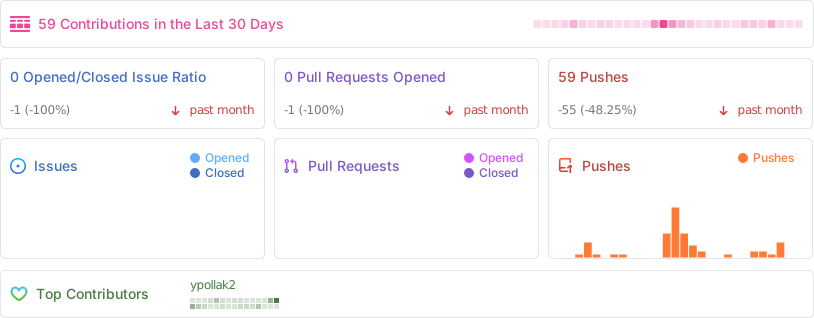
Activity
Issues · Discussions · PyPI · Changelog
MIT License
Как установить
Выполни в терминале:
claude mcp add ypollak2-llm-router -- npx 
