

About
Open Kioku command-line interface and MCP server binary.
README
Plan before edit. Verify after edit.
Open Kioku is a local repository evidence and change-safety layer for coding agents.
It builds a local evidence model of a repository, compiles the smallest useful context for a task, produces bounded change plans before edits begin, and verifies the resulting change against what the agent intended to modify.
CODE + SYMBOLS + RELATIONSHIPS + TESTS + HISTORY + RUNTIME + DOCS + ARCHITECTURE + LOCAL SEMANTICS
                                      │
                                      ▼
                               EVIDENCE MODEL
                                      │
                                      ▼
                              CONTEXT COMPILER
                                      │
                                      ▼
                         PLAN → EDIT → VERIFY → PROVE
No hosted code index. No source upload. Read-only MCP tools by default. Optional semantic retrieval runs locally.
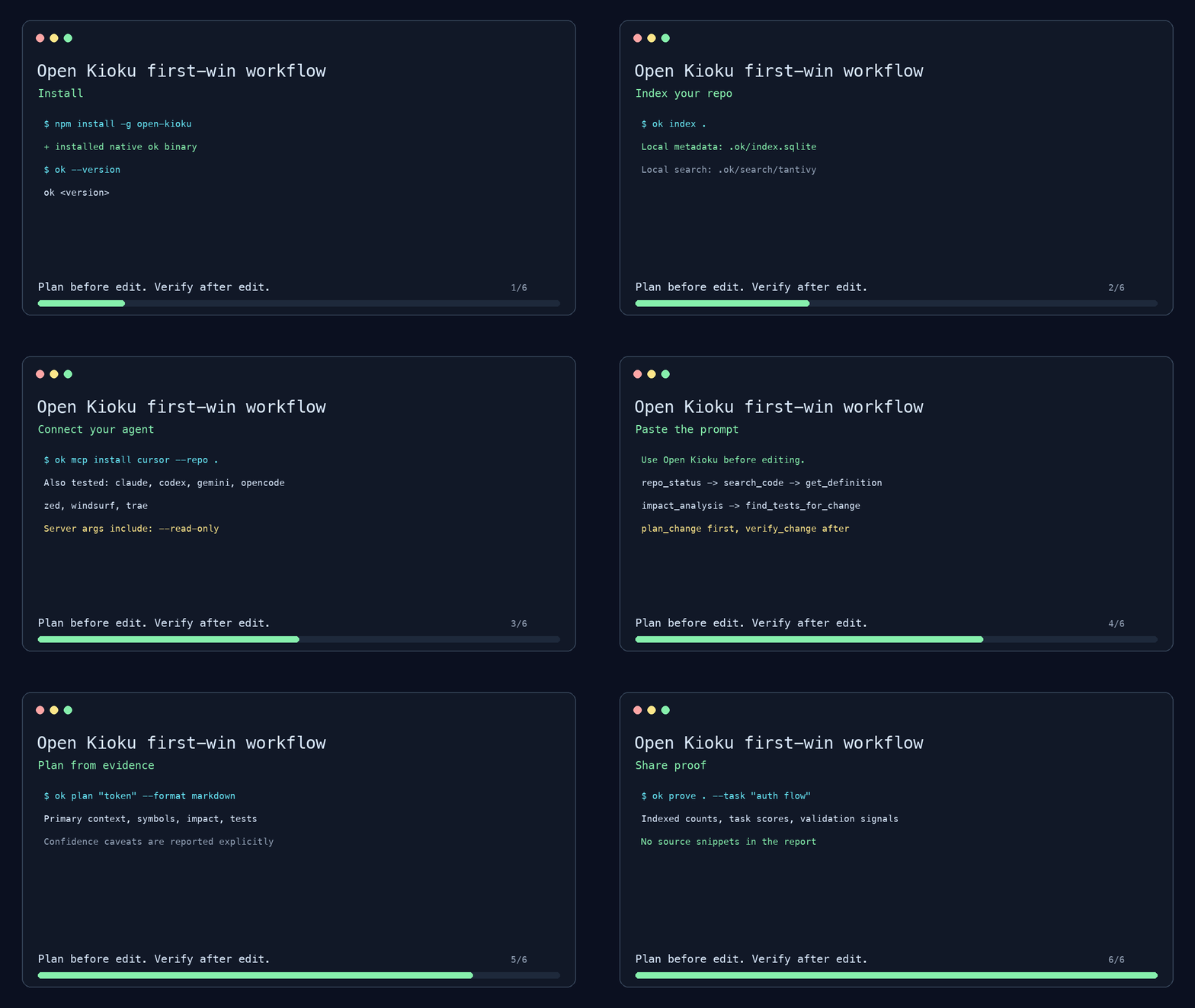
First Win: 2 Commands
npm install -g open-kioku
ok setup agent cursor --repo . --apply
For Claude Code:
ok setup agent claude --repo . --apply
The setup command indexes the repository, installs repository-scoped guidance and MCP configuration, and checks that the local MCP server responds. Run it without --apply first to inspect the exact changes.
Then ask the agent for the change you need. Open Kioku gives it a pre-edit evidence routine instead of making it rediscover the repository from scratch for every task.
What Open Kioku Understands
Open Kioku combines multiple evidence streams instead of treating repository understanding as a single search problem:
| Evidence | What it contributes |
|---|---|
| Code & symbols | Definitions, chunks, imports, occurrences, scopes, source ranges |
| Relationships & impact | Dependency paths, calls, references, types, inheritance, affected files/symbols |
| Tests & coverage | Validation candidates, test-to-code evidence, local coverage reports |
| Git history | Churn, co-change, ownership, reviewers, provenance, similar changes |
| Runtime evidence | Local traces, spans, logs, incidents, errors, failures |
| Documentation | Heading-aware repository documentation retrieval |
| Architecture & contracts | Boundaries, policies, public API/dependency constraints, change contracts |
| Local semantics | Optional local embeddings, hybrid retrieval, exact-flat and persistent ANN backends |
Exact evidence remains authoritative over heuristic evidence. Ambiguity is represented as ambiguity rather than silently promoted to a fact.
Context Compiler
A coding task is routed through independent candidate streams and compiled into a bounded ContextPack:
TASK
  │
  ├─ lexical / BM25
  ├─ exact symbol + reference evidence
  ├─ graph + impact evidence
  ├─ tests + coverage
  ├─ history
  ├─ runtime
  ├─ docs
  ├─ architecture + contracts
  └─ optional local semantic retrieval
          │
          ▼
 authority-aware fusion
 diversity / redundancy control
 token-budget optimization
          │
          ▼
 CONTEXTPACK + omissions + provenance + quality
Task-family routing, evidence provenance, blocker handling, token budgets, and retrieval quality are benchmarked through the real routed path rather than only through isolated search functions.
What Your Agent Gets
Explore → plan_change → edit → verify_change
Start with:
ok plan "change token expiration"
or MCP plan_change.
A plan can include:
- primary context with source identity and evidence provenance
- impact candidates
- likely validation targets
- edit boundaries
- explicit missing-evidence caveats
- confidence and quality signals
After the edit, verification checks the actual change against the plan rather than treating a successful command exit as proof that the right files changed.
Dogfooded Proof
The homepage includes proof artifacts produced from a pinned main build at commit acbc5bcb387551501b3bc350247d25c133116d75.
Local semantic scale
A synthetic offline repository produced:
- 51,349 semantic vectors
- 25,673 symbols
- 25,676 chunks
- persistent local HNSW selected automatically above the crossover
- 21.70s fresh semantic build
- about 554 MB peak RSS during that build
- 0 stale / 0 failed vectors
- successful fresh-process reopen of the persisted ANN index
See demo/proof/ann-50k-dogfood.json.
Plan → edit → validate → verify
The same pinned build was exercised through a real sandbox workflow. Open Kioku ran cargo test through its policy-gated validation runner, recorded the validation attestation, observed 2 tests passed / 0 failed, and found 0 boundary violations. The final verdict still remained warn because stronger supporting evidence was absent.
That behavior is intentional: passing tests do not manufacture certainty that the available evidence does not support.
See demo/proof/verification-dogfood.json.
A separate public-repository audit indexed 4,600+ files, 46,000+ symbols, and 8,900+ tests locally in 33.1s. Methodology, revisions, caveats, and language limitations are recorded in docs/large-repo-proof.md.
Large Java repository validation
The 3.0.4 release was tested end to end on a large Java repository. The workload and limitations are included so the results remain reproducible and useful.
| Measurement | Result |
|---|---|
| Tracked source files / Java files | 11,404 / 9,247 |
| Indexed files / symbols / chunks | 9,312 / 136,212 / 136,646 |
| Graph nodes / edges | 211,057 / 707,271 |
| Tests / imports | 67,810 / 87,148 |
| Cold structural index | 14m 44s |
| Repeat full structural rebuild | 8m 22s |
| Exact class lookup, fresh process | 3.82s |
| Exact definition / implementation graph queries | 2.88s / 4.50s |
| Exact-flat semantic build | 272,858 vectors in 33.33s; 0 failures |
| Persistent HNSW build | 272,858 vectors in 5m 02s; 0 failures |
| Structural / HNSW disk footprint | 4.7 GB / 2.35 GB |
The repeat index reproduced the same file, symbol, chunk, node, and edge totals. Four parallel graph reads completed without SQLite lock failures. Exact symbol identity ranked ahead of broader prefix matches, and exact graph queries used indexed anchors instead of scanning the full edge table.
These are observed local workstation timings, not a universal performance guarantee. Hardware, repository shape, Git history, enabled evidence sources, and semantic model affect runtime and storage. Compiler-grade Java SCIP evidence remains optional; when an external SCIP build integration is unavailable, Open Kioku keeps structural Java indexing operational and reports the missing evidence rather than overstating certainty.
Local Semantic Retrieval
Semantic search is optional. The default repository-intelligence workflow does not require a hosted embedding service.
When enabled, Open Kioku can build embeddings locally, combine semantic and lexical retrieval, persist the semantic manifest and model provenance, and select between an exact-flat correctness oracle and a persistent ANN backend based on the configured/indexed scale.
ok --repo . semantic status
ok --repo . semantic index
ok --repo . search "authorization expiry" --hybrid
Model acquisition is explicit and policy-controlled. Network-denied execution fails closed rather than silently reaching a hosted service.
See docs/semantic-search.md, docs/vector-index.md, and docs/embedding-providers.md.
See the Proof on Your Repo
ok prove . --task "the feature you're working on"
ok prove . --task "the feature you're working on" --html
ok prove creates a shareable report with indexed counts, task scores, validation signals, and caveats while intentionally omitting source snippets.
For pull requests, the opt-in open-kioku-action can attach a privacy-safe preflight artifact:
permissions:
  contents: read

steps:
  - uses: actions/checkout@v4
  - uses: shivyadavus/open-kioku-action@v1
    with:
      task: "change token expiration"
      verify: true
Install
npm (recommended)
npm install -g open-kioku
ok --version
cargo-binstall
cargo binstall open-kioku-cli
crates.io
cargo install open-kioku-cli
From source
git clone https://github.com/shivyadavus/open-kioku.git
cd open-kioku
cargo install --path crates/open-kioku-cli
Set Up a Repository
ok init /absolute/path/to/repo
ok index /absolute/path/to/repo
ok doctor /absolute/path/to/repo
ok status /absolute/path/to/repo --markdown --write ok-status.md
Open Kioku writes repository intelligence under .ok/, including SQLite metadata/graph state and Tantivy lexical search data. Source files are not rewritten by indexing.
Keep the index current while editing:
ok watch /absolute/path/to/repo
Connect an Agent
Repository-scoped onboarding:
ok setup agent claude --repo /absolute/path/to/repo --apply
ok setup agent cursor --repo /absolute/path/to/repo --apply
Manual MCP configuration is available for the supported client matrix:
ok mcp install cursor --repo /absolute/path/to/repo
ok mcp install claude --repo /absolute/path/to/repo
ok mcp install codex --repo /absolute/path/to/repo
ok mcp install gemini --repo /absolute/path/to/repo
ok mcp install windsurf --repo /absolute/path/to/repo
ok mcp install trae --repo /absolute/path/to/repo
ok mcp install opencode --repo /absolute/path/to/repo
ok mcp install zed --repo /absolute/path/to/repo
The default MCP server is local, read-only, and communicates over stdio.
Its 58 tools are advertised with MCP titles, task-specific usage and “do not use” guidance, input and output schemas, standard read-only/destructive/idempotent/open-world annotations, stable-versus-experimental maturity, and machine-readable routing categories. A metadata regression test rejects newly added tools that omit these agent-discovery fields or leave input properties undocumented.
Agent setup guides: Claude · Cursor · Codex · Gemini CLI.
Multi-Project Intelligence
Index projects individually, then link them into a workspace without reparsing source:
[workspace]
projects = [
  { name = "service-a", repo = "../service-a" },
  { name = "service-b", repo = "../service-b" },
]
ok index --mode cross-project --workspace /absolute/path/to/workspace
ok architecture fleet --workspace /absolute/path/to/workspace
Index Snapshots
Known-good indexes can be exported/imported for local team and CI reuse:
ok --repo . snapshot export --quality best
ok --repo . snapshot doctor
ok --repo . snapshot import
ok --repo . index --from-snapshot auto
Personal memory and compressed-context state are excluded from the shared index snapshot by default.
History, Runtime, and Validation Evidence
Git history is local and enabled by default with a bounded window. It contributes typed commit metadata, file touches and renames, co-change, churn, provenance, ownership, reviewer, and similar-change signals.
Runtime evidence is opt-in: local JSONL traces/logs/incidents/errors can be placed under .ok/runtime/ or .ok/analysis/runtime/ and re-indexed.
Validation evidence is opt-in: Open Kioku can ingest JUnit XML, lcov, Cobertura XML, JaCoCo XML, and coverage.py XML/JSON from common local report directories and map covered lines back to indexed files, symbols, and plausible tests.
These sources contribute evidence; they do not outrank exact source/reference truth.
Architecture, Contracts, and Verification
Open Kioku can detect architecture, evaluate policies, create bounded change contracts, and verify dependency/API/boundary constraints around a change.
ok --repo . architecture detect
ok --repo . architecture overview
ok --repo . architecture policy check --json
ok --repo . --json contract create "update API boundary"
ok --repo . contract verify --id <contract-id> --changed src/api.rs
ok --repo . verify --plan /tmp/plan.json --git
Benchmarks
Quality is treated as a measurable product surface:
ok retrieval-bench . --cases-file benchmarks/retrieval-cases.json --min-cases 30
ok workflow-bench . --cases-file benchmarks/workflow-cases.json --limit 10
ok eval . --case "auth flow=src/auth.rs,tests/auth_flow.rs"
The frozen retrieval corpus and regression policy are documented in docs/retrieval-benchmark.md.
Security Model
- read-only MCP by default
- no hosted repository index
- no source upload
- no hosted embeddings required for the core workflow
- optional semantic inference stays local
- secret-like paths are blocked by policy
- command execution is policy-gated
- source edits remain in the normal editor/agent harness
- network denial is supported and failures are explicit
See docs/security-model.md and SECURITY.md.
Language Support
Tree-sitter parsing and symbol extraction covers Rust, Python, TypeScript/TSX, JavaScript/JSX, Go, and Java. YAML and JSON are parsed structurally. File/chunk indexing also covers repository text and configuration formats including TOML, SQL, Markdown, and Terraform.
Language-aware resolution adds scope, import, receiver/type, containment, and inheritance semantics where supported. Exact-reference indexes can further raise authority and precision.
Useful Commands
ok --repo . search "token expiration handler"
ok --repo . symbol definition PolicyGate
ok --repo . symbol refs PolicyGate
ok --repo . impact --file src/auth.rs
ok --repo . tests --changed src/auth.rs
ok --repo . context "change token expiration" --format markdown
ok --repo . plan "change token expiration" --format markdown
ok --repo . preflight "change token expiration"
ok --repo . verify --plan /tmp/plan.json --git
ok --repo . history similar --task "change token expiration" --path src/auth.rs
ok --repo . semantic status
ok --repo . graph schema
ok prove . --task "change token expiration"
Current top-level commands (38): init, index, snapshot, watch, status, doctor, setup, demo, search, semantic, symbol, explain, impact, path, tests, context, retrieve-context, plan, preflight, verify-boundary, verify, contract, bench, workflow-bench, retrieval-bench, relationship-bench, contract-bench, eval, prove, adr, ui, architecture, history, patch, memory, mcp, scip, and graph.
Full MCP tool reference: docs/mcp-tools.md.
Repository Layout
This is a 43-crate Cargo workspace. Important crates include:
open-kioku-cli—okCLI and top-level product surfaceopen-kioku-mcp— local JSON-RPC MCP serveropen-kioku-core— evidence, graph, report, and relationship authority contractsopen-kioku-ingest— indexing pipeline and evidence ingestionopen-kioku-resolution— scope/receiver/type-aware semantic resolutionopen-kioku-context— routed candidate streams and ContextPack compilationopen-kioku-graph— evidence graph and query layeropen-kioku-semantic— local semantic indexing and hybrid retrievalopen-kioku-vector— exact-flat oracle and persistent local ANN backendopen-kioku-plan— evidence-backed pre-edit planningopen-kioku-impact— impact analysisopen-kioku-tests— validation target selectionopen-kioku-architecture— architecture detection and policy evaluationopen-kioku-contract— change-contract schema and validationopen-kioku-patch— post-edit verificationopen-kioku-storage-sqlite— local persistence
Architecture: docs/architecture.md · Crate map: docs/crate-map.md · Storage: docs/storage-model.md
Development
cargo fmt --all --check
cargo clippy --all-targets --all-features -- -D warnings
cargo test --all
cargo test -p open-kioku-cli --test cli_smoke
ok retrieval-bench . --cases-file benchmarks/retrieval-cases.json --min-cases 30
ok workflow-bench . --cases-file benchmarks/workflow-cases.json --limit 10
Contributing
Issues and pull requests are welcome. See CONTRIBUTING.md.
If Open Kioku improves your agent workflow, consider starring the repository.
Installing Open Kioku Cli
This server has no published package — it is built from source. Open the repository and follow its README.
▸ github.com/shivyadavus/open-kiokuFAQ
Is Open Kioku Cli MCP free?
Yes, Open Kioku Cli MCP is free — one-click install via Unyly at no cost.
Does Open Kioku Cli need an API key?
No, Open Kioku Cli runs without API keys or environment variables.
Is Open Kioku Cli hosted or self-hosted?
Self-hosted: the server runs locally on your machine via the install command above.
How do I install Open Kioku Cli in Claude Desktop, Claude Code or Cursor?
Open Open Kioku Cli on unyly.org, pick your client tab (Claude Desktop, Claude Code, Cursor) and press Install — the config is generated automatically, no JSON editing.
Related MCPs
GitHub
PRs, issues, code search, CI status
 by GitHub
Filesystem
Secure file operations with configurable access controls.
Memory
Knowledge graph-based persistent memory system.
Template MCP Server
A CLI tool to create a new Model Context Protocol server project with TypeScript support, dual transport options, and an extensible structure
 by mcpdotdirect
Amap Maps Mcp Server
MCP server for using the AMap Maps API
 by duxiaohui
Supabase
Database, auth and storage
 by Supabase
Everything
Reference / test server with prompts, resources, and tools.
Git
Tools to read, search, and manipulate Git repositories.
Sequential Thinking
Dynamic and reflective problem-solving through thought sequences.
Time
Time and timezone conversion capabilities.
Compare Open Kioku Cli with
Not sure what to pick?
Find your stack in 60 seconds
Author?
Embed badge for your README
Browse similar
All development MCPs