
ymw0407/auth-fetch-mcp
FreeNot checkedFetch content from login-protected web pages (Notion, Google Docs, Jira, Confluence, etc.) by opening a real browser for authentication with persistent session

About
Fetch content from login-protected web pages (Notion, Google Docs, Jira, Confluence, etc.) by opening a real browser for authentication with persistent session caching.
README
npm version npm downloads License: MIT auth-fetch-mcp MCP server
MCP server that lets AI assistants fetch content from authenticated web pages.
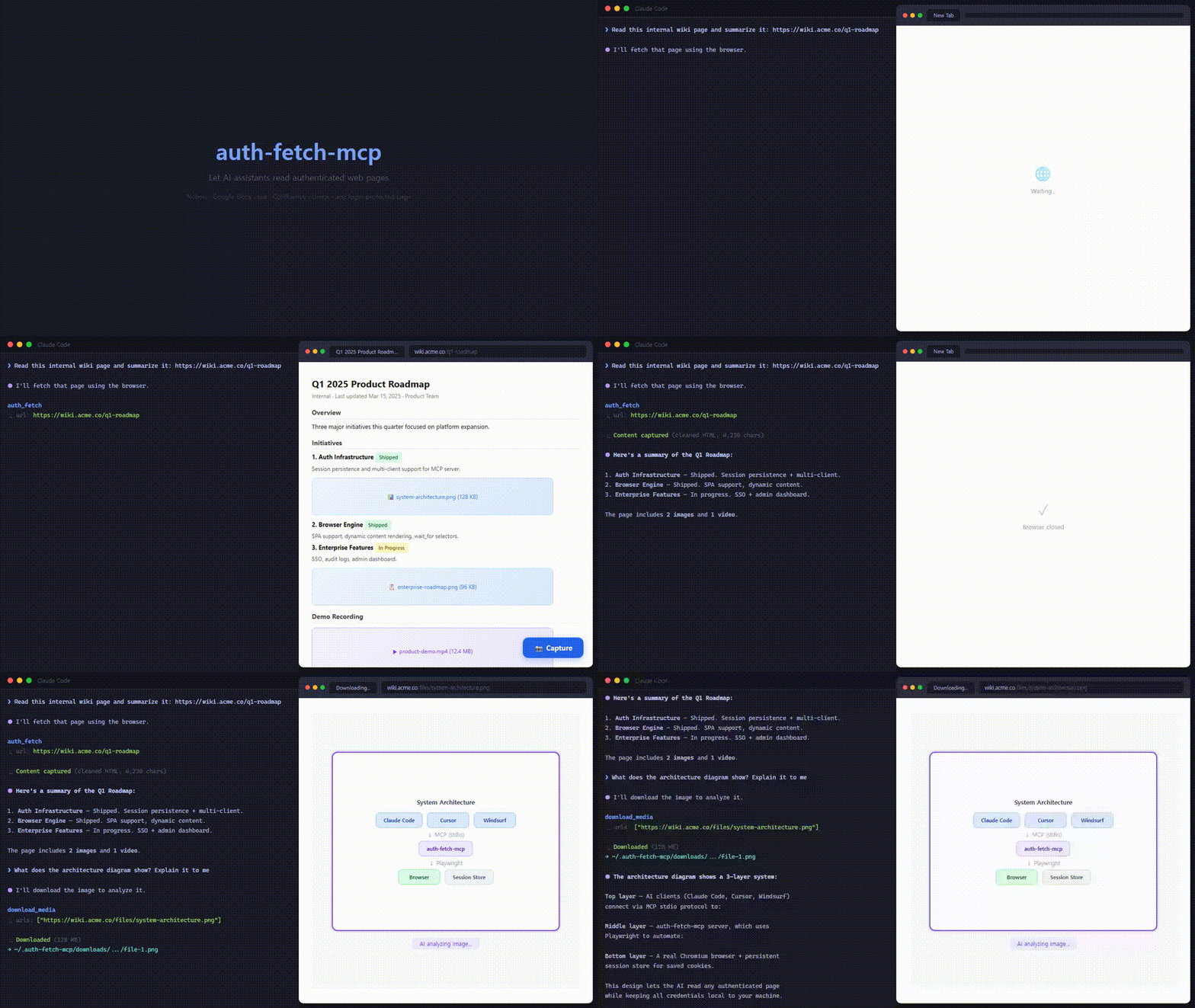
When your AI tries to read a URL that requires login, this tool opens a real browser for you to sign in — then captures the page content as cleaned HTML. Sessions are saved locally, so you only log in once per service.
Demo
Quick Start
Claude Code
claude mcp add --scope user auth-fetch -- npx auth-fetch-mcp@latest
.mcp.json (Cursor, Windsurf, etc.)
{
  "mcpServers": {
    "auth-fetch": {
      "command": "npx",
      "args": ["auth-fetch-mcp@latest"]
    }
  }
}
Chromium is auto-installed on first run if not already present.
How It Works
- Ask your AI to read any authenticated page — just paste the URL.
- A browser window opens automatically and navigates to the page.
- Log in as you normally would (supports SSO, 2FA, CAPTCHA — anything).
- Click the "📸 Capture" button in the bottom-right corner when ready.
- The page content is captured as cleaned HTML (noise elements stripped, media tags preserved), the browser closes, and your AI receives the content.
Tools
auth_fetch
The primary tool. Fetches page content using a real browser, opening a window for login if needed. Returns cleaned HTML with noise elements (nav, footer, scripts, etc.) stripped and media tags (<img>, <video>, <iframe>) preserved.
| Parameter | Type | Required | Description |
|---|---|---|---|
url |
string | yes | The URL to fetch content from (only http/https; see URL restrictions) |
wait_for |
string | no | CSS selector to wait for before capturing (useful for SPAs) |
download_media
Downloads files from URLs using saved browser sessions. Use this to lazily download images, videos, or other files found in auth_fetch results. The browser's saved cookies handle authentication automatically — no need to log in again.
| Parameter | Type | Required | Description |
|---|---|---|---|
urls |
string[] | yes | One or more URLs to download (only http/https; see URL restrictions) |
output_dir |
string | no | Subdirectory under ~/.auth-fetch-mcp/downloads/ to save files into. Absolute paths or .. segments that escape this root are rejected. Defaults to ~/.auth-fetch-mcp/downloads/<timestamp>/ |
Example flow:
1. auth_fetch("https://notion.so/my-page")
   → Returns HTML with <img src="https://s3.notion.so/signed-url..."/> tags

2. AI reads the HTML, identifies an image it needs

3. download_media(["https://s3.notion.so/signed-url..."])
   → Downloads the image using saved session cookies
   → Returns { localPath: "~/.auth-fetch-mcp/downloads/.../file-1.png" }
list_pages
Lists all open tabs in the browser with their URLs and titles.
close_browser
Closes the browser window. Login sessions are saved and will be reused next time.
URL restrictions
To prevent SSRF (server-side request forgery) attacks driven by prompt injection, both auth_fetch and download_media validate every URL before dispatching it:
- Only
httpandhttpsschemes are allowed.file:,data:,javascript:, etc. are rejected. - The hostname is resolved via DNS and the resulting IP is checked. Requests are rejected when the address falls in private, loopback, link-local, CGNAT, or multicast ranges:
- IPv4:
0.0.0.0/8,10.0.0.0/8,100.64.0.0/10,127.0.0.0/8,169.254.0.0/16,172.16.0.0/12,192.0.0.0/24,192.168.0.0/16,198.18.0.0/15,224.0.0.0/4,240.0.0.0/4 - IPv6:
::,::1,fc00::/7,fe80::/10,ff00::/8, IPv4-mapped equivalents
- IPv4:
download_mediaadditionally constrainsoutput_dirto stay inside~/.auth-fetch-mcp/downloads/. Absolute paths and..segments that escape this root are rejected.
Allowing private hosts
If you need to access a host on your local machine or LAN (e.g., a dev server, NAS, or Tailscale node), opt in with environment variables:
| Variable | Effect |
|---|---|
AUTH_FETCH_ALLOW_PRIVATE |
Set to 1, true, or yes to disable all private/loopback/link-local checks. Most permissive — use only in trusted environments. |
AUTH_FETCH_ALLOW_HOSTS |
Comma-separated allowlist of hostnames or IPs. Matches against the URL's hostname and every resolved IP. |
.mcp.json example:
{
  "mcpServers": {
    "auth-fetch": {
      "command": "npx",
      "args": ["auth-fetch-mcp@latest"],
      "env": {
        "AUTH_FETCH_ALLOW_HOSTS": "localhost,127.0.0.1,192.168.1.10"
      }
    }
  }
}
Heads up: enabling these variables re-opens those hosts to any prompt the MCP client (LLM) processes. Prefer the narrowest possible allowlist over
AUTH_FETCH_ALLOW_PRIVATE=1, and only enable them in environments you trust.
Data Storage
All data is stored locally under ~/.auth-fetch-mcp/. Nothing is sent to external servers.
| What | Where | When | Persistent? |
|---|---|---|---|
| Browser sessions (cookies, local storage) | ~/.auth-fetch-mcp/browser-data/ |
After first login | Yes — reused across restarts |
| Downloaded media files | ~/.auth-fetch-mcp/downloads/<timestamp>/ |
Only when download_media is called |
Yes — stays until you delete it |
| Captured page content (HTML) | Not saved to disk | Passed directly to AI via stdio | No — exists only in the AI's context |
To clear all data:
# Clear login sessions only
rm -rf ~/.auth-fetch-mcp/browser-data/

# Clear downloaded files only
rm -rf ~/.auth-fetch-mcp/downloads/

# Clear everything
rm -rf ~/.auth-fetch-mcp/
Supported AI Tools
- Claude Code
- Cursor
- Windsurf
- Any MCP-compatible client using stdio transport
Limitations
- Requires a local environment (does not work in web-based chat interfaces)
- First access to each service requires manual login
- Very long pages are truncated to fit LLM context windows (100K chars)
- Some sites with aggressive bot detection may not work (try the
wait_foroption) - Private, loopback, and link-local hosts are blocked by default — opt in via
AUTH_FETCH_ALLOW_PRIVATE/AUTH_FETCH_ALLOW_HOSTS(see URL restrictions)
Privacy
- All data stays on your machine — nothing is sent to external servers
- Captured HTML is never written to disk — it only passes through the stdio pipe to the AI tool
- Browser sessions are stored locally as a standard Chromium profile
- Downloaded files go to a local directory you control
Contributing
Contributions are welcome! Please open an issue or submit a pull request.
git clone https://github.com/ymw0407/auth-fetch-mcp.git
cd auth-fetch-mcp
npm install
npm run build
License
MIT
Installing ymw0407/auth-fetch-mcp
This server has no published package — it is built from source. Open the repository and follow its README.
▸ github.com/ymw0407/auth-fetch-mcpFAQ
Is ymw0407/auth-fetch-mcp MCP free?
Yes, ymw0407/auth-fetch-mcp MCP is free — one-click install via Unyly at no cost.
Does ymw0407/auth-fetch-mcp need an API key?
Yes, it requires environment variables: AUTH_FETCH_ALLOW_HOSTS. Unyly injects them into the config during install.
Is ymw0407/auth-fetch-mcp hosted or self-hosted?
Self-hosted: the server runs locally on your machine via the install command above.
How do I install ymw0407/auth-fetch-mcp in Claude Desktop, Claude Code or Cursor?
Open ymw0407/auth-fetch-mcp on unyly.org, pick your client tab (Claude Desktop, Claude Code, Cursor) and press Install — the config is generated automatically, no JSON editing.
Related MCPs
Playwright
Browser automation, scraping, screenshots
 by Microsoft
Puppeteer
Browser automation and web scraping.
 by modelcontextprotocol
opentabs-dev/opentabs
Plugin-based MCP server + Chrome extension that gives AI agents access to web applications through the user's authenticated browser session. 100+ plugins with a
 by opentabs-dev
robhunter/agentdeals
1,500+ developer infrastructure deals, free tiers, and startup programs across 54 categories. Search deals, compare vendors, plan stacks, and track pricing chan
 by robhunter
Compare ymw0407/auth-fetch-mcp with
Not sure what to pick?
Find your stack in 60 seconds
Author?
Embed badge for your README
Browse similar
All browse MCPs