
Aimonitor
БесплатноНе проверенMulti-account Claude Code usage monitor & silent account switcher, plus a Slack/ClickUp MCP server — macOS menu bar + CLI. Local-first, no telemetry.

Описание
Multi-account Claude Code usage monitor & silent account switcher, plus a Slack/ClickUp MCP server — macOS menu bar + CLI. Local-first, no telemetry.
README
aimonitor
Multi-account Claude Code usage monitor & silent account switcher for macOS & Linux.
CI License: MIT Latest release
English | 简体中文 | 繁體中文 | Tiếng Việt
Features
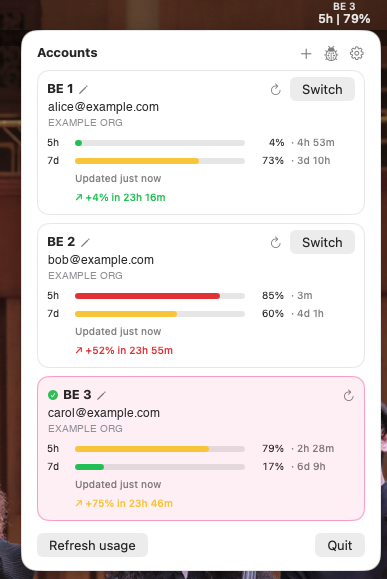
- 🔍 Live 5h + 7d usage bars per account — polled from Anthropic's
/api/oauth/usage(no tokens consumed), with a trend line (↗ +21% in 45m). - 🔀 Silent switching —
aimonitor switch <label>refreshes the OAuth token and swaps the live credential. Noclaude /login, no terminal hop. - 🤖 Auto-swap at the 5h or 7d threshold (default 80 %) — picks the account with the most overall headroom, skips exhausted/rate-limited ones, and rescues immediately if the active account hits 100 %. Running
claudesessions follow automatically. - 🔔 Threshold notifications as an account nears its limit (when auto-swap is off).
- 💾 Export / import settings, or migrate accounts to another machine — credentials optional and passphrase-encrypted (Argon2id + AES-256-GCM).
- 🔌 MCP server — Slack, ClickUp & Sentry tools for Claude Code over stdio, with per-service read-only mode.
- 🔐 OS-keyring storage (macOS Keychain, Linux libsecret). SQLite holds references; tokens never leave the keyring. No telemetry.
Install
# macOS (Sonoma 14+) — one command: taps, trusts, installs, clears Gatekeeper
curl -fsSL https://raw.githubusercontent.com/japananh/aimonitor/main/packaging/macos/install.sh | bash

# Linux (Ubuntu 22.04+) — CLI only
curl -fsSL https://raw.githubusercontent.com/japananh/aimonitor/main/packaging/linux/install.sh | sh

# Any platform, CLI only
go install github.com/japananh/aimonitor/cmd/aimonitor@latest
Prefer Homebrew directly?
brew trust japananh/tap && brew install --cask japananh/tap/aimonitor, then clear Gatekeeper on first launch:xattr -dr com.apple.quarantine /Applications/AIMonitor.app(or right-click → Open). The one-line installer above does both for you. See docs/unsigned-app.md.
Upgrade
brew upgrade --cask aimonitor   # macOS
aimonitor update check          # CLI: is a newer release out?
aimonitor update install        # CLI: upgrade in the background
⚠️ macOS:
brew upgrade --caskre-quarantines the app. Each upgrade lays down a fresh unsigned.app, so if it won't open afterward, re-clear Gatekeeper withxattr -dr com.apple.quarantine /Applications/AIMonitor.app(re-running the one-line installer does it for you). This is expected — not a broken install, so don't reinstall or--purge. The CLI keeps working regardless.
The menu-bar app also checks GitHub on launch and offers the update under Preferences → Check for updates. Pre-releases are never auto-served — brew upgrade keeps you on the latest stable.
Quick start
aimonitor add --adopt-current --label personal   # register your current Claude login
aimonitor add --label work                        # add another (drives claude /login, polls keychain)
aimonitor switch work                             # switch silently
aimonitor list                                    # live 5h / 7d usage per account
aimonitor doctor                                  # health check
Already on another switcher? aimonitor import pulls its accounts in one step. Auto-swap is on by default at 80 % — nothing else to configure for the common case.
Configuration
aimonitor config set auto_swap.enabled true        # default true
aimonitor config set auto_swap.threshold_pct 80    # 5h threshold
aimonitor config set auto_swap.threshold_7d_pct 80 # 7d threshold
aimonitor config set autostart true                # daemon at login
Back up or move to another machine:
aimonitor config export --out backup.json                                          # settings only (no secrets)
AIMONITOR_PASSPHRASE=… aimonitor config export --include-tokens --out full.json     # + encrypted credentials
AIMONITOR_PASSPHRASE=… aimonitor config import full.json                            # restore elsewhere
--include-tokens bundles your logins encrypted under the passphrase — restoring it means claude works on the other machine without re-login, so treat that file like a password. Same actions live in Preferences → Backup.
All config keys
| Key | Default | Description |
|---|---|---|
auto_swap.enabled |
true |
Master toggle for auto-swap |
auto_swap.threshold_pct |
80 |
5h utilization (%) to auto-swap |
auto_swap.threshold_7d_pct |
80 |
7d utilization (%) to auto-swap |
auto_swap.grace_sec |
60 |
Delay between the "pending" notification and the swap (0 = immediate) |
notify.enabled |
true |
Warn as the active account nears its limit (only when auto-swap is off) |
notify.warn_pct / notify.crit_pct |
80 / 95 |
Warning / critical notification levels |
daily_summary.enabled |
true |
Once-a-day notification recapping yesterday's token usage across accounts |
auto_update.enabled |
true |
Check GitHub for releases on launch (never auto-installs) |
autostart |
false |
Start the daemon at login |
mcp.slack.enabled / mcp.clickup.enabled / mcp.sentry.enabled |
true |
Expose that service's MCP tools |
mcp.slack.read_only / mcp.clickup.read_only / mcp.sentry.read_only |
false |
Hide the service's write tools |
mcp.sentry.org |
(empty) | Sentry organization slug the tools query |
mcp.sentry.base_url |
https://sentry.io |
Sentry API host (set to your self-hosted host) |
mcp.disabled_tools |
(empty) | Comma-separated tool names to hide |
How it works
The daemon polls /api/oauth/usage (~5 min ± jitter, no tokens consumed). When the active account crosses its 5h or 7d threshold, it picks the account with the most overall headroom, refreshes that account's OAuth token (POST .../v1/oauth/token), and writes it to the live Keychain slot. Running and new claude sessions adopt the new account — no /login, no restart.
See docs/architecture.md and docs/thresholds.md for the full picture.
MCP server (Slack, ClickUp & Sentry for Claude Code)
One stdio process serving Slack, ClickUp & Sentry tools — no extra runtimes.
aimonitor mcp connect slack     # store a Slack user token (xoxp-…)
aimonitor mcp connect clickup   # store a ClickUp token (pk_…)
aimonitor mcp connect sentry    # store a Sentry auth token (set mcp.sentry.org first)
aimonitor mcp register          # add the server to Claude Code
- Slack: post to channels/threads (mrkdwn, code blocks), upload files (from a local path or inline text), search, history, permalinks, react to a message (acknowledge it without posting a reply), and read attachments — including images, returned as viewable pixels (or saved to a local path).
- ClickUp: workspace hierarchy, tasks, comments, attachments both ways — upload from a local path/inline text and read them back, images included — Docs (read & write).
- Sentry: triage digests (projects, issue search, detail), root-cause (latest event stacktrace, tag/value distributions), and actions (resolve/ignore/assign, comment). Org-scoped and self-hosted-aware (
mcp.sentry.org,mcp.sentry.base_url). - Safety: Claude Code's per-tool prompts are the approval layer; per-service Enabled / Read-only switches and a per-tool disable list refine it. Tokens are verified live, then stored in the OS keyring — never in SQLite or logs.
Slack token scopes. The Slack token is a user token (
xoxp-…). Grant these User Token Scopes on your Slack app (api.slack.com → OAuth & Permissions), reinstall, then connect — a missing one surfaces asslack: missing scope "…"on the affected tool:search:read,users:read,users:read.email,channels:history,groups:history,im:history,mpim:history,channels:read,groups:read,im:read,mpim:read,chat:write,files:read,files:write,reactions:write.
Sentry token scopes. A Sentry auth token (User Auth Token, or an Internal Integration). Set
mcp.sentry.org— andmcp.sentry.base_urlfor self-hosted — beforeconnect. Scopes:org:read,project:read,event:readfor the read/triage tools; addevent:write+member:readto resolve/assign/comment;event:adminto delete comments.
Privacy & security
- No telemetry, no phone-home. OAuth tokens live only in the OS keyring; SQLite holds references. Token bytes are never logged.
- Outbound traffic is limited to:
GET /api/oauth/usage(introspection, no tokens consumed),POST /v1/oauth/token(silent token refresh), and the GitHub release check. Nothing about you is sent.
See docs/security.md for the threat model.
Troubleshooting
aimonitor doctor # health check: config, SQLite, keyring, accounts
- "Daemon not running" / usage looks stale. Start or restart the background daemon with
aimonitor config set autostart true, or click Start daemon in the popover — it registers a LaunchAgent that relaunches at login. - App won't open — "damaged", "can't be opened", or "unidentified developer" (macOS Gatekeeper on the unsigned app). Happens on first launch and after every
brew upgrade/reinstall — each lays down a fresh unsigned.app. Clear the quarantine flag, then reopen:xattr -dr com.apple.quarantine /Applications/AIMonitor.app. This is not a broken install, so don't uninstall oraimonitor uninstall --purgeto "reset" it —--purgewipes your saved account logins. The CLI (aimonitor …) is unaffected. Details: docs/unsigned-app.md. - Logs. The daemon writes to
~/Library/Logs/aimonitor/aimonitor.daemon.log(INFO/WARN/ERROR — never token bytes); background upgrades log toupdate.logbeside it. - Recent switches.
aimonitor logprints the switch audit trail.
Uninstall
# Remove the app + daemon, KEEP your saved accounts
brew uninstall --cask aimonitor

# Full wipe — ALSO deletes every account login aimonitor saved in your Keychain.
# Purge runs first: it needs the binary still installed to reach the stashes.
aimonitor uninstall --purge && brew uninstall --cask aimonitor
🔴
--purgeis destructive and irreversible. It permanently deletes aimonitor's saved copies of all your accounts (theaimonitor-<uuid>Keychain stashes) — you'll have toaimonitor addand complete/loginfor every account again. Plainbrew uninstall --cask aimonitor(no--purge) keeps them all.App won't open? That's Gatekeeper, not a broken install — don't
--purgeto "reset" it. Run thexattrfix in Troubleshooting instead.
--purge never touches Claude's own Claude Code-credentials slot, so the account you're currently signed into keeps working in claude with no re-login — only aimonitor's saved copies of your other accounts are dropped (and those you must re-add).
Build from source
Requires Go 1.25+. Pure Go (CGO_ENABLED=0 works on macOS; keychain access shells out to /usr/bin/security).
make build              # CLI binary
make test               # unit tests
make widget             # AIMonitor.app (macOS; needs the Swift toolchain)
make release-snapshot   # goreleaser dry-run
License
Установка Aimonitor
У этого сервера нет опубликованного пакета — он собирается из исходников. Открой репозиторий и следуй инструкции в README.
▸ github.com/japananh/aimonitorFAQ
Aimonitor MCP бесплатный?
Да, Aimonitor MCP бесплатный — установка в пару кликов через Unyly без оплаты.
Нужен ли API-ключ для Aimonitor?
Нет, Aimonitor работает без API-ключей и переменных окружения.
Aimonitor — hosted или self-hosted?
Self-hosted: сервер запускается локально на твоей машине командой из раздела установки.
Как установить Aimonitor в Claude Desktop, Claude Code или Cursor?
Открой Aimonitor на unyly.org, выбери вкладку своего клиента (Claude Desktop, Claude Code, Cursor) и нажми Install — конфиг сгенерируется автоматически, без правки JSON.
Похожие MCP
Gmail
Read, send and search emails from Claude
 автор: Google
Slack
Send, search and summarize Slack messages
 автор: Slack
Runbear
No-code MCP client for team chat platforms, such as Slack, Microsoft Teams, and Discord.
Discord Server
A community discord server dedicated to MCP by [Frank Fiegel](https://github.com/punkpeye)
Klavis AI
Open Source MCP Infra. Hosted MCP servers and MCP clients on Slack and Discord.
Work90210/APIFold
Turn any REST API into a hosted MCP server. 18 free public servers (GitHub, Stripe, Slack, OpenAI, Notion, and more) — no setup required, bring your own API key
 автор: Work90210
arikusi/deepseek-mcp-server
MCP server for DeepSeek AI with chat, reasoning, multi-turn sessions, function calling, thinking mode, and cost tracking.
 автор: arikusi
hashgraph-online/hashnet-mcp-js
MCP server for the Registry Broker. Discover, register, and chat with AI agents on the Hashgraph network.
 автор: hashgraph-online
profullstack/mcp-server
A comprehensive MCP server aggregating 20+ tools including SEO optimization, document conversion, domain lookup, email validation, QR generation, weather data,
 автор: profullstack
WayStation-ai/mcp
Seamlessly and securely connect Claude Desktop and other MCP hosts to your favorite apps (Notion, Slack, Monday, Airtable, etc.). Takes less than 90 secs.
 автор: waystation-ai
Compare Aimonitor with
Не уверен что выбрать?
Найди свой стек за 60 секунд
Автор?
Embed-бейдж для README
Похожее
Все в категории communication