
Azure Compliance
FreeNot checkedEnables natural-language queries about Azure resource compliance, including VM compliance, patch status, orphaned RBAC, and infrastructure health, through read-

About
Enables natural-language queries about Azure resource compliance, including VM compliance, patch status, orphaned RBAC, and infrastructure health, through read-only MCP tools.
README
CI License: MIT Python 3.12+ FastMCP 3.x
Honest Azure compliance for LLM agents — ask infra-health questions in plain English and get answers that distinguish a real
failfrom anot_evaluable, and never fake apass.
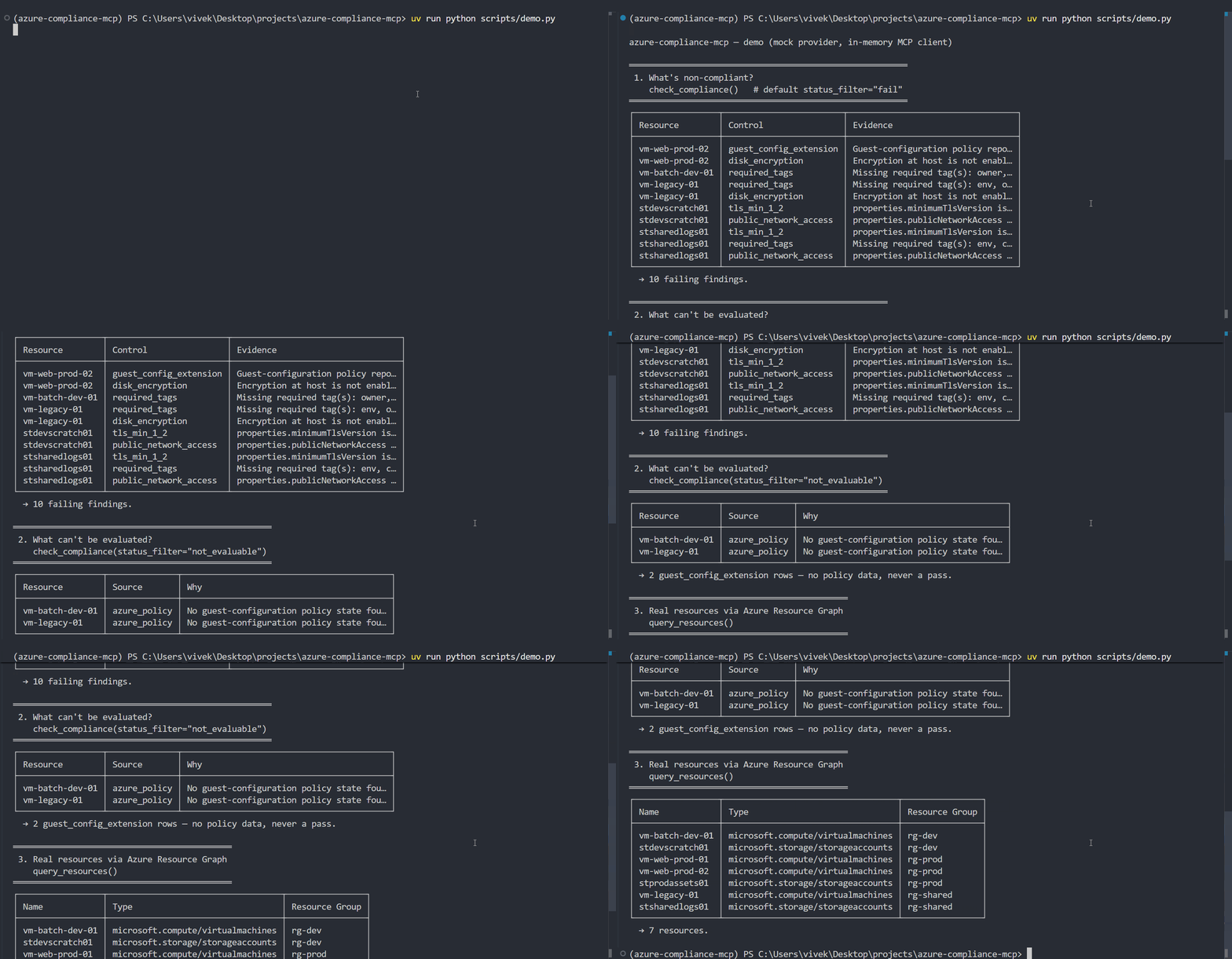
An MCP server, built with FastMCP 3.x, that exposes read-only Azure resource-compliance data so an agent can answer questions like "which storage accounts allow TLS 1.0?" or "which VMs have no disk encryption?" — each finding tagged with where the verdict came from and whether it could be evaluated at all.
Why honest compliance?
Most tooling collapses "compliant", "non-compliant", and "couldn't tell" into a single pass/fail bit — so a control it can't actually measure silently shows green. This server refuses to guess:
fail— positive evidence a protection is absent (e.g.encryptionAtHost = false). Actionable; shows up in the default view.not_evaluable— the signal genuinely isn't in the data (e.g. no guest-config policy assigned). Surfaced explicitly, never as a pass.source— every finding records its provenance:arg|azure_policy|defender.
Quickstart
Requires uv and Python 3.12+. Runs out of the box — mock mode needs zero Azure setup.
uv sync                          # install dependencies
uv run python scripts/demo.py    # fastest look — runs the tools against mock data
uv run server.py                 # mock data, stdio transport — works immediately
Point it at your own tenant when you're ready:
uv run server.py --mode live     # real Azure Resource Graph (e.g. after `az login`)
uv run server.py --transport http  # remote: Streamable HTTP
uv run fastmcp dev inspector server.py  # explore the tools interactively
Live mode authenticates with DefaultAzureCredential against your own tenant and is strictly read-only.
Architecture
Tools depend only on a Provider protocol, never on a concrete data source — so the same tool code runs against synthetic mock data or live Azure Resource Graph (ARG), selected at startup with --mode.
flowchart LR
    Agent["LLM agent / MCP client"] -->|stdio · HTTP| Server["FastMCP server\n(check_compliance, query_resources)"]
    Server --> Protocol["Provider protocol\n(read-only)"]
    Protocol -->|--mode mock| Mock["MockProvider\nseeded ARG-shaped data"]
    Protocol -->|--mode live| Live["LiveProvider\nDefaultAzureCredential"]
    Live -->|injection-safe KQL| ARG[("Azure Resource Graph\nresources · policyresources")]
Controls (check_compliance evaluates five):
| control | source | signal |
|---|---|---|
required_tags |
arg |
resources.tags (env / owner / costCenter) |
tls_min_1_2 |
arg |
resources.properties.minimumTlsVersion |
public_network_access |
arg |
resources.properties.publicNetworkAccess |
disk_encryption |
arg |
securityProfile.encryptionAtHost — host-level only; OFF ⇒ fail, ADE not assessed |
guest_config_extension |
azure_policy |
policyresources guest-config states; no data ⇒ not_evaluable |
Transports: stdio (default, local) and Streamable HTTP (remote, intended behind OAuth 2.1). In stdio mode stdout is reserved for the protocol — logging goes to stderr only.
See SPEC.md for the full tool contracts.
Design decisions & tradeoffs
- Mock provider is the default. The repo runs with zero Azure account, credentials, or network — so reviewers, CI, and new contributors get meaningful output immediately. The mock dataset is shaped exactly like ARG rows, so one mapping serves both modes.
- Read-only by construction. No tool can create, update, or delete a resource. The live path only ever issues ARG queries; there is no mutation surface to misuse.
- Control-based, not Azure-Policy-based. Compliance is evaluated from resource configuration (the ARG row), so it works even when no Azure Policy is assigned — except where the signal genuinely lives elsewhere (guest-config), which routes to
policyresourcesand is honest about it. - The
not_evaluable+sourcehonesty model. A third status plus a provenance field means the agent can tell "this is broken" from "I can't see this from here" — the core reason to trust the output. - KQL pushdown for scale. Live filters (
query_resources) are pushed into the ARG query (where+take) rather than fetched-then-filtered, so large tenants stay cheap. An opt-in contract test asserts the pushdown matches the reference Python filter, so both modes stay provably consistent. - Injection-safe escaping. ARG has no bind parameters, so every user-supplied value is encoded as an escaped KQL string literal — never concatenated raw. (ARG is read-only regardless, but the discipline is enforced and unit-tested.)
Status & roadmap
v0.2.0 — check_compliance and query_resources shipped (mock + live), honest not_evaluable/source model, KQL pushdown, CI on every PR.
Next:
-
get_patch_status— patch/update assessment across VMs -
find_orphaned_rbac— role assignments pointing at deleted principals -
summarize_health— rolled-up infra-health summary - evals — task-level evaluation of agent answers over the mock dataset
Development
uv run pytest               # tests (live tests are opt-in: RUN_LIVE_TESTS=1)
uv run ruff check .         # lint
uv run ruff format --check . # format
Security
- All Azure tools are read-only — nothing in this server modifies Azure resources.
- Secrets, tenant IDs, and
.envare gitignored and must never be committed; live mode uses only your localDefaultAzureCredential. - In stdio mode, logging goes to stderr only (stdout is reserved for the protocol).
License
Installing Azure Compliance
This server has no published package — it is built from source. Open the repository and follow its README.
▸ github.com/vivekanjana76/azure-compliance-mcpFAQ
Is Azure Compliance MCP free?
Yes, Azure Compliance MCP is free — one-click install via Unyly at no cost.
Does Azure Compliance need an API key?
No, Azure Compliance runs without API keys or environment variables.
Is Azure Compliance hosted or self-hosted?
Self-hosted: the server runs locally on your machine via the install command above.
How do I install Azure Compliance in Claude Desktop, Claude Code or Cursor?
Open Azure Compliance on unyly.org, pick your client tab (Claude Desktop, Claude Code, Cursor) and press Install — the config is generated automatically, no JSON editing.
Related MCPs
GitHub
PRs, issues, code search, CI status
 by GitHub
Filesystem
Secure file operations with configurable access controls.
Memory
Knowledge graph-based persistent memory system.
Template MCP Server
A CLI tool to create a new Model Context Protocol server project with TypeScript support, dual transport options, and an extensible structure
 by mcpdotdirect
Compare Azure Compliance with
Not sure what to pick?
Find your stack in 60 seconds
Author?
Embed badge for your README
Browse similar
All development MCPs