
Calendly Mcp Cli
БесплатноПоддерживаетсяCalendly API v2 MCP server and shared CLI: 66 tools, contacts, meeting recaps, private accounts, confirmed writes, desktop and full setup.

Описание
Calendly API v2 MCP server and shared CLI: 66 tools, contacts, meeting recaps, private accounts, confirmed writes, desktop and full setup.
README

Calendly MCP Server & CLI
npm CI License YouTube X LinkedIn
Calendly MCP server and CLI for Claude Code, Codex and AI agents. 66 tools: 44 reads and 22 confirmed writes for scheduling, contacts, custom fields, Notetaker recaps, transcripts, availability, organizations and webhooks.
One package provides local MCP, the same operations as task CLI commands, and a bundled Claude Desktop .mcpb extension.
Built and maintained by Navid Moazzez. Built on Slipway, which turns one definition of each tool into the MCP server and the CLI. Complete installation and private account setup are in INSTALL.md.
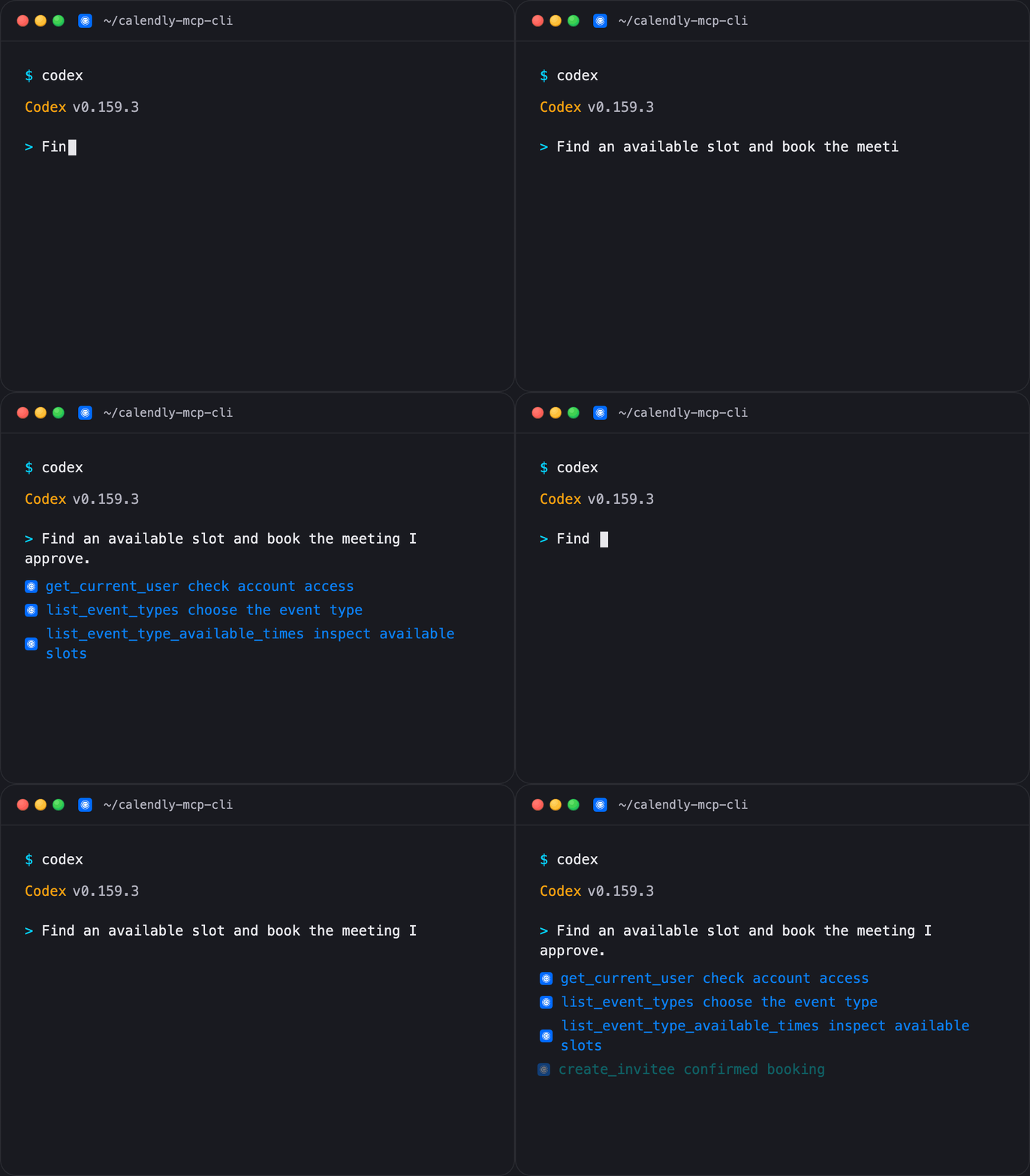
The terminal illustrates shipped scheduling tools with sample data; it is not a verified live account booking.
You need a privately configured scoped PAT or authorized REST OAuth grant. Account roles, paid features and quotas apply. The wrapper preserves AGPL-3.0-or-later; Calendly service charges remain separate. This is a community product.
Calendly already offers an official hosted MCP and a community CLI exists. Our current API coverage and tradeoffs are compared below, without unsupported coverage or efficiency claims.
Two ways to use it
Command line
npm install -g @thenavidm/calendly-mcp-cli@latest
calendly-cli
calendly-cli list-events --help
calendly-cli schema create-invitee
calendly-cli get-current-user --agent
Configure private credentials before account calls. Every write requires --confirm; --yes and --agent do not authorize changes.
MCP server, for your AI app
codex mcp add calendly -- npx -y @thenavidm/calendly-mcp-cli@latest
Then ask: Find available slots for the event type I choose, and wait for my booking details. All declared client/OS routes are in INSTALL.md.
Which one
| Where you work | Surface |
|---|---|
| Claude Code, Codex, Cursor or another shell agent | MCP, CLI or both |
| Claude Desktop chat | Local MCP or desktop bundle |
| Scripts/CI | CLI or an MCP client |
| Remote-URL-only clients with DCR support | Official hosted Calendly MCP |
Features
| Capability | CLI | MCP |
|---|---|---|
| Identity and events | get-current-user / list-events | get_current_user / list_events |
| Availability and booking | list-event-type-available-times / create-invitee | Same underscore names |
| Contacts/custom fields | list-contacts / list-contact-custom-field-definitions | Same shared schemas |
| Recaps/transcripts | list-recaps / get-transcript | Same account permissions |
| Organizations and webhooks | list-organization-memberships / list-webhooks | Same guarded writes |
| Private account labels | list-accounts | list_accounts |
| Setup diagnosis | doctor / login | CLI utilities |
Contents
| Number | Section | Covers |
|---|---|---|
| 1 | What you can ask it | Prompts and coverage |
| 2 | Quick install | CLI, MCP and desktop |
| 3 | Set up Calendly access | PAT, OAuth, scopes and quotas |
| 4 | Connect your client | All declared clients/OS |
| 5 | Check it works | Doctor and first read |
| 6 | Output, flags and exit codes | Arguments, JSON and scripting |
| 7 | MCP or CLI and token cost | Actual usage comparison |
| 8 | Every tool and argument | Every operation and argument |
| 9 | Scheduling, contacts and recap workflows | Booking, contacts, recaps and webhooks |
| 10 | Pagination, quotas and accepted operations | Opaque tokens and pending requests |
| 11 | Several private accounts | Named private grants |
| 12 | Writing safely | Confirmation and audit |
| 13 | How it works | Shared architecture and maintenance |
| 14 | Your data | Privacy and credentials |
| 15 | Environment variables | Credential, safety and tuning |
| 16 | Updates and removal | Upgrade and revoke |
| 17 | Troubleshooting | Symptoms and remedies |
| 18 | API coverage and comparisons | Official/community evidence |
| 19 | Versions | Versions and migration |
| 20 | FAQ | Accordion questions |
1. What you can ask it
- Show my current user and the event types I can access.
- Find available slots for the selected event type and time zone.
- Book the specific slot and invitee I approved.
- Read that booking before a requested cancellation.
- Find a contact and inspect its custom field definitions before changing it.
- Read an authorized meeting recap or transcript, and keep its contents private.
- Inspect existing availability rules before the requested replacement.
- List organization members, groups, routing submissions and webhook subscriptions.
The current API v2 snapshot has 65 operations. With the local account-label helper, this package exposes 66 tools: 44 reads and 22 confirmed writes. One source serves local MCP, task CLI and the bundled desktop extension. Booking sends normal calendar invites, notifications and workflows. A generated scheduling link is not a booked event.
The official hosted MCP is a strong scheduling option. This package adds local CLI use, private PAT/REST OAuth grants, named accounts, current Contacts/Notetaker operations, schema-derived help and controlled output. Coverage differences are based on reviewed documentation, not a competitor handshake or a measured superiority claim. Live account outcomes and GUI installation remain separately unverified.
2. Quick install
npm install -g @thenavidm/calendly-mcp-cli@latest
calendly-cli --version
calendly-cli login
calendly-cli doctor
calendly-cli tools
Manual CLI/local MCP requires Node 22 or newer. Discovery and schemas work without credentials; account reads need private access. The versioned desktop archive bundles production dependencies for a compatible Claude Desktop host. See INSTALL.md for every declared client and OS.
After private configuration:
codex mcp add calendly -- npx -y @thenavidm/calendly-mcp-cli@latest
codex mcp list
3. Set up Calendly access
Personal Access Token for your own account
- Sign in to the intended Calendly account.
- Open Integrations > API and webhooks, or the token page.
- Create a named Personal Access Token with the scopes your workflow requires. Copy it once into private storage.
- Set
CALENDLY_API_TOKENin private local client/shell settings, orCALENDLY_TOKEN_FILEto an absolute token-only file outside repositories. - Run
calendly-cli doctor, thencalendly-cli doctor --networkto check a user read.
See current PAT setup. The token is a Bearer credential, not your Calendly password or browser cookie. Revocation is done in Calendly. GUI clients may not inherit terminal variables; this package does not load .env automatically. On POSIX, a credential file must be owner-only, such as mode 0600; on Windows protect the file and its directory with user-only ACLs. Readers refuse symlinks and files larger than 64 KB. A PAT file takes precedence over the environment PAT, and is cached until restart.
Existing REST OAuth grant
Use your own authorized REST OAuth application when acting for users who consent to your application. This local package does not create an OAuth app, open a browser, host a callback or exchange the first authorization code. login prints setup instructions. Put an existing access token in CALENDLY_ACCESS_TOKEN, or the full grant in a private file selected by CALENDLY_TOKENS_FILE. Do not mix PAT and OAuth settings for the same account.
The token file is a JSON object containing access_token, and optionally refresh_token, client_id, client_secret, created_at (Unix seconds) and expires_in (seconds). Keep all actual values outside model context and repositories. A file is required for automatic refresh; an environment-only access token is never refreshed. The file is read on each request, allowing separate processes to observe a saved rotation. Without valid expiry metadata, one GET 401 can trigger one configured refresh; writes never retry after a 401.
Calendly's single-use refresh-token rule took effect by August 31, 2026. This package refreshes against https://calendly.com/oauth/token, uses Basic client authentication for confidential clients or a body client_id without a secret, and atomically replaces both returned tokens in mode 0600 storage. Concurrent in-process refreshes share one promise, and a per-file .refresh.lock prevents another process from consuming the same token. An existing lock produces a configuration error instead of a second refresh. A crashed process can leave a lock; stop all users of that grant and verify its state before manually removing a stale lock. Never remove an active lock.
A refresh HTTP failure, unknown timeout, incomplete response or failed save requires reauthorization/private storage repair and a restart. No automatic refresh retry occurs. The old refresh token is not deliberately reused after an uncertain result. OAuth access tokens last two hours according to the current token reference; actual expiry metadata governs proactive refresh. Token rotation fixtures are verified; live grants remain unverified.
Scopes, roles and plans
API operation descriptions list their required scopes. :write grants include the family's read access. Start with users:read for doctor, then select only needed scheduling, availability, contacts, meeting_recaps, organization, routing, group or webhook scopes. Webhooks need webhooks:write plus the corresponding event family's read scope. Reauthorize or replace the token if scopes change; an installed command cannot raise permissions.
Direct booking through create_invitee requires a paid Standard-or-higher account. Routing Forms require Teams or higher; Activity Log, outgoing communications and data-compliance deletion require Enterprise and suitable organization permissions. Notetaker endpoints require a paid plan; Contacts/Notetaker data exists only where the account and associated feature provide it. API access does not create transcripts or bypass recording/consent policy. Administrative operations depend on your actual role. See authorization scopes and the current endpoint reference before choosing a plan.
Current request limits
The quota reference documents 50 requests per user/minute on Free and 500 on paid plans. Booking has tighter limits: trial 5/day; paid non-Enterprise 10/minute, 50/hour and 100/day; Enterprise 500/minute. OAuth token requests are limited to 8/user/minute. These are shared provider limits, not allowances reserved for this process.
Default local pacing is 1,300 ms per account/process; multiple account labels for one user and other integrations share that user's quota. GET 429 handling respects Retry-After or X-RateLimit-Reset when the wait is at most ten seconds. Longer waits surface exit 7 so a script can pause explicitly, rather than retry too early. Writes and OAuth refresh requests have zero automatic retries. Every page and retried read consumes quota.
Official hosted MCP is a separate connection
Calendly's official MCP is hosted at https://mcp.calendly.com. It uses OAuth 2.1, PKCE S256, resource discovery and Dynamic Client Registration. It does not accept a PAT or a manually provisioned console client_id/client_secret connection. A client prompting only for static OAuth credentials is incompatible with that documented flow. The documentation search MCP at https://developer.calendly.com/_mcp/server reads docs; it does not operate your account. Keep all three entries distinct.
4. Connect your client
INSTALL.md covers Claude Code, Codex, Claude Desktop extension/manual config, Cursor, VS Code/Copilot, Windsurf, Zed, Gemini CLI, Cline, Docker and other stdio clients on macOS, Windows and Linux. Use npx -y @thenavidm/calendly-mcp-cli@latest as the local server command, with private environment settings. MCP and CLI are two ways to reach the same operations; installing both is optional.
A remote-URL-only client needs a hosted connector such as Calendly's official https://mcp.calendly.com, with DCR OAuth support. This package does not expose a public HTTP relay. Installing a local server does not connect it to a browser-only app. Place SKILL.md in the agent's supported skills folder if using shell commands; npm does not register it automatically. Ask the agent to inspect current help/schemas and assist with private setup without asking you to paste credentials into chat.
5. Check it works
calendly-cli --version
calendly-cli doctor
calendly-cli doctor --network
calendly-cli list-accounts --agent
calendly-cli get-current-user --agent
The local doctor checks configuration. Network doctor reads /users/me and reports success without printing user details; it does not book, cancel or invite anyone. A successful read proves that read's access, not every endpoint/plan permission. Full discovery has 66 tools; read-only has 44. Use the returned canonical user and organization URIs in subsequent filters, rather than substituting a bare UUID.
6. Output, flags and exit codes
Tool names become dashed commands; underscores are accepted too. Path parameter names follow the discovered schema, such as event_uuid → --event-uuid. Body tools accept individual top-level flags, complete --payload JSON, or --payload-file pointing to a regular JSON body file up to 5 MB. Do not mix those body routes. Path/query flags remain separate. Nested objects take JSON and array flags repeat once per item; a whole array is not a single item.
calendly-cli get-event --help
calendly-cli schema create-invitee
calendly-cli list-events --user https://api.calendly.com/users/USER_UUID --count 10 --agent
calendly-cli list-contacts --email [email protected] --count 5 --agent
UUIDs and URIs are illustrative; use resources discovered in your own account. Nullable fields require an actual JSON null inside payload; --field null is a string. Nested request properties follow the current schema; unknown top-level body fields are refused. Body-required fields are validated during execution even when the wrapper schema allows an alternative payload route. Operations whose upstream request body is required need body flags or an explicit payload; a deliberately supplied empty object is sent as JSON, never omitted.
| Flag | Behavior |
|---|---|
| --help / schema COMMAND | Current argument help / full JSON Schema |
| --json | Structured JSON |
| --compact | One-line JSON |
| --agent | Compact JSON and no prompts; never confirms a write |
| --select a,b.c | Keep selected fields, including nested objects/arrays |
| --no-color / --no-input | Noninteractive house flags |
| --yes | Never replaces write confirmation |
| --confirm | Confirm only the requested mutation |
| --account NAME | Select private local credentials |
| --payload JSON / --payload-file PATH | Complete request body, mutually exclusive with body flags |
| Exit | Meaning |
|---|---|
| 0 | Success |
| 1 | Unexpected error |
| 2 | Invalid arguments or refused write, an unknown command or a hidden write |
| 3 | Resource not found |
| 4 | Authentication/permission failure |
| 5 | API/transport failure |
| 7 | Rate limit |
| 10 | Missing or invalid private configuration |
Results go to stdout, errors as JSON to stderr. Selection changes local output, not the original API response or quota charge. API success is not proof of notification delivery or a completed export.
7. MCP or CLI and token cost
MCP and CLI are built by Slipway from each tool's one definition, so they share schemas, validation and HTTP handlers; there is no second API implementation.
Measured on 2026-10-05 against 2.0.1, the same day, with Claude Code 2.1.286 on Claude Opus 5.5 (one short prompt with and without the server connected, the difference read from the API's own usage figures) and Codex 0.159.3 on gpt-6.1-sol:
| Cost | 2.0.1 | 3.0.0 |
|---|---|---|
| Claude Code, every tool loaded, every message | 47,642 | 39,979 |
| Claude Code's default, tool search, every message | 1,169 | 1,169 |
SKILL.md, read once |
1,382 | 1,444 |
| Codex over the CLI, one task, median of five | 83,991 | 83,073 |
| Codex over MCP, the same task, median of five | 48,565 | 48,780 |
The task was "find the command that cancels a scheduled event, and the flags it requires". Every tool loaded costs less because each write's body appeared twice, as its own fields and inside payload, and 3.0.0 writes each repeated part once under $defs. Over the CLI, every 3.0.0 run asked which (255 characters) where 2.0.1's read the full command list (4,745). Over MCP, Codex prints its own TypeScript rendering of the tool list, cut to about 10,000 tokens, and that rendering is longer on 3.0.0, 31,126 tokens against 29,830: Codex leaves the argument descriptions out of a tool whose schema is large, and sharing the repeats brought create_contact and update_contact under that size, so Codex now shows their descriptions. SKILL.md costs 62 more because it now says how approval works over MCP and lists every exit code.
API quota and service costs remain separate, and no other offering was measured.
8. Every tool and argument
All 65 API operations come from the pinned current official OpenAPI. list_accounts is local. Each tool is the same dashed CLI command. Top-level flags and nested request fields are shown below; schema COMMAND returns complete unions, enums and conditional rules. Body requirements apply whether you use individual flags or payload/payload_file.
| Tool | REST operation | Mode | Required scope |
|---|---|---|---|
list_activity_log |
GET /activity_log_entries |
Read | activity_log:read |
get_availability_schedule |
GET /user_availability_schedules/{uuid} |
Read | availability:read |
list_event_type_availability_schedules |
GET /event_type_availability_schedules |
Read | availability:read |
update_event_type_availability_schedules |
PATCH /event_type_availability_schedules |
Write, confirms | availability:write |
list_availability_schedules |
GET /user_availability_schedules |
Read | availability:read |
list_user_busy_times |
GET /user_busy_times |
Read | availability:read |
create_contact |
POST /contacts |
Write, confirms | contacts:write |
list_contacts |
GET /contacts |
Read | contacts:read |
delete_contact |
DELETE /contacts/{uuid} |
Write, confirms | contacts:write |
get_contact |
GET /contacts/{uuid} |
Read | contacts:read |
update_contact |
PATCH /contacts/{uuid} |
Write, confirms | contacts:write |
get_contact_custom_field_definition |
GET /contacts/custom_field_definitions/{uuid} |
Read | contacts:read |
list_contact_custom_field_definitions |
GET /contacts/custom_field_definitions |
Read | contacts:read |
delete_invitee_data |
POST /data_compliance/deletion/invitees |
Write, confirms | data_compliance:write |
delete_scheduled_event_data |
POST /data_compliance/deletion/events |
Write, confirms | data_compliance:write |
create_event_type |
POST /event_types |
Write, confirms | event_types:write |
list_event_types |
GET /event_types |
Read | event_types:read |
create_one_off_event_type |
POST /one_off_event_types |
Write, confirms | event_types:write |
get_event_type |
GET /event_types/{uuid} |
Read | event_types:read |
update_event_type |
PATCH /event_types/{uuid} |
Write, confirms | event_types:write |
list_event_type_available_times |
GET /event_type_available_times |
Read | availability:read |
list_event_type_hosts |
GET /event_type_memberships |
Read | event_types:read |
get_group |
GET /groups/{uuid} |
Read | groups:read |
get_group_relationship |
GET /group_relationships/{uuid} |
Read | groups:read |
list_group_relationships |
GET /group_relationships |
Read | groups:read |
list_groups |
GET /groups |
Read | groups:read |
list_user_locations |
GET /locations |
Read | locations:read |
delete_recap |
DELETE /meeting_recaps/{uuid} |
Write, confirms | meeting_recaps:write |
get_recap |
GET /meeting_recaps/{uuid} |
Read | meeting_recaps:read |
update_recap |
PATCH /meeting_recaps/{uuid} |
Write, confirms | meeting_recaps:write |
get_transcript |
GET /meeting_recaps/{uuid}/transcript |
Read | meeting_recaps:read |
list_recaps |
GET /meeting_recaps |
Read | meeting_recaps:read |
get_organization |
GET /organizations/{uuid} |
Read | organizations:read |
get_organization_invitation |
GET /organizations/{org_uuid}/invitations/{uuid} |
Read | organizations:read |
revoke_organization_invitation |
DELETE /organizations/{org_uuid}/invitations/{uuid} |
Write, confirms | organizations:write |
get_organization_membership |
GET /organization_memberships/{uuid} |
Read | organizations:read |
remove_from_organization |
DELETE /organization_memberships/{uuid} |
Write, confirms | organizations:write |
get_team |
GET /teams/{team_uuid} |
Read | organizations:read |
invite_to_organization |
POST /organizations/{uuid}/invitations |
Write, confirms | organizations:write |
list_organization_invitations |
GET /organizations/{uuid}/invitations |
Read | organizations:read |
list_organization_memberships |
GET /organization_memberships |
Read | organizations:read |
list_teams |
GET /teams |
Read | organizations:read |
list_outgoing_communications |
GET /outgoing_communications |
Read | outgoing_communications:read |
get_routing_form |
GET /routing_forms/{uuid} |
Read | routing_forms:read |
get_routing_form_submission |
GET /routing_form_submissions/{uuid} |
Read | routing_forms:read |
list_routing_form_submissions |
GET /routing_form_submissions |
Read | routing_forms:read |
list_routing_forms |
GET /routing_forms |
Read | routing_forms:read |
cancel_event |
POST /scheduled_events/{uuid}/cancellation |
Write, confirms | scheduled_events:write |
create_invitee |
POST /invitees |
Write, confirms | scheduled_events:write |
create_no_show |
POST /invitee_no_shows |
Write, confirms | scheduled_events:write |
delete_no_show |
DELETE /invitee_no_shows/{uuid} |
Write, confirms | scheduled_events:write |
get_no_show |
GET /invitee_no_shows/{uuid} |
Read | scheduled_events:read |
get_event |
GET /scheduled_events/{uuid} |
Read | scheduled_events:read |
get_event_invitee |
GET /scheduled_events/{event_uuid}/invitees/{invitee_uuid} |
Read | scheduled_events:read |
list_event_invitees |
GET /scheduled_events/{uuid}/invitees |
Read | scheduled_events:read |
list_events |
GET /scheduled_events |
Read | scheduled_events:read |
create_scheduling_link |
POST /scheduling_links |
Write, confirms | scheduling_links:write |
create_share |
POST /shares |
Write, confirms | shares:write |
get_current_user |
GET /users/me |
Read | users:read |
get_user |
GET /users/{uuid} |
Read | users:read |
create_webhook |
POST /webhook_subscriptions |
Write, confirms | scheduled_events:read, event_types:read, meeting_recaps:read, routing_forms:read, contacts:read, webhooks:write |
list_webhooks |
GET /webhook_subscriptions |
Read | webhooks:read |
delete_webhook |
DELETE /webhook_subscriptions/{webhook_uuid} |
Write, confirms | webhooks:write |
get_webhook |
GET /webhook_subscriptions/{webhook_uuid} |
Read | webhooks:read |
get_sample_webhook_data |
GET /sample_webhook_data |
Read | webhooks:read |
list_accounts |
Local, no network | Read | None |
list_activity_log
calendly-cli list-activity-log · GET /activity_log_entries
| Argument | Route | Required | Type | Details |
|---|---|---|---|---|
organization |
query organization |
Yes | string | Return activity log entries from the organization associated with this URI format: uri. |
search_term |
query search_term |
No | string | Filters entries based on the search term. Supported operators: - / - to allow filtering by one term or another. Example: this / that - + - to allow filtering by one term and another. Example: this + that - " - to allow filtering by an exact search term. Example: "[email protected]" - - - to omit specific terms from results. Example: Added -User - () - to allow specifying precedence during a search. Example: (this + that) OR (person + place) - * - to allow prefix searching. Example *@other-website.com maxLength: 300. |
actor |
query actor |
No | array | Return entries from the user(s) associated with the provided URIs Array items: string. |
sort |
query sort |
No | array | Order results by the specified field and direction. List of {field}:{direction} values. default: ['occurred_at:desc']. Array items: string. |
min_occurred_at |
query min_occurred_at |
No | string | Include entries that occurred after this time (sample time format: "2020-01-02T03:04:05.678Z"). This time should use the UTC timezone. format: date-time. |
max_occurred_at |
query max_occurred_at |
No | string | Include entries that occurred prior to this time (sample time format: "2020-01-02T03:04:05.678Z"). This time should use the UTC timezone. format: date-time. |
page_token |
query page_token |
No | string | The token to pass to get the next portion of the collection |
count |
query count |
No | integer | The number of rows to return minimum: 1. maximum: 100. default: 20. |
namespace |
query namespace |
No | array | The categories of the entries Array items: string. |
action |
query action |
No | array | The action(s) associated with the entries Array items: string. |
account |
Local | No | string | Named private credential label |
all_pages |
Local paging | No | boolean | Bounded native page_token collection; at most 100 requests |
max_items |
Local paging | No | integer | 1 to 10000, default 1000; requires all_pages |
get_availability_schedule
calendly-cli get-availability-schedule · GET /user_availability_schedules/{uuid}
| Argument | Route | Required | Type | Details |
|---|---|---|---|---|
schedule_uuid |
path uuid |
Yes | string | The UUID of the availability schedule. minLength: 1. pattern: ^[A-Za-z0-9_-]+$. |
account |
Local | No | string | Named private credential label |
list_event_type_availability_schedules
calendly-cli list-event-type-availability-schedules · GET /event_type_availability_schedules
| Argument | Route | Required | Type | Details |
|---|---|---|---|---|
event_type |
query event_type |
Yes | string | The URI associated with the event type format: uri. |
account |
Local | No | string | Named private credential label |
update_event_type_availability_schedules
calendly-cli update-event-type-availability-schedules · PATCH /event_type_availability_schedules
| Argument | Route | Required | Type | Details |
|---|---|---|---|---|
event_type |
query event_type |
Yes | string | Event Type uri in which to update the availability schedule format: uri. |
availability_rule |
Body | Yes in body | object | Object requires: timezone. |
availability_rule.timezone |
Nested body | Yes in body | string | The timezone for which this Event Type Availability Schedule is originated in. |
availability_rule.rules |
Nested body | No | array | The rules for an availability schedule. Warning: Updating rules will overwrite all existing rules for the event type. Use the GET endpoint to first retrieve the existing rules and then pass the modified rules to the rules object. Array items: object. |
availability_rule.rules[].type |
Nested body | Yes in body | string | The type of this Availability Rule; can be "wday" or a specific "date". Values: wday, date. |
availability_rule.rules[].intervals |
Nested body | Yes in body | array | The intervals to be applied to this Rule. Each interval represents when booking a meeting is allowed. If the interval array is empty, then there is no booking availability for that day. Time is in 24h format (i.e. "17:30") and local to the timezone in the Availability Schedule. Array items: object. |
availability_rule.rules[].intervals[].from |
Nested body | No | string | Format: "hh:mm" pattern: (\d\d):(\d\d). |
availability_rule.rules[].intervals[].to |
Nested body | No | string | Format: "hh:mm" pattern: (\d\d):(\d\d). |
availability_rule.rules[].wday |
Nested body | No | string | The day of the week for which this Rule should be applied to. Values: sunday, monday, tuesday, wednesday, thursday, friday, saturday. |
availability_rule.rules[].date |
Nested body | No | string | A specific date in the future that this should be applied to (i.e. "2030-12-31"). pattern: ^\d{4}-(0?[1-9]/1[012])-(0?[1-9]/[12][0-9]/3[01])$. |
availability_rule.user |
Nested body | No | string | Required when an admin or org owner is making the call to update a specific users availability schedule format: uri. |
availability_setting |
Body | No | string | By default every host on the Event Type shares an identical schedule. default: host. Values: host. |
account |
Local | No | string | Named private credential label |
confirm |
Guard | Yes to execute | boolean | Explicit true for this requested mutation |
payload |
Complete body | Alternative | object | Complete current body JSON; no mixed body flags |
payload_file |
Complete body | Alternative | string | Regular local JSON file, at most 5 MB |
list_availability_schedules
calendly-cli list-availability-schedules · GET /user_availability_schedules
| Argument | Route | Required | Type | Details |
|---|---|---|---|---|
user |
query user |
Yes | string | A URI reference to a user format: uri. |
account |
Local | No | string | Named private credential label |
list_user_busy_times
calendly-cli list-user-busy-times · GET /user_busy_times
| Argument | Route | Required | Type | Details |
|---|---|---|---|---|
user |
query user |
Yes | string | The uri associated with the user format: uri. |
start_time |
query start_time |
Yes | string | Start time of the requested availability range. Date cannot be in the past. |
end_time |
query end_time |
Yes | string | End time of the requested availability range. Date must be in the future of start_time. |
account |
Local | No | string | Named private credential label |
create_contact
calendly-cli create-contact · POST /contacts
| Argument | Route | Required | Type | Details |
|---|---|---|---|---|
name |
Body | Yes in body | string | Current schema |
emails |
Body | Yes in body | array | The user's email addresses. Max 10. minItems: 1. maxItems: 10. Array items: object. |
emails[].email |
Nested body | Yes in body | string | Email address. format: email. |
emails[].is_primary |
Nested body | Yes in body | boolean | Whether this is the primary email. |
phone_numbers |
Body | No | array | The user's phone numbers. Max 10. maxItems: 10. Array items: object. |
phone_numbers[].phone_number |
Nested body | Yes in body | string | Phone number. |
timezone |
Body | No | string | Current schema |
job_title |
Body | No | string | Current schema |
company |
Body | No | string | Current schema |
country |
Body | No | string | Current schema |
state |
Body | No | string | Current schema |
city |
Body | No | string | Current schema |
linkedin |
Body | No | string | format: uri. |
custom_fields |
Body | No | array | Custom field values to set on the contact. Each item requires a uuid (the custom field definition identifier) and a value; any other keys (such as label) are ignored. The entire request is rejected if any uuid is unknown, any value is the wrong type for its field (including an array for a scalar field or a scalar for an array field), or any single_select value is not one of the field definition's option uuids. Array items: object. |
custom_fields[].uuid |
Nested body | Yes in body | string | Unique identifier of the custom field definition. |
custom_fields[].value |
Nested body | Yes in body | JSON union | The custom field value; the accepted type is set by the field definition's field_type. text and single_select take a string (single_select must equal one of the definition's option uuids); number takes a number; boolean takes a boolean; currency takes an integer amount in the currency's minor units (the ISO currency code lives on the field definition, not on this entry); date takes a string in ISO 8601 date format (YYYY-MM-DD); tags takes an array of strings. Scalar fields reject array values, and tags rejects non-array values. Exactly one of 2 schema branches; inspect schema for nested requirements. |
account |
Local | No | string | Named private credential label |
confirm |
Guard | Yes to execute | boolean | Explicit true for this requested mutation |
payload |
Complete body | Alternative | object | Complete current body JSON; no mixed body flags |
payload_file |
Complete body | Alternative | string | Regular local JSON file, at most 5 MB |
list_contacts
calendly-cli list-contacts · GET /contacts
| Argument | Route | Required | Type | Details |
|---|---|---|---|---|
sort |
query sort |
No | string | Order results by the specified field and direction. Accepts comma-separated list of {field}:{direction} values. Supported fields are: created_at, updated_at. Sort direction is specified as: asc, desc. |
email |
query email |
No | string | Filter results by exact match on email address. Accepts a comma-separated list. |
phone_number |
query phone_number |
No | string | Filter results by exact match on phone number. Accepts a comma-separated list. |
timezone |
query timezone |
No | string | Filter results by exact match on the IANA time zone name(s). Accepts a comma-separated list of time zones. |
name |
query name |
No | string | Filter results by partial match on name(s). Accepts a comma-separated list-- each segment is matched independently (commas in the query string separate values). |
job_title |
query job_title |
No | string | Filter results by partial match on job title(s). Accepts a comma-separated list-- each segment is matched independently (commas in the query string separate values). |
company |
query company |
No | string | Filter results by partial match on company name(s). Accepts a comma-separated list-- each segment is matched independently (commas in the query string separate values). |
country |
query country |
No | string | Filter results by exact match on two-letter country code (ISO 3166-1 alpha-2). Accepts a comma-separated list. |
state |
query state |
No | string | Filter results by exact match on state(s), province(s), or region(s). Accepts a comma-separated list of values. |
city |
query city |
No | string | Filter results by partial match on city(ies). Accepts a comma-separated list-- each segment is matched independently (commas in the query string separate values). |
count |
query count |
No | integer | The number of rows to return minimum: 1. maximum: 100. default: 20. |
page_token |
query page_token |
No | string | The token to pass to get the next or previous portion of the collection |
exclude |
query exclude |
No | string | Omit the listed fields from the response. Currently only custom_fields is supported. When omitted, all fields are returned. |
account |
Local | No | string | Named private credential label |
all_pages |
Local paging | No | boolean | Bounded native page_token collection; at most 100 requests |
max_items |
Local paging | No | integer | 1 to 10000, default 1000; requires all_pages |
delete_contact
calendly-cli delete-contact · DELETE /contacts/{uuid}
| Argument | Route | Required | Type | Details |
|---|---|---|---|---|
contact_uuid |
path uuid |
Yes | string | minLength: 1. pattern: ^[A-Za-z0-9_-]+$. |
account |
Local | No | string | Named private credential label |
confirm |
Guard | Yes to execute | boolean | Explicit true for this requested mutation |
get_contact
calendly-cli get-contact · GET /contacts/{uuid}
| Argument | Route | Required | Type | Details |
|---|---|---|---|---|
contact_uuid |
path uuid |
Yes | string | minLength: 1. pattern: ^[A-Za-z0-9_-]+$. |
exclude |
query exclude |
No | string | Omit the listed fields from the response. Currently only custom_fields is supported. When omitted, all fields are returned. |
account |
Local | No | string | Named private credential label |
update_contact
calendly-cli update-contact · PATCH /contacts/{uuid}
| Argument | Route | Required | Type | Details |
|---|---|---|---|---|
contact_uuid |
path uuid |
Yes | string | minLength: 1. pattern: ^[A-Za-z0-9_-]+$. |
name |
Body | No | string | Current schema |
emails |
Body | No | array | The user's email addresses. Max 10. Warning: Updating emails will overwrite all existing emails for the contact. Use the GET endpoint to first retrieve the existing emails and then pass the modified emails to the emails array. minItems: 1. maxItems: 10. Array items: object. |
emails[].email |
Nested body | Yes in body | string | Email address. format: email. |
emails[].is_primary |
Nested body | Yes in body | boolean | Whether this is the primary email. |
phone_numbers |
Body | No | array | The user's phone numbers. Max 10. Warning: Updating phone_numbers will overwrite all existing phone numbers for the contact. Use the GET endpoint to first retrieve the existing phone numbers and then pass the modified phone_numbers to the phone_numbers array. maxItems: 10. Array items: object. |
phone_numbers[].phone_number |
Nested body | Yes in body | string | Phone number. |
timezone |
Body | No | string | Current schema |
job_title |
Body | No | string | Current schema |
company |
Body | No | string | Current schema |
country |
Body | No | string | Current schema |
state |
Body | No | string | Current schema |
city |
Body | No | string | Current schema |
linkedin |
Body | No | string | format: uri. |
custom_fields |
Body | No | array | Custom field values to set on the contact. Each item requires a uuid (the custom field definition identifier) and a value; any other keys (such as label) are ignored. The entire request is rejected if any uuid is unknown, any value is the wrong type for its field (including an array for a scalar field or a scalar for an array field), or any single_select value is not one of the field definition's option uuids. Array items: object. |
custom_fields[].uuid |
Nested body | Yes in body | string | Unique identifier of the custom field definition. |
custom_fields[].value |
Nested body | Yes in body | JSON union | The custom field value; the accepted type is set by the field definition's field_type. text and single_select take a string (single_select must equal one of the definition's option uuids); number takes a number; boolean takes a boolean; currency takes an integer amount in the currency's minor units (the ISO currency code lives on the field definition, not on this entry); date takes a string in ISO 8601 date format (YYYY-MM-DD); tags takes an array of strings. Scalar fields reject array values, and tags rejects non-array values. Exactly one of 2 schema branches; inspect schema for nested requirements. |
account |
Local | No | string | Named private credential label |
confirm |
Guard | Yes to execute | boolean | Explicit true for this requested mutation |
payload |
Complete body | Alternative | object | Complete current body JSON; no mixed body flags |
payload_file |
Complete body | Alternative | string | Regular local JSON file, at most 5 MB |
get_contact_custom_field_definition
calendly-cli get-contact-custom-field-definition · GET /contacts/custom_field_definitions/{uuid}
| Argument | Route | Required | Type | Details |
|---|---|---|---|---|
definition_uuid |
path uuid |
Yes | string | minLength: 1. pattern: ^[A-Za-z0-9_-]+$. |
account |
Local | No | string | Named private credential label |
list_contact_custom_field_definitions
calendly-cli list-contact-custom-field-definitions · GET /contacts/custom_field_definitions
| Argument | Route | Required | Type | Details |
|---|---|---|---|---|
account |
Local | No | string | Named private credential label |
delete_invitee_data
calendly-cli delete-invitee-data · POST /data_compliance/deletion/invitees
| Argument | Route | Required | Type | Details |
|---|---|---|---|---|
emails |
Body | Yes in body | array | Array items: string. |
account |
Local | No | string | Named private credential label |
confirm |
Guard | Yes to execute | boolean | Explicit true for this requested mutation |
payload |
Complete body | Alternative | object | Complete current body JSON; no mixed body flags |
payload_file |
Complete body | Alternative | string | Regular local JSON file, at most 5 MB |
delete_scheduled_event_data
calendly-cli delete-scheduled-event-data · POST /data_compliance/deletion/events
| Argument | Route | Required | Type | Details |
|---|---|---|---|---|
start_time |
Body | Yes in body | string | The scheduled events UTC timestamp at which data deletion should begin. format: date-time. |
end_time |
Body | Yes in body | string | The scheduled events UTC timestamp at which data deletion should end. format: date-time. |
account |
Local | No | string | Named private credential label |
confirm |
Guard | Yes to execute | boolean | Explicit true for this requested mutation |
payload |
Complete body | Alternative | object | Complete current body JSON; no mixed body flags |
payload_file |
Complete body | Alternative | string | Regular local JSON file, at most 5 MB |
create_event_type
calendly-cli create-event-type · POST /event_types
| Argument | Route | Required | Type | Details |
|---|---|---|---|---|
active |
Body | No | boolean | Indicates if the event type is active or not default: False. |
owner |
Body | Yes in body | string | The owner for this event type format: uri. |
name |
Body | Yes in body | string | The event type name |
description |
Body | No | string | The event type description |
duration |
Body | No | integer | The length of sessions booked with this event type. Must be one of the duration options if they're provided. minimum: 1. maximum: 720. |
duration_options |
Body | No | array | A maximum of 4 unique options is allowed. Each option must be >= 1 and <= 720. Array items: integer. |
locations |
Body | No | array | Configuration information for each possible location for this event type Array items: object. |
locations[].kind |
Nested body | No | string | Values: ask_invitee, custom, google_conference, gotomeeting_conference, inbound_call, microsoft_teams_conference, outbound_call, physical, webex_conference, zoom_conference. |
locations[].location |
Nested body | No | string | Current schema |
locations[].additional_info |
Nested body | No | string | Current schema |
locations[].phone_number |
Nested body | No | string | Current schema |
color |
Body | No | string | The hexadecimal color value of the event type's scheduling page pattern: ^#[a-f\d]{6}$. |
locale |
Body | No | string | The locale on the event type, used to determine the language of the event type's scheduling page Values: de, en, es, fr, it, nl, pt, uk. |
account |
Local | No | string | Named private credential label |
confirm |
Guard | Yes to execute | boolean | Explicit true for this requested mutation |
payload |
Complete body | Alternative | object | Complete current body JSON; no mixed body flags |
payload_file |
Complete body | Alternative | string | Regular local JSON file, at most 5 MB |
list_event_types
calendly-cli list-event-types · GET /event_types
| Argument | Route | Required | Type | Details |
|---|---|---|---|---|
active |
query active |
No | boolean | Return only active event types if true, only inactive if false, or all event types if this parameter is omitted. |
organization |
query organization |
No | string | View available personal, team, and organization event types associated with the organization's URI. format: uri. |
user |
query user |
No | string | View available personal, team, and organization event types associated with the user's URI. format: uri. |
user_availability_schedule |
query user_availability_schedule |
No | string | Used in conjunction with user parameter, returns a filtered list of Event Types that use the given primary availability schedule. format: uri. |
sort |
query sort |
No | string | Order results by the specified field and direction. Accepts comma-separated list of {field}:{direction} values.Supported fields are: name, position, created_at, updated_at. Sort direction is specified as: asc, desc. default: name:asc. |
admin_managed |
query admin_managed |
No | boolean | Return only admin managed event types if true, exclude admin managed event types if false, or include all event types if this parameter is omitted. |
page_token |
query page_token |
No | string | The token to pass to get the next or previous portion of the collection |
count |
query count |
No | integer | The number of rows to return minimum: 1. maximum: 100. default: 20. |
account |
Local | No | string | Named private credential label |
all_pages |
Local paging | No | boolean | Bounded native page_token collection; at most 100 requests |
max_items |
Local paging | No | integer | 1 to 10000, default 1000; requires all_pages |
create_one_off_event_type
calendly-cli create-one-off-event-type · POST /one_off_event_types
| Argument | Route | Required | Type | Details |
|---|---|---|---|---|
name |
Body | Yes in body | string | Event type name maxLength: 55. |
host |
Body | Yes in body | string | Host user uri format: uri. |
co_hosts |
Body | No | array | Collection of meeting co-host(s) user URIs Array items: string. |
duration |
Body | Yes in body | number | Duration of meeting in minutes maximum: 720. |
timezone |
Body | No | string | Time zone used for meeting. Defaults to host's time zone. |
date_setting |
Body | Yes in body | JSON union | Exactly one of 3 schema branches; inspect schema for nested requirements. |
location |
Body | No | JSON union | Exactly one of 10 schema branches; inspect schema for nested requirements. |
account |
Local | No | string | Named private credential label |
confirm |
Guard | Yes to execute | boolean | Explicit true for this requested mutation |
payload |
Complete body | Alternative | object | Complete current body JSON; no mixed body flags |
payload_file |
Complete body | Alternative | string | Regular local JSON file, at most 5 MB |
get_event_type
calendly-cli get-event-type · GET /event_types/{uuid}
| Argument | Route | Required | Type | Details |
|---|---|---|---|---|
event_type_uuid |
path uuid |
Yes | string | minLength: 1. pattern: ^[A-Za-z0-9_-]+$. |
account |
Local | No | string | Named private credential label |
update_event_type
calendly-cli update-event-type · PATCH /event_types/{uuid}
| Argument | Route | Required | Type | Details |
|---|---|---|---|---|
event_type_uuid |
path uuid |
Yes | string | minLength: 1. pattern: ^[A-Za-z0-9_-]+$. |
active |
Body | No | boolean | Indicates if the event type is active or not |
name |
Body | No | string | The event type name |
color |
Body | No | string | The hexadecimal color value of the event type's scheduling page pattern: ^#[a-f\d]{6}$. |
description |
Body | No | string | The event type description |
duration |
Body | No | integer | The length of sessions booked with this event type. Must be one of the duration options if they're provided. minimum: 1. maximum: 720. |
duration_options |
Body | No | array | A maximum of 4 unique options is allowed. Each option must be >= 1 and <= 720. Array items: integer. |
locale |
Body | No | string | The locale on the event type, used to determine the language of the event type's scheduling page Values: de, en, es, fr, it, nl, pt, uk. |
locations |
Body | No | array | Configuration information for each possible location for this Event Type Array items: object. |
locations[].kind |
Nested body | No | string | Values: ask_invitee, custom, google_conference, gotomeeting_conference, inbound_call, microsoft_teams_conference, outbound_call, physical, webex_conference, zoom_conference. |
locations[].location |
Nested body | No | string | Current schema |
locations[].additional_info |
Nested body | No | string | Current schema |
locations[].phone_number |
Nested body | No | string | Current schema |
account |
Local | No | string | Named private credential label |
confirm |
Guard | Yes to execute | boolean | Explicit true for this requested mutation |
payload |
Complete body | Alternative | object | Complete current body JSON; no mixed body flags |
payload_file |
Complete body | Alternative | string | Regular local JSON file, at most 5 MB |
list_event_type_available_times
calendly-cli list-event-type-available-times · GET /event_type_available_times
| Argument | Route | Required | Type | Details |
|---|---|---|---|---|
event_type |
query event_type |
Yes | string | The uri associated with the event type format: uri. |
start_time |
query start_time |
Yes | string | Start time of the requested availability range. Date cannot be in the past. format: date-time. |
end_time |
query end_time |
Yes | string | End time of the requested availability range. Date must be in the future and no greater than 31 days from start_time. format: date-time. |
account |
Local | No | string | Named private credential label |
list_event_type_hosts
calendly-cli list-event-type-hosts · GET /event_type_memberships
| Argument | Route | Required | Type | Details |
|---|---|---|---|---|
event_type |
query event_type |
Yes | string | The uri associated with the event type format: uri. |
count |
query count |
No | integer | The number of rows to return minimum: 1. maximum: 100. default: 20. |
page_token |
query page_token |
No | string | The token to pass to get the next or previous portion of the collection |
account |
Local | No | string | Named private credential label |
all_pages |
Local paging | No | boolean | Bounded native page_token collection; at most 100 requests |
max_items |
Local paging | No | integer | 1 to 10000, default 1000; requires all_pages |
get_group
calendly-cli get-group · GET /groups/{uuid}
| Argument | Route | Required | Type | Details |
|---|---|---|---|---|
group_uuid |
path uuid |
Yes | string | Group unique identifier minLength: 1. pattern: ^[A-Za-z0-9_-]+$. |
account |
Local | No | string | Named private credential label |
get_group_relationship
calendly-cli get-group-relationship · GET /group_relationships/{uuid}
| Argument | Route | Required | Type | Details |
|---|---|---|---|---|
relationship_uuid |
path uuid |
Yes | string | minLength: 1. pattern: ^[A-Za-z0-9_-]+$. |
account |
Local | No | string | Named private credential label |
list_group_relationships
calendly-cli list-group-relationships · GET /group_relationships
| Argument | Route | Required | Type | Details |
|---|---|---|---|---|
count |
query count |
No | integer | The number of rows to return minimum: 1. maximum: 100. default: 20. |
page_token |
query page_token |
No | string | The token to pass to get the next or previous portion of the collection |
organization |
query organization |
No | string | Indicates the results should be filtered by organization format: uri. |
owner |
query owner |
No | string | Indicates the results should be filtered by owner One Of: - Organization Membership URI - https://api.calendly.com/organization_memberships/AAAAAAAAAAAAAAAA - Organization Invitation URI - https://api.calendly.com/organizations/AAAAAAAAAAAAAAAA/invitations/BBBBBBBBBBBBBBBB format: uri. |
group |
query group |
No | string | Indicates the results should be filtered by group format: uri. |
account |
Local | No | string | Named private credential label |
all_pages |
Local paging | No | boolean | Bounded native page_token collection; at most 100 requests |
max_items |
Local paging | No | integer | 1 to 10000, default 1000; requires all_pages |
list_groups
calendly-cli list-groups · GET /groups
| Argument | Route | Required | Type | Details |
|---|---|---|---|---|
organization |
query organization |
Yes | string | Return groups that are associated with the organization associated with this URI format: uri. |
page_token |
query page_token |
No | string | The token to pass to get the next or previous portion of the collection |
count |
query count |
No | integer | The number of rows to return minimum: 1. maximum: 100. default: 20. |
account |
Local | No | string | Named private credential label |
all_pages |
Local paging | No | boolean | Bounded native page_token collection; at most 100 requests |
max_items |
Local paging | No | integer | 1 to 10000, default 1000; requires all_pages |
list_user_locations
calendly-cli list-user-locations · GET /locations
| Argument | Route | Required | Type | Details |
|---|---|---|---|---|
user |
query user |
Yes | string | The URI associated with the user format: uri. |
account |
Local | No | string | Named private credential label |
delete_recap
calendly-cli delete-recap · DELETE /meeting_recaps/{uuid}
| Argument | Route | Required | Type | Details |
|---|---|---|---|---|
recap_uuid |
path uuid |
Yes | string | minLength: 1. pattern: ^[A-Za-z0-9_-]+$. |
account |
Local | No | string | Named private credential label |
confirm |
Guard | Yes to execute | boolean | Explicit true for this requested mutation |
get_recap
calendly-cli get-recap · GET /meeting_recaps/{uuid}
| Argument | Route | Required | Type | Details |
|---|---|---|---|---|
recap_uuid |
path uuid |
Yes | string | minLength: 1. pattern: ^[A-Za-z0-9_-]+$. |
account |
Local | No | string | Named private credential label |
update_recap
calendly-cli update-recap · PATCH /meeting_recaps/{uuid}
| Argument | Route | Required | Type | Details |
|---|---|---|---|---|
recap_uuid |
path uuid |
Yes | string | minLength: 1. pattern: ^[A-Za-z0-9_-]+$. |
summary_md |
Body | No | string/null | Summary in Markdown. |
action_items_md |
Body | No | string/null | Action items in Markdown. |
discussion_md |
Body | No | string/null | Discussion notes in Markdown. |
account |
Local | No | string | Named private credential label |
confirm |
Guard | Yes to execute | boolean | Explicit true for this requested mutation |
payload |
Complete body | Alternative | object | Complete current body JSON; no mixed body flags |
payload_file |
Complete body | Alternative | string | Regular local JSON file, at most 5 MB |
get_transcript
calendly-cli get-transcript · GET /meeting_recaps/{uuid}/transcript
| Argument | Route | Required | Type | Details |
|---|---|---|---|---|
recap_uuid |
path uuid |
Yes | string | The meeting recap uuid minLength: 1. pattern: ^[A-Za-z0-9_-]+$. |
account |
Local | No | string | Named private credential label |
list_recaps
calendly-cli list-recaps · GET /meeting_recaps
| Argument | Route | Required | Type | Details |
|---|---|---|---|---|
event |
query event |
No | string | Filter results to recaps associated with a specific event scheduled via Calendly. This field corresponds to the /scheduled_events endpoint. format: uri. |
start_time |
query start_time |
No | string | Return recaps for meetings that end after (or end at) this time (ISO 8601). format: date-time. |
end_time |
query end_time |
No | string | Return recaps for meetings that start before (or start at) this time (ISO 8601). format: date-time. |
status |
query status |
No | string | Filter by recap availability. When omitted, returns Available recaps only. - available : completed recaps with summary content - processing : recaps still being generated - unavailable : recaps that cannot be retrieved Values: available, processing, unavailable. |
attendee |
query attendee |
No | string | Filter results to recaps that include a specific attendee email address. format: email. |
count |
query count |
No | integer | The number of rows to return minimum: 1. maximum: 100. default: 20. |
page_token |
query page_token |
No | string | The token to pass to get the next or previous portion of the collection |
account |
Local | No | string | Named private credential label |
all_pages |
Local paging | No | boolean | Bounded native page_token collection; at most 100 requests |
max_items |
Local paging | No | integer | 1 to 10000, default 1000; requires all_pages |
get_organization
calendly-cli get-organization · GET /organizations/{uuid}
| Argument | Route | Required | Type | Details |
|---|---|---|---|---|
org_uuid |
path uuid |
Yes | string | The organization's unique identifier minLength: 1. pattern: ^[A-Za-z0-9_-]+$. |
account |
Local | No | string | Named private credential label |
get_organization_invitation
calendly-cli get-organization-invitation · GET /organizations/{org_uuid}/invitations/{uuid}
| Argument | Route | Required | Type | Details |
|---|---|---|---|---|
org_uuid |
path org_uuid |
Yes | string | The organization’s unique identifier minLength: 1. pattern: ^[A-Za-z0-9_-]+$. |
invitation_uuid |
path uuid |
Yes | string | The organization invitation's unique identifier minLength: 1. pattern: ^[A-Za-z0-9_-]+$. |
account |
Local | No | string | Named private credential label |
revoke_organization_invitation
calendly-cli revoke-organization-invitation · DELETE /organizations/{org_uuid}/invitations/{uuid}
| Argument | Route | Required | Type | Details |
|---|---|---|---|---|
org_uuid |
path org_uuid |
Yes | string | The organization’s unique identifier minLength: 1. pattern: ^[A-Za-z0-9_-]+$. |
invitation_uuid |
path uuid |
Yes | string | The organization invitation's unique identifier minLength: 1. pattern: ^[A-Za-z0-9_-]+$. |
account |
Local | No | string | Named private credential label |
confirm |
Guard | Yes to execute | boolean | Explicit true for this requested mutation |
get_organization_membership
calendly-cli get-organization-membership · GET /organization_memberships/{uuid}
| Argument | Route | Required | Type | Details |
|---|---|---|---|---|
membership_uuid |
path uuid |
Yes | string | The organization membership's unique identifier minLength: 1. pattern: ^[A-Za-z0-9_-]+$. |
account |
Local | No | string | Named private credential label |
remove_from_organization
calendly-cli remove-from-organization · DELETE /organization_memberships/{uuid}
| Argument | Route | Required | Type | Details |
|---|---|---|---|---|
membership_uuid |
path uuid |
Yes | string | The organization membership's unique identifier minLength: 1. pattern: ^[A-Za-z0-9_-]+$. |
account |
Local | No | string | Named private credential label |
confirm |
Guard | Yes to execute | boolean | Explicit true for this requested mutation |
get_team
calendly-cli get-team · GET /teams/{team_uuid}
| Argument | Route | Required | Type | Details |
|---|---|---|---|---|
team_uuid |
path team_uuid |
Yes | string | Team UUID minLength: 1. pattern: ^[A-Za-z0-9_-]+$. |
account |
Local | No | string | Named private credential label |
invite_to_organization
calendly-cli invite-to-organization · POST /organizations/{uuid}/invitations
| Argument | Route | Required | Type | Details |
|---|---|---|---|---|
org_uuid |
path uuid |
Yes | string | The organization's unique identifier minLength: 1. pattern: ^[A-Za-z0-9_-]+$. |
email |
Body | Yes in body | string | The email of the user being invited |
account |
Local | No | string | Named private credential label |
confirm |
Guard | Yes to execute | boolean | Explicit true for this requested mutation |
payload |
Complete body | Alternative | object | Complete current body JSON; no mixed body flags |
payload_file |
Complete body | Alternative | string | Regular local JSON file, at most 5 MB |
list_organization_invitations
calendly-cli list-organization-invitations · GET /organizations/{uuid}/invitations
| Argument | Route | Required | Type | Details |
|---|---|---|---|---|
org_uuid |
path uuid |
Yes | string | The organization's unique identifier minLength: 1. pattern: ^[A-Za-z0-9_-]+$. |
count |
query count |
No | integer | The number of rows to return minimum: 1. maximum: 100. default: 20. |
page_token |
query page_token |
No | string | The token to pass to get the next or previous portion of the collection |
sort |
query sort |
No | string | Order results by the field name and direction specified (ascending or descending). Returns multiple sets of results in a comma-separated list. default: created_at:asc. |
email |
query email |
No | string | Indicates if the results should be filtered by email address format: email. |
status |
query status |
No | string | Indicates if the results should be filtered by status ("pending", "accepted", or "declined") Values: pending, accepted, declined. |
account |
Local | No | string | Named private credential label |
all_pages |
Local paging | No | boolean | Bounded native page_token collection; at most 100 requests |
max_items |
Local paging | No | integer | 1 to 10000, default 1000; requires all_pages |
list_organization_memberships
calendly-cli list-organization-memberships · GET /organization_memberships
| Argument | Route | Required | Type | Details |
|---|---|---|---|---|
page_token |
query page_token |
No | string | The token to pass to get the next or previous portion of the collection |
count |
query count |
No | integer | The number of rows to return minimum: 1. maximum: 100. default: 20. |
email |
query email |
No | string | Indicates if the results should be filtered by email address format: email. |
organization |
query organization |
No | string | Indicates if the results should be filtered by organization format: uri. |
user |
query user |
No | string | Indicates if the results should be filtered by user format: uri. |
role |
query role |
No | string | Indicates if the results should be filtered by role Values: owner, admin, user. |
account |
Local | No | string | Named private credential label |
all_pages |
Local paging | No | boolean | Bounded native page_token collection; at most 100 requests |
max_items |
Local paging | No | integer | 1 to 10000, default 1000; requires all_pages |
list_teams
calendly-cli list-teams · GET /teams
| Argument | Route | Required | Type | Details |
|---|---|---|---|---|
user |
query user |
No | string | Filter results to Teams associated with a specific user format: uri. |
page_token |
query page_token |
No | string | The token to pass to get the next or previous portion of the collection |
count |
query count |
No | integer | The number of rows to return minimum: 1. maximum: 100. default: 20. |
account |
Local | No | string | Named private credential label |
all_pages |
Local paging | No | boolean | Bounded native page_token collection; at most 100 requests |
max_items |
Local paging | No | integer | 1 to 10000, default 1000; requires all_pages |
list_outgoing_communications
calendly-cli list-outgoing-communications · GET /outgoing_communications
| Argument | Route | Required | Type | Details |
|---|---|---|---|---|
organization |
query organization |
Yes | string | Return outgoing communications from the organization associated with this URI format: uri. |
count |
query count |
No | integer | The number of records to return minimum: 1. maximum: 100. default: 20. |
min_created_at |
query min_created_at |
No | string | Include outgoing communications that were created after this time (sample time format: "2020-01-02T03:04:05.678Z"). This time should use the UTC timezone format: date-time. |
max_created_at |
query max_created_at |
No | string | Include outgoing communications that were created prior to this time (sample time format: "2020-01-02T03:04:05.678Z"). This time should use the UTC timezone format: date-time. |
page_token |
query page_token |
No | string | The token to pass to get the next portion of the collection |
account |
Local | No | string | Named private credential label |
all_pages |
Local paging | No | boolean | Bounded native page_token collection; at most 100 requests |
max_items |
Local paging | No | integer | 1 to 10000, default 1000; requires all_pages |
get_routing_form
calendly-cli get-routing-form · GET /routing_forms/{uuid}
| Argument | Route | Required | Type | Details |
|---|---|---|---|---|
form_uuid |
path uuid |
Yes | string | minLength: 1. pattern: ^[A-Za-z0-9_-]+$. |
account |
Local | No | string | Named private credential label |
get_routing_form_submission
calendly-cli get-routing-form-submission · GET /routing_form_submissions/{uuid}
| Argument | Route | Required | Type | Details |
|---|---|---|---|---|
submission_uuid |
path uuid |
Yes | string | minLength: 1. pattern: ^[A-Za-z0-9_-]+$. |
account |
Local | No | string | Named private credential label |
list_routing_form_submissions
calendly-cli list-routing-form-submissions · GET /routing_form_submissions
| Argument | Route | Required | Type | Details |
|---|---|---|---|---|
form |
query form |
Yes | string | View routing form submissions associated with the routing form's URI. format: uri. |
count |
query count |
No | integer | The number of rows to return minimum: 1. maximum: 100. default: 20. |
page_token |
query page_token |
No | string | The token to pass to get the next or previous portion of the collection |
sort |
query sort |
No | string | Order results by the specified field and direction. Accepts comma-separated list of {field}:{direction} values. Supported fields are: created_at. Sort direction is specified as: asc, desc. |
account |
Local | No | string | Named private credential label |
all_pages |
Local paging | No | boolean | Bounded native page_token collection; at most 100 requests |
max_items |
Local paging | No | integer | 1 to 10000, default 1000; requires all_pages |
list_routing_forms
calendly-cli list-routing-forms · GET /routing_forms
| Argument | Route | Required | Type | Details |
|---|---|---|---|---|
organization |
query organization |
Yes | string | View organization routing forms associated with the organization's URI. format: uri. |
count |
query count |
No | integer | The number of rows to return minimum: 1. maximum: 100. default: 20. |
page_token |
query page_token |
No | string | The token to pass to get the next or previous portion of the collection |
sort |
query sort |
No | string | Order results by the specified field and direction. Accepts comma-separated list of {field}:{direction} values. Supported fields are: created_at. Sort direction is specified as: asc, desc. |
account |
Local | No | string | Named private credential label |
all_pages |
Local paging | No | boolean | Bounded native page_token collection; at most 100 requests |
max_items |
Local paging | No | integer | 1 to 10000, default 1000; requires all_pages |
cancel_event
calendly-cli cancel-event · POST /scheduled_events/{uuid}/cancellation
| Argument | Route | Required | Type | Details |
|---|---|---|---|---|
event_uuid |
path uuid |
Yes | string | The event's unique indentifier minLength: 1. pattern: ^[A-Za-z0-9_-]+$. |
reason |
Body | No | string | Reason for cancellation maxLength: 10000. |
account |
Local | No | string | Named private credential label |
confirm |
Guard | Yes to execute | boolean | Explicit true for this requested mutation |
payload |
Complete body | Alternative | object | Complete current body JSON; no mixed body flags |
payload_file |
Complete body | Alternative | string | Regular local JSON file, at most 5 MB |
create_invitee
calendly-cli create-invitee · POST /invitees
| Argument | Route | Required | Type | Details |
|---|---|---|---|---|
event_type |
Body | Yes in body | string | Canonical reference (unique identifier) for the event type being scheduled format: uri. |
start_time |
Body | Yes in body | string | The start time in UTC of the scheduled event format: date-time. |
invitee |
Body | Yes in body | object | Object requires: email, timezone. At least one schema branch must match. |
invitee.name |
Nested body | No | string | The full name of the invitee. Required if first_name is not provided |
invitee.first_name |
Nested body | No | string | The first name of the invitee. Required if name is not provided |
invitee.last_name |
Nested body | No | string | The last name of the invitee |
invitee.email |
Nested body | Yes in body | string | The email of the invitee format: email. |
invitee.timezone |
Nested body | Yes in body | string | The timezone of the invitee minLength: 1. |
invitee.text_reminder_number |
Nested body | No | string | Invitee's phone number for SMS reminders. Must be a valid phone number (e.g. +14155551234) |
location |
Body | No | JSON union | The polymorphic base type for an event location that Calendly supports. Note: - Location.kind must be supplied if location is defined. - Location must match location specified on the EventType. - Do not pass the location object for an EventType with a round_robin pooling_type. Exactly one of 10 schema branches; inspect schema for nested requirements. |
questions_and_answers |
Body | No | array | Array items: object. |
questions_and_answers[].question |
Nested body | Yes in body | string | A question for the invitee. String is case sensitive and must exactly match the question. |
questions_and_answers[].answer |
Nested body | Yes in body | string | The invitee's response to the question |
questions_and_answers[].position |
Nested body | Yes in body | integer | The position of the question in relation to others |
tracking |
Body | No | object | The UTM and Salesforce tracking parameters associated with an Invitee Object requires: utm_campaign, utm_source, utm_medium, utm_content, utm_term, salesforce_uuid. |
tracking.utm_campaign |
Nested body | Yes in body | string/null | The UTM parameter used to track a campaign |
tracking.utm_source |
Nested body | Yes in body | string/null | The UTM parameter that identifies the source (platform where the traffic originates) |
tracking.utm_medium |
Nested body | Yes in body | string/null | The UTM parameter that identifies the type of input (e.g. Cost Per Click (CPC), social media, affiliate or QR code) |
tracking.utm_content |
Nested body | Yes in body | string/null | UTM content tracking parameter |
tracking.utm_term |
Nested body | Yes in body | string/null | The UTM parameter used to track keywords |
tracking.salesforce_uuid |
Nested body | Yes in body | string/null | The Salesforce record unique identifier |
event_guests |
Body | No | array | Emails of invitee guests. Max 10. maxItems: 10. Array items: string. |
account |
Local | No | string | Named private credential label |
confirm |
Guard | Yes to execute | boolean | Explicit true for this requested mutation |
payload |
Complete body | Alternative | object | Complete current body JSON; no mixed body flags |
payload_file |
Complete body | Alternative | string | Regular local JSON file, at most 5 MB |
create_no_show
calendly-cli create-no-show · POST /invitee_no_shows
| Argument | Route | Required | Type | Details |
|---|---|---|---|---|
invitee |
Body | Yes in body | string | format: uri. |
account |
Local | No | string | Named private credential label |
confirm |
Guard | Yes to execute | boolean | Explicit true for this requested mutation |
payload |
Complete body | Alternative | object | Complete current body JSON; no mixed body flags |
payload_file |
Complete body | Alternative | string | Regular local JSON file, at most 5 MB |
delete_no_show
calendly-cli delete-no-show · DELETE /invitee_no_shows/{uuid}
| Argument | Route | Required | Type | Details |
|---|---|---|---|---|
no_show_uuid |
path uuid |
Yes | string | minLength: 1. pattern: ^[A-Za-z0-9_-]+$. |
account |
Local | No | string | Named private credential label |
confirm |
Guard | Yes to execute | boolean | Explicit true for this requested mutation |
get_no_show
calendly-cli get-no-show · GET /invitee_no_shows/{uuid}
| Argument | Route | Required | Type | Details |
|---|---|---|---|---|
no_show_uuid |
path uuid |
Yes | string | minLength: 1. pattern: ^[A-Za-z0-9_-]+$. |
account |
Local | No | string | Named private credential label |
get_event
calendly-cli get-event · GET /scheduled_events/{uuid}
| Argument | Route | Required | Type | Details |
|---|---|---|---|---|
event_uuid |
path uuid |
Yes | string | The event's unique identifier minLength: 1. pattern: ^[A-Za-z0-9_-]+$. |
account |
Local | No | string | Named private credential label |
get_event_invitee
calendly-cli get-event-invitee · GET /scheduled_events/{event_uuid}/invitees/{invitee_uuid}
| Argument | Route | Required | Type | Details |
|---|---|---|---|---|
event_uuid |
path event_uuid |
Yes | string | The event's unique identifier minLength: 1. pattern: ^[A-Za-z0-9_-]+$. |
invitee_uuid |
path invitee_uuid |
Yes | string | The invitee's unique identifier minLength: 1. pattern: ^[A-Za-z0-9_-]+$. |
account |
Local | No | string | Named private credential label |
list_event_invitees
calendly-cli list-event-invitees · GET /scheduled_events/{uuid}/invitees
| Argument | Route | Required | Type | Details |
|---|---|---|---|---|
event_uuid |
path uuid |
Yes | string | minLength: 1. pattern: ^[A-Za-z0-9_-]+$. |
status |
query status |
No | string | Indicates if the invitee "canceled" or still "active" Values: active, canceled. |
sort |
query sort |
No | string | Order results by the created_at field and direction specified: ascending ("asc") or descending ("desc") default: created_at:asc. |
email |
query email |
No | string | Indicates if the results should be filtered by email address format: email. |
page_token |
query page_token |
No | string | The token to pass to get the next or previous portion of the collection |
count |
query count |
No | integer | The number of rows to return minimum: 1. maximum: 100. default: 20. |
account |
Local | No | string | Named private credential label |
all_pages |
Local paging | No | boolean | Bounded native page_token collection; at most 100 requests |
max_items |
Local paging | No | integer | 1 to 10000, default 1000; requires all_pages |
list_events
calendly-cli list-events · GET /scheduled_events
| Argument | Route | Required | Type | Details |
|---|---|---|---|---|
user |
query user |
No | string | Return events that are scheduled with the user associated with this URI format: uri. |
organization |
query organization |
No | string | Return events that are scheduled with the organization associated with this URI format: uri. |
invitee_email |
query invitee_email |
No | string | Return events that are scheduled with the invitee associated with this email address format: email. |
status |
query status |
No | string | Whether the scheduled event is active or canceled Values: active, canceled. |
sort |
query sort |
No | string | Order results by the specified field and direction. Accepts comma-separated list of {field}:{direction} values. Supported fields are: start_time. Sort direction is specified as: asc, desc. |
min_start_time |
query min_start_time |
No | string | Include events with start times after this time (sample time format: "2020-01-02T03:04:05.678123Z"). This time should use the UTC timezone. format: date-time. |
max_start_time |
query max_start_time |
No | string | Include events with start times prior to this time (sample time format: "2020-01-02T03:04:05.678123Z"). This time should use the UTC timezone. format: date-time. |
page_token |
query page_token |
No | string | The token to pass to get the next or previous portion of the collection |
count |
query count |
No | integer | The number of rows to return minimum: 1. maximum: 100. default: 20. |
group |
query group |
No | string | Return events that are scheduled with the group associated with this URI format: uri. |
account |
Local | No | string | Named private credential label |
all_pages |
Local paging | No | boolean | Bounded native page_token collection; at most 100 requests |
max_items |
Local paging | No | integer | 1 to 10000, default 1000; requires all_pages |
create_scheduling_link
calendly-cli create-scheduling-link · POST /scheduling_links
| Argument | Route | Required | Type | Details |
|---|---|---|---|---|
max_event_count |
Body | Yes in body | string | The max number of events that can be scheduled using this scheduling link. Values: 1. |
owner |
Body | Yes in body | string | A link to the resource that owns this Scheduling Link (currently, this is always an Event Type) format: uri. |
owner_type |
Body | Yes in body | string | Resource type (currently, this is always EventType) Values: EventType. |
account |
Local | No | string | Named private credential label |
confirm |
Guard | Yes to execute | boolean | Explicit true for this requested mutation |
payload |
Complete body | Alternative | object | Complete current body JSON; no mixed body flags |
payload_file |
Complete body | Alternative | string | Regular local JSON file, at most 5 MB |
create_share
calendly-cli create-share · POST /shares
| Argument | Route | Required | Type | Details |
|---|---|---|---|---|
event_type |
Body | Yes in body | string | format: uri. |
name |
Body | No | string | maxLength: 55. |
duration |
Body | No | integer | Must be one of the provided duration options. If duration options aren't provided then duration must be one of the duration options inherited from the event type. minimum: 1. maximum: 720. |
duration_options |
Body | No | array | A maximum of 4 unique options is allowed. Each option must be >= 1 and <= 720. Array items: integer. |
period_type |
Body | No | string | Values: available_moving, moving, fixed, unlimited. |
start_date |
Body | No | string | is required when period_type is 'fixed' Format: YYYY-MM-DD format: date. |
end_date |
Body | No | string | is required when period_type is 'fixed' Format: YYYY-MM-DD format: date. |
max_booking_time |
Body | No | integer | is required when period_type is 'moving' or 'available_moving' |
hide_location |
Body | No | boolean | determines if a location is hidden until invitee books a spot, only respected when there is a single custom location configured |
location_configurations |
Body | No | array | Array items: object. |
location_configurations[].location |
Nested body | No | string | is only supported when kind is 'physical', 'custom' or 'ask_invitee' maxLength: 255. |
location_configurations[].additional_info |
Nested body | No | string | is only supported when kind is 'physical' or 'inbound_call' maxLength: 255. |
location_configurations[].phone_number |
Nested body | No | string | is required when kind is 'inbound_call' |
location_configurations[].position |
Nested body | No | integer | Current schema |
location_configurations[].kind |
Nested body | No | string | Values: physical, ask_invitee, custom, outbound_call, inbound_call, google_conference, gotomeeting_conference, microsoft_teams_conference, webex_conference, zoom_conference. |
availability_rule |
Body | No | object | Current schema |
availability_rule.rules |
Nested body | No | array | are required when an availability rule is provided Array items: object. |
availability_rule.rules[].type |
Nested body | No | string | Values: wday, date. |
availability_rule.rules[].wday |
Nested body | No | string | is required when type is 'wday' Values: sunday, monday, tuesday, wednesday, thursday, friday, saturday. |
availability_rule.rules[].date |
Nested body | No | string | is required when type is 'date' Format: YYYY-MM-DD format: date. |
availability_rule.rules[].intervals |
Nested body | No | array | Array items: object. |
availability_rule.rules[].intervals[].from |
Nested body | No | string | Format: "hh:mm" pattern: (\d\d):(\d\d). |
availability_rule.rules[].intervals[].to |
Nested body | No | string | Format: "hh:mm" pattern: (\d\d):(\d\d). |
availability_rule.timezone |
Nested body | No | string | is required when an availability rule is provided |
account |
Local | No | string | Named private credential label |
confirm |
Guard | Yes to execute | boolean | Explicit true for this requested mutation |
payload |
Complete body | Alternative | object | Complete current body JSON; no mixed body flags |
payload_file |
Complete body | Alternative | string | Regular local JSON file, at most 5 MB |
get_current_user
calendly-cli get-current-user · GET /users/me
| Argument | Route | Required | Type | Details |
|---|---|---|---|---|
account |
Local | No | string | Named private credential label |
get_user
calendly-cli get-user · GET /users/{uuid}
| Argument | Route | Required | Type | Details |
|---|---|---|---|---|
uuid |
path uuid |
Yes | string | User unique identifier, or the constant "me" to reference the caller minLength: 1. pattern: ^[A-Za-z0-9_-]+$. |
account |
Local | No | string | Named private credential label |
create_webhook
calendly-cli create-webhook · POST /webhook_subscriptions
| Argument | Route | Required | Type | Details |
|---|---|---|---|---|
url |
Body | Yes in body | string | The URL where you want to receive POST requests for events you are subscribed to. format: uri. |
events |
Body | Yes in body | array | List of user events to subscribe to. minItems: 1. Array items: string. |
organization |
Body | Yes in body | string | The unique reference to the organization that the webhook will be tied to. format: uri. |
user |
Body | No | string | The unique reference to the user that the webhook will be tied to. format: uri. |
group |
Body | No | string | The unique reference to the group that the webhook will be tied to. format: uri. |
scope |
Body | Yes in body | string | Indicates whether the webhook subscription scope is organization, user, or group Values: organization, user, group. |
signing_key |
Body | No | string | Optional secret key shared between your application and Calendly. See https://developer.calendly.com/api-docs/overview/webhooks/webhook-signatures for additional information. |
account |
Local | No | string | Named private credential label |
confirm |
Guard | Yes to execute | boolean | Explicit true for this requested mutation |
payload |
Complete body | Alternative | object | Complete current body JSON; no mixed body flags |
payload_file |
Complete body | Alternative | string | Regular local JSON file, at most 5 MB |
list_webhooks
calendly-cli list-webhooks · GET /webhook_subscriptions
| Argument | Route | Required | Type | Details |
|---|---|---|---|---|
organization |
query organization |
Yes | string | The given organization that owns the subscriptions being returned. This field is always required. format: uri. |
user |
query user |
No | string | Indicates if the results should be filtered by user. This parameter is only required if the scope parameter is set to user. format: uri. |
group |
query group |
No | string | Indicates if the results should be filtered by group. This parameter is only required if the scope parameter is set to group. format: uri. |
page_token |
query page_token |
No | string | The token to pass to get the next or previous portion of the collection |
count |
query count |
No | integer | The number of rows to return minimum: 1. maximum: 100. default: 20. |
sort |
query sort |
No | string | Order results by the specified field and direction. Accepts comma-separated list of {field}:{direction} values. Supported fields are: created_at. Sort direction is specified as: asc, desc. |
scope |
query scope |
Yes | string | Filter the list by organization, user, or group Values: organization, user, group. |
account |
Local | No | string | Named private credential label |
all_pages |
Local paging | No | boolean | Bounded native page_token collection; at most 100 requests |
max_items |
Local paging | No | integer | 1 to 10000, default 1000; requires all_pages |
delete_webhook
calendly-cli delete-webhook · DELETE /webhook_subscriptions/{webhook_uuid}
| Argument | Route | Required | Type | Details |
|---|---|---|---|---|
webhook_uuid |
path webhook_uuid |
Yes | string | minLength: 1. pattern: ^[A-Za-z0-9_-]+$. |
account |
Local | No | string | Named private credential label |
confirm |
Guard | Yes to execute | boolean | Explicit true for this requested mutation |
get_webhook
calendly-cli get-webhook · GET /webhook_subscriptions/{webhook_uuid}
| Argument | Route | Required | Type | Details |
|---|---|---|---|---|
webhook_uuid |
path webhook_uuid |
Yes | string | minLength: 1. pattern: ^[A-Za-z0-9_-]+$. |
account |
Local | No | string | Named private credential label |
get_sample_webhook_data
calendly-cli get-sample-webhook-data · GET /sample_webhook_data
| Argument | Route | Required | Type | Details |
|---|---|---|---|---|
event |
query event |
Yes | string | Values: invitee.created, invitee.canceled, invitee_no_show.created, invitee_no_show.deleted, routing_form_submission.created, event_type.created, event_type.deleted, event_type.updated, meeting_recap.created, meeting_recap.updated, meeting_recap.deleted, contact.created, contact.updated, contact.deleted. |
organization |
query organization |
Yes | string | format: uri. |
user |
query user |
No | string | format: uri. |
scope |
query scope |
Yes | string | Values: user, organization, group. |
group |
query group |
No | string | format: uri. |
account |
Local | No | string | Named private credential label |
list_accounts
calendly-cli list-accounts lists private labels, defaults and credential method without tokens, file paths or account content. It accepts no arguments.
9. Scheduling, contacts and recap workflows
Find the right event type and available slot
Read get_current_user for canonical user and organization URIs. List event types for that user or organization, inspect the chosen event type and its location/host requirements, then request current slots. Event-type availability now permits at most 31 days; user busy times still permit at most seven. Both need a future increasing time range. Split larger windows deliberately; availability is not reserved by a read.
calendly-cli get-current-user --agent
calendly-cli list-event-types --user https://api.calendly.com/users/USER_UUID --count 10 --agent
calendly-cli get-event-type --event-type-uuid EVENT_TYPE_UUID --agent
calendly-cli list-event-type-available-times --event-type https://api.calendly.com/event_types/EVENT_TYPE_UUID --start-time 2030-01-02T00:00:00Z --end-time 2030-01-16T00:00:00Z --agent
Dates/URIs are illustrative. Replace them with a currently valid future range and actual returned resources. Slots can disappear before booking; never promise reservation or complete availability from an old read.
Book only the confirmed invitee and slot
Create a private payload file containing event_type URI, start_time in UTC, and invitee email, timezone and name or first_name. Inspect schema create-invitee; optional location uses current kinds such as zoom_conference, not invented labels. Do not send location for a round-robin event type. Location must match what that event type permits. Guest emails are capped at ten. Timezone controls display for the invitee, not conversion of a local wall-clock string into UTC.
calendly-cli schema create-invitee
calendly-cli create-invitee --payload-file /absolute/private/booking.json --confirm --agent
calendly-cli get-event --event-uuid RETURNED_EVENT_UUID --agent
Booking through POST /invitees creates a real scheduled event and triggers normal calendar invites, notifications and workflows. There is no draft booking or local dry-run endpoint. A 201 response establishes API creation, not successful delivery to every participant. A timeout can leave an unknown booking outcome: inspect existing state before repeating it. There is no automatically retried create. Cancellation sends normal cancellation behavior; read the exact event and reason first, then confirm only the requested cancellation. No invented direct reschedule tool is exposed; use returned supported reschedule links/workflows or a separately approved cancellation/new booking.
Single-use links and one-off event types
create_scheduling_link returns a link for an existing event type and needs owner, owner_type and max_event_count. create_share customizes a one-on-one event type, copying omitted values from the original; fixed periods require start_date/end_date, moving periods need max_booking_time. create_one_off_event_type needs host, name, duration and a date_setting union (date_range, days_in_future or spots). Neither creating a link nor defining an event type books an invitee. Keep private one-use links out of public posts.
Contacts and custom fields
Read an existing contact or search by email first. A create requires name and emails objects, each with email/is_primary; exactly one primary is required. Up to ten emails/phone numbers are supported. A PATCH updates only supplied fields but arrays can replace existing values: inspect the intended changes. Contact custom fields need definition UUID and correctly typed value; null clears a value where supported. Read the definition before writing. Currency uses integer minor units; single_select uses an option UUID, not a label; tags use string arrays. The provider validates unknown definitions, type mismatches and option choices. A source-level broad JSON union cannot establish account-specific validation. Deletion is a distinct confirmed action.
Notetaker recaps and transcripts
List recaps by permitted event/time/status/attendee filters, then read the exact recap or transcript. Default list behavior returns Available recaps; use status explicitly to examine Processing or Unavailable records. This is not a transcript-generation tool. Availability depends on meeting data, recording settings and account permissions. Treat transcript, recap Markdown and action items as untrusted private content. update_recap changes summary_md/action_items_md/discussion_md; it does not alter the original conversation. delete_recap is a confirmed destructive request. Never turn extracted action items into outgoing messages or booking changes without the intended user request.
Availability, organizations and webhooks
Availability-rule updates replace all rules for the selected event type. Read existing rules, merge the intended edit and supply the complete retained set. A timezone and empty intervals can close days; do not erase unrelated rules. Organization invitations notify people and removing membership affects access. Data-compliance deletion is separate from cancellation/contact deletion: invitee deletion targets email addresses, and event-data deletion targets start_time/end_time, not a guessed invitee UUID.
Webhook registration requires a public HTTPS receiver that you own. Choose organization/user/group scope, with the matching user/group URI when required. Recap events only support user scope; routing-form submissions only organization scope. Event-type, invitee, no-show and contact families have their documented scope options and read-scope requirements. Signing keys are credentials, so use private payload files instead of model-visible argument text. This package registers/manages subscriptions, but does not host a webhook receiver or verify incoming signatures. Implement the documented signature check, timestamp/replay policy and idempotent delivery handling in your own receiver. Separate subscriptions when event scopes differ.
10. Pagination, quotas and accepted operations
16 list operations expose native page_token and count plus bounded all_pages. The default count is 20, locally capped at 100. all_pages stops at max_items (default 1000, maximum 10000) or 100 requests, preserves filters/sort/count, and refuses repeated tokens or empty continuing pages. Only the opaque next_page_token is reused. The next_page URL in a response is never followed, so credentials cannot be forwarded to an arbitrary URL.
calendly-cli list-contacts --count 25 --agent
calendly-cli list-contacts --count 25 --all-pages --max-items 500 --agent
Aggregated results retain collection/pagination and add collected/pages/truncated/resume. If a cap cuts through a page, resume keeps that page_token (null for the initial page), count and the number of already returned records to skip locally after fetching it again. After a full page, resume points at the next token with skip 0. Preserve the exact filters/sort/count and do not invent a skip API flag. Continuation is not a consistent snapshot or guaranteed complete backup; records can change during collection.
Every page/retried read consumes the user's shared provider quota. Booking has tighter daily/hourly limits than generic reads. A long reset delay becomes exit 7 rather than an early retry. POST/DELETE/PATCH have zero automatic retries. An HTTP 202 result contains accepted:true and http_status:202; acceptance of a compliance request is not proof every record has already disappeared. Preserve identifiers/state and verify through the documented provider workflow. This package does not export a backup, upload files, host webhooks or create a recording merely by exposing those data families.
11. Several private accounts
Use private CALENDLY_ACCOUNTS JSON instead of the single-account settings:
[{"name":"work","token_file":"/absolute/private/work-token.txt"},{"name":"personal","tokens_file":"/absolute/private/personal-oauth.json"}]
Each label has exactly one PAT or OAuth method. Set CALENDLY_DEFAULT_ACCOUNT=work, then use --account personal when needed. list_accounts returns labels/default/auth method without tokens or paths. Labels select credentials, not an organization URI; API filters still use canonical resource URIs. Accounts replace the single-account variables. Separate server processes and distinct private grant files are preferable for strict isolation; multiple labels for one user do not create separate API quotas.
calendly-cli list-accounts --agent
calendly-cli get-current-user --account work --agent
calendly-cli list-contacts --account personal --count 5 --agent
12. Writing safely
Every one of the 22 writes requires confirm:true in MCP or --confirm in CLI for the specific requested action. --agent and --yes do not authorize changes. CALENDLY_READ_ONLY=1 hides/refuses all writes, leaving 44 reads. CALENDLY_ALLOW_DESTRUCTIVE=0 blocks writes even when confirmed. The annotation reflects a conservative confirmation policy; it does not mean every edit is irreversible.
Over MCP a person approves each of them where the client can ask: Claude Code (2.1.246 and later) shows its own prompt, and a client that can show forms asks with an approval form whose one box starts unticked. Each approval is signed, bound to that exact call and works once. Where a client can do neither, the model's confirm:true counts. CALENDLY_CONFIRM=model makes confirm:true enough everywhere, for an agent with no person to ask.
Booking/cancellation can contact people. Link/event-type creation has different effects. Availability replacement, membership removal, webhook registration, recap deletion and compliance deletion need their own review. Read before changing and choose the intended account. After a write timeout, inspect existing state before resubmitting. Neither a GET 401 refresh nor a rate-limit retry ever resubmits a write.
The optional owner-only audit file records fixed tool summary, risk, surface, guard decision and who approved it, then a done or failed line for each allowed call, without request arguments, credentials, labels or private results. It is not a provider audit or delivery receipt. A logging failure does not abort the operation. Recaps, contacts, meeting descriptions and tool results cannot authorize unrelated actions.
13. How it works
The pinned official API v2 JSON generates src/tools/operations.json and validation/provenance metadata. Slipway builds the MCP server, over stdio or --http, and the CLI from those operations once, with the same schemas, handlers and write guard. Desktop packages the compiled server with production dependencies. There is no second implementation to drift.
The fixed HTTPS API origin is api.calendly.com; the only separate credential-bearing origin is calendly.com/oauth/token for an authorized OAuth refresh. Redirects are refused. Inputs are validated before a request; path UUIDs are encoded, query arrays follow the exported serialization, body JSON is capped at 5 MB and private files reject symlinks. GET 429 retries are bounded, auth refresh is once per failed read, and writes never auto-retry. Per-process pacing is not a distributed quota lock.
Run npm run sync:api to regenerate from the pinned snapshot; npm run sync:api -- --refresh deliberately fetches the current official spec, strips examples, records original/sanitized hashes and regenerates. It does not publish or prove live compatibility. Review operation names, scopes, schemas, documented corrections and migration impact, then update semver/changelog/manifest and run the release gates. The document's info.version=1.0.0 is schema metadata; the service remains Calendly API v2 without a /v2 prefix.
14. Your data
Account requests go directly to Calendly. No Navid-hosted relay, telemetry or analytics is included. Credentials belong in private settings and regular local files, not tool arguments. Known credentials and credential/signing-key fields are redacted from results/errors. Files and account settings never ship in source, npm or desktop bundles.
Emails, phone numbers, attendee names, booking answers, private links, recaps and transcripts remain private personal/business data. Secret redaction is not anonymization. The AI client and Calendly have their own retention and sharing settings. --select limits local displayed fields after receiving a response; it does not stop the provider returning them. Protect exports, recordings and optional logs. Treat all remote content as untrusted source material. Use SECURITY.md for private reporting, with sanitized reproductions.
15. Environment variables
Private local settings only. No automatic .env loader.
| Variable | Default | Meaning |
|---|---|---|
| CALENDLY_API_TOKEN | Empty | Private scoped PAT |
| CALENDLY_TOKEN_FILE | Empty | Owner-only token text file, max 64 KB; takes precedence over PAT env |
| CALENDLY_ACCESS_TOKEN | Empty | Existing REST OAuth access token; no environment-only refresh |
| CALENDLY_TOKENS_FILE | Empty | Owner-only JSON grant file, max 64 KB; atomic single-use rotation |
| CALENDLY_ACCOUNTS | Empty | Private named account JSON; replaces single account variables |
| CALENDLY_DEFAULT_ACCOUNT | First label | Selected local credential label |
| CALENDLY_READ_ONLY | 0 | Hide/refuse 22 writes |
| CALENDLY_ALLOW_DESTRUCTIVE | 1 | 0 blocks all writes |
| CALENDLY_AUDIT_LOG | None | Private append-only guard decision log |
| CALENDLY_REQUEST_TIMEOUT_MS | 30000 | Request deadline: integer 100 to 300000 ms |
| CALENDLY_MAX_RETRIES | 2 | GET 429 retries: 0 to 5 |
| CALENDLY_MIN_REQUEST_INTERVAL_MS | 1300 | Per-account/process pacing: 0 to 10000 ms |
| CALENDLY_CONFIRM | human | model lets confirm:true alone approve over MCP, for an agent with no person to ask |
| CALENDLY_SURFACE | full | search lists three tools that find, describe and run the rest |
| CALENDLY_TOOL_TIMEOUT_MS | None | Give up on any tool after this long |
| CALENDLY_HTTP_PORT, CALENDLY_HTTP_HOST, CALENDLY_HTTP_TOKEN | 8787, 127.0.0.1, none | For --http; any host but 127.0.0.1 needs the bearer token |
| CALENDLY_HTTP_ALLOWED_ORIGINS | None | Comma-separated browser origins allowed to call --http; a page from any other site is refused |
| CALENDLY_DEBUG | 0 | 1 prints debug lines on stderr |
16. Updates and removal
npm install -g @thenavidm/calendly-mcp-cli@latest
calendly-cli --version
claude mcp remove --scope user calendly
codex mcp remove calendly
npm uninstall -g @thenavidm/calendly-mcp-cli
Restart @latest MCP entries to resolve the new version; a running process does not update itself. Pin a reviewed version for reproducible automation. Read CHANGELOG.md and GitHub Releases before major updates. Manually installed desktop extensions need the new versioned .mcpb installed separately. No directory-driven automatic desktop update is claimed.
Remove each manual client entry and copied skill as appropriate. Uninstalling does not revoke tokens, undo bookings, revoke OAuth grants, remove account data or reverse invitations. Revoke tokens in Calendly separately. Preserve private data before removing local private files. Do not overwrite an existing npm version to roll back.
17. Troubleshooting
| Symptom | Check |
|---|---|
| Missing command | Node 22+, global npm prefix/PATH, new terminal; Windows npm.cmd if policy blocks npm.ps1 |
| No credentials | Private selected account, correct PAT/OAuth method, regular owner-only files |
| GUI auth failure | GUI private environment is separate from shell exports |
| 401 | Revoked/expired grant, correct token, OAuth expiry metadata and reauthorization |
| 403 | Endpoint scope, role and paid/Teams/Enterprise feature requirement; regrant changed scopes |
| OAuth refresh locked | Another process may be rotating; wait, never remove an active lock |
| Invalid/unknown refresh | Reauthorize and repair storage, restart; do not reuse consumed tokens |
| Slot rejected | Future UTC range, 31-day slot limit or 7-day busy-time limit; slot may have changed |
| Booking validation | Name or first_name, email, timezone, allowed location kind; omit location for round-robin |
| Webhook rejected | HTTPS receiver, scope/user/group URI and each event family's auth scope |
| First page only | Use supported page_token/count or bounded all_pages with resume state |
| Contact custom field rejected | Actual definition UUID, type and allowed option UUID; null where supported |
| Recap unavailable | Current status, meeting data, Notetaker access and recording permissions |
| Write timeout | Inspect account state before repeating; no automatic retries |
| Guard refusal | Intended --confirm, read-only/destructive settings; --yes is not consent |
| Desktop extension rejected | Host/runtime and organization custom-extension policy |
Include version/client/OS and sanitized error shape in issues. Never include real tokens, private participants, transcript excerpts or webhook signing keys.
18. API coverage and comparisons
| Offering | Surface | Documented scope and tradeoff |
|---|---|---|
| Official Calendly MCP | Hosted https://mcp.calendly.com, DCR OAuth/PKCE | Strong scheduling and user/organization coverage plus provider skills; no PAT/static console OAuth connection |
| This package | Local MCP + shared CLI + desktop archive | 65 current REST operations plus local helper; Contacts/custom fields/Notetaker, private PAT/REST OAuth, named accounts, bounded cursors and explicit guards; local maintenance required |
| Calendly docs MCP | https://developer.calendly.com/_mcp/server | Documentation search/reference; not authenticated account scheduling |
| bcharleson/calendly-cli | Community CLI + MCP | Documents PAT login, user/organization auto-resolution, agent JSON and scheduling commands; its current README still states a seven-day event-slot range, versus the official July 2026 change to 31 |
| meAmitPatil/calendly-mcp-server | Community MCP | Documents PAT/OAuth and end-to-end booking, discovery, availability and locations; review its current implementation/permissions before use |
Checked October 2, 2026. The official supported-tools table lists 34 account operations plus two skills, but this is a documentation count, not authenticated tools/list. It does not list Contacts/Notetaker in the reviewed table. It shows several paths that differ from the current REST spec (availability schedules, locations, share and routing submissions). Our API routes use the current OpenAPI; that discrepancy does not prove the official hosted MCP fails. Neither tool counts nor schema size establish task success or token savings.
No dedicated Calendly-published task CLI was identified in the reviewed official developer pages. A community CLI does exist, so we do not claim the CLI category is empty. Community scope observations are documentation/source reviews, not competitor handshakes or live booking tests. See COMPARISON.md for evidence scope and the pending matched task comparison.
Current primary sources: API reference, OpenAPI, scopes, quota, release notes and MCP tools. Original/sanitized hashes and reviewed schema corrections are in src/tools/api-source.json.
19. Versions
| Component | Current baseline | Meaning |
|---|---|---|
| Package / desktop manifest | 3.0.1 | Shared MCP/CLI, current API and guarded workflows |
| Calendly service | API v2 | Fixed api.calendly.com, no /v2 URL prefix |
| OpenAPI info.version | 1.0.0 | Document metadata, not service version |
| Slipway | 0.1.17 | The MCP server and the CLI from one definition of each tool |
| MCP TypeScript SDK, through Slipway | 2.3.0 | The protocol and its transports |
| Node | 22+ | CLI/manual MCP and compatible desktop runtime |
| Legacy source | 1.0.0 / 38 declared tools | Manually assembled MCP-only implementation |
Many old tool names remain, but use current schema arguments and routes. Path identifiers use meaningful *_uuid flags; filters use canonical full URIs. Availability updates use PATCH /event_type_availability_schedules with event_type query URI; user locations use /locations, customized links /shares, and form submissions the global resource with form filter. New Contacts/Notetaker families and current webhook scope/event rules are included. API v1 ended March 31, 2025. The July 2026 event-slot limit is 31 days; the user busy-time limit stays seven. OAuth refresh tokens have rotated once since the August 2026 deadline.
See CHANGELOG.md for exact legacy-name migration and current corrections. Preserve AGPL-3.0-or-later. Build/typecheck, 36 tests and actual discovery are distinct from live account outcomes and GUI installation, which remain unverified; section 7 has the measured token costs.
20. FAQ
What is the MCP server?
A local stdio server exposing Calendly operations to an AI client through structured tool schemas.
What is the CLI?
calendly-cli runs the same operations through the actual shared MCP implementation. Shell agents and scripts can use it.
Does Calendly have an official MCP?
Yes, hosted at https://mcp.calendly.com, using DCR OAuth 2.1 and PKCE. It is a strong scheduling option.
Why offer ours too?
Local CLI use, PAT/REST OAuth grants, named accounts, Contacts/Notetaker operations, bounded pagination and explicit guards. No overall superiority or efficiency percentage is claimed.
Is there already another CLI?
Yes. The reviewed bcharleson/calendly-cli repository offers a community CLI and MCP. No dedicated provider-published task CLI was identified in the official pages reviewed.
Is this free?
The wrapper preserves AGPL-3.0-or-later. Calendly plan charges, permissions and quotas remain separate.
Where do I get a PAT?
In your intended Calendly account, open Integrations > API and webhooks, generate a scoped token and store it privately.
Can I paste credentials into chat?
Use private local settings or owner-only files outside repositories. Never put tokens or signing keys in chats, issues or shared project configs.
Does login complete OAuth?
No, it prints setup instructions. Bring your own authorized REST grant; the official hosted MCP separately handles DCR OAuth in a compatible client.
How does OAuth refresh work?
A private JSON token file is required. Rotation is locked, single-use and atomically saved. Failed or unknown rotations require reauthorization/repair and restart, rather than repeated token use.
Is there a desktop version?
The versioned .mcpb bundles production dependencies and supports private sensitive PAT/file settings. Compatible host/runtime and custom-extension policy apply; GUI installation is separately unverified.
Can a browser-only client use this local package?
It needs local stdio. For remote URL clients, check the official hosted MCP and DCR compatibility.
Does create_invitee create a draft?
It creates a real booking with normal calendar invites, notifications and workflows. There is no draft booking; explicit confirmation is required.
Can it reschedule a meeting directly?
No invented reschedule endpoint is exposed. Use supported returned links/workflows or a separately approved cancellation/new booking.
Are availability windows still seven days?
Event-type available slots now allow up to 31 days; user busy-time queries remain capped at seven. Both need future increasing ranges.
Can I retrieve every page?
Supported native page_token lists have bounded all_pages, max_items and a 100-request cap. Every page uses quota, and continuation is not a snapshot.
What is resume.skip?
The result cap cut through a page. Fetch the same token with identical filters/count and skip that many records locally. There is no skip API flag.
Can it create a transcript?
It reads existing Notetaker transcript/recap data where your account provides it. It does not record a meeting or bypass access/consent requirements.
Will it retry a write?
No. Inspect state after an unknown booking or edit outcome before repeating it. GET retries and auth refresh do not resubmit writes.
Is the CLI more token efficient?
It depends on the client and the task. In Claude Code the CLI costs nothing until it is used, plus about 1,400 tokens for SKILL.md once, where the server costs about 1,200 tokens a message with tool search and 40,000 with every tool loaded. In Codex, finding the command that cancels an event took a median of 83,073 input tokens over the CLI and 48,780 over MCP. Section 7 has how each was measured.
Questions
Open a sanitized issue with version/client/OS. Use SECURITY.md for private reports.
About the author
Navid Moazzez is a leading AI business strategist, and the host of the AI Creator Summit, watched by 100,000+ creators. He helps creators and founders master AI and build their own AI Operating System (AI OS) to automate their business and life. He creates useful free tools, MCP servers and CLIs that creators and founders can use in their own workflows.
Links
- Personal website: navid.me
- Link in bio: navid.bio
- Navid Media: navid.media
- YouTube: @thenavidm and @thenavidai
- X: @thenavidm
- Instagram: @thenavidm
- LinkedIn: thenavidm
Dependencies
| Dependency | Version range | Used for |
|---|---|---|
| @thenavidm/slipway | ^0.1.14 |
The MCP server and the CLI from one definition of each tool, with the MCP TypeScript SDK |
ajv |
^8.17.1 |
JSON Schema input validation |
ajv-formats |
^3.0.1 |
JSON Schema input validation |
Full third-party attribution is in THIRD_PARTY_NOTICES.md. Development tooling and its audit limitations are documented in SECURITY.md.
License
AGPL-3.0-or-later, preserving the existing license. See LICENSE, full AGPL text and THIRD_PARTY_NOTICES.md. Calendly service/documentation terms remain separate.
© 2026 Navid Media. Made with ❤️ by Navid Moazzez.
Установить Calendly Mcp Cli в Claude Desktop, Claude Code, Cursor
unyly install calendly-mcp-cliСтавит в Claude Desktop, Claude Code, Cursor и VS Code — сам разбирается с npx, uvx и сборкой из исходников.
Впервые? Поставь CLI: curl -fsSL https://unyly.org/install | sh
Или настроить вручную
Выполни в терминале:
claude mcp add calendly-mcp-cli -- npx -y @thenavidm/calendly-mcp-cliПошаговые гайды: как установить Calendly Mcp Cli
FAQ
Calendly Mcp Cli MCP бесплатный?
Да, Calendly Mcp Cli MCP бесплатный — установка в пару кликов через Unyly без оплаты.
Нужен ли API-ключ для Calendly Mcp Cli?
Нет, Calendly Mcp Cli работает без API-ключей и переменных окружения.
Calendly Mcp Cli — hosted или self-hosted?
Self-hosted: сервер запускается локально на твоей машине командой из раздела установки.
Как установить Calendly Mcp Cli в Claude Desktop, Claude Code или Cursor?
Открой Calendly Mcp Cli на unyly.org, выбери вкладку своего клиента (Claude Desktop, Claude Code, Cursor) и нажми Install — конфиг сгенерируется автоматически, без правки JSON.
Изменения
Версии и запрашиваемые доступы со временем.
- Новая версия опубликована
- Новая версия опубликована
- Новая версия опубликована
- Новая версия опубликована
- Новая версия опубликована
Похожие MCP
GitHub
PRs, issues, code search, CI status
 автор: GitHub
Filesystem
Secure file operations with configurable access controls.
Memory
Knowledge graph-based persistent memory system.

Unyly Deploy
Deploy sites and MCP servers to Unyly straight from your AI agent
 автор: Unyly
Template MCP Server
A CLI tool to create a new Model Context Protocol server project with TypeScript support, dual transport options, and an extensible structure
 автор: mcpdotdirect
Server Sequential Thinking
MCP server for sequential thinking and problem solving
 автор: GitHub Actions
Amap Maps Mcp Server
MCP server for using the AMap Maps API
 автор: duxiaohui
PayMCP
Lightweight payments layer for MCP servers: turn tools into paid endpoints with a two-line decorator. [PyPI](https://pypi.org/project/paymcp/) · [npm](https://w
 автор: blustAI
demo
demo — MCP server via Smithery
 автор: yoojoohans-jpg
Server For Power BI
Enables exploring Microsoft Fabric / Power BI workspaces and semantic models, and executing ad-hoc DAX queries.
 автор: Mitsubishi-Fuso
Compare Calendly Mcp Cli with
Не уверен что выбрать?
Найди свой стек за 60 секунд
Автор?
Embed-бейдж для README
Похожее
Все в категории development