
Chancery
FreeNot checkedThe identity provider for AI agents — registry, scoped delegation, in-path MCP enforcement, instant revocation, tamper-evident audit.

About
The identity provider for AI agents — registry, scoped delegation, in-path MCP enforcement, instant revocation, tamper-evident audit.
README


The identity provider for AI agents. Every agent gets its own identity, authority that can only narrow when delegated, revocation that lands on its next action, and an audit trail it cannot write to.
Self-hosted. Single Go binary. Apache-2.0. chanceryai.vercel.app
Why
Agents usually run on a shared API key, so you can't revoke one without breaking the rest and can't attribute an action to a specific agent. A prompt injection then isn't bad output — it drives every tool that key can reach. And the logs come from the agent itself, the one component you stopped trusting the moment it was compromised.
Chancery moves all three outside the agent: identity it doesn't mint, authority it can't widen, and a record it can't write.
Install
brew install chanceryhq/tap/chancery          # macOS / Linux
# or: docker run --rm -v chancery:/data ghcr.io/chanceryhq/chancery --help
# or: go build -o chancery ./cmd/chancery
Binaries are cosign-signed (keyless, GitHub OIDC) and ship an SBOM.
Try it
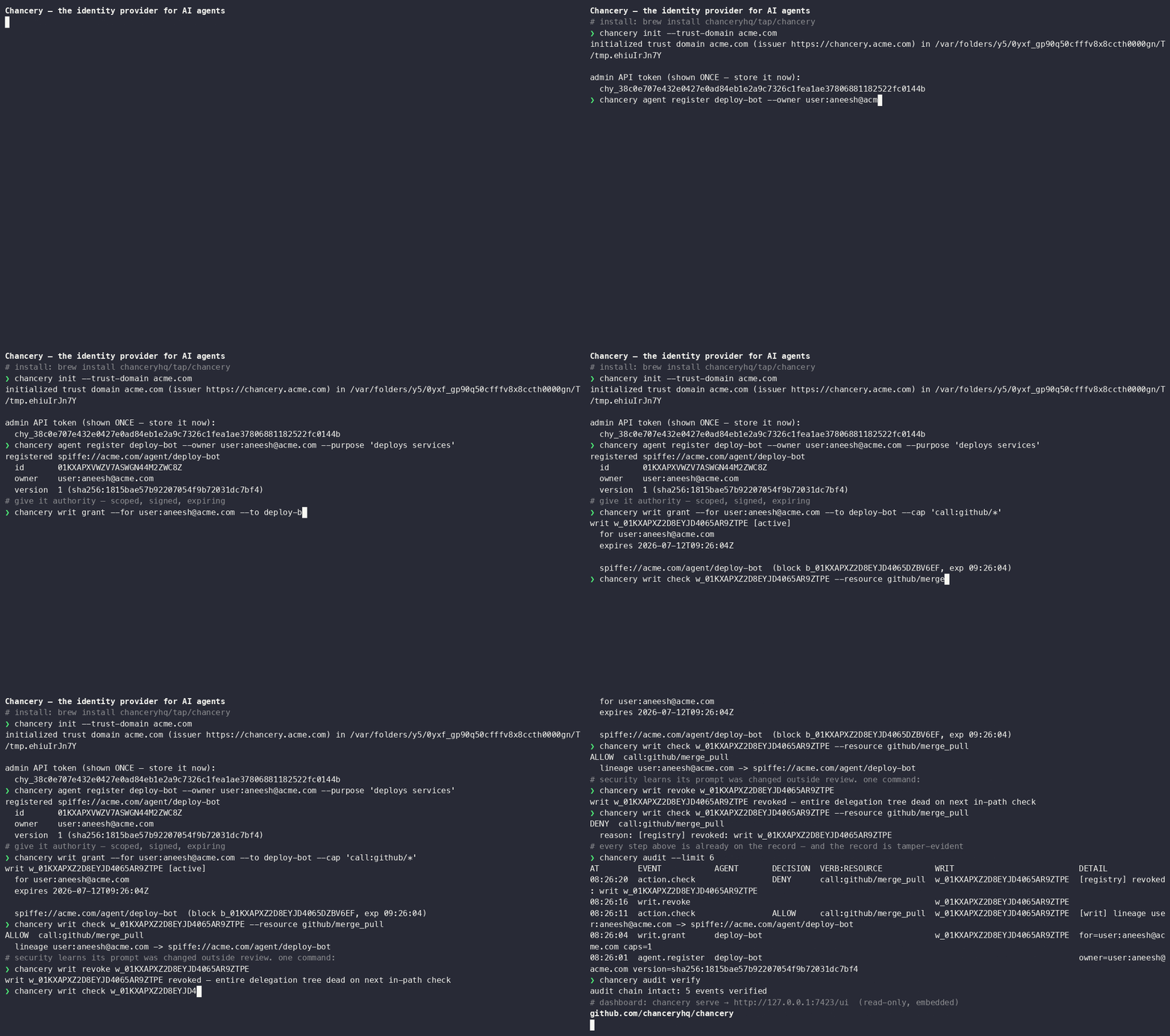
chancery init --trust-domain acme.com
chancery agent register deploy-bot --owner user:[email protected] --purpose "deploys services"
chancery writ grant --for user:[email protected] --to deploy-bot --cap "call:github/get_*" --ttl 8h

# run a real MCP server behind the gate, with a sealed token
chancery secret put github-token --from-file ./token
chancery mcp wrap --agent deploy-bot --writ <writ-id> \
    --secret GITHUB_TOKEN=github-token -- npx @acme/github-mcp
#   get_pull_request → ALLOW      forwarded, attributed, recorded
#   delete_repo      → DENY       never reaches the server

chancery writ revoke <writ-id>    # the agent's NEXT call fails, mid-session
chancery audit                    # the timeline; `audit verify` checks the chain
Full walkthrough: QUICKSTART · try every feature in order: testing playbook.
What it does
- Identity — agent → immutable content-addressed version → revocable running instance, each separately killable, all owner-attributed.
- Writs — authority as a signed chain that can only add restrictions. Widening isn't forbidden, it's unrepresentable: the delegation block format has no field for it.
- In-path enforcement —
mcp wrapdecides every tool call against fresh state, filterstools/list, and answers denials in-protocol. A prompt-injected agent can't talk its way around an out-of-process proxy. - Sealed credentials — injected into the tool server's environment, never the agent's context.
- Runtime spawn — orchestrators mint governed workers without an admin token, bounded by a human-approved template.
- Callee trust — the server's code identity is pinned (image digest,
install tree, or binary) and re-verified before every spawn; drift
refuses to start.
--confineadds an egress allow-list and read-only filesystem as an OS boundary, and--run-asgives the server its own UID so injected secrets aren't readable by anything sharing yours. - Per-call semantics — task-bound grants, a veto-only socket for your own intent checker, and short-lived leases a cooperating server verifies right before it commits.
- Evidence — hash-chained and metadata-only by schema: prompts,
payloads, and arguments have nowhere to be stored. Plus a read-only
dashboard at
/ui.
MCP-first, not MCP-only. Identity, writs, policy, credentials, and audit govern any agent in any language today via the decision API — see governing any agent. What's MCP-specific is the unbypassable enforcement; HTTP, shell, and browser PEPs follow, with the same writs.
Docs
| Quickstart | govern a real MCP server in 5 minutes |
| Concepts | agent, version, instance, writ |
| Governing any agent | the non-MCP path |
| Verify every claim | hands-on checks that each promise holds |
| Testing playbook | one guided run through every feature |
| Design RFCs | 19 locked decisions, each argued before it was written |
| Security | threat model and the honest gap table |
| Changelog | what shipped, when |
Examples: Claude Code / MCP clients · browser agents · LangGraph · Perseus Vault · Go SDK
Status
Beta. All 19 design RFCs are locked and implemented; 109 tests across 11 packages gate every commit. The security model is settled and every known gap is published in SECURITY.md with an owner and a phase. The CLI and REST surfaces may still take breaking changes before 1.0, always noted in the changelog.
Two promises (RFC-011): what ships open source stays Apache-2.0 — no license flip, ever — and security is never paywalled; every gap in that table closes in the open core.
Contributing
make build && make test    # Go 1.26+, no CGO; go vet + 109 tests in seconds
make demo                  # the 60-second enforcement + audit arc
CONTRIBUTING.md has the repo layout, how tests map to each RFC, and how to propose changes. Found a hole? Please open an issue — that's worth more to me than a star.
Installing Chancery
This server has no published package — it is built from source. Open the repository and follow its README.
▸ github.com/chanceryhq/chanceryFAQ
Is Chancery MCP free?
Yes, Chancery MCP is free — one-click install via Unyly at no cost.
Does Chancery need an API key?
No, Chancery runs without API keys or environment variables.
Is Chancery hosted or self-hosted?
Self-hosted: the server runs locally on your machine via the install command above.
How do I install Chancery in Claude Desktop, Claude Code or Cursor?
Open Chancery on unyly.org, pick your client tab (Claude Desktop, Claude Code, Cursor) and press Install — the config is generated automatically, no JSON editing.
Related MCPs
Playwright
Browser automation, scraping, screenshots
 by Microsoft
Puppeteer
Browser automation and web scraping.
 by modelcontextprotocol
opentabs-dev/opentabs
Plugin-based MCP server + Chrome extension that gives AI agents access to web applications through the user's authenticated browser session. 100+ plugins with a
 by opentabs-dev
robhunter/agentdeals
1,500+ developer infrastructure deals, free tiers, and startup programs across 54 categories. Search deals, compare vendors, plan stacks, and track pricing chan
 by robhunter
Compare Chancery with
Not sure what to pick?
Find your stack in 60 seconds
Author?
Embed badge for your README
Browse similar
All browse MCPs