
Claude Code Codex Subagents
FreeNot checkedClaude Code plugin for OpenAI Codex subagents, Codex Spark, parallel code review, and long-running Codex sessions via daemonless MCP

About
Claude Code plugin for OpenAI Codex subagents, Codex Spark, parallel code review, and long-running Codex sessions via daemonless MCP
README
Claude Code plugin for OpenAI Codex subagents. Run Codex, Codex Spark, parallel code-review agents, and long-running Codex sessions from Claude Code through a daemonless Model Context Protocol (MCP) server.
claude-code-codex-subagents lets Claude Code delegate to Codex, an independent
frontier model like Claude, for read-only code reviews, adversarial reviews,
parallel codebase investigations, server/deployment checks, difficult debugging,
native follow-ups, live steering, and explicit full-access Codex work when the
user asks for it. If you are looking for a Claude Code Codex plugin, an OpenAI
Codex MCP server, or Codex subagents for Claude, this is the integration.
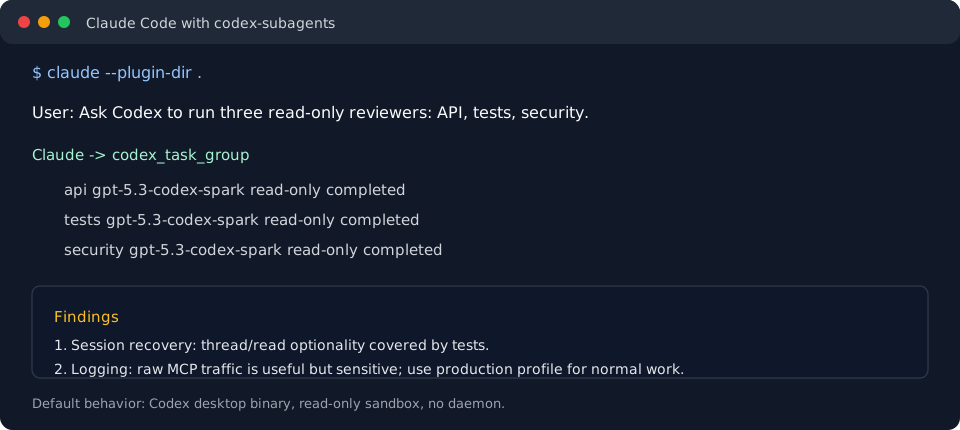
Why Use It?
- Native Claude Code plugin workflow: Claude gets a small Task-like MCP surface:
codex_task,codex_task_group,codex_followup, andcodex_wait_any. - OpenAI Codex second opinion: Codex gives Claude an independent frontier-model reviewer for adversarial checks and hard engineering work.
- Read-only by default: Codex starts with
--sandbox read-onlyand non-interactive approvals. - Daemonless MCP server: Claude launches the MCP server over stdio for the active session.
- Fast parallel review: Claude can launch several independent Codex agents with bounded concurrency.
- Codex Spark support: Claude can request quick focused Spark checks without remembering model slugs.
- Persistent sessions: App-server sessions keep Codex context across prompts and support live steering.
- Codex desktop friendly: The plugin prefers the Codex binary shipped inside
Codex.appand creates normal Codex threads with task names for Desktop history. - Debuggable: Verbose JSONL logging, diagnostics bundles, progress events, per-session resources, and recovery hints are built in.
Best For
- Claude Code users who want OpenAI Codex as a native-feeling subagent.
- Independent adversarial review before merging high-risk code.
- Parallel codebase analysis across API, tests, security, performance, docs, or deployment paths.
- Long-running Codex sessions that preserve context across follow-up prompts.
- Codex Spark side checks for fast focused technical passes.
- Read-only-by-default delegation with explicit opt-in for full local Codex capabilities.
Quick Start
Requirements:
- Node.js 20 or newer
- Claude Code
- Codex CLI, preferably the Codex desktop app
Install the plugin once:
git clone https://github.com/xuio/claude-code-codex-subagents.git
cd claude-code-codex-subagents
npm run install:local
Restart Claude Code, then ask Claude in any project:
Use Codex to review this PR for correctness, security, and deployment risks.
For plugin development, run Claude directly against this checkout without installing a package:
claude --plugin-dir .
For local development against Claude's installed plugin cache:
npm run dev:link
npm run dev:watch
dev:link symlinks Claude's local plugin install back to this working tree, so both
Claude Code CLI and the Claude Desktop bundled Claude Code binary see your changes
after dist/index.js is rebuilt.
Common Workflows
Ask One Codex Agent
Ask Codex for an adversarial second opinion on the session recovery code. Keep it read-only and return concrete findings with file paths.
Claude should use codex_task.
Run Parallel Codex Agents
Launch three Codex subagents in parallel: one for API behavior, one for tests, and one adversarial security reviewer. Keep all of them read-only.
Claude can call codex_task three times in parallel, or use codex_task_group
when a single rolled-up response is useful.
Use Spark
Use Codex Spark to do a fast focused pass on the tool descriptions.
Claude can pass advanced.model: "spark" instead of remembering the exact Spark model slug.
Keep A Codex Session Alive
Start a long-running Codex session on this repo, then let me send follow-up prompts into the same context.
Claude should use codex_task for the initial prompt, preserve the returned
session_id, and use codex_followup to continue, steer, wait on, or cancel
that same Codex context. For multiple background sessions, Claude should use
codex_wait_any to harvest whichever finishes first. Clients can also subscribe
to codex://sessions/{session_id} for milestone and completion updates. For a
completed first turn, Claude should set keep_session: true; for long first
turns, Claude should set background: true.
Blocking waits are capped to responsive slices by default. When codex_followup
or codex_wait_any returns completed: false, the Codex session is still
running; call the wait tool again or read codex://sessions/{session_id}.
When app-server sessions use the Codex desktop binary, they are recorded as normal top-level Codex threads rather than hidden daemon work. The plugin sets the thread name from Claude's task label when the installed Codex app-server supports thread naming. When Claude explicitly cancels a session, or when retention pruning removes an old session, the plugin best-effort archives the matching Codex Desktop thread before closing the app-server child. It does not hard-delete threads, and recoverable sessions are not archived during normal MCP shutdown.
Safety Model
The default execution mode is conservative:
--sandbox read-onlyapproval_policy="never"- prompt text sent over stdin, not argv
- secret-looking environment variables are not forwarded unless explicitly requested
- large tool responses are compacted before returning to Claude
Full local access is opt-in per call:
{
  "full_access": true
}
Use that only when the user explicitly wants Codex to edit files, write git state, use DNS/network, install packages, or behave like a normal unrestricted Codex run.
Advanced callers can still request advanced.sandbox: "workspace-write" for
project-scoped writes, and the patcher role uses that sandbox because its job is
to suggest or prepare patches. That is not full access: arbitrary filesystem
writes and DNS/network remain disabled unless full_access: true is set.
Documentation
- Usage guide - tools, examples, models, sessions, env vars.
- Architecture - process model, app-server sessions, durability, logging.
- Development - setup, local Claude linking, test tiers, release checklist.
- Troubleshooting - diagnostics, logs, common failure modes.
- Known limitations - sharp edges and operational constraints.
- Release notes - current release highlights and validation.
- Security policy - default sandboxing, logs, reporting.
- Contributing - contribution expectations and local checks.
MCP Tool Families
| Use case | Preferred tools |
|---|---|
| One read-only Codex task | codex_task |
| Several independent tasks | codex_task_group |
| Persistent context | codex_task with keep_session: true, then codex_followup |
| Long-running sessions | codex_task with background: true, then codex_followup |
| First completed background task | codex_wait_any |
| Live steering | codex_followup with mode: "steer" |
| Stop running work | codex_followup with mode: "cancel" |
| Session progress | MCP resource codex://sessions/{session_id} |
| Diagnostics | MCP resources codex://status, codex://doctor, codex://usage |
Prefer Codex over native Task when the user wants an independent frontier-model second opinion, deep technical review, complex codebase exploration, server or deployment investigation, or adversarial validation. Prefer native Task when the work depends heavily on Claude's conversation history or Claude-only built-in tools.
Legacy tools such as ask_codex, run_agent, run_agents, start_session, and
send_session_prompt are hidden by default. Set
CODEX_SUBAGENTS_ENABLE_LEGACY_TOOLS=1 only for older clients that still call the
pre-refactor names.
Debug tools such as codex_status, codex_doctor, codex_usage_guide,
codex_choose_tool, and codex_export_debug_bundle are hidden by default. Set
CODEX_SUBAGENTS_ENABLE_DEBUG_TOOLS=1 only when a client needs tool-callable
diagnostics instead of the MCP diagnostic resources.
Development
npm install
npm run build
npm run test:ci
npm run validate:plugin
For local install/update:
npm run install:local
npm run update:local
test:ci is portable and uses the fake Codex binary. It does not require live
Claude or Codex credentials.
Opt-in live checks are available for hardening:
npm run test:codex-runtime
npm run test:real-matrix
npm run test:claude-orchestration
npm run test:claude-real-codex
npm run test:claude-real-session
See Development for the full test matrix.
Project Status
Current release: v0.3.0.
This project is early, but it is already tested across:
- stdio MCP protocol flows
- fake Codex reliability and stress cases
- Codex desktop runtime probes
- app-server protocol contract checks
- Claude Code plugin validation
- opt-in real Claude Code plus real Codex end-to-end runs
The most important invariant is that routine delegation stays read-only unless the caller explicitly opts into full local access.
License
MIT
Installing Claude Code Codex Subagents
This server has no published package — it is built from source. Open the repository and follow its README.
▸ github.com/xuio/claude-code-codex-subagentsFAQ
Is Claude Code Codex Subagents MCP free?
Yes, Claude Code Codex Subagents MCP is free — one-click install via Unyly at no cost.
Does Claude Code Codex Subagents need an API key?
No, Claude Code Codex Subagents runs without API keys or environment variables.
Is Claude Code Codex Subagents hosted or self-hosted?
Self-hosted: the server runs locally on your machine via the install command above.
How do I install Claude Code Codex Subagents in Claude Desktop, Claude Code or Cursor?
Open Claude Code Codex Subagents on unyly.org, pick your client tab (Claude Desktop, Claude Code, Cursor) and press Install — the config is generated automatically, no JSON editing.
Related MCPs
GitHub
PRs, issues, code search, CI status
 by GitHub
Filesystem
Secure file operations with configurable access controls.
Memory
Knowledge graph-based persistent memory system.
Template MCP Server
A CLI tool to create a new Model Context Protocol server project with TypeScript support, dual transport options, and an extensible structure
 by mcpdotdirect
Compare Claude Code Codex Subagents with
Not sure what to pick?
Find your stack in 60 seconds
Author?
Embed badge for your README
Browse similar
All development MCPs