
Concrete CMS Server
FreeNot checkedEnables interaction with Concrete CMS sites through the Concrete CMS REST API, allowing content management, user operations, and file uploads via natural langua

About
Enables interaction with Concrete CMS sites through the Concrete CMS REST API, allowing content management, user operations, and file uploads via natural language.
README
A Model Context Protocol (MCP) server for Concrete CMS built with TypeScript.
Installation
git clone https://github.com/MacareuxDigital/concretecms-mcp-server.git
cd concretecms-mcp-server
npm ci && npm run build
Usage
Enable API in Concrete CMS
Since the MCP server uses the Concrete CMS API, you need to enable it in your Concrete CMS installation first. Please refer to the Concrete CMS documentation for more information.
Connect your LLM to the local Concrete CMS MCP Server
Here's an example configuration for Claude Desktop:
{
  "mcpServers": {
    "concretecms": {
      "command": "node",
      "args": [
        "/path/to/concretecms-mcp-server/dist/index.js"
      ],
      "env": {
        "CONCRETE_CANONICAL_URL": "https://your-concrete.example",
        "CONCRETE_API_CLIENT_ID": "YOUR_API_CLIENT_ID",
        "CONCRETE_API_CLIENT_SECRET": "YOUR_API_CLIENT_SECRET",
        "CONCRETE_API_SCOPE": "account:read system:info:read"
      }
    }
  }
}
- Set
CONCRETE_CANONICAL_URLto the URL of your Concrete CMS installation. - Set
CONCRETE_API_CLIENT_IDandCONCRETE_API_CLIENT_SECRETto the credentials of a registered API integration. - Set
CONCRETE_API_SCOPEto the scopes you want to request. You can find a list of available scopes fromhttps://your-concrete.example/index.php/dashboard/system/api/scopes.
After you've configured the MCP server, please restart Claude Desktop. On the first tool call, it will open an authorization window — sign in and authorize the requested scopes.
Now you should be able to get information about your Concrete CMS in a chat. A refresh token will be saved under ~/.concretecms-mcp/tokens/<site>/local.tokens.json (one directory per CONCRETE_CANONICAL_URL), so you don't need to sign in again.
Use separate MCP server entries in Claude Desktop for each Concrete CMS site — each site's tokens are stored independently.
Optionally set TOKEN_ENCRYPTION_KEY in the env block to encrypt tokens at rest. See the Security Guide for details.
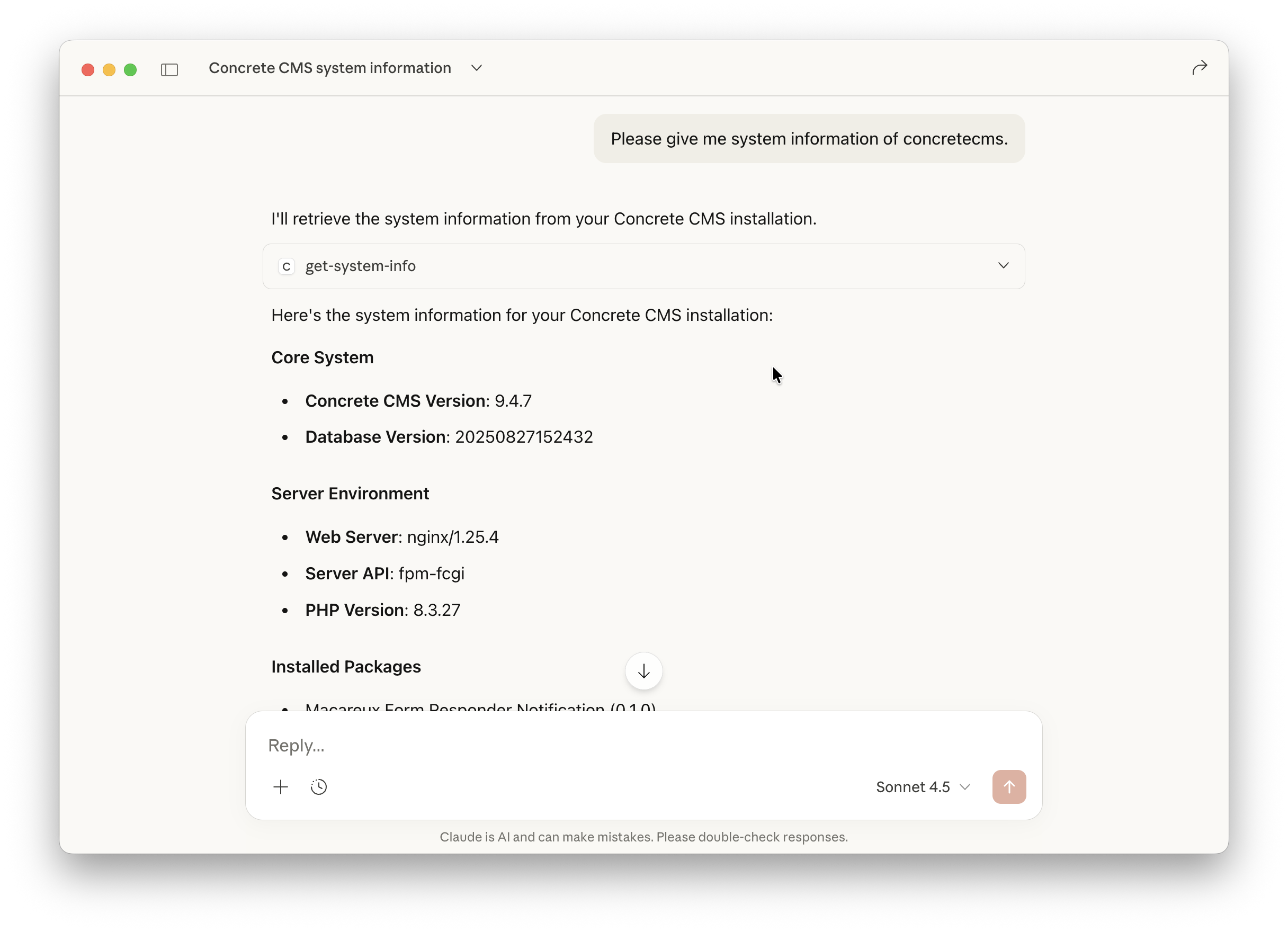
For more information about local MCP servers, please refer to the Claude Desktop documentation.
Security
OAuth refresh tokens are stored on disk under ~/.concretecms-mcp/tokens/<site>/ by default (namespaced per CONCRETE_CANONICAL_URL). See the Security Guide for the threat model, chmod 600 behavior, encryption, cleanup commands, and remote deployment guidance.
Run as a remote MCP server
To host the MCP server on a remote Linux server, see the Remote MCP Server Guide.
It covers systemd deployment, reverse proxy setup, OAuth configuration, and Docker as an alternative.
For developers: build an MCP client or AI agent
If you are building a programmatic MCP client or AI agent (backend service, web app with chat UI, or Concrete CMS package) that connects to a remote MCP server over HTTP, see the MCP Client Developer Guide.
It covers the HTTP API, per-user OAuth, agent loops, and implementation patterns. It does not cover Claude Desktop or Cursor configuration — use the local stdio section above for that.
Use your own OpenAPI specification
The MCP server is loading openapi.yml to know which endpoints are available in the Concrete CMS API.
The bundled openapi.yml file is generated from the Concrete CMS default installation, but you can also use your own OpenAPI specification.
If you added some Express Objects to your Concrete CMS installation and want to use them in your chat, you can generate a new OpenAPI specification from your installation and use it instead.
- Check "Include this entity in REST API integrations." in the Express Object settings.
- Open
https://your-concrete.example/index.php/ccm/system/api/openapi.jsonin your browser, and copy the JSON output. - Replace the
openapi.ymlfile in theconcretecms-mcp-serverdirectory with your own OpenAPI specification.
Features
This MCP server is depended on the Concrete CMS API, so it supports all features that are available through the API. For example:
- Get information about your Concrete CMS installation.
- Get content from your Concrete CMS installation.
- Update content in your Concrete CMS installation.
- Upload files to your Concrete CMS installation.
- Get a list of users in your Concrete CMS installation.
- And more!
You can find a list of all available endpoints in Concrete CMS REST API - Endpoints
High-level page tools
In addition to OpenAPI-generated tools, the server exposes helpers for common page workflows:
get_page_content— read a page as a document (html,html_raw, and plaintext) viaincludes=contentupdate_page_content— create an editable page version, remap block IDs, then update specific blocks (PUT page + PUT area)
Prefer these when reviewing or editing page copy. Use the raw OpenAPI tools (getPageById, updateBlockInPageArea, etc.) for lower-level control.
Required OAuth scopes for the update helper: pages:read, pages:update, pages:areas:update_blocks.
ToDos
- Test with other MCP clients.
- Add useful prompts.
- Support another authentication method than OAuth2.
License
MIT
Install Concrete CMS Server in Claude Desktop, Claude Code & Cursor
unyly install concrete-cms-mcp-serverInstalls into Claude Desktop, Claude Code, Cursor & VS Code — handles npx, uvx and build-from-source repos for you.
First time? Get the CLI: curl -fsSL https://unyly.org/install | sh
Or configure manually
Run in your terminal:
claude mcp add concrete-cms-mcp-server -- npx -y github:MacareuxDigital/concretecms-mcp-serverFAQ
Is Concrete CMS Server MCP free?
Yes, Concrete CMS Server MCP is free — one-click install via Unyly at no cost.
Does Concrete CMS Server need an API key?
No, Concrete CMS Server runs without API keys or environment variables.
Is Concrete CMS Server hosted or self-hosted?
Self-hosted: the server runs locally on your machine via the install command above.
How do I install Concrete CMS Server in Claude Desktop, Claude Code or Cursor?
Open Concrete CMS Server on unyly.org, pick your client tab (Claude Desktop, Claude Code, Cursor) and press Install — the config is generated automatically, no JSON editing.
Related MCPs
GitHub
PRs, issues, code search, CI status
 by GitHub
Filesystem
Secure file operations with configurable access controls.
Memory
Knowledge graph-based persistent memory system.
Template MCP Server
A CLI tool to create a new Model Context Protocol server project with TypeScript support, dual transport options, and an extensible structure
 by mcpdotdirect
Compare Concrete CMS Server with
Not sure what to pick?
Find your stack in 60 seconds
Author?
Embed badge for your README
Browse similar
All development MCPs