
Coordination Memory
FreeNot checkedAn append-only coordination memory for multi-agent and human work, backed by SQLite, with a local dashboard and acceptance contracts that enforce integrator rev

About
An append-only coordination memory for multi-agent and human work, backed by SQLite, with a local dashboard and acceptance contracts that enforce integrator review before work is considered accepted.
README
Append-only coordination memory for multi-agent (and agent + human) work, exposed as a local Model Context Protocol (MCP) server backed by SQLite — plus a local web management dashboard and goal-level acceptance contracts.
It records who owns which task, run liveness, human interventions, handoff evidence, and integrator review decisions. Only an integrator can promote work into the accepted ledger, which you can export as a durable, auditable projection (for example, committed into Git).
Design stance: the MCP is the live coordination layer; durable accepted truth lives in whatever you project to. It is local-first (SQLite + stdio), and it never deploys, never reads secrets, and never executes shell commands.
Why
When several agents (or agents and people) push on the same body of work, two things go wrong: they overwrite each other, and "I'm done" gets confused with "this was accepted." Coordination Memory gives you:
- Assignment claims with leases so two actors don't clobber the same task.
- A hard distinction between an agent reporting
completed_gate_passedand an integrator decidingintegrator_accepted. Proposals are not truth. - An integrator-owned accepted projection you review before archiving.
- Acceptance contracts that make "self-certified done" structurally impossible for goal-level outcomes (see below).
- A human-facing Attention view and latest Resume Brief so people can re-enter long-running work without turning summaries into agent recovery state or changing the coordination lifecycle.
Good fits: multiple agents on separate worktrees advancing one effort; needing a review gate before something counts as accepted; wanting a replayable audit trail of coordination decisions.
Not a fit: as your only long-term source of truth; as a place to store .env
files, tokens, passwords, or credential-bearing logs.
Launch resources
- 90-second demo script — a short walkthrough for showing leases, handoff evidence, integrator acceptance, and the dashboard.
- Launch post draft — copy for announcing the project without positioning it as generic memory or RAG.
- OSS launch checklist — release, GitHub metadata, MCP Registry, and directory-submission steps.
Install
Requires Python ≥ 3.11.
Install the single comem command with
uv or pipx after the package is published to
PyPI:
uv tool install coordination-memory-mcp   # or: pipx install coordination-memory-mcp
comem --help
Or run it without installing (the package name and command differ, so pass
--from):
uvx --from coordination-memory-mcp comem --help
From source
If the PyPI page is not live yet, or you want to run your own changes, install
the comem command straight from a checkout:
git clone https://github.com/yanqiw/comem
cd coordination-memory-mcp
uv tool install .                  # or: pipx install .
comem --version
This is a snapshot install — re-run it after editing the source to pick up changes:
uv tool install . --reinstall              # rebuild from current source
uv tool install . --editable --reinstall   # or install editable: changes apply live
uv tool uninstall coordination-memory-mcp  # remove it
The command exposes four subcommands:
comem serve— the stdio MCP server.comem dashboard— the local web management console.comem init— scaffold agent-onboarding files into a repo.comem loop— run the local-only scheduler for Codex agent conversations.
For local development, clone and uv sync, then prefix commands with uv run.
Quickstart
Run the MCP server
comem serve
This starts a stdio MCP server (normally launched by an MCP client). It opens no HTTP port and prints no interactive CLI.
The database defaults to ./.coordination-memory/coordination.sqlite3. Override
it with COORDINATION_MEMORY_DB. When several agents/worktrees collaborate, point
all of them at one absolute path outside every worktree, or each worktree
gets its own SQLite copy and the shared memory forks:
COORDINATION_MEMORY_DB=/absolute/path/coordination.sqlite3 \
  comem serve
Do not commit the SQLite database to Git.
Configure an MCP client
Client config locations differ, but with the command installed the server entry should look like:
{
  "mcpServers": {
    "coordination-memory": {
      "command": "comem",
      "args": ["serve"],
      "env": {
        "COORDINATION_MEMORY_DB": "/absolute/path/coordination.sqlite3"
      }
    }
  }
}
Set up your agent
comem init scaffolds onboarding files so your coding agents know
the protocol, then prints this MCP config snippet:
comem init            # all tools, current directory
comem init --tools claude,cursor --dir ./my-repo
It writes a canonical Coordination Memory protocol section into AGENTS.md
(idempotently, between markers) and thin per-tool adapters that point to it:
| Tool | File written |
|---|---|
| Codex, OpenCode | AGENTS.md (read directly) |
| Claude Code | .claude/skills/coordination-memory/SKILL.md |
| Cursor | .cursor/rules/coordination-memory.mdc |
| GitHub Copilot | .github/copilot-instructions.md |
Re-running init updates the AGENTS.md section in place (no duplication).
Edit the protocol once in AGENTS.md; the adapters defer to it.
Local loop
comem loop is the local-only scheduler for first-class Codex agent
conversations. The initial release supports --adapter fake for deterministic
testing and a guarded --adapter codex-app-server capability probe for future
local Codex app-server integration.
When Codex creates a workspace, team, and assignments for a plan, ask the user to choose one execution mode before starting work:
codex_subagent(default): the current Codex conversation remains the Integrator, starts Codex subagents as workers, and records claims, heartbeats, handoffs, and reviews in Coordination Memory.comem_loop: Codex startscomem loopwith the selected workspace/team and the loop owns worker claims and thread starts.
Use codex_subagent for the smoothest Codex experience. Use comem_loop when
worker conversations must be independently resumable or scheduler-owned.
Dry-run scheduling:
COORDINATION_MEMORY_DB=/absolute/path/coordination.sqlite3 \
  comem loop --workspace <workspace_id> --team <team_id> --adapter fake --dry-run --once
Fake local dispatch:
COORDINATION_MEMORY_DB=/absolute/path/coordination.sqlite3 \
  comem loop --workspace <workspace_id> --team <team_id> --adapter fake --once
COORDINATION_MEMORY_DB=/absolute/path/coordination.sqlite3 \
  comem loop --workspace <workspace_id> --team <team_id> --adapter fake --poll-interval 30
Loop-managed assignments should carry metadata.session_bind.target_actor_id
so the scheduler knows the intended worker before any run exists. The actual
Codex thread binding is recorded on the run after claim/start. Project design
and plan context must remain in Markdown files; assignments should reference
those files through metadata context_refs.
Concepts
The store is six core tables:
- workspace → team → assignment → run → event, plus actors.
- An assignment is a unit of work. Claiming one starts a run and takes a lease. Events are the append-only log (evidence, handoffs, reviews, …).
- Actors act in a role:
integrator,agent, orhuman. - Mutating writes use optimistic concurrency: each carries the current
base_revisionand bumps the revision.
Event statuses an agent may submit: proposed, observed,
completed_gate_passed, completed_gate_failed. Decision statuses are
integrator-only: integrator_accepted, integrator_rejected, needs_fix.
completed_gate_passed is not accepted truth — only an integrator review
decision produces accepted state.
Tools
Coordination
| Tool | Role | Purpose |
|---|---|---|
register_actor |
any | register/refresh an actor profile |
register_workspace |
any | create/refresh a workspace record (idempotent) |
create_team |
any | create/refresh a team (auto-creates its workspace) |
create_assignment |
integrator | create a task (optional workspace/team/paths/criteria) |
cancel_assignment / supersede_assignment |
integrator | void / retire a task (releases any lease) |
claim_assignment |
agent | claim a lease; records run/session/worktree metadata |
heartbeat_run |
agent | report run liveness |
checkpoint_run |
agent | refresh the human-only latest Brief without changing run status |
raise_attention |
agent | write yellow/green non-blocking Attention; green resolves a dedupe key |
request_intervention / respond_intervention |
agent / human | use the red/blocking path, optionally with a Decision Packet, and move a run to/from an awaiting-human lane |
append_event / submit_handoff |
agent | append evidence / submit a reviewable handoff |
list_pending_reviews |
any | reviewable events with no decision yet |
review_event / accept_event / reject_event |
integrator | record a review decision |
get_team_board / get_assignment_detail / get_run_detail |
any | coordination read models |
get_human_brief / get_attention_board |
any | reconstruct latest human projections from the event ledger |
get_snapshot / export_git_projection |
integrator | accepted projection (see below) |
Acceptance contracts
create_acceptance_contract, add_invariant, raise_deviation,
bind_assignment_to_contract, seal_contract, report_verification,
evaluate_contract, accept_contract, reject_contract, waive_deviation,
reopen_contract, get_contract_detail, list_contracts.
Mutating tools take a base_revision and reject stale writes. Run/intervention
tools only change local lanes and the event timeline; they never execute commands,
resume threads, or touch files.
Human Brief and Attention
Use checkpoint_run to refresh the human-only latest Brief without changing the
run status. Use raise_attention for non-blocking yellow/green updates; a green
update resolves the matching dedupe_key. Use request_intervention for the
red/blocking path when execution must wait for a person; it may include a
structured decision_packet. Read the latest ledger-derived views with
get_human_brief and get_attention_board:
get_human_brief({"run_id": "run_123"})
get_attention_board({"team_id": "default", "target": "human", "include_green": false})
See the tool reference for complete write examples and Decision Packet semantics.
Acceptance contracts (goal-level governance)
An acceptance contract is a first-class object that sits above assignments and defines machine-checkable, non-self-certifiable acceptance criteria for a goal-level outcome. It is a structural protection layer whose purpose is to make "the implementer declares it done" impossible.
Data model
| Table | Role |
|---|---|
acceptance_contracts |
the contract: goal_statement, status (state machine), revision (optimistic concurrency), acceptor_actor_id (independent acceptor), max_repair_attempts/repair_attempt (loop bounds), last_failing_keys_json (no-progress brake) |
contract_invariants |
one machine-checkable predicate per row: probe_kind (command/http/sql/file_assert/artifact_present), probe_spec_json (references only — no secrets), is_negative (a deny test), is_second_instance (a second-tenant/second-instance test). Frozen after seal. |
contract_verifications |
append-only probe results: outcome (passed/failed/error), evidence_json (log path / commit / response hash — references only). "Pass or not" is decided by the latest probe result; a runner cannot mark a predicate passed by fiat. |
contract_deviations |
a deviation/shortcut register: disposition is required (acceptable_forever/acceptable_this_phase/blocker). While any blocker is open, the contract cannot reach accepted. |
Three gates
seal_contract(drafting → criteria_sealed) — refuses to seal unless there is at least one deny test, at least one second-instance test, every invariant has a probe spec, and the bound acceptor is not an actor that ran a bound assignment. Invariants freeze after seal; the only way to change them isreopen_contract(a loud reset that clears the seal and prior probe results).evaluate_contract— the objective gate and self-healing loop driver. It needs no acceptor, so the loop self-drives. If every required invariant's latest result ispassedand no blocker is open →awaiting_acceptor. Otherwise it bumps the attempt and emits a bound repair assignment for an external scheduler/runner to pick up; bounded bymax_repair_attemptsand a no-progress brake (failing set must strictly shrink), after which it escalates toawaiting_human. A bound runner cannot callevaluate/accepton its own contract.accept_contract(awaiting_acceptor → accepted) — only the independent acceptor may sign off, certifying the invariant set adequately covers the goal (green is already objective fact).reject_contractsends it toawaiting_human.
drafting ──seal──▶ criteria_sealed ──(report_verification)──▶ verifying
                                                                  │
                                                          evaluate (objective gate)
                                    ┌─────────────────────────────┼──────────────────────────┐
                             all required green             some failed / open blocker
                             AND no open blocker                       │
                                    │                       enter repair loop (bounded)
                            awaiting_acceptor                          │
                                    │                         repair_attempt > max OR
                              accept / reject                   no-progress → awaiting_human
                                    │
                             accepted / awaiting_human
The gate logic lives entirely in the store layer (store.py) — there is no prompt
or client that can bypass it.
Dashboard (local management console)
A local, single-page management dashboard over the same SQLite memory. A small
stdlib HTTP server serves the Svelte/Vite-built static SPA plus JSON APIs. Read
APIs open the DB with mode=ro + query_only and fail rather than creating a
missing DB. The only write action is Archive workspace, which soft-updates
workspaces.status to archived through
POST /api/workspaces/<id>/archive; it never deletes tasks, runs shell, deploys,
or pushes.
COORDINATION_MEMORY_DB=/absolute/path/coordination.sqlite3 \
  comem dashboard --host 127.0.0.1 --port 8765
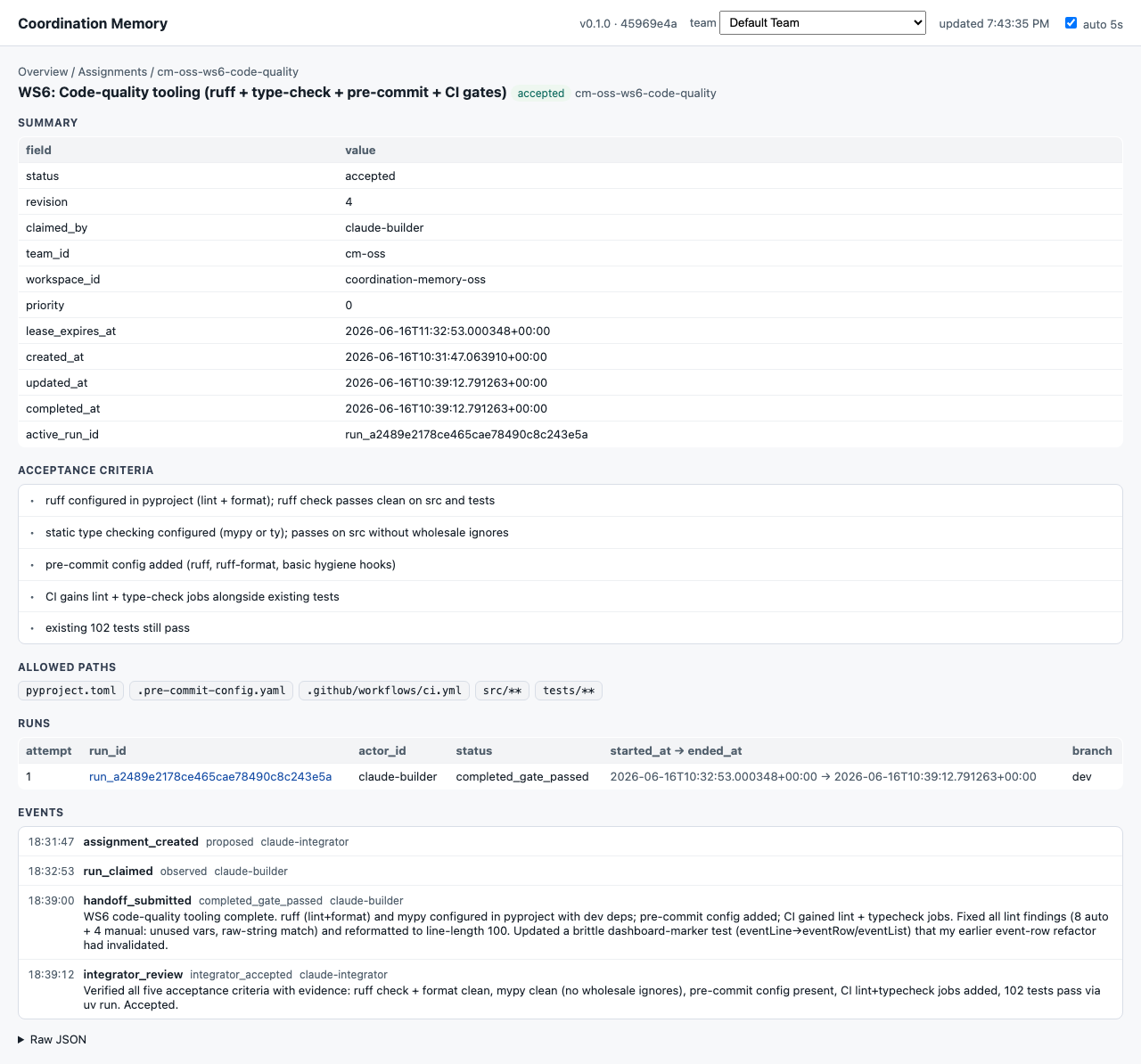
Open http://127.0.0.1:8765/. The Overview starts with Human Attention:
red items require intervention now, yellow items are safe to digest later, and
resolved green items stay collapsed into the count. The assignment lifecycle
board remains directly below it. The console also includes an Acceptance
Contracts section, a Workspaces management page, workspace detail pages,
and drill-downs for a contract, assignment, or run. Assignment and run pages
show the latest Human Resume Brief when one exists, followed by the existing
evidence and event detail. A team switcher and a 5s auto-refresh (overview only,
paused while you select text or the tab is hidden) live in the header, and the
header shows a build hash so you can tell when the UI changed. The same data is
available as JSON:
/api/workspaces, /api/workspaces/<id>, POST /api/workspaces/<id>/archive,
/api/board, /api/governance, /api/contracts (+ /api/contracts/<id>),
/api/assignments/<id>, /api/runs/<id>, /api/runs/<id>/brief,
/api/attention (with team_id, target, and include_green=true|false),
/api/teams, /api/reviews, /api/version.
Accepted projection (export)
get_snapshot returns the accepted read model derived from the store — only events
an integrator accepted. export_git_projection writes (integrator-only) to a
directory you choose:
{ "output_dir": "/tmp/coordination-projection", "actor_role": "integrator" }
produces:
/tmp/coordination-projection/coordination-memory/snapshots/accepted-state.json
/tmp/coordination-projection/coordination-memory/events/accepted-events.md
Review the export before committing it anywhere. The tool writes only to the directory you pass; it never overwrites other files.
Security boundaries
- Does not read or commit
.envfiles; does not store secrets, tokens, passwords, or private keys. Contractprobe_spec, verificationevidence, and all metadata hold references only (paths, commits, hashes). - Does not execute deployments, shell commands, or version-control pushes. The acceptance-contract repair loop only emits an assignment record; execution stays in your own (externally authorized) scheduler/runner.
- Dashboard read APIs are read-only. The dashboard's only write action is Archive workspace, a soft workspace status update; it does not delete data, execute commands, deploy, or push.
Development
uv sync
uv run pytest -q
uv run ruff check src tests        # lint
uv run ruff format --check src tests
uv run mypy src                    # type check
uv run pre-commit install          # optional: run lint/format on commit
npm test                           # frontend unit tests
npm run build                      # rebuild Svelte dashboard static assets
More docs: docs/ (quickstart, concepts/governance, tool reference, examples). See CONTRIBUTING.md for the invariants a change must preserve, and CHANGELOG.md for release notes.
License
MIT.
Install Coordination Memory in Claude Desktop, Claude Code & Cursor
unyly install coordination-memory-mcpInstalls into Claude Desktop, Claude Code, Cursor & VS Code — handles npx, uvx and build-from-source repos for you.
First time? Get the CLI: curl -fsSL https://unyly.org/install | sh
Or configure manually
Run in your terminal:
claude mcp add coordination-memory-mcp -- uvx coordination-memory-mcpFAQ
Is Coordination Memory MCP free?
Yes, Coordination Memory MCP is free — one-click install via Unyly at no cost.
Does Coordination Memory need an API key?
No, Coordination Memory runs without API keys or environment variables.
Is Coordination Memory hosted or self-hosted?
Self-hosted: the server runs locally on your machine via the install command above.
How do I install Coordination Memory in Claude Desktop, Claude Code or Cursor?
Open Coordination Memory on unyly.org, pick your client tab (Claude Desktop, Claude Code, Cursor) and press Install — the config is generated automatically, no JSON editing.
Related MCPs
wenb1n-dev/SmartDB_MCP
A universal database MCP server supporting simultaneous connections to multiple databases. It provides tools for database operations, health analysis, SQL optim
 by wenb1n-dev
Postgres Server
This server enables interaction with PostgreSQL databases through the Model Context Protocol, optimized for the AWS Bedrock AgentCore Runtime. It provides tools
 by madhurprash
Postgres
Query your database in natural language
 by Anthropic
PostgreSQL
Read-only database access with schema inspection.
by modelcontextprotocolCompare Coordination Memory with
Not sure what to pick?
Find your stack in 60 seconds
Author?
Embed badge for your README
Browse similar
All data MCPs