
CourtVision Rules
FreeNot checkedTurns official pickleball scoring rules into callable tools for LLMs to track live matches accurately.

About
Turns official pickleball scoring rules into callable tools for LLMs to track live matches accurately.
README


A Model Context Protocol server that turns the official pickleball scoring rules into callable tools, so an LLM tracks a live match without ever improvising the rules.
Built as part of CourtVision AI — an AI pickleball companion — this is the protocol-layer piece: the small, provably correct service the model leans on so the conversation stays accurate.
Preview
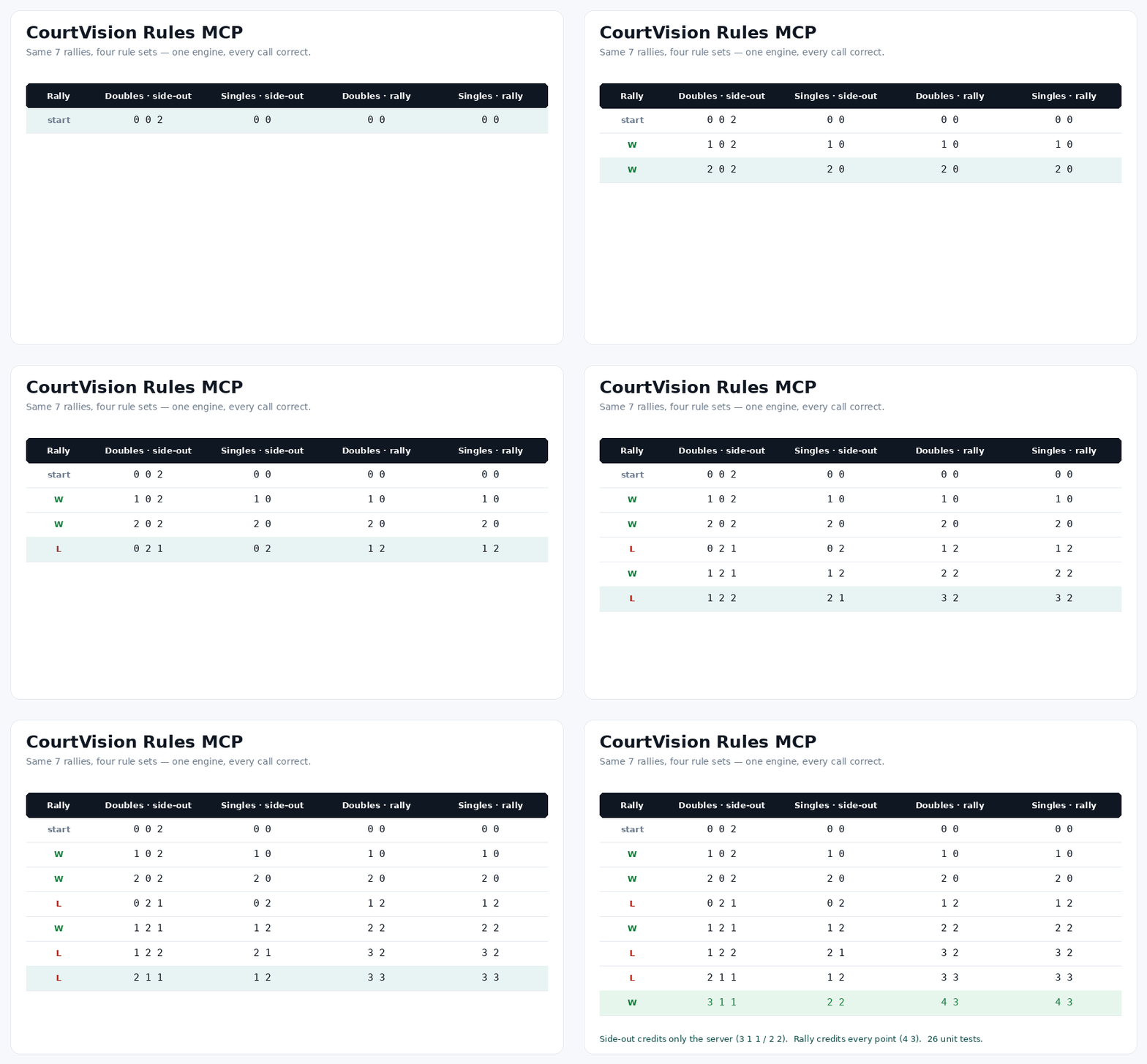
The same seven rallies, scored four ways — doubles/singles × side-out/rally. One engine, all correct, all unit-tested.
Why it exists
Pickleball's side-out scoring is exactly the kind of thing language models get almost right. The one-server rule at the start, the server-1-to-server-2 rotation, win-by-two — a model that holds these in its head drifts after a few turns. The fix is not a better prompt. It is moving the part that must be exact out of the model and into a tool.
That is the entire MCP thesis in one server, and it doubles as a design rule this product was built on: accuracy is the brand. A wrong call in front of four players ends the app's life with that crew. So the engine never guesses — ambiguous input is rejected with an actionable message rather than resolved silently.
What it does
Six tools, exposed over MCP:
| Tool | What it does |
|---|---|
pickleball_new_match |
Start a doubles match; returns a match_id and the opening 0-0-2 call |
pickleball_record_rally |
Apply a rally result (server_won / server_lost) with full side-out logic |
pickleball_record_fault |
Record a fault by either team and apply the right transition |
pickleball_get_score |
Return the current state and three-number score call |
pickleball_undo |
Revert the last rally or fault |
pickleball_explain_rule |
Plain-language summary of common rules topics |
State is held server-side, keyed by match_id, so a client runs a whole match
across many turns without re-sending the board.
Architecture
The rules logic and the transport are deliberately separate:
pickleball_engine.py   pure rules engine, zero dependencies, unit-tested
                       (doubles + singles, side-out + rally scoring)
server.py              thin MCP wrapper: input validation + state registry
tests/                 the rules engine's safety net (26 cases)
evaluation/            MCP eval questions an agent must answer using the tools
The engine is the load-bearing part, so it lives on its own where it can be tested in isolation and reused by any surface — the MCP server today, the Match Mode web app and native clients later.
Run it
python -m venv .venv && source .venv/bin/activate
pip install "mcp[cli]"

# run the server (stdio transport)
python server.py

# or inspect it interactively
npx @modelcontextprotocol/inspector python server.py
Use it from Claude Desktop
Add to your claude_desktop_config.json:
{
  "mcpServers": {
    "courtvision-rules": {
      "command": "python",
      "args": ["/absolute/path/to/courtvision-rules-mcp/server.py"]
    }
  }
}
Then ask Claude: "Start a pickleball match between the Reds and the Blues. The
Reds win the first rally, then lose the next one — what's the score?" It will
call the tools and answer 0 1 1, correctly, every time.
Tests
pip install pytest
python -m pytest tests/ -q
The tricky cases are pinned: the one-server match start, the server-1 → server-2 → side-out rotation, win-by-two, and that only the serving team can score.
Notes
Rules summaries defer to the current USA Pickleball Official Rulebook — this server computes scoring and explains the common cases; it does not reproduce the rulebook.
Formats
Set match_format and scoring when you start a match:
match_format |
scoring |
Call | Rule |
|---|---|---|---|
doubles |
sideout |
7 4 2 |
Traditional two-server side-out with the one-server opening (the default). |
singles |
sideout |
7 4 |
One server per side; every lost rally is an immediate side-out. Serve court follows score parity. |
doubles |
rally |
7 4 |
A point on every rally; lose your serve and the other side scores and takes serve. |
singles |
rally |
7 4 |
Same rally logic, one server per side. |
Doubles side-out remains the default, so existing callers are unaffected. Rally
games are commonly played to 15 or 21, win by 2 — pass target/win_by to set them.
License
MIT — see LICENSE.
Run as a service (Docker)
docker build -t courtvision-rules-mcp .
docker run -i --rm courtvision-rules-mcp        # stdio transport
The server speaks MCP over stdio by default (what Claude Desktop and local MCP
clients use). For a hosted deployment, set MCP_TRANSPORT=sse to serve over
HTTP/SSE. Console script after pip install -e .: courtvision-rules-mcp.
Installing CourtVision Rules
This server has no published package — it is built from source. Open the repository and follow its README.
▸ github.com/WhitGai/courtvision-rules-mcpFAQ
Is CourtVision Rules MCP free?
Yes, CourtVision Rules MCP is free — one-click install via Unyly at no cost.
Does CourtVision Rules need an API key?
No, CourtVision Rules runs without API keys or environment variables.
Is CourtVision Rules hosted or self-hosted?
Self-hosted: the server runs locally on your machine via the install command above.
How do I install CourtVision Rules in Claude Desktop, Claude Code or Cursor?
Open CourtVision Rules on unyly.org, pick your client tab (Claude Desktop, Claude Code, Cursor) and press Install — the config is generated automatically, no JSON editing.
Related MCPs
GitHub
PRs, issues, code search, CI status
 by GitHub
Filesystem
Secure file operations with configurable access controls.
Memory
Knowledge graph-based persistent memory system.
Template MCP Server
A CLI tool to create a new Model Context Protocol server project with TypeScript support, dual transport options, and an extensible structure
 by mcpdotdirect
Compare CourtVision Rules with
Not sure what to pick?
Find your stack in 60 seconds
Author?
Embed badge for your README
Browse similar
All development MCPs