
Cowork QA
FreeNot checkedGoal-driven Playwright browser sessions for AI agents with full action traces and automated QA workflows.

About
Goal-driven Playwright browser sessions for AI agents with full action traces and automated QA workflows.
README
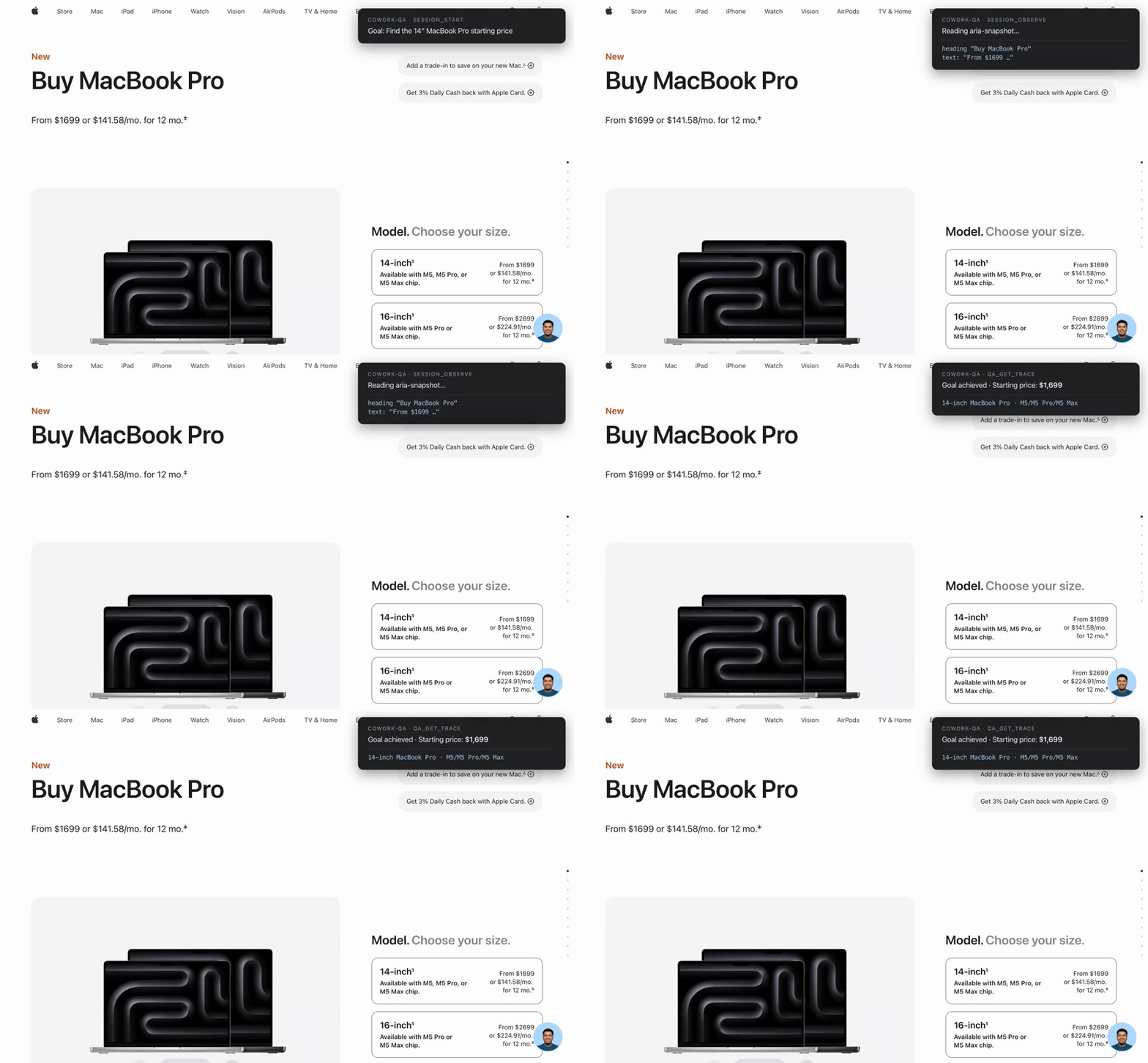
A Model Context Protocol server that gives an LLM a real Chromium browser, records every action it takes toward a stated goal, and hands back a structured trace so the LLM (or a second LLM) can decide whether the goal was actually achieved.
Built on Playwright. Five tools, one binary, no cloud dependency.
Why
Most browser-tool MCP servers are stateless — the LLM clicks, gets HTML back, repeats. There's no record of what happened, no way to grade the run after the fact, and no goal context.
cowork-qa-mcp flips that:
- Every session starts with a goal in plain English.
- Every action (
goto,click,fill,press,eval) is recorded with timestamps, the URL after, and the page's aria-snapshot. - When the session ends, a JSON trace is persisted to disk and exposed via a single
qa_get_tracecall.
The orchestrating LLM can then reason over the trace ("did this run actually fulfill the goal, or did it click the wrong button?") instead of trusting the run-time chatter.
Tools
| Tool | What it does |
|---|---|
session_start |
Open a fresh tab, optional starting URL, return a session id |
session_act |
Run one of: goto, click, fill, press, eval. Records the step. |
session_observe |
Return current URL + full aria-snapshot of the page |
session_end |
Close the tab, persist the trace to disk, return the file path |
qa_get_trace |
Return the goal, every step, final URL, and final aria-snapshot — formatted for an LLM to read |
Install
Requires Node 20+. The package is on npm — no clone needed.
# Try it once, no install
npx cowork-qa-mcp

# Or install globally
npm install -g cowork-qa-mcp
The first install pulls Chromium via Playwright's postinstall (~150 MB).
Wire into your MCP-compatible client
Claude Code
claude mcp add cowork-qa --scope user -- npx -y cowork-qa-mcp
To watch the browser instead of running headless:
claude mcp add cowork-qa --scope user \
  -e COWORK_QA_HEADED=1 \
  -- npx -y cowork-qa-mcp
Verify with /mcp inside a fresh claude session — you should see cowork-qa ✓ connected and 5 tools.
Claude Desktop
Add to ~/Library/Application Support/Claude/claude_desktop_config.json (macOS) or %APPDATA%\Claude\claude_desktop_config.json (Windows):
{
  "mcpServers": {
    "cowork-qa": {
      "command": "npx",
      "args": ["-y", "cowork-qa-mcp"]
    }
  }
}
Cursor / Windsurf / other MCP clients
Any client that speaks the MCP stdio transport works. Point its server config at npx -y cowork-qa-mcp.
From source (for development)
git clone https://github.com/inSideos-designs/cowork-qa-mcp.git
cd cowork-qa-mcp
npm install
npm run build
node dist/server.js   # stdio server, expects an MCP client
MCP Registry
This server is also published on the official MCP Server Registry as io.github.inSideos-designs/cowork-qa — clients that auto-discover from the registry will find it without any manual config.
Environment variables
| Variable | Default | Purpose |
|---|---|---|
COWORK_QA_HEADED |
unset (headless) | Set to 1 to launch Chromium with a visible window |
COWORK_QA_DATA |
<cwd>/.cowork-qa |
Directory where <session-id>.json traces are written |
Usage example
A typical end-to-end loop the orchestrating LLM runs:
session_start({ goal: "find the cheapest 14\" MacBook Pro on apple.com",
                url: "https://www.apple.com/shop/buy-mac/macbook-pro" })
  → { session_id: "abc-123" }

session_observe({ session_id: "abc-123" })
  → URL + aria-snapshot

session_act({ session_id: "abc-123", action: "click",
              target: "button:has-text('Continue')" })

# ... more acts / observes ...

session_end({ session_id: "abc-123" })
  → { steps: 7, trace_path: "~/.cowork-qa/abc-123.json" }

qa_get_trace({ session_id: "abc-123" })
  → Goal: ...
    Steps (7 total): ...
    Final URL: ...
    Final aria-snapshot: ...
Trace format
Each trace is a JSON file:
{
  "session_id": "abc-123",
  "goal": "...",
  "steps": [
    {
      "t": 142,
      "action": "click",
      "args": { "target": "...", "value": null },
      "url_after": "...",
      "aria_after": "..."
    }
  ],
  "final": { "url": "...", "aria": "..." },
  "path": "/.../abc-123.json"
}
Limitations / known quirks
session_observecalls don't show up in the trace's step count — onlysession_actcalls do. The final aria-snapshot is captured atsession_end.evalruns the JS expression but doesn't return the value to the caller — only side effects on the page are observable.- One Chromium process is shared across all sessions in a server instance; each session gets its own context (cookies, etc. are isolated).
- Selectors are passed straight to Playwright. CSS, text-selectors (
button:has-text("Send")), androle=selectors all work.
License
MIT — see LICENSE.
Contributing
PRs welcome. Keep it small: this is meant to stay a thin, auditable server.
Installing Cowork QA
This server has no published package — it is built from source. Open the repository and follow its README.
▸ github.com/insideos-designs/cowork-qa-mcpFAQ
Is Cowork QA MCP free?
Yes, Cowork QA MCP is free — one-click install via Unyly at no cost.
Does Cowork QA need an API key?
No, Cowork QA runs without API keys or environment variables.
Is Cowork QA hosted or self-hosted?
Self-hosted: the server runs locally on your machine via the install command above.
How do I install Cowork QA in Claude Desktop, Claude Code or Cursor?
Open Cowork QA on unyly.org, pick your client tab (Claude Desktop, Claude Code, Cursor) and press Install — the config is generated automatically, no JSON editing.
Related MCPs
Playwright
Browser automation, scraping, screenshots
 by Microsoft
Puppeteer
Browser automation and web scraping.
 by modelcontextprotocol
opentabs-dev/opentabs
Plugin-based MCP server + Chrome extension that gives AI agents access to web applications through the user's authenticated browser session. 100+ plugins with a
 by opentabs-dev
robhunter/agentdeals
1,500+ developer infrastructure deals, free tiers, and startup programs across 54 categories. Search deals, compare vendors, plan stacks, and track pricing chan
 by robhunter
Compare Cowork QA with
Not sure what to pick?
Find your stack in 60 seconds
Author?
Embed badge for your README
Browse similar
All browse MCPs