
Crewmemory
FreeNot checkedShared crew memory MCP server for AI coding agents (Claude Code, Codex, Cursor, ...)

About
Shared crew memory MCP server for AI coding agents (Claude Code, Codex, Cursor, ...)
README

Crew Memory
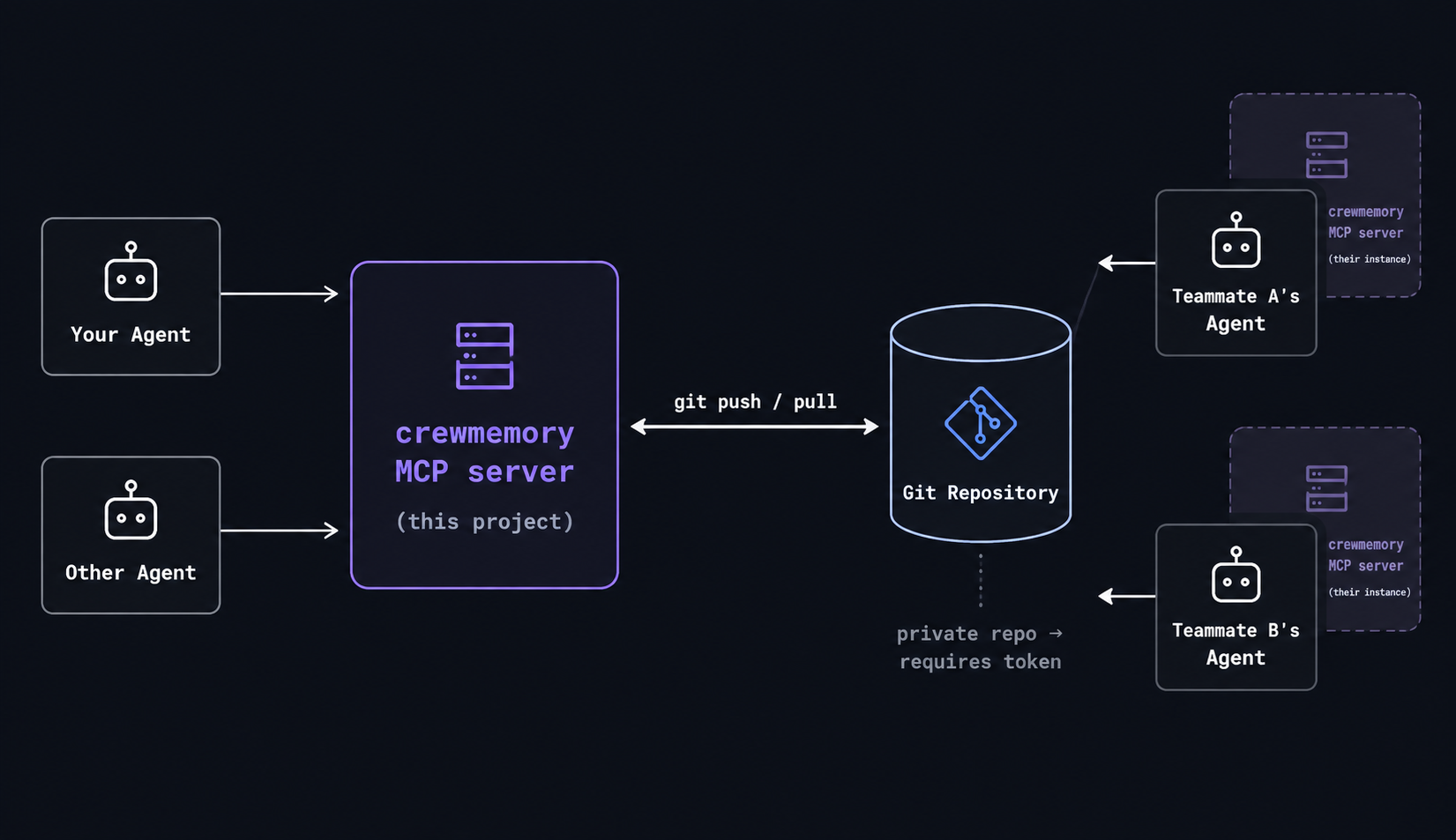
One shared memory for every AI coding agent on your team — Claude Code, Codex, Cursor, Gemini CLI, opencode, Windsurf, Claude Desktop, or any MCP client.
Memory lives in a git repo you own (GitHub or any git host). Every save is automatically committed and pushed; every read pulls the latest first. When your teammate's agent logs a fix, a decision, or what it's working on — your agent knows seconds later.
No server to run. No cloud database. No lock-in: it's plain markdown + git.
Install
One command (after the package is published)
uvx --from crewmemory-mcp crewmemory install codex --repo https://github.com/org/crewmemory.git --user alice --launcher uvx
Replace codex with claude-code, claude-desktop, cursor, gemini, opencode, or
windsurf. The same command works on Windows, macOS, and Linux when uv is installed.
Restart the client after registration.
For a private memory repo, also pass --token <fine-grained-token>; use a token limited to that
repository with Contents read/write access.
Install from a source checkout
uv venv .venv
uv pip install --python .venv/bin/python -e .
.venv/bin/crewmemory install codex --repo https://github.com/org/crewmemory.git --user alice
On Windows, the executable is .venv\Scripts\crewmemory.exe.
Supported clients: claude-code, claude-desktop, codex, cursor, gemini, opencode,
windsurf. The installer backs up and merges existing config, is idempotent, and saves a private
local connection profile so crewmemory doctor and crewmemory ui work outside the agent.
Or just ask your AI
Paste this to the agent running in this folder:
Install yourself as a crewmemory MCP server for Claude Code. My memory repo is https://github.com/org/crewmemory.git, my name is alice, token is github_pat_xxx.
The agent runs crewmemory install claude-code ... for you. No manual tool calls needed.
Project detection
At session start the MCP instructions tell the agent to call
team_context(project_path="<absolute workspace root>"). This selects the current Git repository
and branch dynamically, so one global MCP installation works across projects. crewmemory init
is optional and records a project in the local registry for humans and diagnostics.
crewmemory init # registers the project; reads branch/git identity
Verify anytime
crewmemory doctor # config, connectivity, project detection, counts
Human dashboard (no agent needed)
crewmemory ui              # opens http://127.0.0.1:8765 in your browser
crewmemory ui --port 9000 --no-browser
A local web dashboard for the whole team — see everything without asking an agent:
- Team now — who is working on what right now, progress bars, ⛔ blockers, stale badges
- Activity — full timeline: every note/decision/solution/status/deletion by everyone
- Memories — browse & search all six types, filter by author/kind, expand full text
- Profiles — member roles, timezones, git identities
- Overview — counts by type/author/project/lifecycle + storage info
Read-only, binds to 127.0.0.1 only, auto-refreshes every 30s. Zero extra dependencies.
Windows
Fully supported:
uv venv .venv-win
uv pip install --python .\.venv-win\Scripts\python.exe -e .
.\.venv-win\Scripts\crewmemory.exe install claude-code --repo ... --user alice --token ...
.\.venv-win\Scripts\crewmemory.exe ui
Member names are sanitized into safe filenames on every platform (_member_filename),
Codex TOML values are properly escaped for Windows paths/backslashes/quotes, and all git
calls run with GIT_TERMINAL_PROMPT=0 so nothing hangs waiting for input.
What your agents can do (tools)
| Area | Tools |
|---|---|
| Session | team_context (start-here briefing), MCP prompts session_start / session_end / pr_review_flow |
| Smart retrieval | recall — ranked by relevance × recency × confidence, packed into a context budget; searches team + personal scopes |
| Raw search | search_memory (filters: kind/tags/author/file/project), list_recent, memory_stats (auto index), recent_activity |
| Save knowledge | save_note, log_decision (context+decision+rationale), log_solution (problem/error/fix), save_gotcha, save_pattern, remember_commit_digest (summarize commits) |
| Presence | update_status(task, progress%, blockers), get_team_status, profiles via set_my_profile/get_profile |
| Handoffs | save_handoff (summary/next steps/blockers/questions), latest_handoff |
| Lifecycle | verify_memory, flag_stale, mark_superseded(old, new), find_duplicates (dedupe/consolidation) |
| Git-native | entry_history (commit-level provenance), memory_at(ref) (time travel to tag/sha/branch), sync_memory (manual pull/push; offline writes queue locally) |
| Code-aware | why_code(path) ("why does this exist?"), pr_memory_review(base) (decisions invalidated by a PR), git_blame_context(file, lines) |
| For humans | crewmemory ui dashboard — statuses, blockers, activity, memory browser, profiles |
Feature checklist
- Shared crew memory on your own git host · personal private memory (local-only scope, never pushed)
- Git-native storage: markdown + YAML frontmatter, zero-conflict file strategy (unique filenames, per-user status/activity files)
- Auto session sync on every read/write · manual sync tool · offline-safe (writes commit locally, push retries later)
- User & member profiles, auto-created from git config (
crewmemory init) - Progress tracking & blocker tracking in team status, with staleness markers
- Decision memory, gotchas, patterns, solutions, handoffs — six entry types
- Memory lifecycle: unverified → verified → superseded/stale, with confidence scores that decay with age and when linked code changes (code-change-aware decay)
- Conflict/duplicate detection on save + consolidation finder
- Provenance: author attribution, commit-linked memories, full
git log --followhistory per memory - Time travel: read crew memory at any commit/tag/branch
- Branch-aware context: entries remember project+branch; recall boosts current-branch matches
- Context budget management:
recallpacks the best memories into a char budget - Code integration: file-linked memories power PR-vs-decision review, obsolete-memory detection after PRs, why-does-this-code-exist lookup, blame cross-referencing, commit summarization
- Per-project memory: entries are tagged with the detected project slug; status shows project@branch
- Faceted search: tags, author, file, type, project (semantic search: future work)
- MCP-based, stdio transport, self-hosted/open-source by default
Repo layout (created automatically)
notes/ decisions/ solutions/ gotchas/ patterns/ handoffs/   # memory types
status/     current focus per member (task, %, blockers)
activity/   append-only timeline per member
profiles/   member profiles
Configuration (per teammate)
| Variable | Required | Meaning |
|---|---|---|
CREWMEMORY_REPO_URL |
yes | memory repo URL |
CREWMEMORY_USER |
yes | identity (author, commits, status) |
CREWMEMORY_TOKEN |
private repos | PAT with Contents Read+Write |
CREWMEMORY_EMAIL |
no | commit email |
CREWMEMORY_BRANCH |
no | pin a branch |
CREWMEMORY_PROJECT_PATH |
no | code repo path (auto-detected from cwd otherwise) |
CREWMEMORY_HOME |
no | data dir (default ~/.crewmemory) |
Manual config snippets (if you prefer editing configs yourself) live in the installer — it writes exactly this shape:
{ "mcpServers": { "crewmemory": {
    "command": "/path/to/crewmemory",
    "env": { "CREWMEMORY_REPO_URL": "...", "CREWMEMORY_USER": "...", "CREWMEMORY_TOKEN": "..." }
} } }
Codex uses [mcp_servers.crewmemory] in ~/.codex/config.toml; OpenCode uses the
mcp.servers.*.type=local shape — both handled by crewmemory install codex/opencode.
Recommended team workflow
Add to your CLAUDE.md / AGENTS.md:
At session start call team_context(project_path="<absolute workspace root>"), then update_status() for your task.
Use recall() before researching anything the team may know.
Save durable learnings immediately (log_solution/log_decision/save_gotcha/save_pattern).
When switching tasks update update_status(); at day's end call save_handoff().
Or just use the built-in prompts: /session-start, /session-end, /pr-review-flow.
Security
- Never save secrets into memory — it's a readable git repo.
- A public memory repository makes every team note, status, path, and handoff public. Prefer private.
- Private repos + fine-grained PATs (one per member, Contents: RW) are the intended setup.
- Tokens stay in local env/config only; all git output is redacted before reaching agents.
Publishing
The repository includes cross-platform CI, wheel/sdist checks, and a PyPI trusted-publishing workflow. See PUBLISHING.md for the release checklist.
Troubleshooting
crewmemory doctordiagnoses everything and prints exact fixes.- Auth failed → token needs Contents Read+Write on the memory repo.
- Push failed after retries → change is safe locally (queued); run
sync_memorylater. - "Points to a different remote" → delete
~/.crewmemory/<repo>or setCREWMEMORY_LOCAL_PATH.
Install Crewmemory in Claude Desktop, Claude Code & Cursor
unyly install crewmemoryInstalls into Claude Desktop, Claude Code, Cursor & VS Code — handles npx, uvx and build-from-source repos for you.
First time? Get the CLI: curl -fsSL https://unyly.org/install | sh
Or configure manually
Run in your terminal:
claude mcp add crewmemory -- uvx crewmemory-mcpStep-by-step: how to install Crewmemory
FAQ
Is Crewmemory MCP free?
Yes, Crewmemory MCP is free — one-click install via Unyly at no cost.
Does Crewmemory need an API key?
No, Crewmemory runs without API keys or environment variables.
Is Crewmemory hosted or self-hosted?
Self-hosted: the server runs locally on your machine via the install command above.
How do I install Crewmemory in Claude Desktop, Claude Code or Cursor?
Open Crewmemory on unyly.org, pick your client tab (Claude Desktop, Claude Code, Cursor) and press Install — the config is generated automatically, no JSON editing.
Related MCPs
GitHub
PRs, issues, code search, CI status
 by GitHub
Filesystem
Secure file operations with configurable access controls.
Memory
Knowledge graph-based persistent memory system.
Template MCP Server
A CLI tool to create a new Model Context Protocol server project with TypeScript support, dual transport options, and an extensible structure
 by mcpdotdirect
Amap Maps Mcp Server
MCP server for using the AMap Maps API
 by duxiaohui
Supabase
Database, auth and storage
 by Supabase
Everything
Reference / test server with prompts, resources, and tools.
Git
Tools to read, search, and manipulate Git repositories.
Sequential Thinking
Dynamic and reflective problem-solving through thought sequences.
Time
Time and timezone conversion capabilities.
Compare Crewmemory with
Not sure what to pick?
Find your stack in 60 seconds
Author?
Embed badge for your README
Browse similar
All development MCPs