
Endpoint Ops
FreeNot checkedA protocol-complete Model Context Protocol server (Tools + Resources + Prompts) for a studio endpoint fleet - talk to your fleet from Claude. No API key. 100% s

About
A protocol-complete Model Context Protocol server (Tools + Resources + Prompts) for a studio endpoint fleet - talk to your fleet from Claude. No API key. 100% synthetic data.
README
Talk to a studio endpoint fleet from Claude. A Model Context Protocol server that exposes a managed-device fleet as Tools, Resources, and Prompts — so you can ask Claude "which recording booths are non-compliant, and draft a runbook for the worst one" and it answers from real (synthetic) inventory instead of guessing.





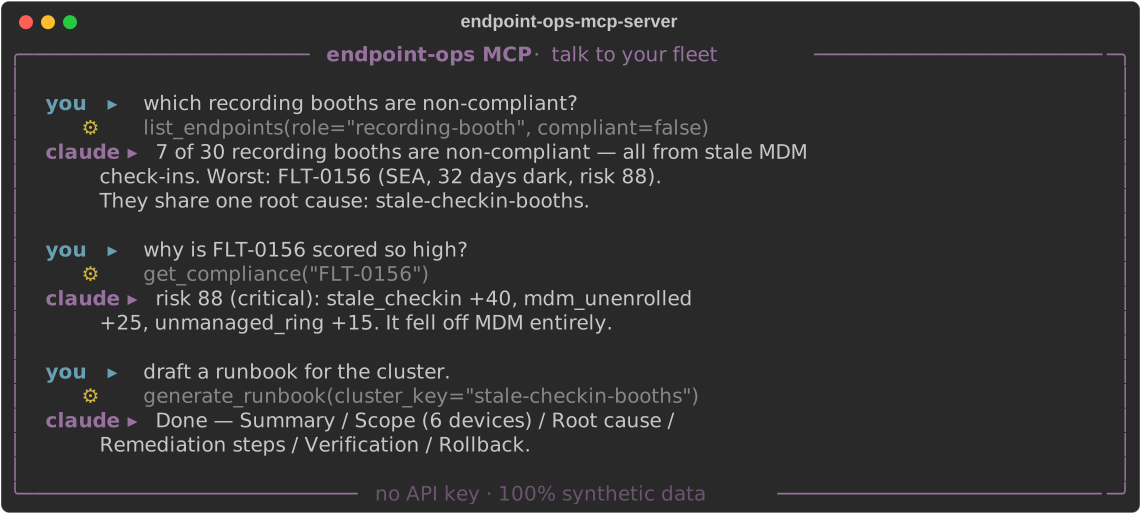
Full demo transcript: samples/transcript.md · Inspector walkthrough: samples/inspector.md
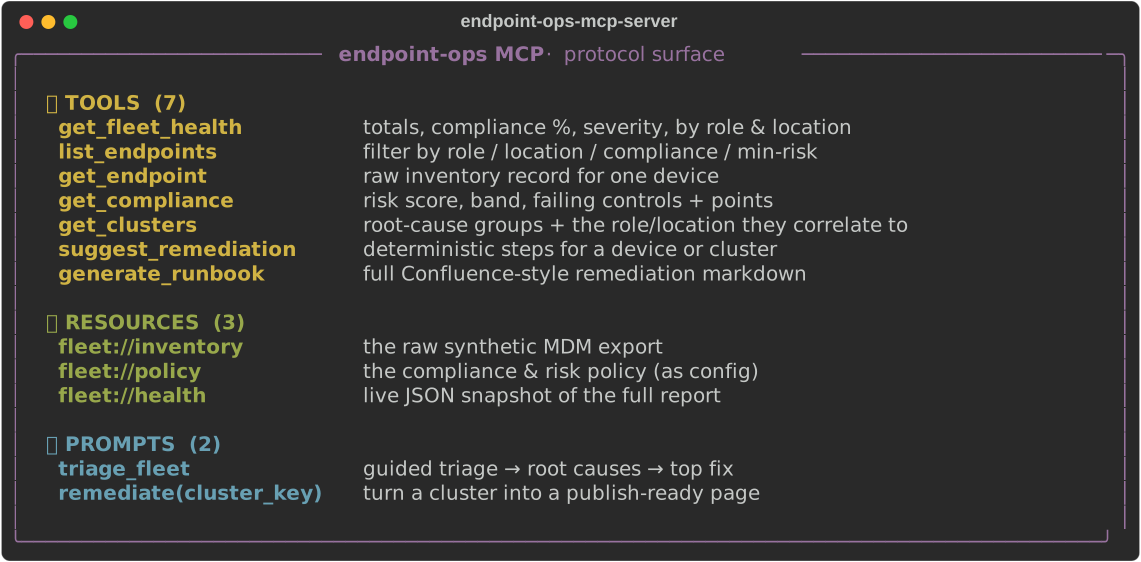
The whole protocol surface at a glance
Why this exists
Most "AI portfolio" projects are a chatbot over a generic dataset. This one sits at the intersection of a real operational domain — endpoint/fleet management, compliance, patch strategy — and the frontier of AI tooling: a protocol-complete MCP server. The hard part of fleet ops isn't calling an LLM; it's the explainable scoring, the root-cause correlation, and the runbook discipline. This server hands all of that to your Claude as ground-truth tools. The model reasons; the server never lies about the fleet.
It's the MCP-native twin of its sibling CLI, Fleet Triage AI — same deterministic engine, exposed as a protocol instead of a terminal.
The no-API-key story (read this first)
An MCP server is not an AI app and needs no Anthropic API key. It's the thing Claude connects to. Your Claude client (Claude Code, Claude Desktop) brings the model; this server just answers tool calls with structured data. So anyone can clone it and run it for free, instantly.
| Layer | What it does | Needs a key? |
|---|---|---|
| Deterministic engine (vendored) | Loads a synthetic inventory → scores every device against a YAML policy → clusters at-risk devices by root cause. Pure Python, no network. | No |
| This MCP server | Exposes the engine as MCP Tools / Resources / Prompts over stdio. | No — your Claude client supplies the model. |
Protocol surface
🔧 Tools — what the model calls for ground truth
| Tool | Description |
|---|---|
get_fleet_health |
Totals, compliance %, severity counts, breakdown by role & location. |
list_endpoints |
Filter devices by role / location / compliance / min-risk; highest risk first. |
get_endpoint |
The raw inventory record for one device (OS, patch level, check-in, owner…). |
get_compliance |
The verdict for one device: risk score, band, and every failing control with points. |
get_clusters |
Root-cause clusters — at-risk devices sharing a dominant fault + the role/location they correlate to. |
suggest_remediation |
Concrete, deterministic remediation steps for a device or a cluster. |
generate_runbook |
A full Confluence-style remediation runbook (markdown) for a device or cluster. |
📄 Resources — context the model can read directly
| URI | Description |
|---|---|
fleet://inventory |
The raw synthetic fleet inventory (the MDM export the engine scores). |
fleet://policy |
The compliance & risk policy as config — lets the model explain why a device scored as it did. |
fleet://health |
A JSON snapshot of the full fleet report; pin it into context to start a triage session. |
💬 Prompts — one-click workflows
| Prompt | Description |
|---|---|
triage_fleet |
Guided triage: summarize health → surface root causes → recommend the highest-leverage fix. |
remediate(cluster_key) |
Turn a root-cause cluster into a publish-ready remediation page. |
Setup
git clone https://github.com/jmlkin/endpoint-ops-mcp-server
cd endpoint-ops-mcp-server
pip install -e .
Claude Code (one command)
claude mcp add endpoint-ops -- endpoint-ops-mcp
Then just ask: "Use the endpoint-ops triage_fleet prompt" or "which edit-bays have encryption off?"
Claude Desktop
Add to claude_desktop_config.json (Settings → Developer → Edit Config):
{
  "mcpServers": {
    "endpoint-ops": {
      "command": "endpoint-ops-mcp"
    }
  }
}
Restart Claude Desktop; the 🔧 tools, 📄 resources, and 💬 prompts appear in the MCP menu.
MCP Inspector (great for screenshots)
mcp dev src/endpoint_ops_mcp/server.py
Opens a local web UI to browse and invoke every tool, resource, and prompt — no Claude client needed.
Point it at your own fleet
The server reads its data and policy from env vars, so it adapts to any inventory and any org baseline (CIS, internal hardening standard, …) without code changes:
ENDPOINT_OPS_DATA=/path/to/fleet.json \
ENDPOINT_OPS_RULESET=/path/to/ruleset.yaml \
endpoint-ops-mcp
The bundled fleet is 100% synthetic (200 devices, deterministic seed 1337, FLT-* ids, synthetic-user-* owners) — no real systems or people. Safe to run, fork, and demo.
Develop
pip install -e ".[dev]"
pytest
Architecture
flowchart LR
    D["data/fleet.json<br/>synthetic inventory"] --> EN
    R["config/ruleset.yaml<br/>policy"] --> EN
    EN["vendored engine<br/>engine.analyze()<br/>score · cluster"] --> SRV
    SRV["MCP server<br/>🔧 tools · 📄 resources · 💬 prompts"] --> CLIENT["Claude client<br/>Code / Desktop<br/>the reasoning"]
    CLIENT -. answers .-> U([you])
One deterministic seam (fleet.engine.analyze) feeds every tool, so the inventory, the verdicts, and the runbooks can never disagree. The model sits on top of that ground truth — it queries the fleet, it doesn't invent it.
Deeper dive — layers, the single-seam rule, determinism: docs/architecture.md.
License
MIT © 2026 Jose Milan. Built as an open, synthetic-data showcase of endpoint operations × modern AI tooling.
Install Endpoint Ops in Claude Desktop, Claude Code & Cursor
unyly install endpoint-opsInstalls into Claude Desktop, Claude Code, Cursor & VS Code — handles npx, uvx and build-from-source repos for you.
First time? Get the CLI: curl -fsSL https://unyly.org/install | sh
Or configure manually
Run in your terminal:
claude mcp add endpoint-ops -- uvx --from git+https://github.com/jmlkin/endpoint-ops-mcp-server endpoint-ops-mcp-serverStep-by-step: how to install Endpoint Ops
FAQ
Is Endpoint Ops MCP free?
Yes, Endpoint Ops MCP is free — one-click install via Unyly at no cost.
Does Endpoint Ops need an API key?
No, Endpoint Ops runs without API keys or environment variables.
Is Endpoint Ops hosted or self-hosted?
Self-hosted: the server runs locally on your machine via the install command above.
How do I install Endpoint Ops in Claude Desktop, Claude Code or Cursor?
Open Endpoint Ops on unyly.org, pick your client tab (Claude Desktop, Claude Code, Cursor) and press Install — the config is generated automatically, no JSON editing.
Related MCPs
GitHub
PRs, issues, code search, CI status
 by GitHub
Filesystem
Secure file operations with configurable access controls.
Memory
Knowledge graph-based persistent memory system.
Template MCP Server
A CLI tool to create a new Model Context Protocol server project with TypeScript support, dual transport options, and an extensible structure
 by mcpdotdirect
Amap Maps Mcp Server
MCP server for using the AMap Maps API
 by duxiaohui
Supabase
Database, auth and storage
 by Supabase
Everything
Reference / test server with prompts, resources, and tools.
Git
Tools to read, search, and manipulate Git repositories.
Sequential Thinking
Dynamic and reflective problem-solving through thought sequences.
Time
Time and timezone conversion capabilities.
Compare Endpoint Ops with
Not sure what to pick?
Find your stack in 60 seconds
Author?
Embed badge for your README
Browse similar
All development MCPs