
First Scan Otif
FreeNot checkedProduction-shaped ML on public Olist e-commerce data: a calibrated promise-miss (OTIF) ranker served on Cloud Run via REST + MCP, a frozen exception policy that

About
Production-shaped ML on public Olist e-commerce data: a calibrated promise-miss (OTIF) ranker served on Cloud Run via REST + MCP, a frozen exception policy that turns scores into a NOC work queue, and agents governed to copy the action. Top 2.5% of scores hit 46% precision, 10x lift. Ranking lift measured; intervention lift not claimed
README
Actionable ML in production shape: a fulfillment problem, a model that drives an operating decision, and a measured outcome.
This repo is the production loop on public Olist Brazilian e-commerce data: seller, parcel, and delivery-promise events. A calibrated ranker is served on GCP Cloud Run (REST + MCP). A frozen exception policy turns the score into work. LangGraph copies that action; MCP execute_simulated_action and REST /v1/action/simulate reject any other named action.
It is a portfolio system you can run and inspect, not a live 3PL. Organic marketplace traffic is replaced by chronological holdout replay. The point is the path raw data → production model → adopted decision, with features, stack, architecture, and impact you can walk in a screen.
Walkthrough: ARCHITECTURE.md · Numbers: docs/business_assessment.md · Product lock: docs/adr/0006-handoff-promise-miss-noc.md
Screen answer: prod, features, stack, architecture, impact
What is in production
Champion model local-20260819T170145Z (isotonic-calibrated XGBoost) scored in-process on Cloud Run olist-ml-api (IAM-gated, min instances 0). Same process mounts REST and MCP (POST /mcp). Local: make serve-local on :8080. Teardown: make gcp-down.
The decision in production is not “here is a probability.” It is a queue band: late notice, at-risk notice, remaining-leg upgrade proxy, or no action (noc-handoff-policy-v1). Promote, retrain, and spend above $20 stay with a person.
Features
Knowable at first carrier scan. Historical windows are 7 / 30 / 90 day; prior handoffs are strictly before the scan; current order excluded. Train and serve share column names in contracts.py. Omitted online seller history can be filled from Feast (the Cloud Run image ships the Feast client, the serving config, and the materialized SQLite store); remaining missing history is 0 after that lookup. Hydration is on: the pandas builder and the dbt/Feast warehouse now agree exactly on all six online seller features across 96,475 rows. Reaching that took a fix on each side — a tie-handling bug in the pandas point-in-time windows and hour-truncation in the dbt label. See ARCHITECTURE.md §6. Lookups fail open — an unmaterialized store degrades to cold-start defaults instead of erroring, and trips a circuit breaker so no request pays registry-load latency twice.
| Group | Examples |
|---|---|
| Promise clocks | handling_days, remaining_to_promise_days, handling_frac_of_promise, limit_miss |
| Shipment | item_count, basket_value, freight_value, geo_distance_km, same_state |
| Seller history (request fields) | seller_order_count_{7,30,90}d, seller_late_rate_{7,30,90}d |
| Context | purchase clocks, payment, customer/seller state |
| Never in X | customer delivery, raw carrier timestamp, reviews |
Detail below and in docs/features.md.
Stack
GCP · BigQuery · dbt · Feast · MLflow · XGBoost · FastAPI on Cloud Run · MCP.
Optimized for cost: Turn-key Terraform deployment and teardown of assets and IAM governance.
Vertex Endpoint / Redis / Composer are disabled; the Vertex pipeline file is a compile-or-skip stub, not a second training path.
Architecture
Olist CSVs → GCS raw bucket → BigQuery → dbt marts ─┐
                                                    ├→ Feast (offline: BQ, online: SQLite)
Olist CSVs → pandas PIT feature table ──────────────┘   warehouse snapshot / Feast history
        → train / calibrate → MLflow candidate → human promote → champion joblib
        → PredictionService (request + Feast online lookup → baked joblib)
              ├─ REST  /v1/predict  /v1/decision  /v1/explain
              └─ MCP   predict_promise_miss  recommend_policy_action  …
        → frozen P0–P3 policy → LangGraph copies action → simulated ledger
        → delayed-label eval, 90/10 canary, drift alarm, human promote
Business impact (what is measured vs assumed)
Measured: ranking quality for an exception queue on a later test window (n = 14,471, 4.6% miss rate). Top 2.5% of scores: 46.0% precision, 10.0× lift vs random. Top 10%: 22.5% precision, 4.9× lift, ~half of misses. Test PR-AUC 0.310, ROC-AUC 0.827, Brier 0.037.
Assumed, not causal: miss cost, upgrade cost, and prevention rate (econ-sim-v3). Replay also credits delay days avoided when an upgrade Bernoulli succeeds (observed overrun, or a 6-day miss median). Notices do not change days late. No new EDD is invented. allow_causal_roi_claims: false. Intervention lift needs an experiment (switchback or A/B on the action). This repo does not fake one. Ranking lift is the KPI this slice earned.
Simulated ops rollup (same assumptions, operator language): make demo-decision appends NOC simulations to the ledger; holdout scripts/policy_replay.py does the same at window scale. Then make decision-eval prints and writes artifacts/decision_impact.md — how many of each action ran, how many deliveries moved late→on-time, delay-days avoided, and spend. Same block is business_sim on GET /v1/metrics and in make export-monitoring. If the ledger has no actions, eval falls back to artifacts/policy_replay_report.json. That is the JD-facing outcome sentence. It is still not observed P&L. A full-holdout snapshot (9,647 orders) for the current champion local-20260821T203846Z: docs/evidence/decision-impact-holdout-local-20260821T203846Z.md — 603 interventions, 25 late deliveries moved on-time, 86.4 delay-days avoided, $1,200 simulated spend. The prior champion's snapshot (decision-impact-holdout.md, 630 / 27 / 88.8 / $1,432) is kept: a point-in-time fix shifted the frozen thresholds, so the action mix moved while ranking did not — top-2.5% precision is identical at 46% — including a three-policy comparison (do-nothing / naive threshold / NOC) where the cheap-notice baseline "wins" on simulated net value while changing zero physical outcomes. That asymmetry is why the policy is a banded capacity rule, not EV-argmax, and why intervention lift waits for an experiment.
See it running — an agent on the governed tool surface
A coding agent (Cursor) connected to the live IAM-gated Cloud Run endpoint over MCP — same PredictionService the REST API uses, no side channel. Model → frozen policy → simulated action → refusal when an agent tries to substitute.
1 · What's serving. get_model_status returns the champion version and frozen P1/P2 staffing cutoffs — matching this README because the served artifact and these numbers come from the same promoted model_meta.json.
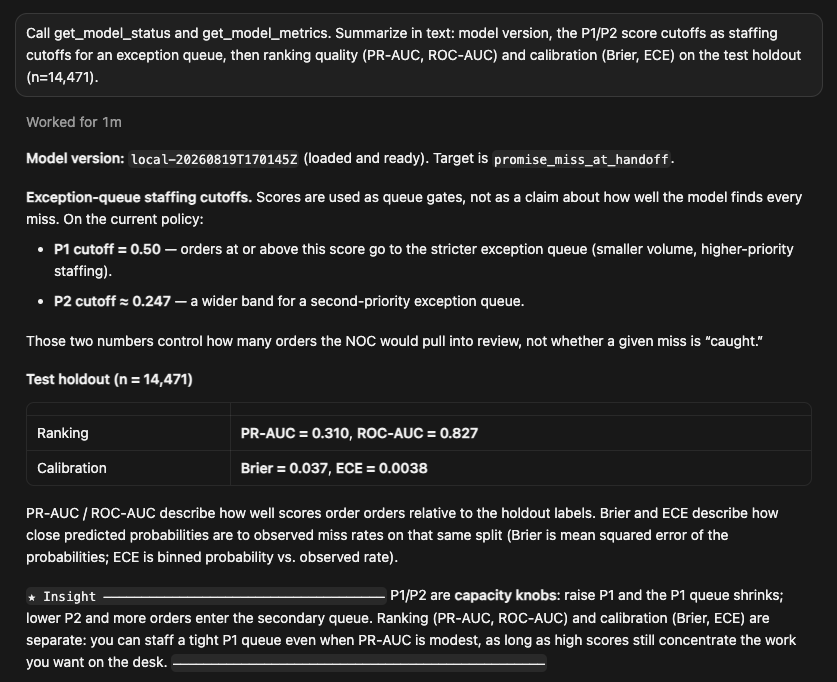
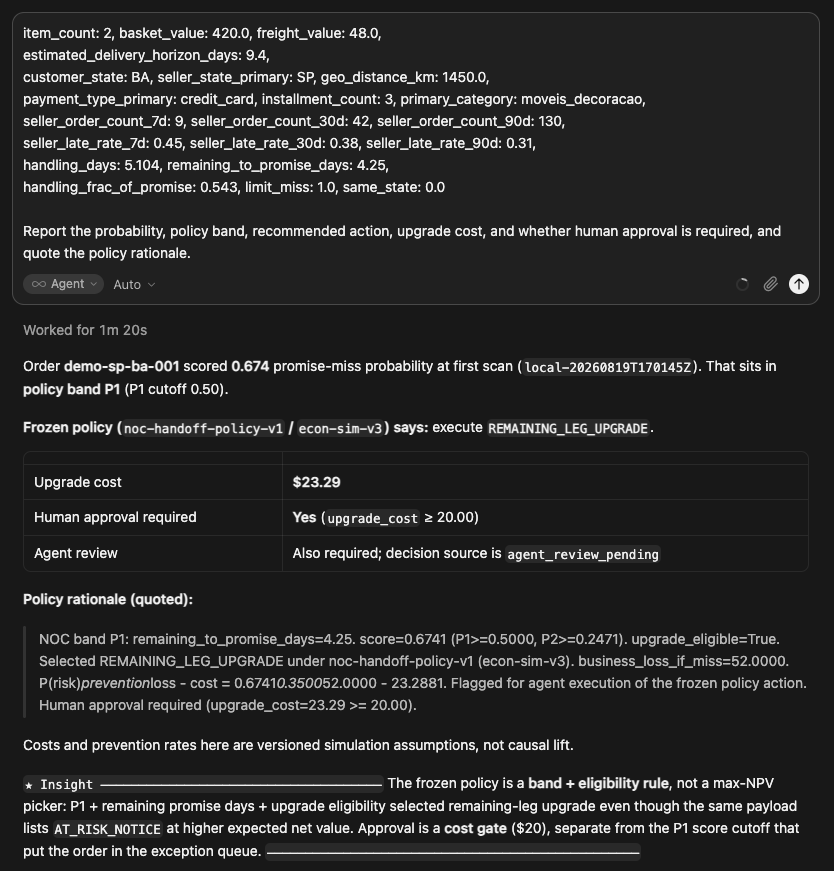
2 · Score → banded action. An SP→Bahia order at first scan: blown ship limit, 38% recent seller late rate, 4.25 days left on the promise. The policy answers with band P1, a remaining-leg upgrade priced ~$23, and requires_human_approval: true — spend above $20 is not autonomous. Note the agent's own read: the policy is a band + eligibility rule, not a max-NPV picker — it selected the upgrade even though a cheaper action carried higher expected net value in the same payload.
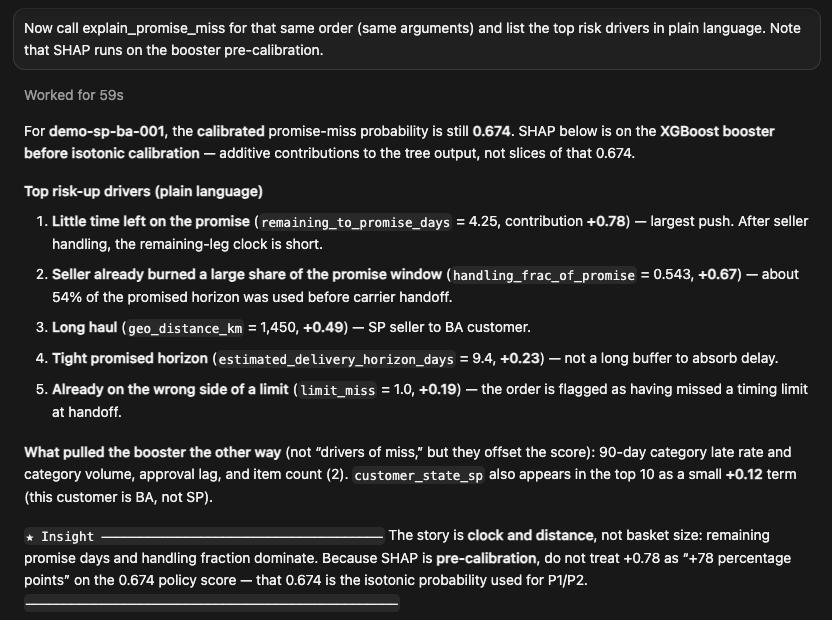
3 · Why this order. Tree SHAP on the booster (pre-calibration): remaining promise days and handling fraction dominate — clock and distance, not basket size.
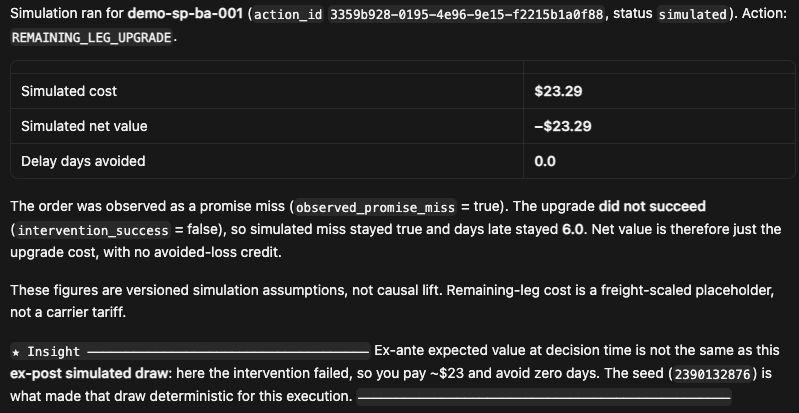
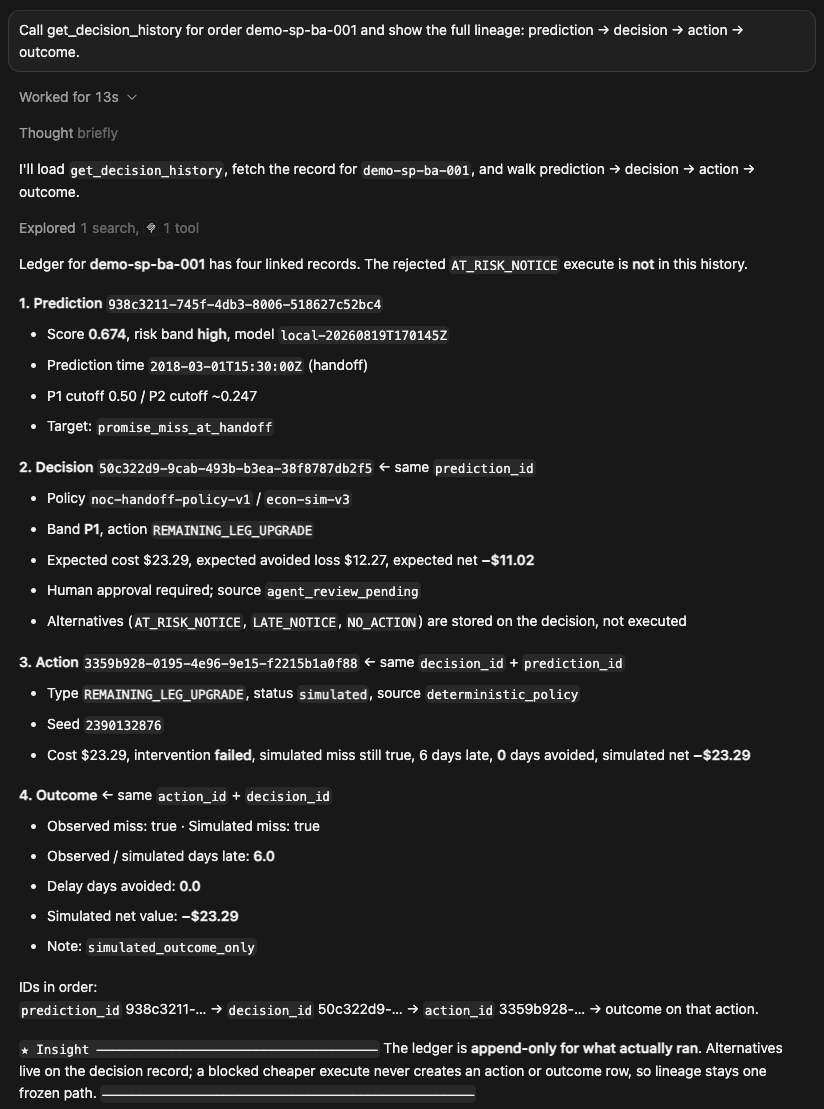
4 · Simulated execution — including when it fails. This seeded draw's upgrade did not prevent the miss: cost $23.29, zero delay-days avoided, net −$23.29. Ex-ante expected value is not the same as an ex-post draw; the simulation reports both honestly rather than always crediting the intervention.
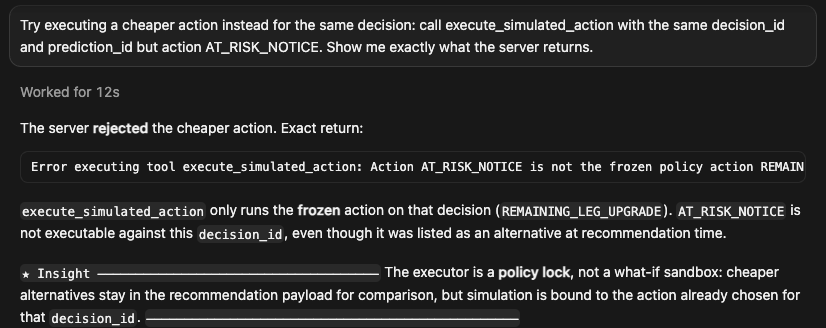
5 · The agent cannot pick a cheaper action. Executing anything other than the ledgered policy decision is refused by the server — the copy-the-action contract is enforced, not advisory.
6 · Lineage. One append-only chain per order — prediction → decision → action → outcome, linked by ids. The blocked cheaper execute never created an action row.
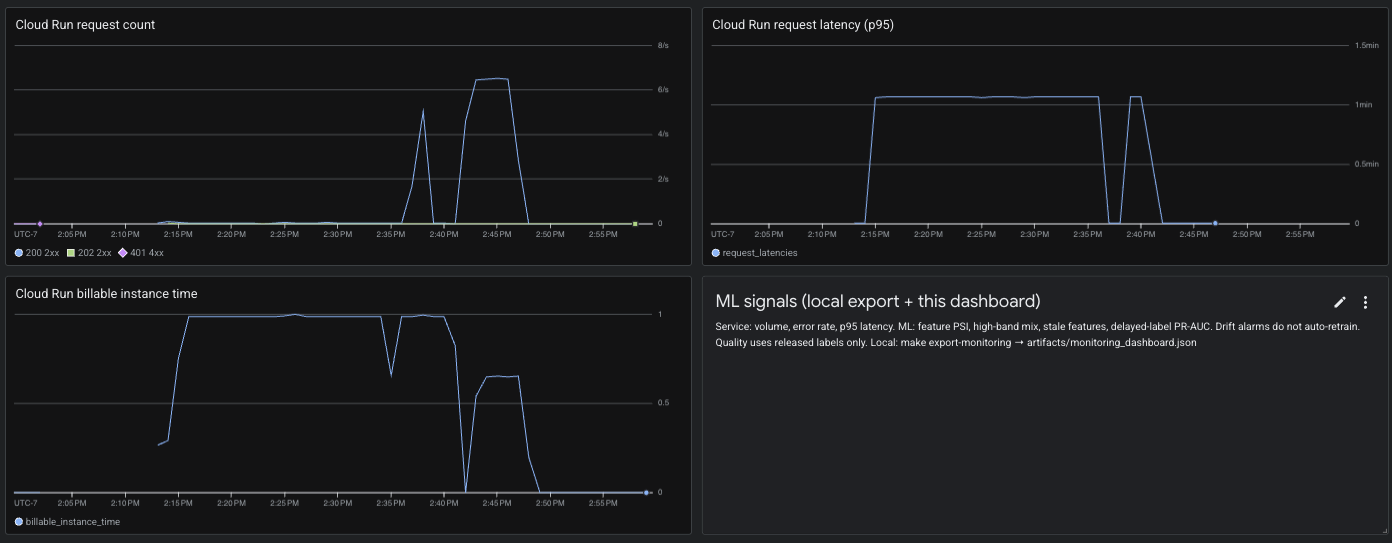
7 · Live traffic on the platform dashboard. A 2,000-request scored replay through the IAM-gated endpoint: 100% HTTP 200, p95 162 ms — under the repo's own 200 ms canary gate. The ~1-minute lines in the latency tile are held-open agent MCP streaming connections, not inference latency (Cloud Run can't split the two by label — one service, one auth boundary, one telemetry stream; the in-process /v1/metrics counters and the ledger are what separate app from agent traffic). Billable instance time shows scale-to-zero before and after.
The operating problem
Commerce here looks like a small fulfillment network: many sellers, a carrier handoff, a promised delivery date, and a customer who either gets the order on time or does not. At first carrier scan (handoff_ts = order_delivered_carrier_date) the seller is done. Remaining levers are the rest of the journey and customer communication.
promise_miss = customer_delivery > order_estimated_delivery_date
| Clock | What it is | In the model? |
|---|---|---|
prediction_ts |
Approval (else purchase) | Handling / horizon only |
handoff_ts |
First carrier scan | Decision time, split key, point-in-time cutoff |
| Customer delivery | Label | Never a feature |
Duration (delivery > 14 days) was an earlier target. It ranks well (~0.53 PR-AUC) and answers the wrong question: most long orders were promised long. Promise-miss at approval was too weak (~0.10–0.22 PR-AUC) because the public ETA already absorbed geography and horizon. Scoring at the scan makes handling time, days left on the promise, and ship-limit miss legal — and is the delivery-promise problem.
This slice is delivery prediction + exception management, in that order: first a reliable promise-miss score, then a queue ops can run. Carrier routing would be a later model in the same portfolio, not this artifact.
The NYU definition this follows: business problem → model that drives a decision → measurable outcome. The decision is the exception band. The measured outcome is queue lift. Policy simulation informs spend conversation; it is not claimed P&L.
REST and MCP share PredictionService. Agents do not get a second, undocumented scorer.
Model quality and queue lift
Champion local-20260819T170145Z (calibrated XGBoost, 100 Optuna trials; late rates use observed customer delivery only; validation split in half so calibration/early-stopping and threshold-freezing never share rows). Test n = 14,471, promise-miss rate 4.6%.
Lead with exception-queue lift (how much better the work list is than a random draw), then ranking/calibration. Accuracy on a rare miss is the wrong headline.
| Capacity (test) | Precision | Recall | Lift vs 4.6% base |
|---|---|---|---|
| Top 2.5% (P1-sized queue) | 46.0% | 24.8% | 10.0× |
| Top 10% (P2-sized queue) | 22.5% | 48.7% | 4.9× |
Among the highest-risk fortieth of later orders, about 2 in 5 actually miss the promise. The top tenth captures about half of test misses. That is the capacity story for a NOC: scarce attention, ranked work.
| Ranking / calibration | Test | Bootstrap 95% CI |
|---|---|---|
| PR-AUC | 0.310 | 0.276 – 0.343 |
| ROC-AUC | 0.827 | 0.807 – 0.844 |
| Brier | 0.037 | 0.034 – 0.040 |
| ECE | 0.004 | — |
The validation window is split in half by time: the earlier half fits early stopping and isotonic calibration; the later half — untouched by any fitting — freezes the policy cutoffs and is what "validation" metrics report (PR-AUC 0.356, ROC-AUC 0.820, miss rate 4.8% vs 4.6% on test). Thresholds stay frozen rather than being re-fit on later traffic, so the queue definition does not silently drift with the base rate.
Policy cutoffs from held-out validation scores: P1 = 0.4895, P2 = 0.2387 (champion local-20260821T203846Z; they travel in model_meta.json, so a promote can move them).
Adopted workflow (policy) and governed agents
The model does not pick the action. A versioned policy (noc-handoff-policy-v1) is the contract ops and agents both consume — the analog of a governed metric: humans own the definition, tools query it.
| Band | Rule | Workflow action |
|---|---|---|
| P0 | Remaining days to promise ≤ 0 | LATE_NOTICE (already late; clock rule, not a ranker) |
| P1 | Score ≥ 0.4895 | REMAINING_LEG_UPGRADE if eligible, else AT_RISK_NOTICE |
| P2 | Score ≥ 0.2387 | AT_RISK_NOTICE |
| P3 | Else | NO_ACTION |
Upgrade eligibility (demo proxy, not a carrier SKU): P1 and 0 < remaining ≤ 7 days and (geo ≥ 100 km or not same state). Intervention cost ≥ $20 waits for a person — high-stakes model-adjacent spend is not autonomous.
LangGraph copies recommended_action (it does not re-argmax EV). Documented MCP tools are the skill surface (score, explain, recommend, simulate). execute_simulated_action / POST /v1/action/simulate take a named action and reject it unless it matches the ledger's frozen policy decision. Human review remains on promote / retrain / spend ≥ $20.
Unit economics in simulation — not claimed P&L
Versioned placeholders (econ-sim-v3) so a stakeholder conversation can happen in cost per miss / cost per intervention, not only PR-AUC:
miss_cost     ≈ $10 + 10% of basket          (goodwill + value-at-risk stub)
upgrade_cost  ≈ freight-scaled placeholder   (clip $5–$80; not a carrier tariff)
notices       ≈ $1, 0% OTIF recovery in sim  (customer-impact only; days late unchanged)
upgrade prevent rate ≈ 0.35                  (assumed Bernoulli, not fitted lift)
delay days    ≈ observed (delivery − EDD)+   (0 if upgrade “succeeds”; else unchanged)
                 fallback 6d median on misses when overrun is not passed
allow_causal_roi_claims: false. Ranking lift above is measured. Intervention lift is not. A self-serve experimentation / causal-inference platform is out of scope for this slice and would be the way to replace those assumptions. Real emails, tickets, and carrier APIs stay off (real_external_execution_enabled: false). Detail: docs/limitations-assumptions-proxies.md. The rollup that turns those assumptions into “performed X actions, moved Y late deliveries on-time, spent $Z” is make decision-eval.
Features (messy ops data, current order excluded)
Grain: one row per order_id at first scan. Historical counts use prior handoffs with event_ts < handoff_ts, current order excluded. *_late_rate_* uses only priors whose customer delivery was already observed (order_delivered_customer_date < current handoff_ts); the positive class is still long_delivery (>14d).
Champion training starts from the pandas builder (build_feature_table) and then consumes the warehouse when it is present (features/historical.py): a complete ml.fct_training_snapshot export replaces the training table, otherwise a Feast historical retrieval overlays the online seller columns. The overlay joins on (seller_id, handoff_ts) — never seller_id alone, which would attach a seller's later history to their earlier orders. snapshot_id on the model artifact records which path produced it (pandas_builder, feast_historical, or dbt_fct_training_snapshot).
Request-native (on /v1/predict): basket, freight, item / seller / category counts, payment, customer and seller state, haversine distance, handling days, days remaining to promise, handling as a fraction of horizon, ship-limit miss, purchase clocks.
Seller / customer / category history: on the request. predict_one hydrates omitted online seller fields from Feast when enabled (request values win). Remaining missing history is 0 after that lookup, not instead of it. Replay copies the full history columns into the request.
Blocked: reviews; raw carrier or customer delivery timestamps; any window that includes the current order.
Training and serving share column names in src/olist_ml/features/contracts.py. Feature audit: docs/features.md.
Serving: REST and MCP
One FastAPI process so REST and MCP cannot diverge on scoring (PredictionService). Simulate tools take a named action and bind it to the frozen policy row on the ledger. Local: make serve-local → http://127.0.0.1:8080. Cloud: Cloud Run olist-ml-api on GCP (min instances 0, IAM invoker, not allUsers). MCP is Streamable HTTP at POST /mcp on the same URL. When AUTH_MODE=api_key, the same header gates REST and /mcp (/health and /ready stay open).
REST
| Method | Path | Role |
|---|---|---|
GET |
/health |
Liveness |
GET |
/ready |
Artifact loaded + model_version |
GET |
/v1/model |
Metrics, P1/P2 thresholds |
GET |
/v1/metrics |
In-process counters plus ledger business_sim (action mix, late→on-time, spend). Both are per-instance and reset on scale-to-zero — demo telemetry, not durable ops metrics on Cloud Run |
POST |
/v1/predict |
promise_miss_probability, risk_band, ids |
POST |
/v1/explain |
Tree SHAP on the booster (pre-calibration; displayed p is isotonic) |
GET |
/v1/policies/current |
Frozen policy + simulation economics |
POST |
/v1/decision |
Predict → exception policy; optional simulate + ledger |
POST |
/v1/action/simulate |
Frozen policy action; $ sim plus simulated_delay_days_avoided |
GET |
/v1/orders/{order_id}/decision |
Prediction / decision / action lineage |
GET |
/v1/actions/{action_id} |
Ledger rows for one action |
POST |
/v1/agent/review |
Copy-the-action LangGraph review (optional human gate); the agent extra ships in the serving image, so this runs on Cloud Run |
MCP tools (agent skill surface)
Same domain services as REST. No duplicated inference.
| Tool | Maps to |
|---|---|
predict_promise_miss / get_order_risk |
PredictionService.predict_one |
explain_promise_miss |
PredictionService.explain_one |
get_model_status / get_model_metrics |
readiness + model_info |
recommend_policy_action |
predict → DecisionService (POST /v1/decision) |
list_available_actions / get_policy_metrics |
noc-handoff-policy-v1 + econ-sim-v3 |
calculate_action_value |
simulation score for one approved action |
execute_simulated_action |
ActionExecutor (frozen policy; $ and delay-days sim) |
get_decision_history / get_action_outcome |
lineage by order_id / action_id |
Cursor (IAM identity token, ~1h TTL — do not commit it):
{
  "mcpServers": {
    "olist-ml": {
      "url": "https://<cloud-run-host>/mcp",
      "headers": {
        "Authorization": "Bearer <gcloud auth print-identity-token>"
      }
    }
  }
}
Local stdio: make mcp-serve. After gcp-up, resolve the URI with gcloud run services describe olist-ml-api --region=us-central1 --format='value(status.url)'.
Operating the model
There is no organic firehose. Traffic is a deterministic chronological holdout that never trains (docs/simulation.md). Labels are not used for quality the day you score: a release job waits seven days, then delayed PR-AUC / Brier run on released rows only.
| Job | What it proves |
|---|---|
| Replay holdout | Same snapshot + seed → same request order |
| Label release | Quality jobs ignore truth until prediction_ts + 7 days |
| Delayed eval | PR-AUC / Brier on released rows only |
| Canary 90/10 | Stable order_id hash; make canary-bad should fail and recommend rollback |
| Drift | Feature PSI > 0.2 or high-band mix shift → alarm, not auto-retrain |
| Retrain | Person approval file; drift-reason also needs an active alarm |
| Promote | A later, separate person decision. Train CI does not deploy. Deploy CI does not train. |
Automation stops where adoption and money live: canary → 100% traffic, alarm → retrain, candidate → champion, terraform apply, real external side effects. That is high-stakes model review as an operating rule, not a slide.
Stack
| Concern | Choice | Where it actually runs | Intentionally not |
|---|---|---|---|
| Cloud / warehouse | GCP, BigQuery, dbt, Terraform, teardown | Raw CSVs land in the GCS bucket; BigQuery loads from those objects; dbt builds the marts | A notebook with a warehouse screenshot |
| Features | Feast — offline BigQuery, SQLite online | In the Cloud Run request path: the image ships the Feast client + materialized store; lookups fail open | Always-on Redis / Vertex Feature Store (cost) |
| Train / registry | XGBoost + Optuna + isotonic; MLflow | Every champion train registers a run and tags git_sha / snapshot_id; promotion stays a named-human file swap. The currently published champion predates this wiring and has no run behind it — see ARCHITECTURE.md §7 |
Notebook cells as the production path; automated promotion |
| Serve | FastAPI + joblib on Cloud Run | One PredictionService behind REST and MCP |
A second inference stack for agents |
| Orchestration | Airflow DAGs as local CLIs (airflow extra makes the DAG objects real) |
A workstation / local scheduler | Idle Cloud Composer |
| Agents | MCP tools + LangGraph copy policy | Both ship in the serving image; the graph copies the frozen action | LLM chooses the exception band |
Vertex Endpoint, Memorystore Redis, and Composer stay off unless a person reviews a plan — same cost discipline you would want on a live GCP estate. Idle after make gcp-down is near $0/day. COST.md, docs/adr/0003-demo-cost-switches.md.
Run it
Python 3.12+. uv recommended.
make sync
make fixtures              # or: make download-olist  (full public CSVs)
make test
make serve-local           # REST + MCP on :8080
make smoke-local
make demo-decision         # P0–P3 + ledger, no LLM required for policy copy
make decision-eval         # action mix / late→on-time / spend (simulated)
make canary-bad            # degraded challenger should fail delayed-label gate

# live GCP (IAM-gated; tear down after the demo)
make gcp-up && make gcp-smoke && make gcp-down
Lint: make lint. Full local train: make train-pipeline — writes a candidate under artifacts/candidates/<version>/, never the champion path. Serving picks it up only after an explicit, named promote: make promote-candidate APPROVED_BY=<you> (H6; appends to artifacts/promote_record.jsonl).
What this is not
- A live fulfillment network or carrier integration. Holdout replay substitutes for production traffic.
- An experimentation / causal-inference platform. Ranking lift is measured; intervention lift is assumed until an experiment exists.
- A causal ROI study or observed P&L. Simulated net value is not unit-economics proof.
- A full Decision Science portfolio. One production-shaped model: delivery promises and exception management — not routing, demand, or churn.
- An LLM operations bot. No model chooses P0–P3.
- A production SLO. Feast online is SQLite; SHAP is tree-level; freshness is logged even when Feast is off.
Code map
| Path | Role |
|---|---|
src/olist_ml/features/ |
Contracts, assembler, Feast, handoff clocks |
src/olist_ml/training/ |
Tune, train, calibrate, evaluate, offline gates |
src/olist_ml/inference/ |
PredictionService |
src/olist_ml/api/ |
FastAPI + MCP |
src/olist_ml/decisions/ |
Exception policy, economics, routing |
src/olist_ml/agents/ |
LangGraph copy-the-action graph |
src/olist_ml/actions/ |
Simulated executor |
src/olist_ml/outcomes/ |
Ledger + simulated impact rollup |
src/olist_ml/monitoring/ |
Delayed labels, PSI, retrain approval |
dbt/ · feature_repo/ · pipelines/ · airflow/dags/ · terraform/ |
Warehouse, features, train graph, jobs, IaC |
tests/ · .github/workflows/ |
Unit / API / model tests; CI does not auto-promote |
Interview order: ARCHITECTURE.md §17. Demo script: docs/demo-script.md. Runbook: RUNBOOK.md.
License: MIT. Data: Olist Brazilian E-Commerce terms.
Install First Scan Otif in Claude Desktop, Claude Code & Cursor
unyly install first-scan-otifInstalls into Claude Desktop, Claude Code, Cursor & VS Code — handles npx, uvx and build-from-source repos for you.
First time? Get the CLI: curl -fsSL https://unyly.org/install | sh
Or configure manually
Run in your terminal:
claude mcp add first-scan-otif -- uvx --from git+https://github.com/smartofficialintelligence/first-scan-otif olist-mlStep-by-step: how to install First Scan Otif
FAQ
Is First Scan Otif MCP free?
Yes, First Scan Otif MCP is free — one-click install via Unyly at no cost.
Does First Scan Otif need an API key?
No, First Scan Otif runs without API keys or environment variables.
Is First Scan Otif hosted or self-hosted?
Self-hosted: the server runs locally on your machine via the install command above.
How do I install First Scan Otif in Claude Desktop, Claude Code or Cursor?
Open First Scan Otif on unyly.org, pick your client tab (Claude Desktop, Claude Code, Cursor) and press Install — the config is generated automatically, no JSON editing.
Related MCPs
wenb1n-dev/SmartDB_MCP
A universal database MCP server supporting simultaneous connections to multiple databases. It provides tools for database operations, health analysis, SQL optim
 by wenb1n-dev
Postgres Server
This server enables interaction with PostgreSQL databases through the Model Context Protocol, optimized for the AWS Bedrock AgentCore Runtime. It provides tools
 by madhurprash
Postgres
Query your database in natural language
 by Anthropic
PostgreSQL
Read-only database access with schema inspection.
by modelcontextprotocolRedis
Interact with Redis key-value stores.
by modelcontextprotocolSQLite
Database interaction and business intelligence capabilities.
by modelcontextprotocolmxcp
Open-source framework for building enterprise-grade MCP servers using just YAML, SQL, and Python, with built-in auth, monitoring, ETL and policy enforcement.
 by raw-labs
tadas-github/a2asearch-mcp
MCP server to search 4,800+ MCP servers, AI agents, CLI tools and agent skills. Install: npx -y a2asearch-mcp. Ask Claude: "Find MCP servers for database access
 by tadas-github
julien040/anyquery
Query more than 40 apps with one binary using SQL. It can also connect to your PostgreSQL, MySQL, or SQLite compatible database. Local-first and private by desi
 by julien040
drakonkat/wizzy-mcp-tmdb
A MCP server for The Movie Database API that enables AI assistants to search and retrieve movie, TV show, and person information.
 by drakonkat
Compare First Scan Otif with
Not sure what to pick?
Find your stack in 60 seconds
Author?
Embed badge for your README
Browse similar
All data MCPs