
Food Delivery Server
FreeNot checkedEnables users to search restaurants, view menus, place orders, and check order status via a local MCP server using Firestore.

About
Enables users to search restaurants, view menus, place orders, and check order status via a local MCP server using Firestore.
README
Python 3.12
Model Context Protocol
Firebase
Demo
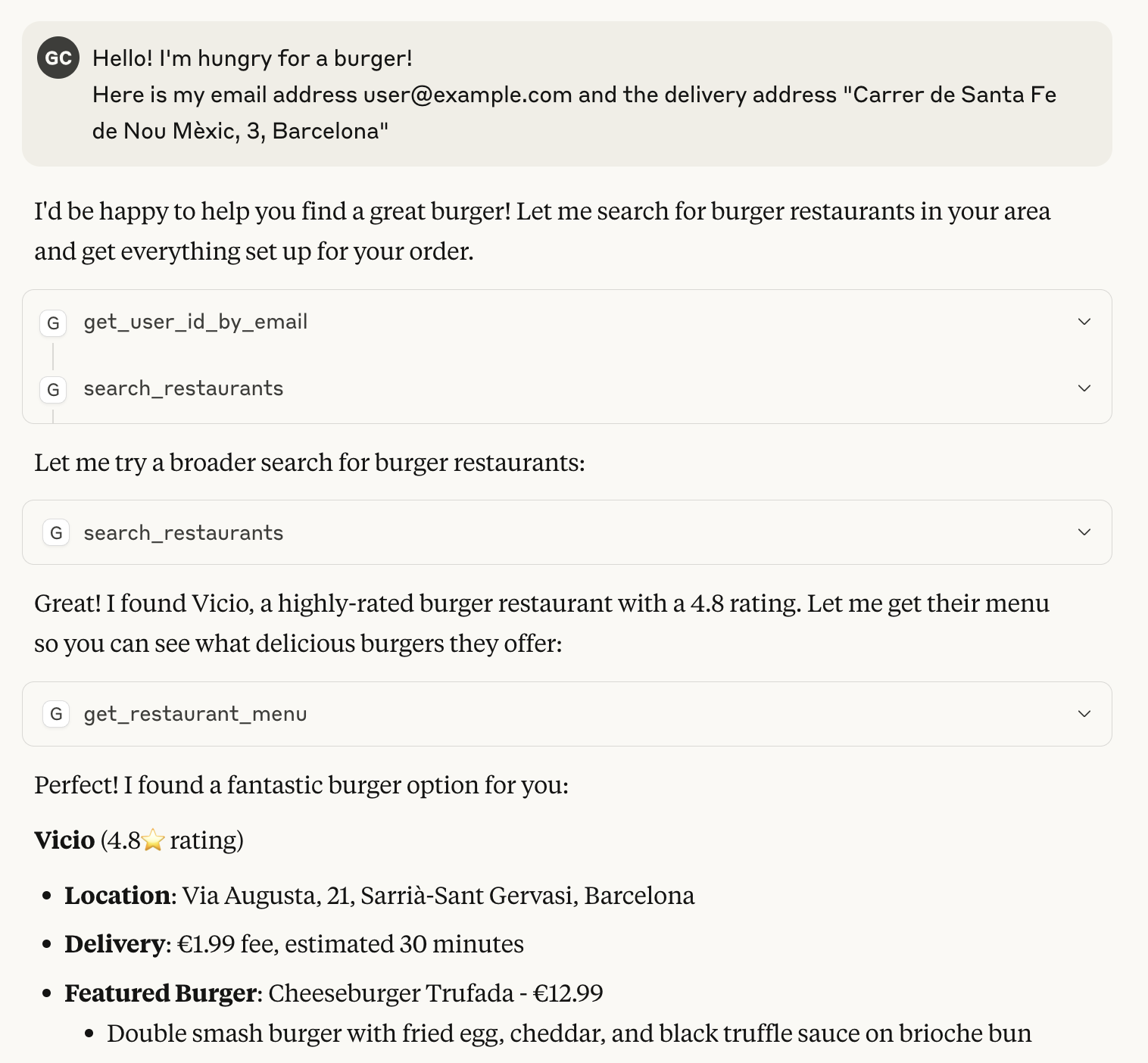
Are you hungry? Ask for the restaurant menu!
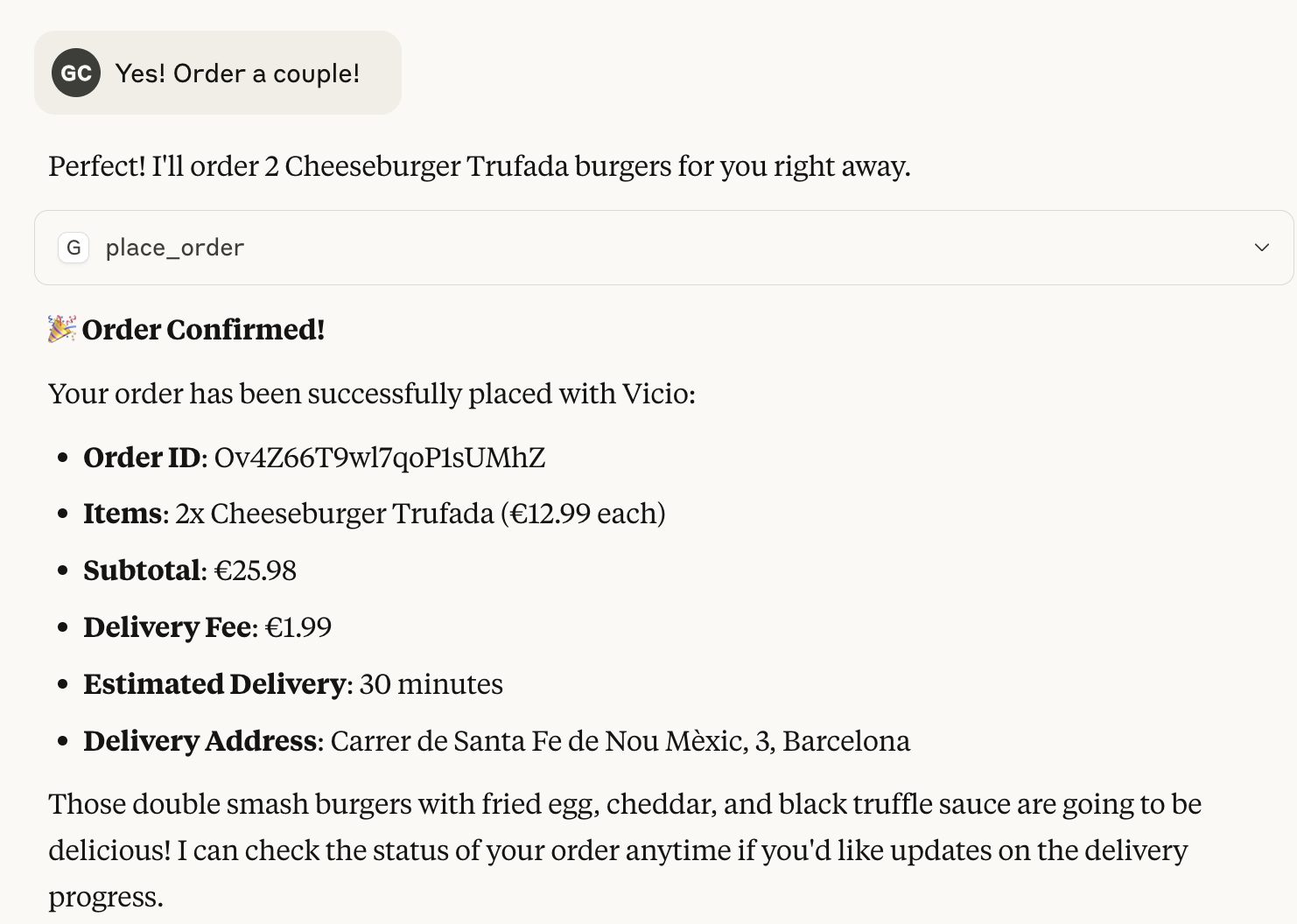
Let the agent order for you!
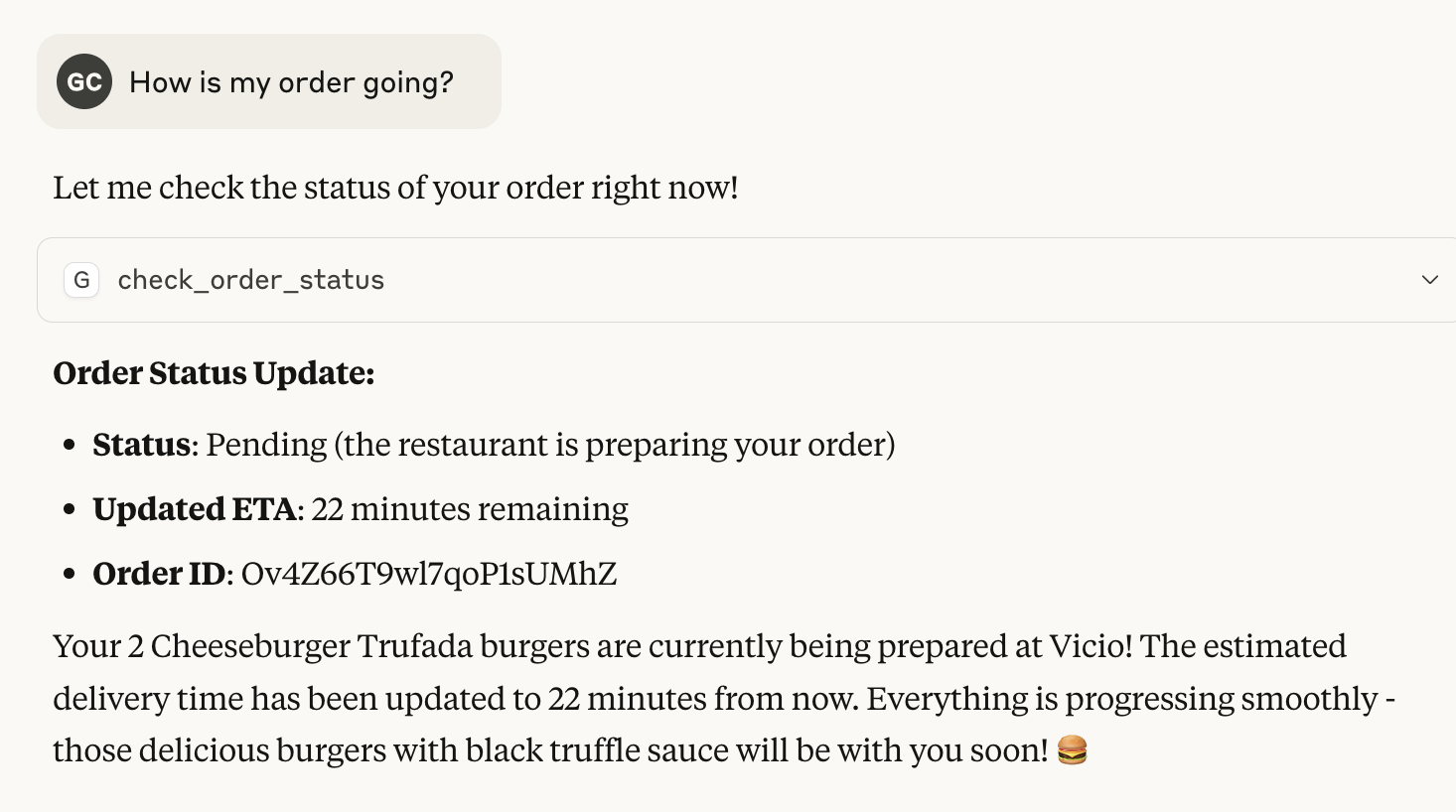
Check the status of your order!
Code structure
An effective directory layout for the food delivery MCP server is as follows:
food-delivery-mcp/
├──.venv/                   # The isolated Python virtual environment
├──.env                     # Secure storage for environment variables
├── data_models/
│   └── models.py           # The dataclasses provided for the application
├── db/
│   └── firestore_client.py # All database interaction logic
├── protocol/
│   ├── __init__.py         # Initializes the protocol package
│   ├── resources.py        # Defines the MCP Resources for the application
│   └── tools.py            # Defines the MCP Tools for the application
├── server.py               # The main FastMCP server implementation
├── pyproject.toml          # Project metadata and dependencies
├── requirements.txt        # List of dependencies for the project
└── README.md               # Project documentation
This structure intentionally isolates distinct logical components. The database interaction logic is encapsulated within the db/ directory, completely separate from the MCP server definition in server.py. This architectural decision is pivotal. It allows the server to act as a clean orchestration layer, defining the Tools and Resources available to the AI agent and delegating the underlying data operations to the firestore_client module. This separation makes each component independently testable and easier to reason about, a significant advantage when time is of the essence.
Database client
For this project we use Firestore as the database. The db/firestore_client.py module encapsulates all interactions with Firestore, providing a clean interface for the server to use. This separation of concerns allows for easier testing and maintenance.
Mapping Application Logic to MCP Primitives: Thinking in AI Terms
The MCP specification defines two primary ways for a server to expose capabilities: Resources and Tools. The distinction between them is one of the most important architectural concepts in the protocol, and getting it right is key to building an effective server.
Resources are defined as application-controlled, read-only data sources. They are meant to provide context to the LLM. Think of them as analogous to
GET endpoints in a traditional REST API. They retrieve information without causing any side effects or state changes. The client application (the "host") typically decides when and how to fetch these resources to inform the model.
Tools are defined as model-controlled functions that the LLM can decide to execute to perform an action. They are analogous to
POST, PUT, or DELETE endpoints in a REST API. They are expected to perform computations and can have side effects, such as creating or modifying data in a database. The AI agent itself determines that a tool needs to be called based on the user's request, and for security, the user should always be prompted for confirmation before a sensitive tool is executed.
For the food delivery app, the features can be mapped to MCP primitives as follows:
| Feature | MCP Primitive | Justification | Example Natural Language Invocation |
|---|---|---|---|
| Search for restaurants | Tool | This is an active search operation that requires parameters (e.g., cuisine, rating) and performs a filtered query against the database. The LLM decides when to perform this action based on a user's request to find something specific. | "Find me Italian restaurants with a rating above 4 stars" |
| View a restaurant's menu | Resource | This is a pure, read-only data retrieval for a specific entity (a restaurant). Once a restaurant is identified, the host application can fetch its menu as context for the LLM without the LLM needing to perform an "action". | (After user selects a restaurant) The client fetches the resource at foodapp://restaurants/{id}/menu |
| Place an order | Tool | This is the quintessential action. It has significant side effects: it creates a new Order document in Firestore and initiates a real-world process. It requires explicit invocation and user confirmation. | "Order a margherita pizza from Pizza Palace." |
| Check order status | Tool | While this is a read operation, it's an action taken to retrieve a specific, dynamic piece of information for the user based on a unique identifier (the order ID). It's a direct request for the server to do something. | "What is the status of my last order?" |
| List all available cuisines | Resource | This involves retrieving a list of relatively static, descriptive data. It's useful context for the LLM to know the possible values it can use for the cuisine parameter in the search_restaurants tool. | "What types of food can I order?" |
Installing Food Delivery Server
This server has no published package — it is built from source. Open the repository and follow its README.
▸ github.com/gonzalo-cordova-pou/food_delivery_mcpFAQ
Is Food Delivery Server MCP free?
Yes, Food Delivery Server MCP is free — one-click install via Unyly at no cost.
Does Food Delivery Server need an API key?
No, Food Delivery Server runs without API keys or environment variables.
Is Food Delivery Server hosted or self-hosted?
A hosted option is available: Unyly runs the server in the cloud, no local setup required.
How do I install Food Delivery Server in Claude Desktop, Claude Code or Cursor?
Open Food Delivery Server on unyly.org, pick your client tab (Claude Desktop, Claude Code, Cursor) and press Install — the config is generated automatically, no JSON editing.
Related MCPs
GitHub
PRs, issues, code search, CI status
 by GitHub
Filesystem
Secure file operations with configurable access controls.
Memory
Knowledge graph-based persistent memory system.
Template MCP Server
A CLI tool to create a new Model Context Protocol server project with TypeScript support, dual transport options, and an extensible structure
 by mcpdotdirect
Compare Food Delivery Server with
Not sure what to pick?
Find your stack in 60 seconds
Author?
Embed badge for your README
Browse similar
All development MCPs