
Global Education
БесплатноНе проверенMCP Server für internationale Bildungsdaten – UNESCO UIS (4000+ Indikatoren) und OECD Education at a Glance (SDMX API)

Описание
MCP Server für internationale Bildungsdaten – UNESCO UIS (4000+ Indikatoren) und OECD Education at a Glance (SDMX API)
README
🇨🇭 Part of the Swiss Public Data MCP Portfolio
🎓 global-education-mcp


MCP server for international education data – UNESCO UIS (4,000+ indicators across all member countries) and OECD Education at a Glance via SDMX. No API keys required.
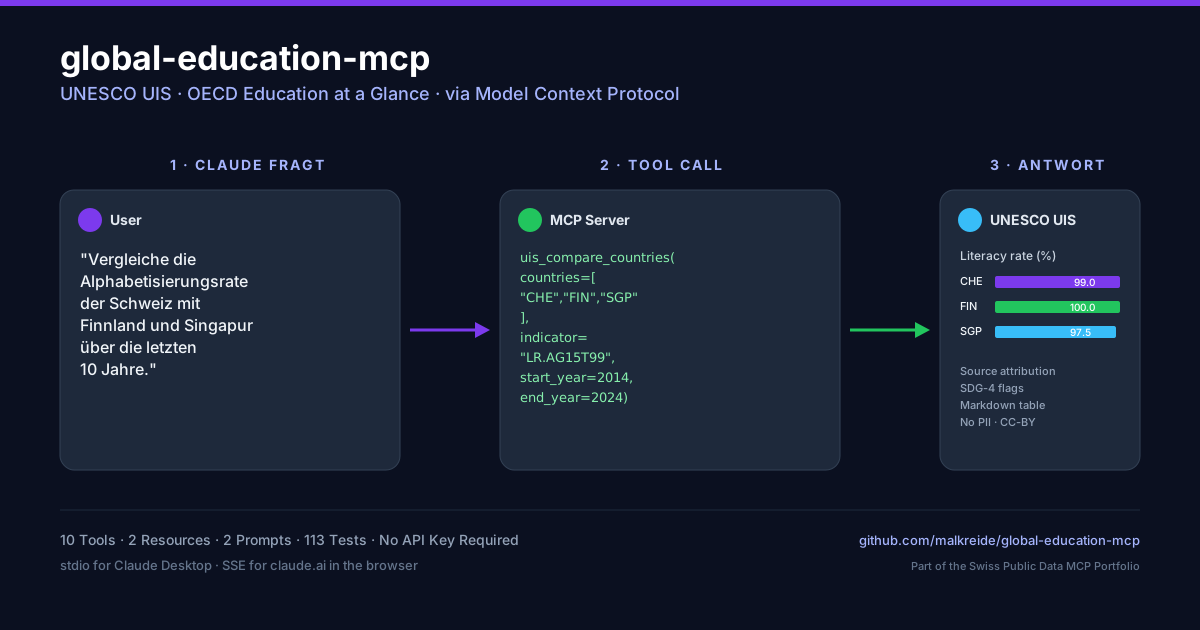
Overview
global-education-mcp gives AI assistants like Claude a complete international education intelligence system – literacy rates, enrolment ratios, education expenditure, teacher salaries, gender parity and SDG-4 monitoring, all accessible through a single standardised MCP interface.
The server bridges two of the most authoritative sources for internationally comparable education statistics: UNESCO UIS (global coverage, 4,000+ indicators) and the OECD's annual Education at a Glance (38 OECD countries, SDMX REST API). Both are open and require no API key.
Anchor demo query: "Compare Switzerland's education expenditure as a percentage of GDP with Finland, Singapore and South Korea over the last 10 years – and flag any SDG-4 gaps."
Features
- 🌍 UNESCO UIS – 4,000+ indicators, all UNESCO member countries, no API key
- 📊 OECD Education at a Glance – 38 OECD countries + partners via SDMX REST
- 🔍 Indicator search – browse and filter the full UNESCO indicator catalogue
- 🗺️ Multi-country comparison – benchmark any indicator across multiple countries
- 🏫 Country education profiles – 10 core indicators in one call
- 🎯 SDG-4 monitoring – structured reporting on Education for All targets
- 📈 OECD dataset search – discover and retrieve Education at a Glance dataflows
- 🔑 No API keys required – fully open data, zero setup friction
- ☁️ Dual transport – stdio for Claude Desktop, Streamable HTTP (
/mcp, spec2026-07-28) for cloud deployment - 🛡️ Graceful degradation – API failures return helpful messages with local reference fallback
Prerequisites
- Python 3.11+
uv(recommended) orpip- No API keys needed
Installation
# Clone the repository
git clone https://github.com/malkreide/global-education-mcp.git
cd global-education-mcp

# Install
pip install -e ".[dev]"
Or with uvx (no permanent installation):
uvx global-education-mcp
Quickstart
# Start the server (stdio mode for Claude Desktop)
global-education-mcp
Try it immediately in Claude Desktop:
"What is Switzerland's literacy rate compared to Finland and Singapore?" "Show me education expenditure as % of GDP for CHE, DEU and AUT over the last 10 years."
Configuration
Claude Desktop Configuration
Windows (%APPDATA%\Claude\claude_desktop_config.json):
{
  "mcpServers": {
    "global-education": {
      "command": "uvx",
      "args": ["global-education-mcp"]
    }
  }
}
macOS (~/Library/Application Support/Claude/claude_desktop_config.json):
{
  "mcpServers": {
    "global-education": {
      "command": "uvx",
      "args": ["global-education-mcp"]
    }
  }
}
A ready-to-use claude_desktop_config.json is included in the repository root.
Cloud Deployment (Streamable HTTP for browser access)
For use via claude.ai in the browser (e.g. on managed workstations without local software).
⚠️ Security note: Since v0.3,
MCP_HOSTdefaults to127.0.0.1. The HTTP transport must always run behind a reverse proxy that adds TLS, authentication, and rate-limiting. Never expose the raw port to the internet —MCP_HOST=0.0.0.0is only safe inside an isolated container network.
Docker (recommended):
The repository ships a hardened multi-stage Dockerfile and a
docker-compose.yml that applies read_only: true, cap_drop: [ALL],
security_opt: [no-new-privileges:true], and runs as non-root user
uid 10001. The compose file binds the port to 127.0.0.1 so a host-level
reverse proxy is required for any external access.
docker compose up --build
# then point nginx/caddy at 127.0.0.1:8000/mcp with TLS + auth
Plain docker run (without compose):
docker build -t global-education-mcp .
docker run --rm \
  --read-only --cap-drop ALL --security-opt no-new-privileges \
  --tmpfs /tmp:size=16M,mode=1777 \
  -p 127.0.0.1:8000:8000 \
  global-education-mcp
Render.com:
- Push/fork the repository to GitHub
- On render.com: New Web Service → connect GitHub repo
- Set environment variables in the Render dashboard:
MCP_TRANSPORT=streamable-http MCP_HOST=0.0.0.0 # Render needs 0.0.0.0; their edge layer provides TLS + auth. PORT=8000 - In claude.ai under Settings → MCP Servers, add:
https://your-app.onrender.com/mcp
Migrating from SSE. Up to v0.3.5 the container defaulted to MCP_TRANSPORT=sse
with the endpoint /sse. The default is now streamable-http at /mcp — the
transport through which 2026-07-28 clients send their single-POST requests;
SSE has been superseded since spec 2025-03-26 and never offered that path.
Existing deployments either switch the client URL to /mcp or set
MCP_TRANSPORT=sse explicitly; the server then logs a
legacy_transport_warning on start. An unknown MCP_TRANSPORT value now
aborts the start instead of silently falling back to stdio.
💡 "stdio for the developer laptop, sandboxed Streamable HTTP container for the browser."
Available Tools
UNESCO UIS Tools
| Tool | Description |
|---|---|
uis_list_indicators |
Search and list available indicators (4,000+) |
uis_list_countries |
List countries and regions with ISO codes |
uis_get_education_data |
Retrieve data for a specific indicator |
uis_compare_countries |
Multi-country comparison for one indicator |
uis_country_education_profile |
Full education profile (10 core indicators) |
uis_list_versions |
List available database versions |
OECD Tools
| Tool | Description |
|---|---|
oecd_list_education_datasets |
List Education at a Glance datasets |
oecd_get_education_indicator |
Retrieve OECD education data via SDMX |
oecd_search_datasets |
Search OECD dataflows by keyword |
Cross-Source Tools
| Tool | Description |
|---|---|
education_benchmark_countries |
Benchmark multiple countries across 5 focus themes (UNESCO UIS) |
Resources & Prompts
Resources:
education://indicators/unesco– Quick reference for core UNESCO indicatorseducation://datasets/oecd– Quick reference for OECD Education at a Glance dataflows
Prompts:
bildungsvergleich_schweiz– Switzerland vs. Finland, Singapore, Japansdg4_monitoring– SDG-4 report for CH/DE/AT
Country Codes
ISO 3166-1 Alpha-3 standard:
| Code | Country | Code | Country |
|---|---|---|---|
CHE |
Switzerland | FIN |
Finland |
DEU |
Germany | SGP |
Singapore |
AUT |
Austria | KOR |
South Korea |
FRA |
France | JPN |
Japan |
SWE |
Sweden | USA |
United States |
Example Use Cases
| Query | Tool |
|---|---|
| "What is Switzerland's literacy rate vs. Finland and Singapore?" | uis_compare_countries |
| "Education expenditure as % of GDP for CHE, DEU, AUT over 10 years" | uis_get_education_data |
| "Create a full education profile for South Korea" | uis_country_education_profile |
| "Which OECD datasets cover teacher salaries?" | oecd_search_datasets |
| "Compare secondary graduation rates across 5 European countries" | education_benchmark_countries |
| "Create an SDG-4 monitoring report for Switzerland" | sdg4_monitoring (prompt) |
→ More use cases by audience →
Architecture
┌─────────────────┐     ┌──────────────────────────────┐     ┌────────────────────┐
│   Claude / AI   │────▶│   Global Education MCP       │────▶│   UNESCO UIS API   │
│   (MCP Host)    │◀────│   (MCP Server)               │◀────│   uis.unesco.org   │
└─────────────────┘     │                              │     └────────────────────┘
                        │  10 Tools · 2 Resources      │
                        │   · 2 Prompts                │     ┌────────────────────┐
                        │  stdio | Streamable HTTP     │────▶│   OECD SDMX API    │
                        │                              │◀────│   sdmx.oecd.org    │
                        │  server.py                   │     └────────────────────┘
                        │   + api_client.py            │
                        └──────────────────────────────┘
Infrastructure Components
| Component | Metaphor | Function |
|---|---|---|
| HTTPClient | Postal service | Handles all outbound HTTP requests, retries and timeouts |
| SimpleCache | Whiteboard | In-memory TTL cache for repeated queries |
| GracefulFallback | Safety net | Returns local reference data when APIs are unavailable |
| SDMXParser | Translator | Converts OECD SDMX/XML responses to clean JSON |
Caching Strategy
| Data Source | Cache TTL | Rationale |
|---|---|---|
| UNESCO UIS indicators | 3600s | Catalogue is stable; updated annually |
| UNESCO UIS country data | 1800s | Figures update yearly, not intraday |
| OECD dataset list | 3600s | Education at a Glance is an annual publication |
| OECD indicator data | 1800s | Same annual update cycle |
| Country/region list | 86400s | ISO codes and country lists are highly stable |
Project Structure
global-education-mcp/
├── src/global_education_mcp/       # Main package
│   ├── __init__.py                 # Package metadata, version
│   ├── server.py                   # FastMCP server, 10 tools, 2 resources, 2 prompts
│   └── api_client.py               # HTTP client, UNESCO UIS + OECD wrappers, formatters
├── scripts/
│   └── record_fixtures.py          # Records the fixtures from the live UIS API
├── tests/
│   ├── fixtures/                   # Recorded responses + PROVENANCE.md (source, date, SHA-256)
│   ├── fixture_data.py             # Fixture loader – raises on a missing name
│   ├── test_source_contract.py     # Contract vs. the recording + live tests
│   ├── test_server.py              # 42 tests (basic / intermediate / advanced)
│   └── test_extended_scenarios.py  # 74 tests across 8 categories
├── claude_desktop_config.json      # Ready-to-use Claude Desktop config
├── pyproject.toml                  # Build configuration (hatchling)
├── CHANGELOG.md
├── CONTRIBUTING.md                 # Contribution guide (English)
├── CONTRIBUTING.de.md              # Contribution guide (German)
├── SECURITY.md                     # Security policy (English)
├── SECURITY.de.md                  # Security policy (German)
├── LICENSE
├── README.md                       # This file (English)
└── README.de.md                    # German version
Known Limitations
- UNESCO UIS: Some indicators have sparse coverage for low-income countries or recent years
- OECD SDMX: Occasional API timeouts on large multi-country, multi-year requests; reduce the year range if needed
- OECD coverage: 38 OECD members + select partners – does not cover all UNESCO member states
- Historical depth: UNESCO UIS data availability varies by indicator; not all series go back to 1970
- Language: UNESCO UIS returns indicator labels in English only; OECD labels may vary by dataflow
- No real-time data: Both sources publish annually – figures reflect the latest published edition, not live school statistics
- Estimated values are labelled: UIS marks part of its observations
UIS_EST(UIS estimate) orNAT_EST(national estimate) – forLR.AG15T99that is 1,306 of 9,818 values. The status column names it; an unlabelled value is a reported one. - Data rows carry the ISO code, not the country name: plain names come from
uis_list_countries. The data tools print the code rather than inventing a name. - An unknown country code is not an error status: UIS answers HTTP 200 with an empty result set and states the reason in the payload's
hintsfield. The tools print that hint – otherwise a typo would look exactly like a country without data.
Compliance & Data Classification (City of Zurich)
Verbindliche Klassifikation für den Einsatz im Schulamt der Stadt Zürich (German section follows in
README.de.md).
ISDS Protection Class (Stadt Zürich Schutzbedarfsklassen)
| Dimension | Class | Reasoning |
|---|---|---|
| Confidentiality | public | UNESCO UIS data licensed under CC BY-SA 3.0 IGO; OECD EaG under public OECD Terms |
| Integrity | normal | Upstream is authoritative; local in-memory cache is TTL-bounded and never written to disk |
| Availability | normal | Graceful fallback to bundled static reference data when an API is unreachable |
| Overall protection class | G1 — public (öffentlich) | lowest tier per ISDS Stadt Zürich |
- Data owner: UNESCO UIS / OECD (external)
- System owner: Schulamt der Stadt Zürich
- Processes personal data: no
- DSG / EDÖB relevance: none (only anonymized country-level aggregates)
Schulamt Classification (BUI / Vertraulich / Streng Vertraulich)
| Aspect | Classification |
|---|---|
| Tool output (Markdown tables, summaries) | BUI (betrieblich unkritische Information) |
| In-memory TTL cache | BUI (same tier as source) |
| Structured logs (JSON on stderr, see OBS-003) | BUI — only tool name, params, duration; no PII |
tools.lock.json, audits/ artefacts |
BUI |
→ The server is approved for any Schulamt use case without additional clearance from the data protection officer.
Compatibility
| Component | Supported version |
|---|---|
| MCP Protocol | 2024-11-05 |
| MCP Python SDK | >=1.0.0,<2.0.0 |
| Python | 3.11, 3.12, 3.13 |
httpx |
>=0.27.0,<1.0.0 |
pydantic |
>=2.0.0,<3.0.0 |
Major-version upgrades are deliberate decisions — the upper bounds in
pyproject.toml exist so a transitive bump does not silently break the
server. See CHANGELOG.md for the upgrade trail.
🛡️ Safety & Limits
| Aspect | Details |
|---|---|
| Access | Read-only (readOnlyHint: true) — the server cannot modify, write or delete any data |
| Personal data | No personal data — UNESCO UIS and OECD EaG publish only aggregated, country-level statistics |
| Rate limits | Built-in per-query caps (max 50 indicators per search, max 10 countries per comparison, conservative year ranges) |
| Caching | In-memory TTL cache (1800–86400s) reduces upstream load and respects publisher capacity |
| Timeout | 30 seconds per upstream API call, with graceful fallback to local reference data |
| Authentication | No API keys required — both UNESCO UIS and OECD SDMX are publicly accessible |
| Licenses | UNESCO UIS data under CC BY-SA 3.0 IGO; OECD data under OECD Terms and Conditions |
| Terms of Service | Subject to ToS of the respective sources: UNESCO UIS, OECD — please cite the source when redistributing |
| Attribution | All tool responses include source attribution (Source: UNESCO UIS / Source: OECD Education at a Glance) |
MCP Protocol Version
This server speaks two protocol eras over the same endpoint. The client's first request on a connection decides which one applies; a later claim from the other era is refused.
| Era | Revision | Who reaches it |
|---|---|---|
initialize handshake |
2024-11-05 … 2025-11-25 |
What today's clients speak. The server answers with the revision asked for, or with the 2025-11-25 ceiling when the request asks for something newer. |
| Per-request envelope | 2026-07-28 |
A request carrying the 2026-07-28 _meta envelope opens a modern connection. |
Over HTTP both eras share the endpoint /mcp (MCP_TRANSPORT=streamable-http,
stateless): a request with the MCP-Protocol-Version: 2026-07-28 header is
served as a self-contained single exchange — no initialize, no
Mcp-Session-Id. The legacy SSE transport (MCP_TRANSPORT=sse) offers no such
path and reaches the handshake era only.
Both revisions are pinned in
tests/test_protocol_version.py and asserted
against the installed SDK, so a Dependabot bump of mcp cannot move either one
silently. tests/test_streamable_http.py
measures them: it builds the HTTP app with the options main() starts, and
sends a 2026-07-28 client, an auto client, a legacy initialize and a raw
server/discover through it. The CI Docker job sends the same
server/discover to the hardened container.
What 2026-07-28 changes for this server. The logging capability is
deprecated (SEP-2577) and is not used: announcements before a fan-out travel as
progress 0 of n, operational logs go to stderr as JSON. serverInfo, which
now rides in _meta on every response, carries the package version. List
methods carry freshness hints (ttlMs, cacheScope, SEP-2549).
Note that the SDK's LATEST_PROTOCOL_VERSION is an alias for the modern
era, not for the handshake era — pinning against it alone would leave the era
that current clients actually negotiate free to drift.
Update policy. When the gate fails, do not edit the constant blindly: read
the spec changelog between the two revisions, verify the server still behaves,
then move the constant, this section, README.de.md and
CHANGELOG.md together.
Testing
# Unit tests (no API key required, no network)
PYTHONPATH=src pytest tests/ -v -m "not integration"

# Full suite including the live tests against api.uis.unesco.org
PYTHONPATH=src pytest tests/ -v

# Re-record the fixtures (writes tests/fixtures/ + PROVENANCE.md)
PYTHONPATH=src python scripts/record_fixtures.py
169 tests – 152 offline, 17 against the live source.
| Category | Tests | Description |
|---|---|---|
| Edge cases & boundary values | 19 | Year limits, string lengths, null/zero values |
| Security & adversarial inputs | 14 | Injection attempts, HTTP error codes, whitespace |
| Output quality | 11 | Markdown structure, source attribution, sort order |
| Resilience & error cascades | 9 | Full API outage, partial results, timeouts |
| Subject-matter correctness | 10 | SDG-4 coverage, correct indicators per focus theme |
| Performance & concurrency | 4 | Concurrent requests, time limits |
| Schulamt scenarios | 7 | DACH comparison, PISA, teacher shortage |
| Source contract vs. the recording | 23 | Field names, envelope, query parameters, hints |
Live tests (-m integration) |
17 | The paths, the shape, and the tools themselves |
Why the fixtures are recorded rather than written
A hand-written mock encodes its author's assumption and therefore cannot refute it: production code and fixture come from the same head, the same hour, the same reading of the docs. Where both are wrong, both are wrong together — and the suite stays green.
That is not a hypothetical here. Before 2026-08-08 this repo had 128 green
tests while three of its four UNESCO paths answered HTTP 404 and every data
query returned an empty list. The mocks carried the same invented field names
as the production code (observations, indicatorId, entityType), so
nothing could ever contradict them.
Every fixture under tests/fixtures/ is now a recorded response.
PROVENANCE.md names the source URL, the recording date, the selection rule
and the SHA-256 for each one. Without a date, "recorded" becomes
indistinguishable from "invented" after two years — the file looks the same.
Three of the fixtures are controls: a made-up theme value, a made-up
country code, and the same time series requested twice with different
parameter names. Without them a measurement only shows what we received; with
them it shows what the source actually distinguishes.
Contributing
Contributions are welcome. Please open an issue first to discuss what you would like to change.
- Follow the existing code style (Ruff linting, Black formatting)
- Add tests for new tools (
tests/test_server.pyortest_extended_scenarios.py) - Use the
@pytest.mark.integrationmarker for tests that call live APIs - Update
CHANGELOG.mdand the tool table in this README - See CONTRIBUTING.md for the full contribution guide
Changelog
See CHANGELOG.md
Security
To report a vulnerability, see SECURITY.md (🇩🇪 Deutsche Version). Please use the private channels described there rather than public issues.
License
MIT License — see LICENSE
Author
Hayal Oezkan · github.com/malkreide
Credits & Related Projects
- Data: UNESCO Institute for Statistics (UIS) – open education data for all UNESCO member states
- Data: OECD Education at a Glance – annual OECD education statistics via SDMX
- Protocol: Model Context Protocol – Anthropic / Linux Foundation
- Related: swiss-transport-mcp – MCP server for Swiss public transport
- Related: zurich-opendata-mcp – MCP server for Zurich city open data
- Portfolio: Swiss Public Data MCP Portfolio
MCP Client Configuration
Run via uv's uvx — no clone or manual install needed. Add to your MCP client config (mcpServers for Claude Desktop, Cursor and Windsurf; use a top-level servers key for VS Code in .vscode/mcp.json):
{
  "mcpServers": {
    "global-education-mcp": {
      "command": "uvx",
      "args": [
        "global-education-mcp"
      ]
    }
  }
}
Установить Global Education в Claude Desktop, Claude Code, Cursor
unyly install global-educationСтавит в Claude Desktop, Claude Code, Cursor и VS Code — сам разбирается с npx, uvx и сборкой из исходников.
Впервые? Поставь CLI: curl -fsSL https://unyly.org/install | sh
Или настроить вручную
Выполни в терминале:
claude mcp add global-education -- uvx global-education-mcpПошаговые гайды: как установить Global Education
FAQ
Global Education MCP бесплатный?
Да, Global Education MCP бесплатный — установка в пару кликов через Unyly без оплаты.
Нужен ли API-ключ для Global Education?
Нет, Global Education работает без API-ключей и переменных окружения.
Global Education — hosted или self-hosted?
Self-hosted: сервер запускается локально на твоей машине командой из раздела установки.
Как установить Global Education в Claude Desktop, Claude Code или Cursor?
Открой Global Education на unyly.org, выбери вкладку своего клиента (Claude Desktop, Claude Code, Cursor) и нажми Install — конфиг сгенерируется автоматически, без правки JSON.
Похожие MCP
GitHub
PRs, issues, code search, CI status
 автор: GitHub
Filesystem
Secure file operations with configurable access controls.
Memory
Knowledge graph-based persistent memory system.

Unyly Deploy
Deploy sites and MCP servers to Unyly straight from your AI agent
 автор: Unyly
Amap Maps Mcp Server
MCP server for using the AMap Maps API
 автор: duxiaohui
PayMCP
Lightweight payments layer for MCP servers: turn tools into paid endpoints with a two-line decorator. [PyPI](https://pypi.org/project/paymcp/) · [npm](https://w
 автор: blustAI
Server For Power BI
Enables exploring Microsoft Fabric / Power BI workspaces and semantic models, and executing ad-hoc DAX queries.
 автор: Mitsubishi-Fuso
Template MCP Server
A CLI tool to create a new Model Context Protocol server project with TypeScript support, dual transport options, and an extensible structure
 автор: mcpdotdirect
Supabase
Database, auth and storage
 автор: Supabase
Everything
Reference / test server with prompts, resources, and tools.
Compare Global Education with
Не уверен что выбрать?
Найди свой стек за 60 секунд
Автор?
Embed-бейдж для README
Похожее
Все в категории development