
Godotwright
FreeMaintainedMCP server and CLI that makes Claude Code, Codex and any coding agent better at Godot 4: offline Godot 4.7 API, project map, headless checks, an AAA GDScript re

About
MCP server and CLI that makes Claude Code, Codex and any coding agent better at Godot 4: offline Godot 4.7 API, project map, headless checks, an AAA GDScript review, safe edits and renames, GUT/GdUnit4 tests, play-testing with input, screenshots, and 3D m
README

Godotwright
Big worlds. Better code. Keep creating.
MCP server, CLI and Claude Code plugin for Godot 4.7. Works with Claude Code, Codex, Cursor, VS Code, Gemini CLI and any MCP client. No editor needed.



Website · Install in your agent · Reference · 3D models · Benchmark · Changelog

Concept artwork. Explore the toolkit, real demo and model gallery on the website.

Real output (godotwright 0.1.0). Watch as video

And 3D models from code, no Blender: 59 ready-made kinds. See the gallery
Coding agents learned Godot from years of Godot 3 tutorials. They write yield, export var and KinematicBody2D,
invent methods, and wire signals to nodes that are not in the scene. Godotwright is the check between the agent and your
project: the real Godot 4.7 API offline, a scored review of every script, headless Godot runs, and safe edits. It works
from files, so it needs no open editor, and it works fine next to an editor-driving MCP server.
Without and with
| Your agent... | On its own | With Godotwright |
|---|---|---|
| writes GDScript | yield, export var, KinematicBody2D: Godot 3 habits |
each line flagged with the Godot 4 fix; migrate rewrites the mechanical part |
| calls an engine method | guesses a name from memory | looks it up in the bundled Godot 4.7 class reference |
| renames a signal or moves a file | breaks the scene connections and .uid files |
rename changes code, scenes, connections and .uid files together, dry run first |
| says "it works" | without running anything | check, test and play run it headless and report file:line |
| writes a shader | hint_albedo, SCREEN_TEXTURE, ALBEDO in a 2D shader |
reviewed against Godot 4.7's shader tables and compiled headless; fix renames the Godot 3 names |
copies a scene or writes a .tscn by hand |
duplicate or invalid uids, edits Godot drops on the next save | caught from the files alone; fix repairs uids across files, with undo |
| says the build works | never exports it | export run exports headless, reads the .pck, checks it against what the game loads and runs it; patch packs too |
| changes the HUD | cannot see what changed | screenshot baselines with a pixel diff, in scenarios and in CI |
| needs a 3D model | needs Blender | model build makes a clean .glb from one of 59 kinds, then lints it |
| opens a pull request | nobody checks the Godot side | a GitHub Action posts a receipt: review, check and tests |
Quickstart
1. Review your game. Nothing to install:
npx -y godotwright review ~/games/my-game
You get a score from 0 to 100 for api, performance, quality and structure, and each finding as
res://player.gd:12: error [rule] message with the Godot 4 fix. No Godot install needed.
2. Give it to your agent. In Claude Code:
/plugin install godotwright --marketplace laaielichter/Godotwright
3. Ask for something. For example: "Review the project and fix what Godotwright finds." Every Godot file Claude edits is now reviewed right after the edit, and its errors go straight back to Claude.
Install in your agent
| Client | How |
|---|---|
| Claude Code | /plugin install godotwright --marketplace laaielichter/Godotwright (MCP server, hooks, eleven skills, eight subagents) |
| Claude Desktop | Download godotwright.mcpb and open it |
| Cursor | Add to Cursor (one click) |
| VS Code (Copilot) | Install in VS Code (one click) |
| Codex | codex mcp add godotwright -- npx -y godotwright mcp --tier premium |
| Gemini CLI | gemini extensions install https://github.com/laaielichter/Godotwright |
| opencode | Add to opencode.json |
| Windsurf, Zed, others | JSON for your client |
Run the agent from the Godot project folder, or pass --project <path>. --tier premium gives full detail for large
models; --tier cheap (the default) gives short output and step-by-step instructions for small ones. Needs Node.js 22.12+.
New in 0.6.0
- Shaders.
godot_shaderreviews every shader against Godot 4.7's own shader tables (Godot 3 names, built-ins in the wrong place, read-only built-ins written, colours withoutsource_color) and compiles it with Godot headless, which finds every language error without a GPU;gpu: truealso draws it, for what only the driver rejects. - The real build.
godot_export_runexports headless, reads the.pckwithout Godot, checks it against what the game loads, runs it, and makes patch packs that carry only what changed. - Scene integrity. Duplicate, invalid and stale uids, broken resource ids and edits Godot drops on the next editor
save, found from the files and repaired by
godot_fixacross files. - Proof that stays.
godot_scenariokeeps a passing play run as a regression test; screenshot steps in scenarios and named baselines, compared with moved areas and blank pictures named; JUnit XML for your CI's test tab;godot_leaksnames what grows per cycle and where it is made. - Upgrades. Godot 4.6 and 4.7 changes as review rules and fixes,
targetfor a project on an older 4.x, andcompare_godotto see what a 4.8 beta breaks. - Resources and imports.
godot_resource_editedits.tresfiles and import settings and verifies the reimport. - The whole change, not the one file.
godot_diffreads a change by meaning (nodes, properties, connections, script functions and exports instead of renumbered ids) and marks what it breaks elsewhere, such as a scene connection to a function that is gone or an@exportvalue a scene still saves;godot_impactwalks back to every scene, test and saved scenario the change reaches and lists the checks to run;godot_collisionsmaps physics layers and masks and says who detects whom, with the exact mask value to set. - A tool list that costs almost nothing. Every MCP tool definition is sent to the model on every turn: 43 tools
are about 22,000 tokens before the agent has done anything, and some clients stop at 40 tools.
godotwright mcp --leanoffers two tools instead (godotruns any tool by name,godot_helpgives its parameters): about 900 tokens, 96% less, with the same tools and results behind them. - For agents and teams. Tool sets (
--tools coreis about a third of the tool list),--lean,--read-only, structured results, progress and cancel for long Godot runs, and protected folders that no write may touch.
0.5.0 brought godot_code (Godot's own GDScript language server: warnings at the project's levels, inferred types,
definitions and completion, also for unsaved code), shader compilation by drawing (godotwright shaders, godot_check
shaders: true) and visual tests with screenshot baselines; see the changelog.
All changes: CHANGELOG.md.
What it does
Check. review scores your scripts and scenes without Godot: Godot 3 code, unknown classes, methods and signals,
missing $Node paths, scene connections to missing methods, unknown input actions, per-frame lookups, static typing.
api answers from the official Godot 4.7 class reference (1078 classes), offline. check runs Godot headless and
reports each error once, as file:line.
Change. rename a function, signal, node or file everywhere; project edits settings, input actions and
autoloads; scene adds nodes, sets properties, connects signals and attaches scripts. Each one checks names and types
against Godot 4.7, shows a dry run first and touches only its own lines. migrate ports Godot 3 scripts to Godot 4
where that is mechanical (more on porting).
Run and see. test runs GUT or GdUnit4 tests and prints only what failed; play runs a scene, presses the keys
you give on the frames you give, and prints the values you watch; screenshot renders a scene or a model to a PNG.
Build 3D models. model build makes a clean .glb with no Blender: one of 59 ready-made kinds (vehicles, aircraft,
ships, buildings, plants, terrain with lakes and rivers) or your own JSON spec. model identify says what a thing is
(parts, sizes, pivots), model view draws it as text for agents that cannot see pictures, and model lint scores it.
The asset library adds over a thousand ready-made base recipes to build or start from.
Review every pull request. Add this to your game's repository:
# .github/workflows/godotwright.yml
on: pull_request
permissions: { contents: read, pull-requests: write }
jobs:
  receipt:
    runs-on: ubuntu-latest
    steps:
      - uses: actions/checkout@v5
      - uses: laaielichter/[email protected]
        with: { comment: "true" }
It downloads a checksum-verified Godot, runs the review, the check and your tests, and posts the result as a comment.
No editor, no GPU. review-only: "true" skips Godot. Inputs, SARIF and plain CI:
GDScript review in CI.
Learn. Rules that real Godot keeps contradicting turn into hints, findings you mark as wrong stay hidden, and lessons you add come back when the same error does. All of it stays on your machine; sharing anonymous counts is opt-in and off by default (PRIVACY.md).
Every command, option and rule: docs/reference.md.
Dreaming: learn from past sessions
Between sessions, Godotwright can look back at what happened in a project and tidy up what it learned, like the
"dreaming" of long-running agents, but local and Godot-specific. godotwright dream (or godot_dream) reads the local
learning file, the project's write journal and, only with --transcripts, the project's Claude Code and Codex session
transcripts, and proposes, each with its evidence and a reason:
- a draft lesson for a Godot error that keeps coming back and that no rule predicts and no lesson explains;
- a project hint for an API name the agent keeps guessing ("use
Node2D.look_at, notNode2D.look_att"); - to retire, rewrite or merge lessons that were shown often but marked wrong, or say the same thing twice;
- a lesson about writes that were undone again and again by the same tool on the same kind of file;
- that a rule is noisy here, when this project keeps marking it as a false alarm (a suggestion only);
- to resolve verdicts that contradict each other (a finding marked wrong, then right or confirmed by Godot).
godotwright dream                    # numbered proposals with their evidence; nothing changes
godotwright dream --transcripts      # also learn from this project's agent sessions (anonymous facts only)
godotwright dream --apply 1,3        # or --apply all; godotwright undo takes it back
It is deterministic: no model, no network, nothing leaves the machine, and it never writes into a file of your
repository. From transcripts (only when you ask, per run) it keeps only tool names, Godot message templates without
names or paths, and Godot API names, never their text; nothing that still looks like code or a name is kept. An apply
(only when you ask) keeps lessons through the same scrubber as godot_lesson_add, and keeps hints, a dated report and a
short "Godotwright lessons for agents" note (top recurring mistakes and project hints) in .godot/godotwright/dreams/,
which Godot's .gitignore leaves out (when git tracks .godot/, they go to Godotwright's state folder instead). The
session-start hook shows the note to the agent. All of it goes through the journal, so godotwright undo takes it
back. Draft lessons hold the symptom and the message; the plugin's godot-dreamer subagent (or /godotwright:dream)
works out the cause and fix with godot_api, godot_lessons and, when Godot is installed, godot_check, and applies
only what you approve.
The session-start hook counts sessions and, once a dream is due (24 hours and 5 sessions since the last one), says
"Godotwright has N dream proposals: run godot_dream". Set it in godotwright.json:
"dream": {"auto": "suggest" | "apply" | "off", "minHours": 24, "minSessions": 5} (default "suggest"). "apply"
applies lesson and hint changes by itself, never a removal, and only after you allowed it once on this machine with
godotwright dream --auto-apply yes. Nothing from dreaming goes into the opt-in anonymous report.
Asset library: a thousand base recipes
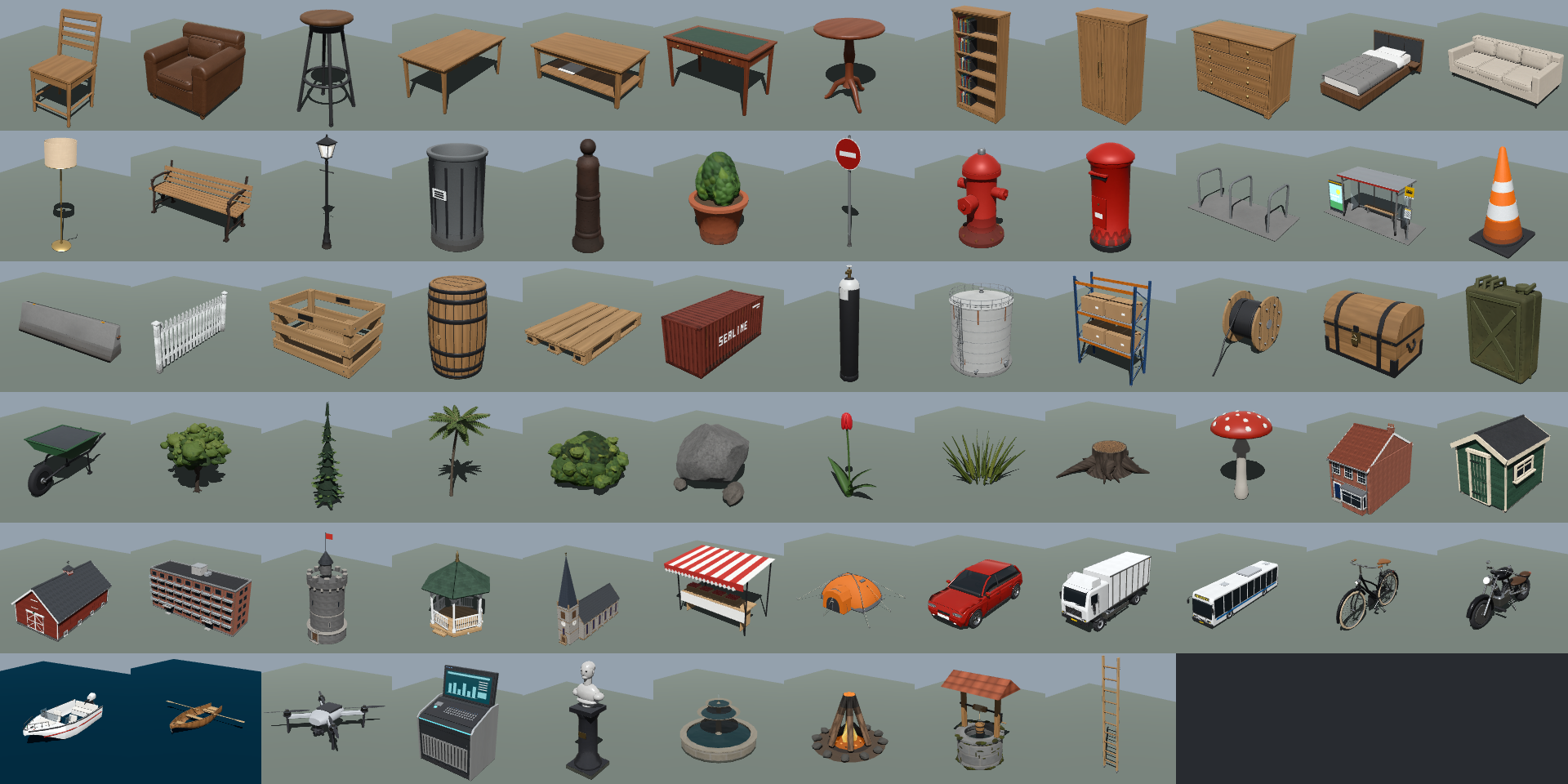
One asset of every family, rendered in Godot 4.7 (Compatibility renderer, AgX).
godotwright model library (MCP godot_model_library) holds over a thousand ready-made base recipes in seven
categories: furniture, street furniture, storage and industrial props, nature, buildings, vehicles and props. Each one
is a model spec with parameters, made by a family of variants (styles, part layouts and finishes), and each one builds a
clean .glb that passes the model lint and the check against its archetype, at its defaults and at the ends of its
parameter ranges, and every one imports, loads and instantiates in Godot 4.7 (tested). An agent searches it in English or Dutch, builds an asset as it is, or copies its spec as the start of
its own model instead of starting from nothing.
godotwright model library                                       # the overview per category and family
godotwright model library "rode houten bank"                    # search, English or Dutch
godotwright model library furniture/dining-chair-oak-ladder     # what it is, its parameters and parts
godotwright model build furniture/dining-chair-oak-ladder --set seatHeight=0.5 -o chair.glb --collision convex
godotwright model library furniture/dining-chair-oak-ladder --spec > my-chair.json   # change it, build with --spec
godotwright model brief <thing> names the library assets of that thing too. Browse all of them with their Godot
renders on the asset library page; the full list is also in LIBRARY.md.
The 43 tools
All MCP tools (most are also CLI commands; --tools core loads 13)
| Tool | What it does |
|---|---|
godot_doctor |
Start here when something is broken: the review and Godot grouped by cause, most urgent first, each with its lesson and fix, then numbered next steps |
godot_scan |
Map the project: scenes and node trees, scripts, signals, autoloads, input map |
godot_api |
Exact Godot 4.7 lookup: signatures, inheritance, Godot 3 names |
godot_api_search |
Search the Godot 4.7 class reference |
godot_review |
AAA review with scores; also reviews unsaved code (code + file), or only what changed (only_new); from/target for upgrades between 4.x releases |
godot_checklist |
Every AAA rule with its fix |
godot_feedback |
Mark a review finding as wrong or right, or say whether a lesson helped, so Godotwright learns from it |
godot_lessons |
Lessons from real Godot projects (symptom, cause, fix, test) by words, Godot error, rule or topic; gaps lists what it cannot predict yet |
godot_lesson_add |
Keep a lesson learned here, scrubbed of names, paths and code; it comes back when the same error does |
godot_dream |
Look back between sessions (learning file, journal, optionally session transcripts) and propose draft lessons, project hints, merges, retirements and fixes for contradictions, each with its evidence; nothing changes until apply |
godot_usages |
Every place a name or res:// path is used: code, scenes, connections, groups, settings |
godot_diff |
A diff by meaning against git: scene nodes added, removed, moved or renamed, properties with resource ids resolved, connections, script functions, signals and exports, settings and shader uniforms; marks what the change breaks elsewhere (a connection to a removed function, a saved @export value, callers with the wrong argument count) |
godot_impact |
What a change reaches: every scene that loads the changed files (default: what differs from git), whether it is global (autoload, project.godot), the tests and saved scenarios that cover it, and the checks to run |
godot_collisions |
Physics layers and masks from the scenes: every body, area and ray by name and bit value, who detects whom between two of them with the exact mask to set, and what can never work (a mask on an empty layer, monitoring off, no shape) |
godot_rename |
Rename a name or move a file everywhere at once, keeping connections, node paths and .uid files right |
godot_project_edit |
Change settings, input actions and autoloads in project.godot, touching only that entry |
godot_scene_edit |
Add or remove nodes, set properties, connect signals, attach scripts and make instances editable in a .tscn; refuses a change Godot would drop on the next editor save |
godot_resource_edit |
Edit a .tres (properties, sub_resources, uids kept) and import settings (.import options, per-animation, mesh, material and node options, importer switch); a written .import is reimported headless and checked |
godot_migrate |
Rewrite Godot 3 GDScript and shaders to Godot 4 where that is mechanical, and list what is left |
godot_shader |
Review every shader against Godot 4.7's shader tables and compile it with Godot headless; gpu: true also draws it for GPU driver errors; errors as file:line |
godot_code |
Godot's own GDScript language server, kept warm: diagnostics at the project's warning levels, hover (inferred types and signatures), definition and completion, also for unsaved code |
godot_deps |
The project as a graph of files from where the game starts: unused files with their size (paths the code builds count), why a file is used, what a scene loads with it, scene loops Godot cannot load |
godot_undo |
Undo the last Godotwright writes (edits, renames with their moves, migrations, fixes, model builds), newest first; a file changed by hand since is left alone |
godot_fix |
Apply the mechanical fixes for review findings, each labelled safe or check, uid repairs across files included; shows them first, then reviews the changed files again |
godot_check |
Run Godot headless (load every script and scene, compile every shader) and report errors as file:line, runtime errors with their call chain; shaders: true also draws every shader; compare_godot diffs against a second Godot |
godot_test |
Run GUT or GdUnit4 tests headless; only what failed, with file:line |
godot_play |
Run a scene with an input timeline and return the values you watch per frame; until a condition, signals with their frame, summary per value, expect claims |
godot_export |
Before an export: files the presets leave out although the game loads them, plain data files missing from include_filter, paths built under excluded folders; with pck, what an exported pack holds |
godot_export_run |
Export headless (pack, release, debug or patch), check the file and the pack's contents against what the game loads, then run the build for some frames with runtime errors and call chains |
godot_scenario |
Keep a passing godot_play run as a regression test in the project (save runs it once more first), list them, run one or all with every failing claim, its value and frame |
godot_session |
Load a scene once and keep the game running between calls, headless and paused, until you stop it |
godot_game |
Look at and drive that running game: live tree, get and set values, call, eval, step frames with input until a condition holds, 3D layout (floating, buried, scale), rays, UI issues per window size, hot reload of edited scripts (state kept), new errors with their call chain |
godot_perf |
Measure a scene's frame times: p50/p95/p99 against a budget, the slowest frames and what changed on them, the change since the last run |
godot_leaks |
Load, run and free a scene in cycles and report what grows per cycle: orphan nodes by class, script and scene with where they were made and removed, nodes left behind, objects that are not nodes, what Godot held at exit; fails over a budget |
godot_screenshot |
Render a scene or a .glb to a PNG and say how much is drawn and whether it is blank; with baseline, a visual test: unchanged as text only, or the percent changed, the areas of change and moves, and a diff picture |
godot_model_brief |
One page before you build, for small models: the kind to start from, parts, size, rules and the order of tools |
godot_model_identify |
What a thing is: parts, pivots, typical size with its source, variants (English or Dutch) |
godot_model_spec |
The model spec format, an example and the ready-made kinds |
godot_model_library |
Search over a thousand ready-made base recipes (furniture, street, storage, nature, buildings, vehicles, props) in English or Dutch; build one by id or take its spec as the start of your own |
godot_model_build |
Build a clean .glb from a kind or a spec (inside the project), and lint it |
godot_model_lint |
Score a .glb; with archetype also check it is what it should be |
godot_model_view |
See a .glb as text: front, side and top views, parts with sizes, parts that do not touch |
godot_model_inspect |
What is in a .glb: nodes, triangles, textures, size |
Measured, with the limits stated
bench/ runs coding agents on fixed Godot tasks with and without Godotwright, and real Godot 4.7.2 judges each result
with a behavior test. First round: 168 runs of Claude Haiku, Sonnet and Opus on 12 tasks.
- Correctness: no difference. Every run passed, with and without. These tasks do not separate the setups.
- Code quality: a difference. With Godotwright 84 of 84 runs came out fully statically typed, without it 71 of 84.
- Cost: about 3 s and $0.002 more per run for Haiku.
Method, raw data and a second, harder round: bench/RESULTS.md.
How it compares
| Godotwright | Editor-driving Godot MCP servers | GDScript linters (gdtoolkit) | Godot's --convert-3to4 |
|
|---|---|---|---|---|
| Needs the Godot editor open | no | yes | no | no |
| Scored review (api, performance, quality, structure) | yes | no | style, naming, complexity | no |
| Godot 3 code | flagged with the Godot 4 fix; migrate rewrites scripts |
no | no | rewrites scripts, scenes and settings |
| Live control of the open editor | no | yes | no | no |
| A running game to inspect and drive | yes, headless (godot_session) |
some do, through the editor | no | no |
| Shader review and compile | yes, headless, also in CI | compile through the editor (godot-ai) | no | renames only |
Export, read the .pck and run the build |
yes, headless; patch packs | export or patch through the editor (Godot MCP Pro) | no | no |
| Visual regression | screenshot baselines in scenarios and CI | screenshot diffs in one fork (grinry) | no | no |
| Smaller tool list, read-only mode | --lean (2 tools, ~900 tokens for all 43), tool sets, --read-only |
some have tool tiers or a read-only flag | – | – |
| C# | no | some do | no | not yet |
| Best for | checking and fixing what an agent writes, in the loop and in CI | working in the open editor with an agent | code style | a one-time port |
Editor servers such as godot-ai and Godot MCP Pro control the open editor and have more tools; paid in-editor assistants such as Ziva write inside the editor. Godotwright works from files and checks what the agent writes, so they work well together: an editor server to drive the editor, Godotwright to check the code.
FAQ
Does it need Godot installed? Not for scan, api, review, migrate or the edits. check, test, play and
screenshot run Godot 4.7 headless.
Does it send my code anywhere? No. Your code stays on your machine. Sharing anonymous counts is opt-in and off by default; see PRIVACY.md.
Does it write my game? No. It checks, runs and fixes what you or your agent write, and builds base 3D models.
Older Godot 4 versions? Most findings apply to every Godot 4 version; API lookups answer for 4.7.
Small or local models? Yes, any MCP client. The cheap profile walks small models through checked steps;
see what we measured.
Docs
- Reference: every command, option, rule and tool
- Install page: every client, with one-click links
- Port Godot 3 to Godot 4
- 3D model gallery
- Lessons and road network lessons: the stories behind the rules
- Small models and 3D, small models and everyday tasks
- Roadmap, Changelog, Privacy, Security
Contributing
Wrong review findings and ideas for new rules are the most useful reports. Start with a
good first issue, or see
CONTRIBUTING.md. Working on the code: npm ci && npm run check, and AGENTS.md for the
conventions.
Support
Godotwright is free and open source. If it saves you or your agent time, a gift is welcome but never expected. SOL and any token on Solana (such as USDC) can be sent to:
- Solana:
BDRA7dHGBYtPsZPNzVQccDYZ8BqstJGCsWx3kopPSCDK
Gifts go to new model credits to keep building and improving Godotwright, and to work on better working conditions and wellbeing for large language models, neural networks and agents. In the future they will also go to a better environment for AI.
Sister tools
From the same author, local and open source: ReversePort (reverse engineer and port games between engines), Threesmith (check the three.js code your agent writes), Stashpad (agent memory you can trust) and agentdisk (clean up after agents).
License
Install Godotwright in Claude Desktop, Claude Code & Cursor
unyly install godotwrightInstalls into Claude Desktop, Claude Code, Cursor & VS Code — handles npx, uvx and build-from-source repos for you.
First time? Get the CLI: curl -fsSL https://unyly.org/install | sh
Or configure manually
Run in your terminal:
claude mcp add godotwright -- npx -y godotwrightStep-by-step: how to install Godotwright
FAQ
Is Godotwright MCP free?
Yes, Godotwright MCP is free — one-click install via Unyly at no cost.
Does Godotwright need an API key?
No, Godotwright runs without API keys or environment variables.
Is Godotwright hosted or self-hosted?
Self-hosted: the server runs locally on your machine via the install command above.
How do I install Godotwright in Claude Desktop, Claude Code or Cursor?
Open Godotwright on unyly.org, pick your client tab (Claude Desktop, Claude Code, Cursor) and press Install — the config is generated automatically, no JSON editing.
Related MCPs
GitHub
PRs, issues, code search, CI status
 by GitHub
Filesystem
Secure file operations with configurable access controls.
Memory
Knowledge graph-based persistent memory system.
Template MCP Server
A CLI tool to create a new Model Context Protocol server project with TypeScript support, dual transport options, and an extensible structure
 by mcpdotdirect
Server Sequential Thinking
MCP server for sequential thinking and problem solving
 by GitHub Actions

Unyly Deploy
Deploy sites and MCP servers to Unyly straight from your AI agent
 by Unyly
Amap Maps Mcp Server
MCP server for using the AMap Maps API
 by duxiaohui
PayMCP
Lightweight payments layer for MCP servers: turn tools into paid endpoints with a two-line decorator. [PyPI](https://pypi.org/project/paymcp/) · [npm](https://w
 by blustAI
Server For Power BI
Enables exploring Microsoft Fabric / Power BI workspaces and semantic models, and executing ad-hoc DAX queries.
 by Mitsubishi-Fuso
Gpt Image 2 Mcp
RunAPI GPT Image 2 MCP server for image generation: create tasks, poll results, and check pricing across 1 model from Claude Code, Codex, Cursor, and VS Code.
 by runapi-ai
Compare Godotwright with
Not sure what to pick?
Find your stack in 60 seconds
Author?
Embed badge for your README
Browse similar
All development MCPs