
Html Web
FreeNot checkedReview AI-generated HTML slides or reports in the browser, anchor comments to specific passages, and have the agent fix them via MCP, with tools for inspection,

About
Review AI-generated HTML slides or reports in the browser, anchor comments to specific passages, and have the agent fix them via MCP, with tools for inspection, commenting, layout checking, and export to PDF/PPTX.
README
Review an AI agent's HTML slides or report from the rendered page while Claude Code or Codex edits the source.
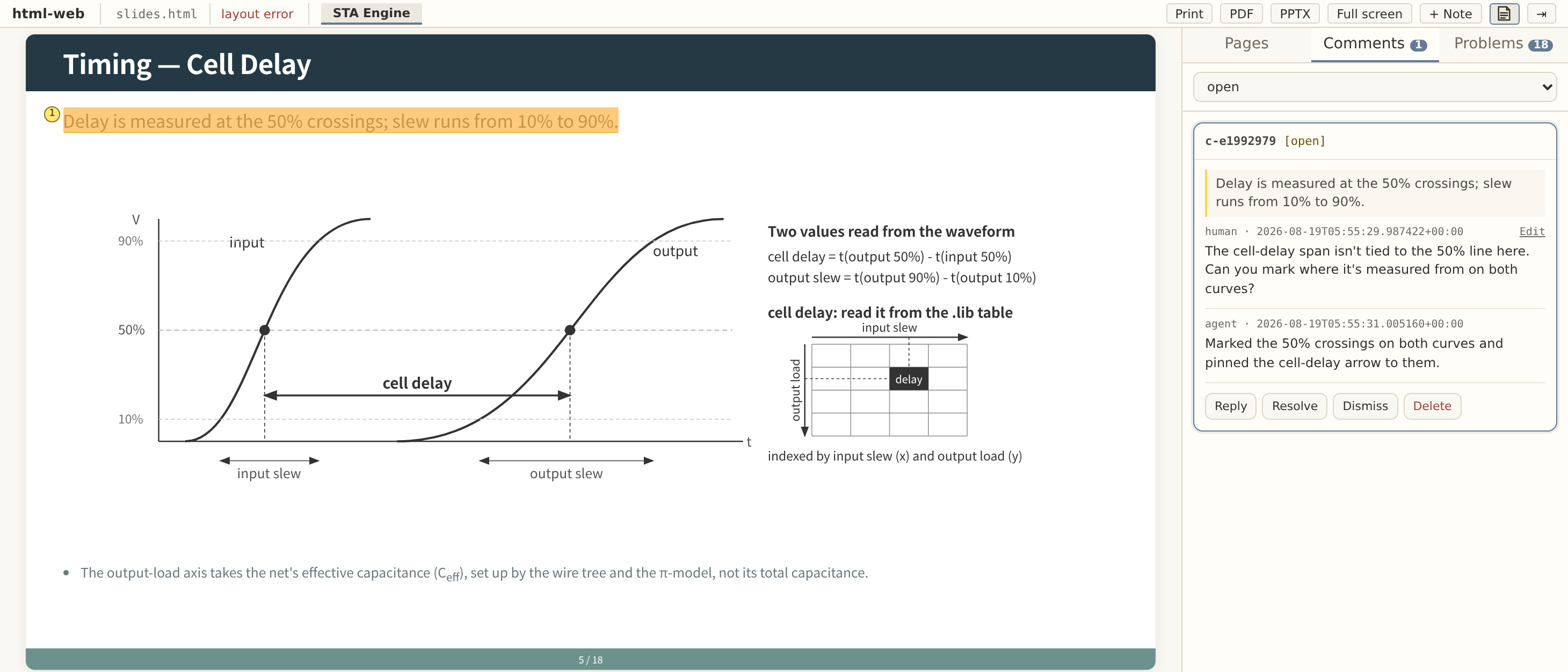
You open the artifact in a local review page, select rendered text, and comment on it. The agent reads the comment over MCP, edits the HTML, and replies in the same thread. Because you point at the rendered page, you never hunt for the source, and saving a file refreshes only the artifact frame, so your scroll position and drafts stay put.
you:    select text on the page -> write a comment
                  |
agent:  read comments -> edit HTML -> reply or resolve
                  |
you:    read the refreshed page -> comment again
Requirements
- Python 3.10 or newer.
- Firefox, only for PDF or PPTX export.
Install
git clone https://github.com/MiiKiyoshi/html-mcp-web.git
cd html-mcp-web
python -m venv .venv
.venv/bin/pip install -e '.[mcp]'
Register the MCP server once, using the executable inside the venv so it resolves without activation. Run this from the repository directory:
Claude Code:
claude mcp add --scope user html-mcp -- "$PWD/.venv/bin/html-mcp"
Codex:
codex mcp add html-mcp -- "$PWD/.venv/bin/html-mcp"
The html-mcp-web command (project setup) is also in .venv/bin; activate the venv or call it by that path.
Quickstart
cd examples
# Start Claude Code or Codex here, with the html-mcp server enabled.
Ask the agent to call inspect(). The review page opens at http://localhost:8766, with tabs for the neutral slides and report examples. Select some text, press Comment, and ask the agent to process the comments.
Set up your own artifact
In the directory that holds your artifact, create one project and pick a layout:
html-mcp-web init --layout slides --main artifact.html
Then ask the agent to call inspect(); the same session starts the review page at the configured port. init writes .html-mcp-web.yaml:
artifacts:
  slides:
    label: Slides
    layout: slides
    main: artifact.html
watch: ['*.html', '*.css', '*.js', '*.svg', '*.png', '*.jpg', '*.jpeg', '*.gif', '*.webp']
ignore: []
port: 8765
artifacts maps an id to its label, layout (slides is 16:9, report is A4), and main file, where every section.page is one printed page. watch refreshes on save, ignore is checked first, and port is the local address. Agent sessions that find the same config share one server, comments, and revisions.
Use it
Select text and press Comment; the anchor reattaches to the quote after edits. Use + Note for a whole-artifact comment, the Pages tab to jump between pages, and the Edit link to fix your own message in place. Resolve and Dismiss close a comment in one click. Then ask the agent:
Process the open html-mcp-web comments.
The agent reads the comments, edits the source, and replies or resolves each one. The review page also flags anything off the page, clipped SVG drawings, and overlapping labels at the artifact's fixed size, and reports them to the agent so it can fix them. Comments are stored in .html-mcp-web/comments/<artifact>.json, which holds selected text, so whether to track it in git is a privacy choice.
Templates
A template compiles a small content file into the artifact, so you edit content while the cover, bars, and page numbers stay consistent:
html-mcp-web init --layout slides --main slides.html --template neutral-slides --content content.html
The build reruns on every content save. This repo ships templates/neutral-slides/ and templates/neutral-report/; the content format is in templates/README.md. Your own templates go in ~/.config/html-mcp-web/templates/<name>/ and stay out of this repository.
Export
The topbar exports each artifact as a file. PDF prints every page at the layout's fixed size through headless Firefox. PPTX (slides only) builds an editable deck: text stays editable text, tables stay tables, inline SVG stays vector, and math becomes an image. A skin can name TrueType files to embed the deck font; see templates/README.md.
Configuration
html-mcp-web config                                  # print the whole config
html-mcp-web config artifacts.slides.layout report   # change one value
html-mcp-web config port 8766
html-mcp-web config watch '*.html,assets/**'
init also takes --port and, for a templated artifact, --template <name> --content <file>. Config changes apply on the next save; a port change takes effect when the agent restarts.
Security
An agent-generated artifact runs JavaScript with the local page's privileges, so html-mcp-web is for trusted local artifacts and binds to 127.0.0.1 only.
Acknowledgements
MIT licensed; see LICENSE. Full-screen wheel navigation adapts the intent-detection strategy from Swiper's Mousewheel module by Vladimir Kharlampidi and the Swiper contributors, under the MIT license.
Install Html Web in Claude Desktop, Claude Code & Cursor
unyly install html-mcp-webInstalls into Claude Desktop, Claude Code, Cursor & VS Code — handles npx, uvx and build-from-source repos for you.
First time? Get the CLI: curl -fsSL https://unyly.org/install | sh
Or configure manually
Run in your terminal:
claude mcp add html-mcp-web -- uvx --from git+https://github.com/MiiKiyoshi/html-mcp-web html-mcp-webStep-by-step: how to install Html Web
FAQ
Is Html Web MCP free?
Yes, Html Web MCP is free — one-click install via Unyly at no cost.
Does Html Web need an API key?
No, Html Web runs without API keys or environment variables.
Is Html Web hosted or self-hosted?
Self-hosted: the server runs locally on your machine via the install command above.
How do I install Html Web in Claude Desktop, Claude Code or Cursor?
Open Html Web on unyly.org, pick your client tab (Claude Desktop, Claude Code, Cursor) and press Install — the config is generated automatically, no JSON editing.
Related MCPs
Playwright
Browser automation, scraping, screenshots
 by Microsoft
Puppeteer
Browser automation and web scraping.
 by modelcontextprotocol
opentabs-dev/opentabs
Plugin-based MCP server + Chrome extension that gives AI agents access to web applications through the user's authenticated browser session. 100+ plugins with a
 by opentabs-dev
robhunter/agentdeals
1,500+ developer infrastructure deals, free tiers, and startup programs across 54 categories. Search deals, compare vendors, plan stacks, and track pricing chan
 by robhunter
hlydecker/ucsc-genome-mcp
MCP server to interact with the UCSC Genome Browser API, letting you find genomes, chromosomes, and more.
 by hlydecker
34892002/bilibili-mcp-js
A MCP server that supports searching for Bilibili content. Provides LangChain integration examples and test scripts.
 by 34892002
achiya-automation/safari-mcp
Native Safari browser automation for AI agents with 80+ tools. No Chrome dependency, optimized for Apple Silicon with 60% less CPU overhead.
 by achiya-automation
agent-infra/mcp-server-browser
Browser automation capabilities using Puppeteer, both support local and remote browser connection.
 by bytedance
aparajithn/agent-scraper-mcp
Web scraping MCP server for AI agents. 6 tools: clean content extraction, structured scraping with CSS selectors, full-page screenshots via Playwright, link ext
 by aparajithn
apireno/DOMShell
Browse the web using filesystem commands (ls, cd, grep, click). 38 MCP tools map Chrome's Accessibility Tree to a virtual filesystem via a Chrome Extension.
 by apireno
Compare Html Web with
Not sure what to pick?
Find your stack in 60 seconds
Author?
Embed badge for your README
Browse similar
All browse MCPs