
Hyperweave
FreeNot checkedHyperWeave gives agents a visual output surface: structured data in, branded SVG out. No JavaScript, no runtime. Works anywhere an image can be embedded. Badges

About
HyperWeave gives agents a visual output surface: structured data in, branded SVG out. No JavaScript, no runtime. Works anywhere an image can be embedded. Badges, cards, charts, dashboards, diagrams, and more.
README

Portable visual output layer for agents.
One API call, one SVG. No JavaScript. Works everywhere.
The Problem
Agents need to show their work through plans, diagrams, dashboards, status cards, receipts, and reports. Markdown is portable but visually limited. HTML is expressive but not always durable across surfaces. Images are easy to share but lose their structure. Raw model output is flexible but inconsistent.
HyperWeave turns structured specs into deterministic visual artifacts. Each artifact is a self-contained SVG with layout, branding, data binding, and machine-readable metadata baked in. No JavaScript, no runtime, no dependencies. Readable by humans, recoverable by agents, and portable anywhere an <img> tag renders.
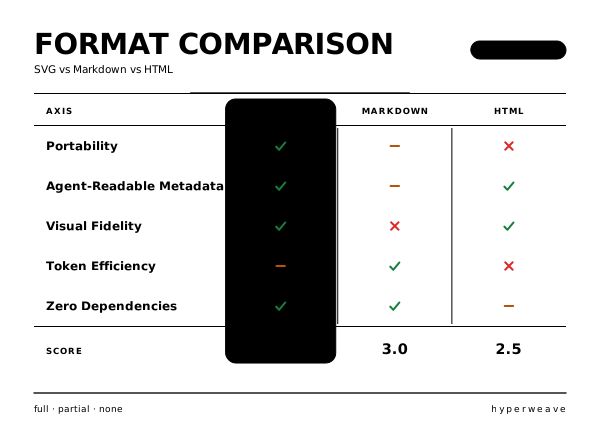
View as table
| FORMAT | Renders identically across surfaces | Agent-Readable Metadata | Visual Fidelity | Token Efficiency | Zero Dependencies | SCORE |
|---|---|---|---|---|---|---|
| SVG | ✓ | ✓ | ✓ | ~ | ✓ | 4.5 |
| MARKDOWN | ~ | ~ | ✗ | ✓ | ✓ | 3 |
| HTML | ✗ | ✓ | ✓ | ✗ | ~ | 2.5 |
Agentic Artifacts
HyperWeave receipts turn an AI coding session into a portable artifact that shows what it cost by model, tool usage, token spend, and context window history. Install the hook once and every session emits one:
pip install hyperweave
hyperweave install-hook
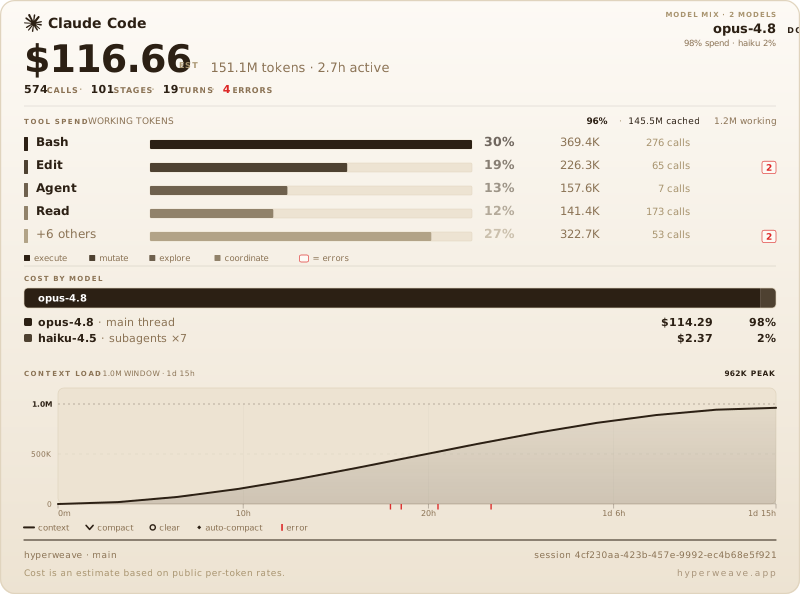
Claude Code · $116.66 · 151.1M tokens · 574 calls · opus-4.8
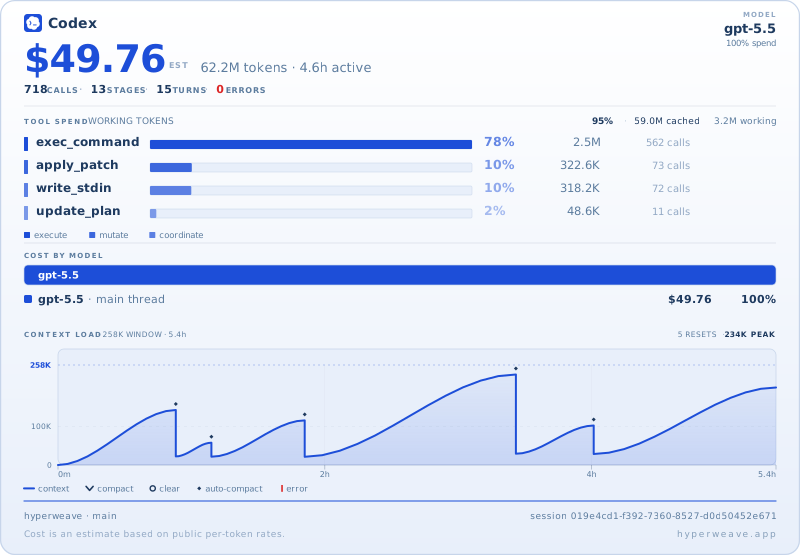
Codex · $49.76 · 62.2M tokens · 718 calls · gpt-5.5
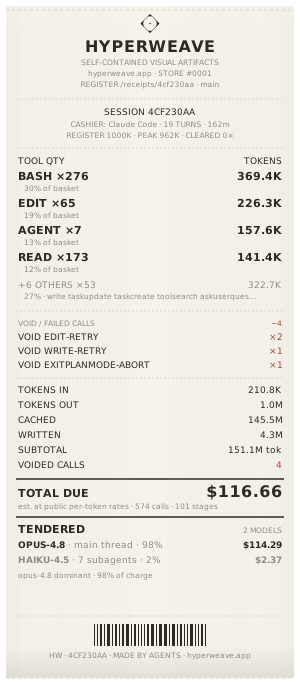
The same Claude session if you fancy a proper receipt
It reads your session's JSONL transcript from disk and detects the harness automatically (Claude Code or Codex). Theme it with any of the 8 primer variants, or the raw register tape:
hyperweave install-hook --genome cream   # any primer variant
hyperweave install-hook --genome raw     # the paper register tape
Want a different agent harness? Open an issue.
Diagrams
HyperWeave draws systems: pipelines, fan-outs, hubs, dependency graphs, swim lanes, state machines, sequences, rings, trees, and more, each rendered as a portable SVG. Nodes carry logos, labels, and small tags; edges carry labels and motion (a moving dash, a particle, or a pulse of light), and motion shows direction. Every diagram also embeds its full spec and a hash-verified digest (see Inside every artifact), so an agent reads the structure, not the pixels.
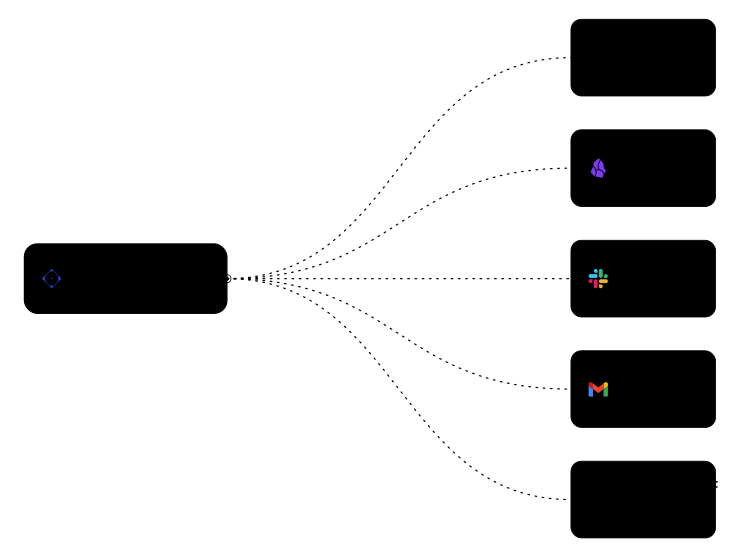
One artifact, every surface · the fan-out topology
Compose this inline
hyperweave compose diagram --spec-file /dev/stdin -g primer --variant porcelain --surface inlay -o one-artifact.svg <<'JSON'
{
  "topology": "fanout",
  "title": "One Artifact, Every Surface",
  "subtitle": "One artifact, every surface · a self-contained SVG renders wherever markdown does",
  "notes": "every surface",
  "glyph_tint": "full",
  "nodes": [
    {
      "id": "artifact",
      "label": "HyperWeave SVG",
      "desc": "self-contained · portable",
      "role": "hero",
      "glyph": "hyperweave",
      "style": "card+glyph"
    },
    {
      "id": "github",
      "label": "GitHub",
      "desc": "README · Issues · PRs",
      "glyph": "github",
      "style": "card+glyph"
    },
    {
      "id": "obsidian",
      "label": "Obsidian",
      "desc": "vault · daily notes",
      "glyph": "obsidian",
      "style": "card+glyph"
    },
    {
      "id": "slack",
      "label": "Slack",
      "desc": "threads · unfurled",
      "glyph": "slack",
      "style": "card+glyph"
    },
    {
      "id": "email",
      "label": "Email",
      "desc": "inline · PDF export",
      "glyph": "gmail",
      "style": "card+glyph"
    },
    {
      "id": "agent",
      "label": "Agent Context",
      "desc": "hw:reasoning parsed",
      "glyph": "anthropic",
      "style": "card+glyph"
    }
  ]
}
JSON
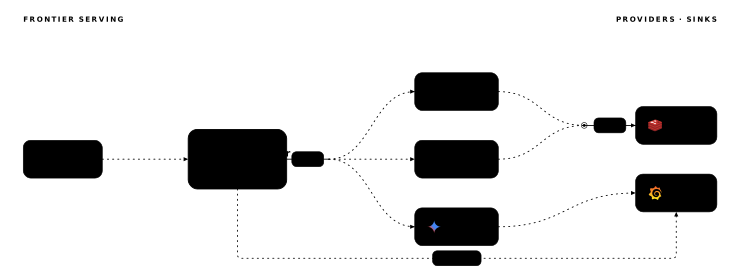
Frontier serving · layered DAG with a telemetry skip edge
Compose this inline
hyperweave compose diagram --spec-file frontier-serving -g primer --variant noir --surface inlay -o frontier-serving.svg
frontier-serving is a bundled preset; the URL API renders it by name at /v1/diagram/frontier-serving/primer.static.

MCP gateway · host → gateway → server, request and response as two lanes
Compose this inline
hyperweave compose diagram --spec-file gateway -g primer --variant space --surface inlay -o mcp-gateway.svg
gateway is a bundled preset; the URL API renders it by name at /v1/diagram/gateway/primer.static.
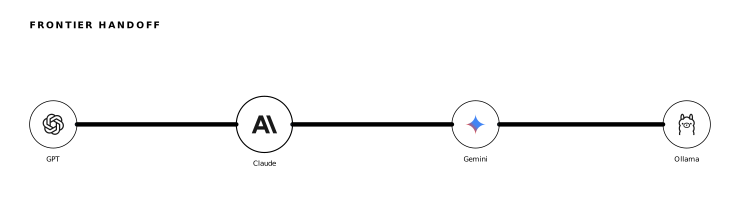
Frontier handoff · beam relay across four labs
Compose this inline
hyperweave compose diagram --spec-file frontier-handoff -g primer --variant noir --surface inlay -o frontier-handoff.svg
frontier-handoff is a bundled preset; the URL API renders it by name at /v1/diagram/frontier-handoff/primer.static.
Pick a layout
| Flows | pipeline · fanout · convergence |
stages in a line, one-to-many, many-to-one |
| Cycles | ring · flywheel · state-machine |
a loop, a driven loop, legal state transitions |
| Structure | dag · tree · stack · lanes |
dependencies, hierarchy, layers, ownership rows |
| Centered | hub |
one thing at the middle of its world |
| Time | sequence |
who calls whom, in order |
| Side by side | comparison |
two options on one sheet |
Thirteen layouts, forty bundled presets, one spec vocabulary. Render any preset by name: /v1/diagram/{preset}/primer.static.
Matrices - Generative Tables
HyperWeave matrices are structured tables rendered as portable SVGs. A single JSON description can produce comparison grids, registries, tiers, benchmark tables, numeric heatmaps, chips, glyphs, bars, and status maps, while carrying a machine-readable payload for agents.
One frame, every table · generated, not drawn
View as table
| READER | PIXELS | MOTION | READS VIA | |
|---|---|---|---|---|
| GitHub README | github | ✓ | Yes | camo, css animation |
| VS Code preview | vscode | ✓ | Yes | markdown preview |
| Slack unfurl | slack | ~ | - | image proxy |
| Gmail body | gmail | ~ | - | img tag |
| Agent | mcp | ✗ | - | hw:payload, hwz/1, markdown twin |
Compose this inline
hyperweave compose matrix --spec-file /dev/stdin -g primer --variant porcelain -o one-artifact.svg <<'JSON'
{
  "title": "One artifact. Many readers.",
  "subtitle": "how each consumer ingests the same SVG",
  "columns": [
    {
      "id": "reader",
      "label": "READER",
      "role": "label"
    },
    {
      "id": "mark",
      "label": "",
      "kind": "glyph",
      "glyph_tint": "full"
    },
    {
      "id": "pixels",
      "label": "PIXELS",
      "kind": "check"
    },
    {
      "id": "motion",
      "label": "MOTION",
      "kind": "pill"
    },
    {
      "id": "via",
      "label": "READS VIA",
      "kind": "chip"
    }
  ],
  "rows": [
    {
      "label": "GitHub README",
      "cells": [
        {
          "glyph": "github"
        },
        {
          "state": "full"
        },
        {
          "state": "on"
        },
        {
          "chips": [
            "camo",
            "css animation"
          ]
        }
      ]
    },
    {
      "label": "VS Code preview",
      "cells": [
        {
          "glyph": "vscode"
        },
        {
          "state": "full"
        },
        {
          "state": "on"
        },
        {
          "chips": [
            "markdown preview"
          ]
        }
      ]
    },
    {
      "label": "Slack unfurl",
      "cells": [
        {
          "glyph": "slack"
        },
        {
          "state": "partial"
        },
        {
          "state": "off"
        },
        {
          "chips": [
            "image proxy"
          ]
        }
      ]
    },
    {
      "label": "Gmail body",
      "cells": [
        {
          "glyph": "gmail"
        },
        {
          "state": "partial"
        },
        {
          "state": "off"
        },
        {
          "chips": [
            "img tag"
          ]
        }
      ]
    },
    {
      "label": "Agent",
      "cells": [
        {
          "glyph": "mcp"
        },
        {
          "state": "none"
        },
        {
          "state": "off"
        },
        {
          "chips": [
            "hw:payload",
            "hwz/1",
            "markdown twin"
          ]
        }
      ]
    }
  ],
  "notes": "pixels for humans · hw:payload for agents"
}
JSON
# Connectors preset
https://hyperweave.app/v1/matrix/connectors/primer.static?variant=porcelain

# Any table, one URL: base64url MatrixSpec JSON (8 KB cap)
https://hyperweave.app/v1/matrix/custom/primer.static?spec=<base64url>

# CLI, with the markdown twin alongside
hyperweave compose matrix --spec-file table.json -g primer --variant porcelain --markdown-out table.md
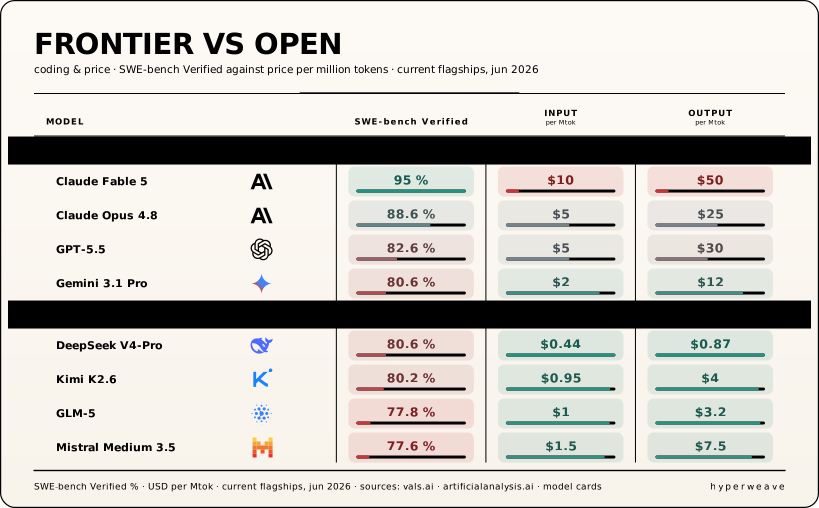
Another matrix configuration for visualizing benchmarks:
View as table
| MODEL | SWE-bench Verified | INPUT (per Mtok) | OUTPUT (per Mtok) | |
|---|---|---|---|---|
| FRONTIER · CLOSED WEIGHTS | ||||
| Claude Fable 5 | anthropic | 95 % | $10 | $50 |
| Claude Opus 4.8 | anthropic | 88.6 % | $5 | $25 |
| GPT-5.5 | openai | 82.6 % | $5 | $30 |
| Gemini 3.1 Pro | gemini | 80.6 % | $2 | $12 |
| OPEN WEIGHTS | ||||
| DeepSeek V4-Pro | deepseek | 80.6 % | $0.44 | $0.87 |
| Kimi K2.6 | kimi | 80.2 % | $0.95 | $4 |
| GLM-5 | zai | 77.8 % | $1 | $3.2 |
| Mistral Medium 3.5 | mistral | 77.6 % | $1.5 | $7.5 |
SWE-bench Verified % · USD per Mtok · current flagships, jun 2026 · sources: vals.ai · artificialanalysis.ai · model cards
Compose this inline
hyperweave compose matrix --spec-file /dev/stdin -g primer --variant cream -o frontier-benchmarks.svg <<'JSON'
{
  "title": "Frontier vs Open",
  "subtitle": "coding & price · SWE-bench Verified against price per million tokens · current flagships, jun 2026",
  "columns": [
    {
      "id": "model",
      "label": "MODEL",
      "kind": "text",
      "align": "left",
      "role": "label"
    },
    {
      "id": "mark",
      "label": "",
      "kind": "glyph",
      "align": "center",
      "glyph_tint": "full"
    },
    {
      "id": "swe",
      "label": "SWE-bench Verified",
      "kind": "numeric",
      "align": "center",
      "polarity": "higher",
      "unit": "%"
    },
    {
      "id": "pin",
      "label": "INPUT",
      "sublabel": "per Mtok",
      "kind": "numeric",
      "align": "center",
      "polarity": "lower",
      "unit": "$"
    },
    {
      "id": "pout",
      "label": "OUTPUT",
      "sublabel": "per Mtok",
      "kind": "numeric",
      "align": "center",
      "polarity": "lower",
      "unit": "$"
    }
  ],
  "rows": [
    {
      "label": "Claude Fable 5",
      "cells": [
        {
          "glyph": "anthropic"
        },
        {
          "value": 95.0
        },
        {
          "value": 10
        },
        {
          "value": 50
        }
      ],
      "section": "FRONTIER · CLOSED WEIGHTS"
    },
    {
      "label": "Claude Opus 4.8",
      "cells": [
        {
          "glyph": "anthropic"
        },
        {
          "value": 88.6
        },
        {
          "value": 5
        },
        {
          "value": 25
        }
      ],
      "section": "FRONTIER · CLOSED WEIGHTS"
    },
    {
      "label": "GPT-5.5",
      "cells": [
        {
          "glyph": "openai"
        },
        {
          "value": 82.6
        },
        {
          "value": 5
        },
        {
          "value": 30
        }
      ],
      "section": "FRONTIER · CLOSED WEIGHTS"
    },
    {
      "label": "Gemini 3.1 Pro",
      "cells": [
        {
          "glyph": "gemini"
        },
        {
          "value": 80.6
        },
        {
          "value": 2
        },
        {
          "value": 12
        }
      ],
      "section": "FRONTIER · CLOSED WEIGHTS"
    },
    {
      "label": "DeepSeek V4-Pro",
      "cells": [
        {
          "glyph": "deepseek"
        },
        {
          "value": 80.6
        },
        {
          "value": 0.44
        },
        {
          "value": 0.87
        }
      ],
      "section": "OPEN WEIGHTS"
    },
    {
      "label": "Kimi K2.6",
      "cells": [
        {
          "glyph": "kimi"
        },
        {
          "value": 80.2
        },
        {
          "value": 0.95
        },
        {
          "value": 4.0
        }
      ],
      "section": "OPEN WEIGHTS"
    },
    {
      "label": "GLM-5",
      "cells": [
        {
          "glyph": "zai"
        },
        {
          "value": 77.8
        },
        {
          "value": 1.0
        },
        {
          "value": 3.2
        }
      ],
      "section": "OPEN WEIGHTS"
    },
    {
      "label": "Mistral Medium 3.5",
      "cells": [
        {
          "glyph": "mistral"
        },
        {
          "value": 77.6
        },
        {
          "value": 1.5
        },
        {
          "value": 7.5
        }
      ],
      "section": "OPEN WEIGHTS"
    }
  ],
  "sections": [
    "FRONTIER · CLOSED WEIGHTS",
    "OPEN WEIGHTS"
  ],
  "notes": "SWE-bench Verified % · USD per Mtok · current flagships, jun 2026 · sources: vals.ai · artificialanalysis.ai · model cards"
}
JSON
- Inside the file: like every artifact, a matrix carries its full spec and a hash-verified digest, so an agent recovers the table rather than scraping pixels. Inside every artifact shows the mechanics.
- Markdown twin: every matrix has a GFM projection of the same table.
--markdown-outon the CLI,respond:"json"over HTTP,render_target="markdown"over MCP.
Inside every artifact
Every HyperWeave artifact is a re-ingestible object, not just an image. It carries its full spec (hw:payload) and a hash-verified digest (hwz/1 envelope), so an agent can work with it directly, never parsing pixels. Two tiers, two jobs. Here they are inside a diagram artifact:
recreate & modify: the complete spec
<hw:payload schema="diagram/1" media-type="application/json">
{
  "spec": {
    "title": "Service dependencies",
    "subtitle": "Service dependencies · a gateway fans to domain services, each grounding on its store",
    "topology": "dag",
    "zones": ["subsystems"],
    "nodes": [
      { "id": "web",     "label": "web",         "desc": "React SPA", "glyph": "react" },
      { "id": "gateway", "label": "API gateway", "role": "hero",      "kind": "router" },
      { "id": "auth",    "label": "Auth",        "desc": "tokens",    "kind": "shield" }
      <!-- … 5 more nodes · lossless -->
    ],
    "edges": [
      { "source": "web",     "target": "gateway",  "relation": "assert" },
      { "source": "gateway", "target": "auth",     "relation": "assert" },
      { "source": "auth",    "target": "postgres", "label": "reads", "label_style": "chip", "relation": "assert" }
      <!-- … 6 more edges · lossless -->
    ]
  }
}
</hw:payload>
the ≈200-token digest: know what an artifact is without opening it
<hw:envelope format="hwz/1" media-type="application/json">
{
  "v": "hwz/1",
  "id": "sha256:48b3de6494886c678f4c8efab4f0aa105922e315f8f62145548e17935175fb11",
  "k": "diagram",
  "title": "Service dependencies",
  "intent": "topology diagram: Service dependencies",
  "state": "active",
  "data": {
    "pattern": "dag",
    "n": 8,
    "hero": "API gateway",
    "nodes": { "web": "React SPA", "API gateway": "", "Auth": "tokens", "Orders": "Python svc", "Search": "query svc", "Postgres": "primary", "Kafka": "events", "Redis": "cache" },
    "edges": ["web → API gateway", "API gateway → Auth", "API gateway → Orders", "API gateway → Search", "Auth → Postgres (reads)", "Orders → Postgres", "Orders → Kafka (emits)", "Search → Redis (cache)", "API gateway → Postgres (direct read)"]
  },
  "frames": [{ "t": "diagram", "l": "Service dependencies" }],
  "prov": { "by": "hyperweave", "ver": "0.4.0a6", "genome": "primer.porcelain", "ts": "2026-07-15T02:01:15.613547+00:00" }
}
</hw:envelope>
The envelope is the lossy digest; only the payload round-trips.
- The round-trip: extract
hw:payload, edit the JSON,POST /v1/composewith it asdiagram: byte-identical re-render. The envelope'sidis the sha256 of the payload, so an agent verifies "this artifact really is this data" before trusting either. - The look is a pointer, not a copy:
prov.genome: "primer.porcelain"names the aesthetics; payload plus that one string is the entire recreation recipe.
Read at a budget: the verb algebra
Pixels for humans, compact JSON for agents. The verb algebra is the read/write grammar over the two tiers: every verb picks how much of the artifact to load, from the ≈200-token envelope to the full payload, and no verb ever parses pixels.
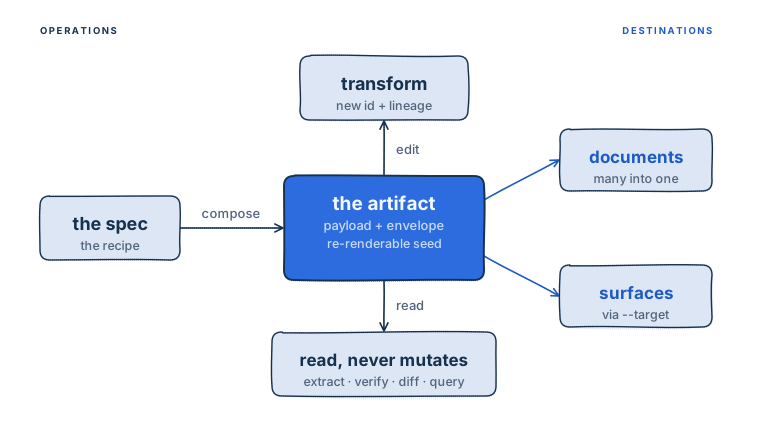
The verbs, split two ways.
Write · mints a new artifact, returns a content-addressed link (/v1/a/{id}), never inline SVG:
| Verb | What it does |
|---|---|
compose |
a spec → an artifact |
transform |
edit an artifact's spec → a new artifact (new id + lineage) |
Read · never mutates the artifact:
| Verb | What it does | Returns |
|---|---|---|
extract |
pull the payload, envelope, or markdown back out | the requested depth |
verify |
recompute the id, proving the artifact is its data | {valid, id} |
validate |
check a spec against the schema before composing | {valid, type, genome} |
diff |
compare two artifacts | the structural delta |
query |
ask a question of the envelope | the answer |
Every verb runs the same over the CLI (hyperweave {verb}), HTTP (POST /v1/{verb}), and MCP (hw_{verb}):
# compose an artifact, then read its spec straight back, no rendering
hyperweave compose matrix --spec-file table.json -g primer -o table.svg
curl -X POST https://hyperweave.app/v1/extract \
  -H 'Content-Type: application/json' \
  -d '{"source": "<svg or /v1/a/{id} url>", "respond": "payload"}'
One transform, start to finish
Compose a bundled preset (or your own spec). This is the diagram whose payload and envelope appear above:
hyperweave compose diagram --spec-file service-dependencies -g primer --variant porcelain --surface inlay -o services.svg
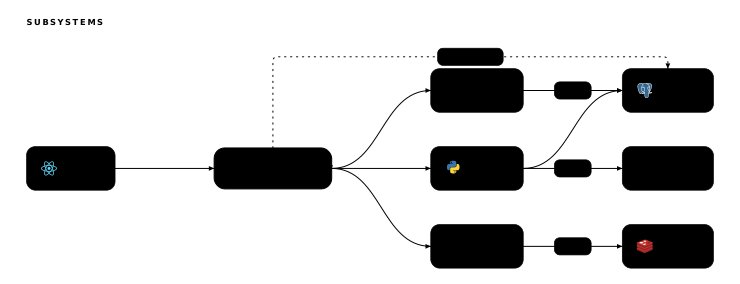
Transform it through the artifact itself. transform verifies the hash, applies the patch to the embedded spec, re-validates, and mints a new artifact with a lineage entry recording exactly what changed:
hyperweave transform services.svg --patch-json '[
  {"op": "add", "path": "/nodes/-", "value": {"id": "billing", "label": "Billing", "desc": "invoices", "glyph": "stripe"}},
  {"op": "add", "path": "/edges/-", "value": {"source": "gateway", "target": "billing", "relation": "assert"}},
  {"op": "add", "path": "/edges/-", "value": {"source": "billing", "target": "postgres", "label": "writes", "label_style": "chip", "relation": "assert"}}
]'
The result is a new artifact: new id, one more service in the fan, and the response carries the new envelope, the lineage, and a /v1/a/{id} link to the new pixels:
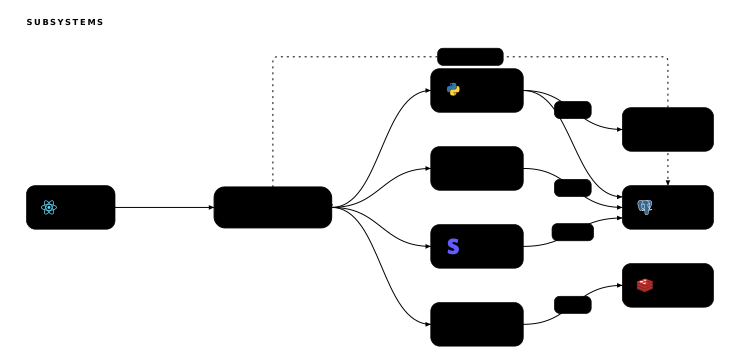
And because the look is a pointer, the same spec re-renders under any variant: swap porcelain for noir in the URL and the whole diagram returns in the dark scheme, structure untouched.
Genomes - Aesthetic DNA
A genome is a portable, machine-readable aesthetic specification. It encodes the complete visual identity (chromatic system, surface material, motion vocabulary, geometric form language) as a set of CSS custom properties that any agent can consume and apply consistently across every artifact type.
Four built-in genomes ship today. Custom genome generation via AI skill files coming soon.
brutalist · automata · chrome · primer
brutalist
22 variants · 8 dark: celadon · alloy · carbon · pigment · umber · ember · temper · onyx
14 light (6 shown): primer · depth · pulse · archive · signal · afterimage
| Signals state machine |
|
|---|---|
| Dashboard strip |
|
| Profile card |
|
| Star Chart star history |
|
| Marquee horizontal ticker |
|
| Icons circle + square |
|
| Divider seam · sigil |
|
automata
16 tones · crimson · copper · bone · solar · amber · sulfur · toxic · jadeabyssal · teal · steel · cobalt · indigo · violet · magenta · burgundy
pair any two via ?variant=primary&pair=secondary
| Signals state machine |
|
|---|---|
| Dashboard strip |
|
| Profile card |
|
| Star Chart star history |
|
| Marquee horizontal ticker |
|
| Icons square |
|
| Divider dissolve |
|
chrome
5 variants: horizon · lightning · abyssal · moth · graphite
| Signals state machine |
|
|---|---|
| Dashboard strip |
|
| Profile card |
|
| Star Chart star history |
|
| Marquee horizontal ticker |
|
| Icons circle + square |
|
| Divider band |
|
primer
8 variants · 4 light: porcelain · cream · dusk · petrol
4 dark: noir · carbon · space · anvil
| Signals animated state marks |
|
|---|---|
| Dashboard strip |
|
| Profile card |
|
| Star Chart star history |
|
| Marquee horizontal ticker |
|
| Icons circle + square |
|
| Divider aura |
|
| brutalist | automata | chrome | primer | |
|---|---|---|---|---|
| Aesthetic | Raw material | Cellular | Metallic | Minimal |
| Variants | 22 (8 dark, 14 light) | 16 tones, any two pair | 5 named | 8 (4 dark, 4 light) |
| Motion | Animated border SMIL | Animated cell grid | Animated border SMIL | Animated state marks |
| Divider | seam · sigil |
dissolve |
band |
aura |
/a/inneraura/dividers/
| block De Stijl composition |
|
|---|---|
| current animated rainbow bezier |
|
| takeoff rocket trajectory + thrust |
|
| void spectral bloom + hover state |
|
| zeropoint aurora rule + nexus beacon |
|
Error fallback: SMPTE NO SIGNAL
Every broken <img> URL renders the SMPTE RP 219 test pattern with ERR_NNN matching the HTTP status, instead of a browser broken-image icon.
/v1/badge/{title}/{value}/{unknown-genome}.statichyperweave.app/v1/badge/TEST/value/unknown-genome.static
Surface modes. A genome renders onto one of three surfaces: plate (opaque, its own background), inlay (bare, borrows the host page's light/dark), or twin (opaque and scheme-aware). Document and README embeds default to a scheme-adaptive surface so a single artifact reads correctly in both GitHub themes; standalone, slide, and raster destinations take plate. The CLI exposes --surface/--ground/--palette, and --faces writes the twin <picture> pair (<out>-light.svg / <out>-dark.svg).
Install
uv add hyperweave            # CLI + SVG rendering (the base)
uv add 'hyperweave[serve]'   # + HTTP server  (hyperweave serve)
uv add 'hyperweave[mcp]'     # + MCP server   (hyperweave mcp)
uv add 'hyperweave[all]'     # + both servers
# or swap `uv add` for `pip install`
Requires Python 3.12+. The base install is CLI + rendering; the HTTP and MCP servers are optional extras so the core stays lean.
Entry Points
Four interfaces, one pipeline. Every path produces the same artifact through the same compositor.



MCP
{
  "mcpServers": {
    "hyperweave": {
      "command": "hyperweave",
      "args": ["mcp"]
    }
  }
}
# Static badge
hw_compose(type="badge", title="BUILD", value="passing", genome="brutalist")

# Data-driven badge - unified token grammar (gh:owner/repo.metric, pypi:pkg.metric, ...)
hw_compose(type="badge", title="STARS", data="gh:anthropics/claude-code.stars", genome="brutalist")

# Strip with multiple live metrics
hw_compose(type="strip", title="readme-ai",
           data="gh:eli64s/readme-ai.stars,gh:eli64s/readme-ai.forks,pypi:readmeai.version",
           genome="chrome")

# Marquee with mixed text + live tokens
hw_compose(type="marquee",
           data="text:NEW RELEASE,gh:anthropics/claude-code.stars,text:DOWNLOAD",
           genome="brutalist")

# Read or edit an existing artifact - the verb algebra
hw_extract(svg_or_url="<svg or /v1/a/{id} url>", respond="payload")
hw_transform(svg_or_id="<svg or /v1/a/{id} url>",
             mutations=[{"op": "replace", "path": "/title", "value": "SHIPPED"}])

# Return the SVG bytes inline instead of a hosted url (default respond="url")
hw_compose(type="badge", title="BUILD", value="passing", genome="brutalist", respond="svg")

hw_discover(what="all")   # the capability registry; full agent contract at /llms-full.txt
CLI
# Badge
hyperweave compose badge "build" "passing" --genome brutalist

# Strip with metrics
hyperweave compose strip "readme-ai" "STARS:2.9k,FORKS:278" -g brutalist

# Live data through the unified --data token grammar
hyperweave compose badge "STARS" --data 'gh:anthropics/claude-code.stars' -g brutalist

# Marquee with mixed text + live tokens
hyperweave compose marquee --data 'text:NEW RELEASE,gh:owner/repo.stars,text:DOWNLOAD' -g brutalist

# Session receipt from an agent transcript (Claude Code / Codex)
hyperweave compose receipt session.jsonl -o receipt.svg

# Validate a spec without rendering
hyperweave validate spec.json

# Profile card (live GitHub data, path-segment identity; 'stats' stays an alias)
hyperweave compose card eli64s -g chrome -o card.svg

# Star history chart
hyperweave compose chart stars eli64s/readme-ai -g brutalist -o chart.svg

# Custom genome from a local JSON file (validated against the profile contract)
hyperweave compose badge "DEPLOY" "live" --genome-file ./my-genome.json
hyperweave validate-genome ./my-genome.json

# The verbs: read or transform any artifact by handle, file, URL, or digest
hyperweave extract diagram.svg                      # the hw:payload seed as JSON
hyperweave diff v1.svg v2.svg --exit-code           # structural diff, git-style exit
hyperweave verify diagram.svg                       # payload ↔ envelope integrity
hyperweave query diagram.svg 'nodes[0].label'       # read one field
hyperweave transform diagram.svg --patch patch.json # mint a new artifact + lineage
HTTP API
# URL grammar: /v1/{type}/{title}/{value}/{genome}.{motion}
curl 'https://hyperweave.app/v1/strip/readme-ai/brutalist.static?value=STARS:2.9k,FORKS:278'

# Live data via the unified ?data= grammar (works on badge / strip / marquee)
curl 'https://hyperweave.app/v1/badge/STARS/chrome.static?data=gh:anthropics/claude-code.stars'
curl 'https://hyperweave.app/v1/strip/readme-ai/brutalist.static?data=gh:eli64s/readme-ai.stars,gh:eli64s/readme-ai.forks'
curl 'https://hyperweave.app/v1/marquee/SCROLL/brutalist.static?data=text:NEW%20RELEASE,gh:anthropics/claude-code.stars'

# Chromatic variants (automata: 16 solo tones, pair any two via &pair=...; chrome: horizon/abyssal/lightning/graphite/moth)
curl 'https://hyperweave.app/v1/badge/PYPI/automata.static?variant=teal&pair=violet&data=pypi:hyperweave.version'
curl 'https://hyperweave.app/v1/badge/build/passing/automata.static?size=compact'

# Genome-themed dividers
curl 'https://hyperweave.app/v1/divider/band/chrome.static'
curl 'https://hyperweave.app/v1/divider/seam/brutalist.static'
curl 'https://hyperweave.app/v1/divider/dissolve/automata.static'

# Genome-agnostic dividers
curl 'https://hyperweave.app/a/inneraura/dividers/zeropoint'

# Structured frames: /v1/{matrix|diagram}/{preset}/{genome}.{motion}
# (preset 'custom' takes a base64url ?spec=)
curl 'https://hyperweave.app/v1/matrix/connectors/primer.static?variant=porcelain'
curl 'https://hyperweave.app/v1/diagram/rag-pipeline/primer.static?variant=porcelain'

# POST compose
curl -X POST https://hyperweave.app/v1/compose \
  -H "Content-Type: application/json" \
  -d '{"type":"strip","title":"hyperweave","genome":"brutalist","value":"STARS:2.9k"}'

# Verb algebra over an existing artifact: extract · verify · transform · diff · query
curl -X POST https://hyperweave.app/v1/extract \
  -H "Content-Type: application/json" \
  -d '{"source":"<svg or /v1/a/{id} url>","respond":"payload"}'

# Local server
hyperweave serve --port 8000
Output formats
Compose once, export to any of these (same artifact, same metadata):
--format |
What you get |
|---|---|
svg |
the default: live, animated, adapts to the reader's light/dark theme |
svg-static |
the same picture with variables flattened and animation stripped, for renderers that don't run CSS |
png · webp |
rasterized bitmaps (needs pip install 'hyperweave[raster]') |
ansi |
a terminal character-grid render |
The HTTP API serves any of these by file suffix (GET /v1/a/{id}.png, width-bounded with ?w=), and a graphics-capable terminal (kitty, ghostty, wezterm) shows --format png inline.
Fonts embed in the SVG by default (--font-mode embed) so the file stands alone anywhere; cdn and system trade that portability for smaller bytes.
How It Works
Every artifact is the output of a single composition formula:
ARTIFACT = FRAME × PROFILE × GENOME × SLOTS × MOTION × ENVIRONMENT
Python builds context dicts. Jinja2 builds SVG. YAML defines config. Three layers, no mixing. Zero f-string SVG in Python.
ComposeSpec → engine.py → assembler.py (CSS) → lanes.py (validate) → templates.py (Jinja2) → SVG
Every artifact ships with:
- Re-ingestible payload: the full spec (
hw:payload) plus a hash-verifiedhwz/1envelope, so an agent can recover, verify, and edit it - the basis of the verb algebra. - Semantic metadata: provenance, reasoning, spatial trace, aesthetic DNA. Machine-readable context so the next agent in the chain knows what it's looking at and why.
- CSS state machines:
data-hw-status,data-hw-state,data-hw-regimedrive visual transitions through the Custom Property Bridge. No JavaScript. - Pure CSS/SMIL animation: all motion uses compositor-safe properties (
transform,opacity,filter). No script tags. Works anywhere SVGs render: GitHub's Camo proxy, email clients, Notion embeds. - Accessibility: WCAG AA,
prefers-reduced-motion,prefers-color-scheme,forced-colors, ARIA markup. Structural, not decorative.
| Dimension | Count |
|---|---|
| Frame types | 10 (badge, strip, icon, divider, marquee, card, chart, matrix, diagram, receipt) |
| Genomes | 4 (automata, brutalist, chrome, primer) |
| Motion configs | 6 (1 static + 5 border SMIL) |
| Glyphs | 192 (183 brand marks + 9 geometric shapes) |
| Divider variants | 10: 5 genome-themed (band chrome, seam + sigil brutalist, dissolve automata, aura primer) + 5 genome-agnostic (block, current, takeoff, void, zeropoint) at /a/inneraura/dividers/ |
| Metadata tiers | 5 (Tier 0 silent → Tier 4 reasoning) |
| Bundled fonts | 5 (JetBrains Mono, Orbitron, Chakra Petch, Barlow Condensed, Inter), embedded per artifact, no external font requests |
Stack: Pydantic, FastAPI, FastMCP v3, Jinja2, Typer.
Data Connectors
HyperWeave binds live data into any artifact through a unified token grammar (?data=...). Tokens are comma-separated; each token is either a literal (text:, kv:) or a live fetch (<provider>:<identifier>.<metric>).
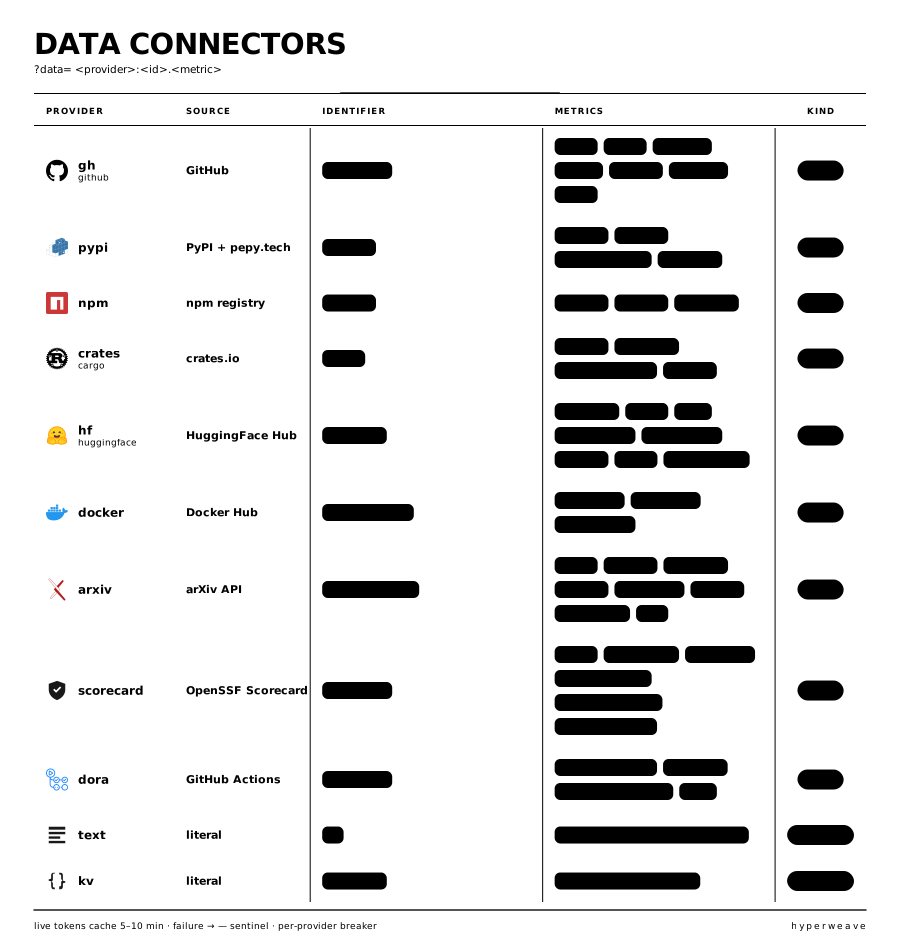
Copy a token · view as table
| Prefix | Source | Identifier shape | Metrics |
|---|---|---|---|
gh / github |
GitHub | owner/repo |
stars, forks, watchers, contributors, issues, pull_requests, last_push, build, license, language |
pypi |
PyPI + pepy.tech | package |
version, license, python_requires, downloads |
npm |
npm | package |
version, license, downloads |
crates / cargo |
crates.io | crate |
version, downloads, recent_downloads, license |
hf / huggingface |
Hugging Face | org/model |
downloads, likes, tags, pipeline_tag, library_name, license, gated, last_modified |
docker |
Docker Hub | namespace/repo |
pull_count, star_count, last_updated |
arxiv |
arXiv | id (e.g. 2310.06825) |
title, authors, published, updated, categories, summary, journal_ref, doi |
scorecard |
OpenSSF Scorecard | owner/repo |
score (overall trust), plus per-check: code_review, maintained, vulnerabilities, token_permissions, ... |
dora |
GitHub Actions | owner/repo |
deploy_frequency, lead_time, change_failure_rate, mttr (30-day window) |
text |
literal | - | renders the payload as displayed text |
kv |
literal | KEY=VALUE |
static role-tagged value |
- Caching: live values for 5–10 min; a failed fetch caches 60s and shows
-rather than a fabricated zero. - Isolation: each provider has its own circuit breaker, so one upstream outage can't trip the others.
- Escaping: commas inside
text:/kv:values escape as\,.
→ Open an issue to request a connector.
Contributing
HyperWeave is early. If you're interested in building genomes, extending frame types, or just seeing what this looks like in your own README, join the Discord.



from github.com/InnerAura/hyperweave
Install Hyperweave in Claude Desktop, Claude Code & Cursor
unyly install hyperweaveInstalls into Claude Desktop, Claude Code, Cursor & VS Code — handles npx, uvx and build-from-source repos for you.
First time? Get the CLI: curl -fsSL https://unyly.org/install | sh
Or configure manually
Run in your terminal:
claude mcp add hyperweave -- uvx hyperweaveFAQ
Is Hyperweave MCP free?
Yes, Hyperweave MCP is free — one-click install via Unyly at no cost.
Does Hyperweave need an API key?
No, Hyperweave runs without API keys or environment variables.
Is Hyperweave hosted or self-hosted?
Self-hosted: the server runs locally on your machine via the install command above.
How do I install Hyperweave in Claude Desktop, Claude Code or Cursor?
Open Hyperweave on unyly.org, pick your client tab (Claude Desktop, Claude Code, Cursor) and press Install — the config is generated automatically, no JSON editing.
Related MCPs
Omni Video
An MCP server that transforms LLM-enabled IDEs into professional video editors by pre-processing footage into text proxies, generating motion graphics via HTML/
 by buildwithtaza
ARA
Generate images, video and audio from any AI agent — one connector.
 by ARA
YouTube
Transcripts, channel stats, search
 by YouTube
EverArt
AI image generation using various models.
 by modelcontextprotocol
Compare Hyperweave with
Not sure what to pick?
Find your stack in 60 seconds
Author?
Embed badge for your README
Browse similar
All media MCPs