loading…
en/
Browse all
Do Not Patch
Karate Graph
FreeEnables analysis of Karate framework feature files, extracting dependencies and generating interactive dependency graphs.
About
Enables analysis of Karate framework feature files, extracting dependencies and generating interactive dependency graphs.
README
Karate Graph is an MCP-powered analyzer for Karate Framework projects. It helps AI agents scan .feature files, Java helpers, JavaScript helpers, database usage, execution reports, and dependency graphs so the AI can answer impact, reuse, failure, and visual-report questions with project context.
What It Helps With
- Scan Karate projects and build dependency graphs.
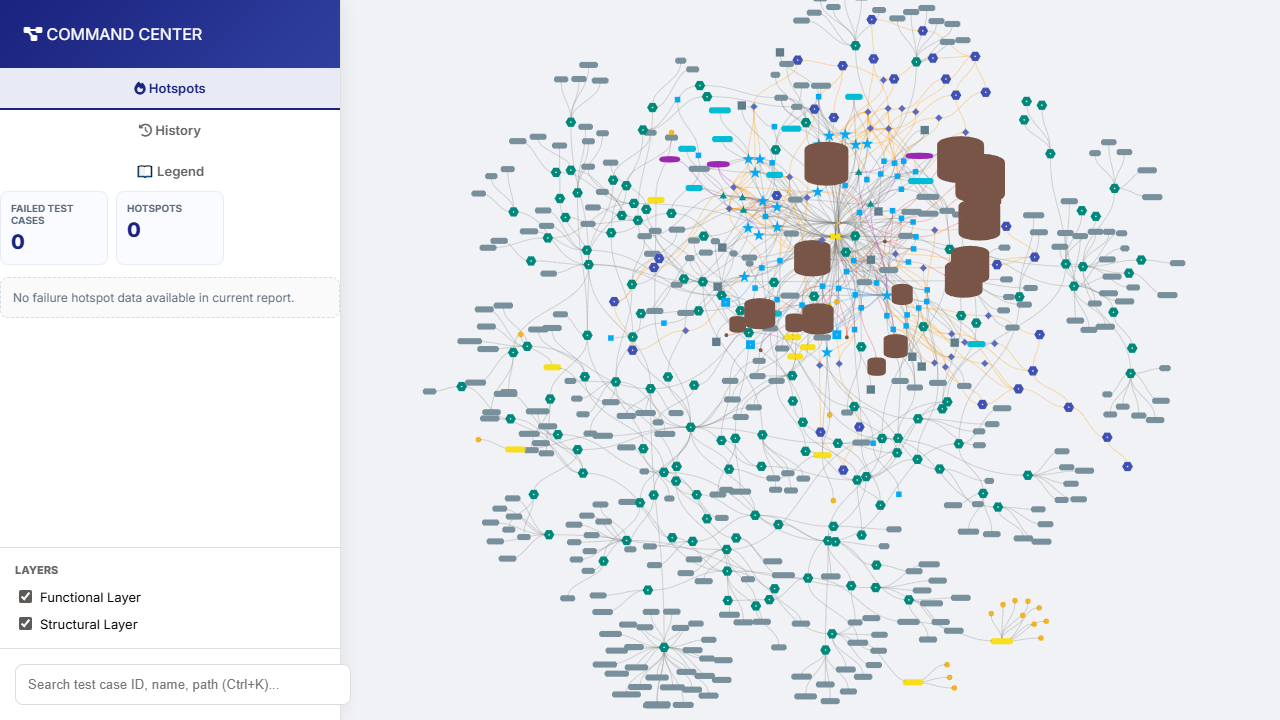
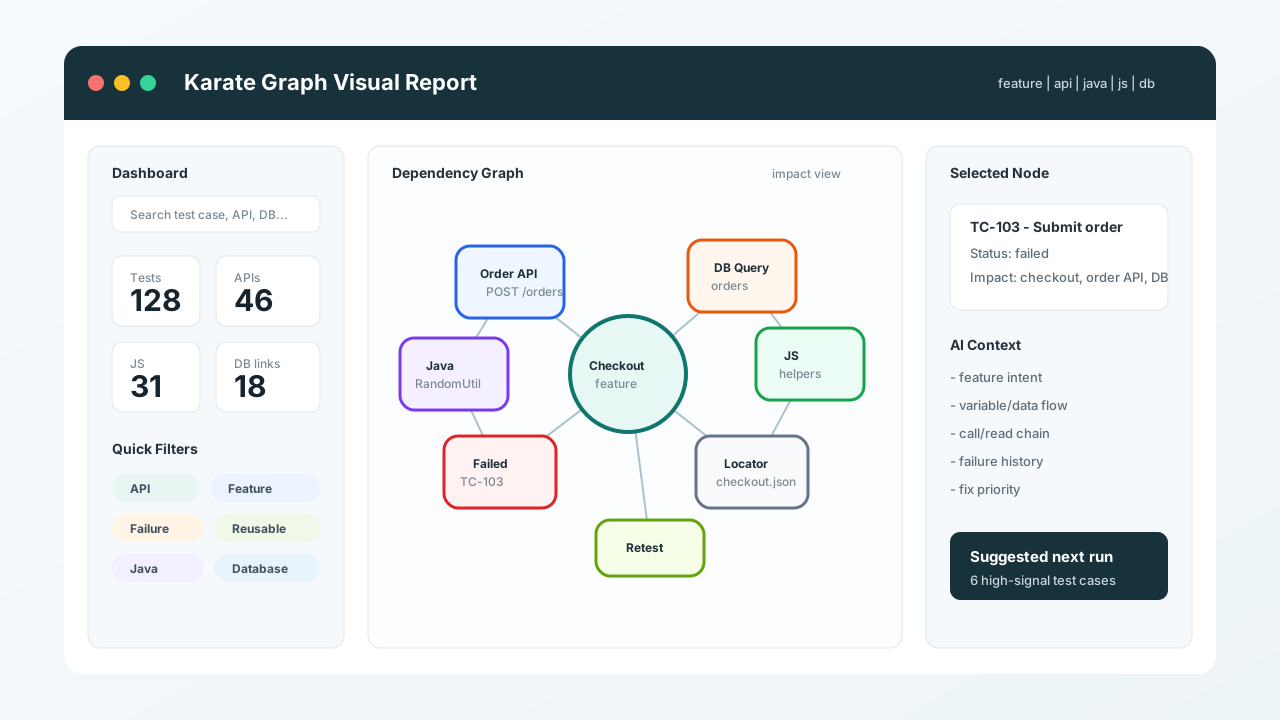
- Generate interactive visual HTML reports.
- Search API, workflow, feature, Java, JavaScript, DB, and reusable helper usage.
- Analyze change impact and suggest test cases to rerun.
- Inspect failure hotspots, flaky risk, execution history, and debug context.
- Help AI understand feature intent, variables, assertions, duplicate steps, and call/read chains.
Visual Report Preview
Real project scan:
Clean overview mockup:
Install
Install from PyPI:
pip install -U karate-graph
Install a specific version:
pip install -U karate-graph==0.1.1
Verify the package:
python -m pip show karate-graph
python -m karate_graph_analyzer.mcp_server --help
python -m karate_graph_analyzer.mcp_server --version
If karate-graph-mcp is on your PATH, this also works:
karate-graph-mcp --help
karate-graph-mcp --version
On Windows, if where karate-graph-mcp cannot find the command, use the python -m MCP config below. That avoids PATH issues.
Configure MCP
Karate Graph is mainly used through an MCP client such as Codex, Claude Desktop, Cursor, or another AI tool that supports MCP.
Recommended Windows Config
Use the full Python path from:
where python
Example Codex config.toml:
[mcp_servers.karate-graph]
command = "C:\\Program Files\\Python311\\python.exe"
args = ["-m", "karate_graph_analyzer.mcp_server"]
env = { PYTHONIOENCODING = "utf-8" }
If your Python is installed somewhere else, replace command with that path.
Generic MCP JSON Config
{
  "mcpServers": {
    "karate-graph": {
      "command": "python",
      "args": ["-m", "karate_graph_analyzer.mcp_server"],
      "env": {
        "PYTHONIOENCODING": "utf-8"
      }
    }
  }
}
Local Source Development Config
Only use PYTHONPATH when you want the MCP server to run directly from your local repo source instead of the package installed by pip.
{
  "mcpServers": {
    "karate-graph": {
      "command": "python",
      "args": ["-m", "karate_graph_analyzer.mcp_server"],
      "env": {
        "PYTHONPATH": "E:/Project/auto/karate_graph/src",
        "PYTHONIOENCODING": "utf-8"
      }
    }
  }
}
After editing MCP config, restart your MCP client.
End-To-End Usage
The normal flow is:
- Check MCP server health.
- Register the Karate project.
- Analyze the project.
- Generate the visual report.
- Use search, impact, DB, reuse, and failure tools.
1. Health Check
Ask your AI to call:
mcp_health()
mcp_version()
list_projects()
Expected result:
- MCP server is reachable.
- Package version is returned.
- Existing registered projects are listed.
2. Register Project
Register a Karate project once:
register_project(
  name="karate-core",
  root_path="E:/Project/auto/karate-fw/karate-core",
  feature_file_patterns=["**/*.feature"]
)
Notes:
nameis the project alias used by all other tools.root_pathshould be the absolute path to the Karate project.feature_file_patternscan be omitted; default is usually["**/*.feature"].
For very large projects where real test cases live only under feature(s)/**testcase,
enable strict test-case directory mode. This lets reusable feature packages such as
reuse, shared, helpers, or services stay outside the test-case count without
renaming the project structure:
register_project(
  name="karate-core",
  root_path="E:/Project/auto/karate-fw/karate-core",
  feature_file_patterns=["**/*.feature"],
  parser_config={
    "strict_test_case_directory_mode": true,
    "test_case_directories": ["testcase", "testcases"],
    "feature_root_directories": ["feature", "features"],
    "default_non_test_feature_type": "COMMON",
    "common_directories": ["common", "services", "reuse", "reusable", "shared", "helpers"],
    "scan_exclude_directories": [
      ".git", ".gradle", ".idea", ".karate_cache", "build", "dist",
      "node_modules", "out", "output", "reports", "target"
    ],
    "javascript_file_patterns": ["**/*.js"],
    "large_project_streaming_scan": true,
    "scan_parallel_enabled": true,
    "scan_parallel_workers": 8,
    "scan_parallel_threshold": 2000,
    "incremental_scan_enabled": true,
    "scan_store_enabled": true,
    "scan_log_every": 2000,
    "visualization_large_graph_threshold": 1500,
    "visualization_physics_enabled": null,
    "visualization_node_limit": 5000,
    "visualization_edge_limit": 12000,
    "visualization_progressive_enabled": true,
    "visualization_chunk_size": 1000,
    "visualization_auto_load_chunks": 0,
    "cycle_detection_enabled": true,
    "cycle_detection_node_limit": 20000,
    "ai_context_cache_feature_threshold": 5000,
    "ai_context_similarity_pool_limit": 1000,
    "ai_context_duplicate_location_limit": 25
  }
)
When parser_config is provided, Karate Graph still keeps values auto-detected from
karate-config*.js and only applies the explicit overrides above.
For projects with tens of thousands of feature files, prefer narrow feature patterns when possible:
feature_file_patterns=[
  "src/test/java/features/**/*testcase/**/*.feature",
  "src/test/java/feature/**/*testcase/**/*.feature",
  "src/test/java/features/**/reuse/**/*.feature",
  "src/test/java/feature/**/reuse/**/*.feature"
]
Performance tips:
- Use
large_project_streaming_scan=truefor very large repositories. It avoids keeping every parsed feature AST in memory. - If not set manually, streaming scan is automatically used when the matched feature count reaches
large_project_streaming_threshold(default20000). - Keep
include_structural_nodes=falsefor the first scan. Turn it on only when you need folder/file nodes in the visual graph. - Keep
scan_exclude_directoriesupdated with generated folders such astarget,reports,output, andnode_modules. - Narrow
javascript_file_patternsif only some JavaScript folders matter, for example["src/test/java/**/*.js", "src/test/resources/**/*.js"]. - For huge graphs, leave
visualization_physics_enabled=null. Karate Graph will disable physics automatically aftervisualization_large_graph_thresholdnodes. - Full 100k-node interactive canvases are not practical in a browser. The report opens with a capped working view (
visualization_node_limit) and, whenvisualization_progressive_enabled=true, writes extra.jschunks next to the HTML so you can load more nodes from the report without freezing the first page load. - Keep
visualization_auto_load_chunks=0for very large reports. Use the report'sLoad morebutton to add chunks on demand. - Keep
cycle_detection_node_limitenabled. Full cycle enumeration is skipped above the limit because it can dominate scan time on 100k-node graphs. - AI feature/DB context tools stream large feature sets instead of caching every parsed AST after
ai_context_cache_feature_threshold. scenario_similarity_mapusesai_context_similarity_pool_limitto avoid O(N²) comparisons across the whole repository.- Duplicate step/flow tools count all matches but only keep
ai_context_duplicate_location_limitexample locations per group. - Turn on
scan_parallel_enabled=truefor faster parsing on large repos; tune workers withscan_parallel_workers. - Keep
incremental_scan_enabled=trueto re-parse only changed files and skip unchanged files when scanning again. - Use
get_scan_output(project_name)after analyze to inspectchanged_files,unchanged_files,deleted_files, node/edge counts, and cache usage.
3. Scan / Analyze Project
Build the dependency graph:
analyze_project(
  project_name="karate-core",
  include_structural_nodes=true
)
Use include_structural_nodes=true when you want the visual report to include folder/file structure. Use false for a cleaner graph focused on test and dependency nodes.
4. Generate Visual Report
Create the interactive HTML graph:
visualize_project(
  project_name="karate-core",
  output_path="E:/Project/auto/karate-fw/karate-core/output/karate_graph.html"
)
Open the generated file in your browser:
E:/Project/auto/karate-fw/karate-core/output/karate_graph.html
The dashboard supports search by:
- test case ID or Jira tag
- scenario name
- feature path
- API path
- Java class or method
- JavaScript file or function
- database table, host, provider, or query keyword
5. Render Execution Report
If you have Karate JSON execution reports, process a report folder:
process_reports_folder(
  project_name="karate-core",
  directory_path="E:/Project/auto/karate-fw/karate-core/target/karate-reports",
  output_path="E:/Project/auto/karate-fw/karate-core/output/execution_graph.html"
)
Or render one report file:
render_execution_report(
  project_name="karate-core",
  report_path="E:/Project/auto/karate-fw/karate-core/target/karate-reports/karate-summary-json.txt",
  output_path="E:/Project/auto/karate-fw/karate-core/output/execution_graph.html"
)
Execution reports add pass/fail/not-run status, failure hotspots, flaky risk, failure history, and debug context.
Common AI Prompts
After MCP is configured, you can ask your AI:
Register project karate-core at E:/Project/auto/karate-fw/karate-core and analyze it.
Generate visual report for karate-core and tell me the output file path.
Search all test cases related to order creation.
Find reusable random string or random number helpers before adding a new one.
If locators/checkout.json changes, which test cases are impacted?
Which feature steps are duplicated and safe to refactor?
Which test cases touch the orders table?
Show the top failure hotspots and prioritize what to fix first.
Build an AI debug context pack for this failed node and error message.
Tool Groups
Project And Graph
mcp_health()checks MCP server connectivity.mcp_version()returns package version.register_project(name, root_path, feature_file_patterns, parser_config)registers a project.list_projects()lists registered projects.delete_project(name)removes one project from registry.clear_all_projects()resets all registered projects.analyze_project(project_name, include_structural_nodes)scans a project and builds graph data.bulk_analyze()analyzes all registered projects.query_dependencies(component_id, transitive)finds dependencies of a component.impact_analysis(component_id)finds impacted tests and workflows from a changed component.get_subgraph(node_id, radius)returns local graph context around a node.find_path(source_id, target_id)finds dependency paths between nodes.global_search(query)searches all graph nodes.query_node_by_metadata(key, value)searches graph nodes by metadata.
Visual And Export
visualize_project(project_name, output_path)generates an interactive graph HTML file.render_execution_report(project_name, report_path, output_path)generates a graph from one execution report.process_reports_folder(project_name, directory_path, output_path)scans a report folder and generates execution visualization.compare_projects(base_project_name, new_project_name, output_path)creates a diff visualization.merge_projects(project_names, new_project_name)merges multiple project graphs.export_graph(project_name, format)exports graph data asjsonorgraphml.
API, Workflow, Test Case, Page
search_api(project_name, method, path, domain)searches API endpoints.get_api_stats(project_name, keyword)summarizes API usage.search_workflow(project_name, path, scenario_tag, keyword)searches workflow/scenario usage.search_test_case(project_name, jira_tag, name_pattern)searches test cases by ID/tag/name.get_page_stats(project_name, domain)summarizes page/action usage.common_usage_map(project_name, limit)shows commonly reused components.unused_components(project_name, limit)lists unused components.
Java And JavaScript Reuse
search_java_usage(project_name, query, include_methods)finds Java class/method usage and linked tests.search_js_usage(project_name, query, include_functions)finds JavaScript file/function usage and linked tests.javascript_structure_map(project_name, limit)shows JS files, functions, dependencies, and test usage.search_reusable_function(project_name, query, language, limit)searches Java/JS helpers for reuse candidates.
search_reusable_function returns tags, aliases, usage examples, stability score, source location, and related test usage where available.
Smart Retest And Change Impact
change_impact_preview(project_name, changed_paths, limit)previews tests impacted by changed files/components.test_selection_suggestion(project_name, changed_paths, limit)suggests a compact rerun set.get_impact_radius(node_id, depth)shows impact within a graph radius.get_component_importance(project_name)ranks important graph components.
Example:
change_impact_preview(
  project_name="karate-core",
  changed_paths=["src/test/java/helpers/RandomUtil.java", "locators/checkout.json"],
  limit=30
)
Feature Understanding
feature_intent_index(project_name, query, limit)summarizes scenario intent and major signals.feature_behavior_map(project_name, feature_path, scenario_tag, scenario_name, node_id, limit)groups preconditions, actions, and expectations.variable_data_flow_trace(project_name, feature_path, scenario_tag, scenario_name, node_id, limit)traces variables from definition to usage.assertion_map(project_name, query, limit)indexes status/match/assert checks.call_read_deep_context(project_name, feature_path, scenario_tag, scenario_name, node_id, max_depth, limit)expands nested call/read chains.ai_feature_context_pack(project_name, feature_path, scenario_tag, scenario_name, node_id, max_call_depth, limit)returns an AI-ready context pack.scenario_similarity_map(project_name, query, limit, top_k)finds similar scenarios.feature_reuse_advisor(project_name, min_group_size, min_flow_length, limit, include_low_signal)finds duplicate steps and repeated flows.similar_common_components(project_name, limit)finds common components with similar dependency shape.
Use include_low_signal=false in feature_reuse_advisor to ignore generic Karate template steps such as When method POST or Then status 201.
Database Understanding
db_query_index(project_name, query, limit, include_components, link_status)indexes DB queries and DB components.search_db_usage(project_name, query, limit, link_status)searches by table, operation, host, dialect, provider, path, or query keyword.db_data_flow_trace(project_name, feature_path, scenario_tag, scenario_name, node_id, limit)traces DB variables, calls, and assertions.db_assertion_map(project_name, query, limit)indexes DB-related assertions.db_impact_preview(project_name, changed_entities, limit)previews impacted tests from changed DB entities.
Supported DB detection includes PostgreSQL, MySQL, MariaDB, Oracle, SQL Server, SQLite, DB2, H2, Redshift, Snowflake, ClickHouse, MongoDB, Redis, DynamoDB, Cassandra/CQL, Elasticsearch/OpenSearch, Neo4j/Cypher, and generic SQL.
Example:
db_impact_preview(
  project_name="karate-core",
  changed_entities=["orders", "postgres", "jdbc:postgresql"],
  limit=30
)
Failure Debugging
get_failure_hotspots(project_name)finds components contributing most to failures.top_hotspots(project_name, limit)returns top failure hotspots.prioritize_fix_queue(project_name, limit)ranks fixes by failure impact and risk.flaky_risk(project_name, limit)finds test cases with mixed pass/fail history.search_error_pattern(project_name, pattern, limit)searches failed nodes by error text or fingerprint.get_failure_history(project_name, node_id)returns execution trend and flaky score.get_failure_debug_context(project_name, node_id, error_message, radius, max_historical)builds an AI debug pack.record_fix(project_name, node_id, error_message, solution, description)records a known fix.get_fix_suggestions(project_name, node_id, error_message)finds historical fix suggestions.auto_fix_hint_pack(project_name, node_id, error_message, max_historical)builds a step-by-step fix checklist.
Typical Workflows
Find Existing Helper Before Coding
search_reusable_function(
  project_name="karate-core",
  query="random string random number uuid",
  language="all",
  limit=20
)
Use the highest-score helper when the tags, aliases, examples, and stability score match your need.
Check What A File Change Impacts
test_selection_suggestion(
  project_name="karate-core",
  changed_paths=["src/test/java/helpers/RandomUtil.java"],
  limit=20
)
Use this before running regression to choose a smaller high-signal test set.
Understand A Feature Before Editing
ai_feature_context_pack(
  project_name="karate-core",
  feature_path="checkout.feature",
  max_call_depth=3,
  limit=10
)
This gives the AI intent, variable flow, assertions, call/read chain, and graph context.
Find Duplicate Feature Steps
feature_reuse_advisor(
  project_name="karate-core",
  min_group_size=2,
  min_flow_length=3,
  limit=50,
  include_low_signal=false
)
Use this to find duplicate steps or repeated flows that can be extracted into reusable feature components.
Debug Failed Regression
process_reports_folder(
  project_name="karate-core",
  directory_path="E:/Project/auto/karate-fw/karate-core/target/karate-reports"
)
Then ask:
top_hotspots(project_name="karate-core", limit=10)
prioritize_fix_queue(project_name="karate-core", limit=10)
get_failure_debug_context(project_name="karate-core", node_id="<failed-node-id>")
Troubleshooting
where karate-graph-mcp Cannot Find The Command
The package may be installed correctly, but the Python Scripts folder is missing from PATH.
Use this instead:
python -m karate_graph_analyzer.mcp_server --help
And configure MCP with:
[mcp_servers.karate-graph]
command = "C:\\Program Files\\Python311\\python.exe"
args = ["-m", "karate_graph_analyzer.mcp_server"]
env = { PYTHONIOENCODING = "utf-8" }
MCP Command Looks Like It Is Hanging
That is normal when running the MCP server without a client:
python -m karate_graph_analyzer.mcp_server
The server is waiting for MCP stdio messages from the AI client.
Do Not Patch site-packages Manually
Avoid editing installed files under paths like:
C:/Users/<user>/AppData/Roaming/Python/Python311/site-packages/karate_graph_analyzer
If there is a real package bug, fix the source repo, bump the package version, publish a new version, and upgrade with:
pip install -U karate-graph==<new-version>
Manual patches are overwritten by pip upgrades and do not help other machines.
Development
Install local development dependencies:
git clone <repository-url>
cd karate-graph
pip install -e ".[dev]"
Run tests:
pytest
Build and validate package:
python -m pip install build twine
python -m build
python -m twine check dist/*
Publish to TestPyPI before PyPI:
python -m twine upload --repository testpypi dist/*
python -m twine upload dist/*
Use a PyPI API token with TWINE_USERNAME=__token__.
Project Structure
karate-graph/
|-- src/karate_graph_analyzer/
|   |-- mcp_server.py
|   |-- mcp_interface/
|   |-- parser/
|   |-- graph/
|   |-- services/
|   |-- utils/
|   `-- visualization/
|-- tests/
`-- pyproject.toml
License
MIT
Install Karate Graph in Claude Desktop, Claude Code & Cursor
Run in your terminal:
claude mcp add karate-graph-mcp -- npx FAQ
Is Karate Graph MCP free?
Yes, Karate Graph MCP is free — one-click install via Unyly at no cost.
Does Karate Graph need an API key?
No, Karate Graph runs without API keys or environment variables.
Is Karate Graph hosted or self-hosted?
Self-hosted: the server runs locally on your machine via the install command above.
How do I install Karate Graph in Claude Desktop, Claude Code or Cursor?
Open Karate Graph on unyly.org, pick your client tab (Claude Desktop, Claude Code, Cursor) and press Install — the config is generated automatically, no JSON editing.


