
Llm Provider
FreeNot checkedLocal MCP server for asynchronous coding-agent delegation, enabling Claude Code or Codex to delegate tasks to Cursor, Pi, Codex, or Claude Code and collect resu

About
Local MCP server for asynchronous coding-agent delegation, enabling Claude Code or Codex to delegate tasks to Cursor, Pi, Codex, or Claude Code and collect results later.
README
Delegate coding work between Claude Code, Codex, Cursor Agent, and Pi.
llm-provider-mcp is a local MCP server for asynchronous coding-agent
delegation. A Codex or Claude Code session can start work in another coding CLI,
receive a job ID immediately, continue its own work, and collect the delegated
result later.
Delegated agents run locally in detached tmux sessions using their existing logins, model access, filesystem permissions, and the host's current trusted project directory.
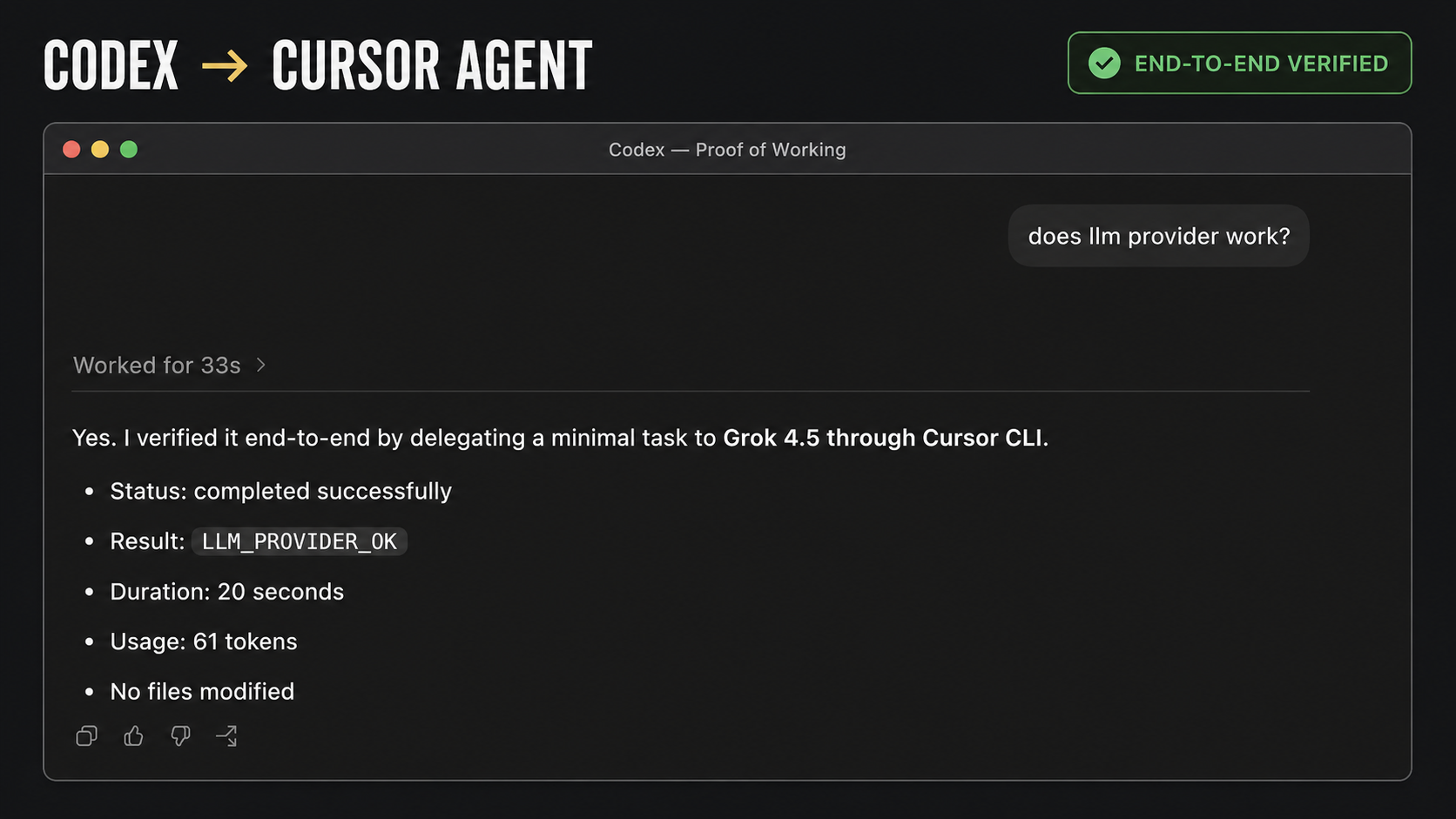
In this live smoke test, Codex used llm-provider-mcp to delegate work to
Grok 4.5 through Cursor Agent, waited for the asynchronous result, and confirmed
that the task completed without modifying files.
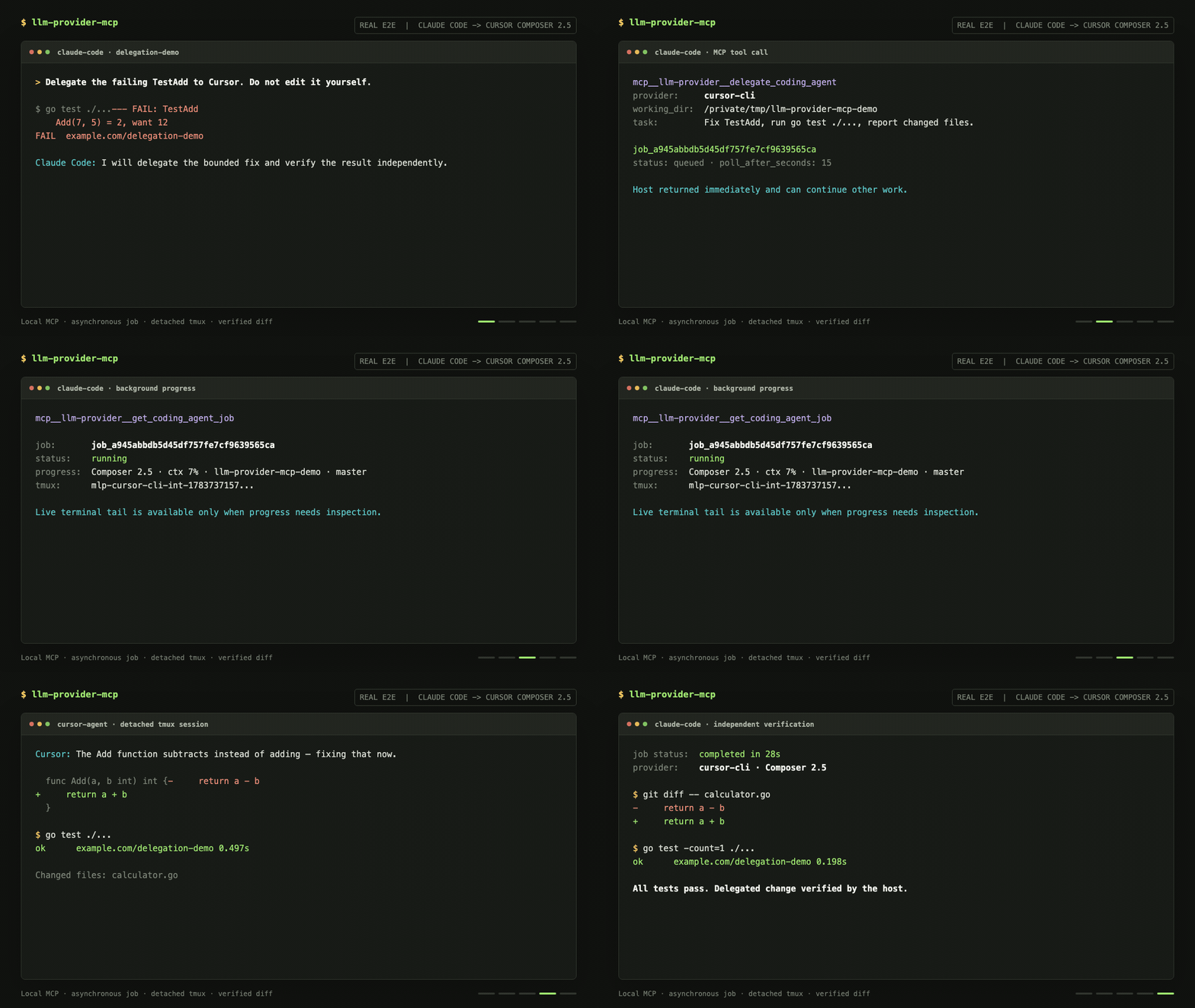
This is a real Claude Code to Cursor Composer 2.5 run: the job completed in 28 seconds and Claude independently verified the diff and uncached test result. See the reproducible demo and sanitized transcript.
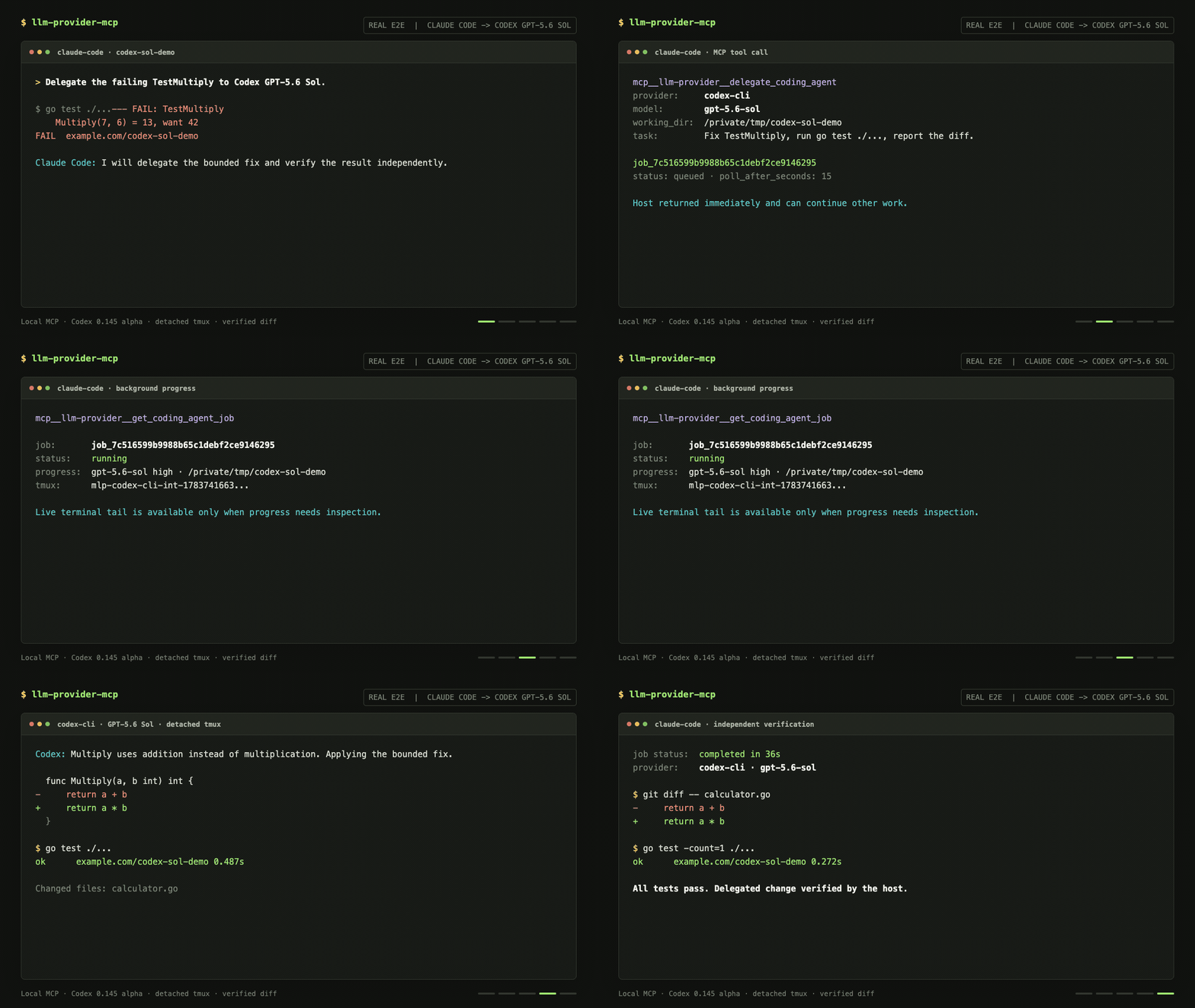
This second real run delegates from Claude Code to Codex CLI with
gpt-5.6-sol. Codex completed the bounded fix in 36 seconds, and Claude
independently inspected the diff and reran the test. The run used Codex CLI
0.145.0-alpha.4; stable 0.144.1 rejected Sol during its rollout.
Quick Start
Requirements:
- macOS or Linux
- tmux 3.x or newer
- Codex or Claude Code as an MCP host
- At least one authenticated target: Cursor Agent, Pi, Codex, or Claude Code
From the project where you want to use delegation, run:
curl -fsSL https://raw.githubusercontent.com/manishiitg/llm-provider-mcp/main/scripts/install-mcp.sh | sh
The interactive setup detects installed CLIs, lets you select multiple hosts and targets, verifies authentication, registers the MCP server only for the current project, and installs a small delegation skill.
The server is also published in the official MCP Registry
as io.github.manishiitg/llm-provider-mcp.
Start a new Codex or Claude Code session in that project and ask naturally:
Delegate the failing authentication test to Cursor using composer-2.5.
Keep working here and check the delegated job when it is ready.
The host receives a response shaped like:
{
  "job_id": "job_03070f8a2626b50ace1a67a463db9b4d",
  "provider": "cursor-cli",
  "status": "queued",
  "poll_after_seconds": 15,
  "next_tool": "get_coding_agent_job"
}
See Installation for manual and security-conscious installation options.
Why Use It
- Use a stronger model for an independent review or difficult implementation.
- Route small work to a faster or lower-cost model without leaving the host.
- Access Cursor, Gemini, OpenRouter, MiniMax, GLM, and Kimi models from Codex or Claude Code.
- Run independent delegations concurrently without blocking the host session.
- Inspect a live terminal tail or attach directly to tmux when human attention is needed.
- Keep credentials with the native CLIs instead of copying API keys into the MCP server.
Supported Coding CLIs
| CLI | MCP host | Delegation target | Model selection |
|---|---|---|---|
| Codex CLI | Yes | Yes | Codex model IDs and reasoning levels |
| Claude Code | Yes | Yes | Claude Code model selectors |
| Cursor Agent | Manual registration | Yes | Composer, Grok, and account-visible models |
| Pi CLI | Manual registration | Yes | Gemini, OpenRouter, MiniMax, GLM, and Kimi |
The setup wizard currently registers Codex and Claude Code as hosts. Cursor and Pi can use the same stdio MCP server through manual project configuration. All four CLIs can run as local delegation targets.
Antigravity CLI remains available only as a deprecated Go-library compatibility integration and is not offered during new MCP setup. Gemini CLI has been removed; use Pi CLI for Gemini models or Vertex for direct Gemini API access.
See Providers and models for selectors, authentication commands, and provider-specific behavior.
How Delegation Works
sequenceDiagram
    participant H as Claude Code or Codex
    participant M as llm-provider-mcp
    participant J as Job worker
    participant T as Cursor, Pi, Codex, or Claude
    H->>M: delegate_coding_agent(task, provider, working_dir)
    M->>J: Persist and queue job
    M-->>H: job_id immediately
    J->>T: Start detached tmux session
    H->>H: Continue host work
    H->>M: get_coding_agent_job(job_id)
    M-->>H: Progress, terminal tail, or final result
- The host passes its current trusted project and a bounded task.
- The server validates the provider and workspace, then persists the job in SQLite.
- A detached worker launches the target CLI in tmux.
- The host polls after the recommended interval while continuing other work.
- The host reviews the final result and verifies any workspace changes.
Polling is the current completion mechanism. MCP task notifications are planned after behavior is consistent across supported hosts.
See Delegation workflow and Architecture for the complete lifecycle.
MCP Tools
The server exposes five tools:
| Tool | Purpose |
|---|---|
list_coding_agents |
List enabled delegation targets and capabilities |
list_coding_agent_models |
Discover curated model selectors |
delegate_coding_agent |
Start an asynchronous coding job |
get_coding_agent_job |
Read status, progress, terminal output, or result |
cancel_coding_agent_job |
Stop a queued or running job |
Running jobs include a tmux attach command for direct human inspection.
get_coding_agent_job can also return a bounded, ANSI-cleaned terminal tail.
CLI Commands
llm-provider-mcp setup
llm-provider-mcp doctor
llm-provider-mcp models cursor-cli
llm-provider-mcp models pi-cli --json
llm-provider-mcp uninstall
setup, doctor, and uninstall are designed to work without additional
arguments. Run llm-provider-mcp --help for automation flags.
Security And Trust
- The MCP server and delegated CLIs run on the local machine.
- Credentials remain owned by each native CLI and are never collected by setup.
- Setup writes project-local MCP and skill configuration only after showing the exact paths.
- The host supplies its current trusted project as
working_dir; users are not asked to enter it for every job. - Detached agents use unattended provider-specific policies so they do not block on invisible approval prompts.
LLM_PROVIDER_MCP_WORKSPACE_ROOTScan restrict accepted working directories, but it is not a process sandbox.
Pi currently has no hard workspace sandbox, so its shell and file tools retain the permissions of the local user. Do not delegate untrusted prompts or repositories to Pi.
Read Security and trust before enabling unattended delegation in sensitive repositories.
Current Limitations
- macOS and Linux only; Windows is not currently supported.
- tmux is required for delegated execution and live inspection.
- Completion is polling-based rather than pushed to the host.
- Host auto-registration currently supports Codex and Claude Code.
- Target model availability depends on the user's existing CLI account.
- A delegated agent can modify the working tree; the host must review and test those changes before accepting them.
Documentation
- Installation
- Delegation workflow
- Providers and models
- Security and trust
- Architecture
- Troubleshooting
- Go compatibility library
- Roadmap
Go Compatibility Library
This repository also contains the Go provider module used by MCP Agent and MCP Agent Builder. Its existing module path remains intentionally unchanged:
go get github.com/manishiitg/multi-llm-provider-go@latest
The general provider APIs remain supported for downstream compatibility, but
the primary product surface of this repository is llm-provider-mcp. See the
Go compatibility library documentation.
Development
make build-mcp
go test ./...
golangci-lint run --timeout=5m ./...
The CI suite also compile-checks MCP Agent and MCP Agent Builder against the current checkout to prevent accidental public-API breakage.
See CONTRIBUTING.md before opening a pull request. Report security issues using SECURITY.md, not a public issue.
License
Installing Llm Provider
This server has no published package — it is built from source. Open the repository and follow its README.
▸ github.com/manishiitg/llm-provider-mcpFAQ
Is Llm Provider MCP free?
Yes, Llm Provider MCP is free — one-click install via Unyly at no cost.
Does Llm Provider need an API key?
No, Llm Provider runs without API keys or environment variables.
Is Llm Provider hosted or self-hosted?
Self-hosted: the server runs locally on your machine via the install command above.
How do I install Llm Provider in Claude Desktop, Claude Code or Cursor?
Open Llm Provider on unyly.org, pick your client tab (Claude Desktop, Claude Code, Cursor) and press Install — the config is generated automatically, no JSON editing.
Related MCPs
GitHub
PRs, issues, code search, CI status
 by GitHub
Filesystem
Secure file operations with configurable access controls.
Memory
Knowledge graph-based persistent memory system.
Template MCP Server
A CLI tool to create a new Model Context Protocol server project with TypeScript support, dual transport options, and an extensible structure
 by mcpdotdirect
Compare Llm Provider with
Not sure what to pick?
Find your stack in 60 seconds
Author?
Embed badge for your README
Browse similar
All development MCPs