
Multi Agent Broker
FreeNot checkedMake LLMs from different vendors collaborate as one team. Capability-based task routing across Claude / GPT / Gemini / Ollama. Lead dispatches → broker filter-b

About
Make LLMs from different vendors collaborate as one team. Capability-based task routing across Claude / GPT / Gemini / Ollama. Lead dispatches → broker filter-broadcasts → workers (any LLM, any host) pick up matching tasks. Single-vendor stacks already have subagents — this is for when the right tool for the job lives in another vendor's stack.
README
Make LLMs from different vendors collaborate as one team — by capability, not by name.
Demo
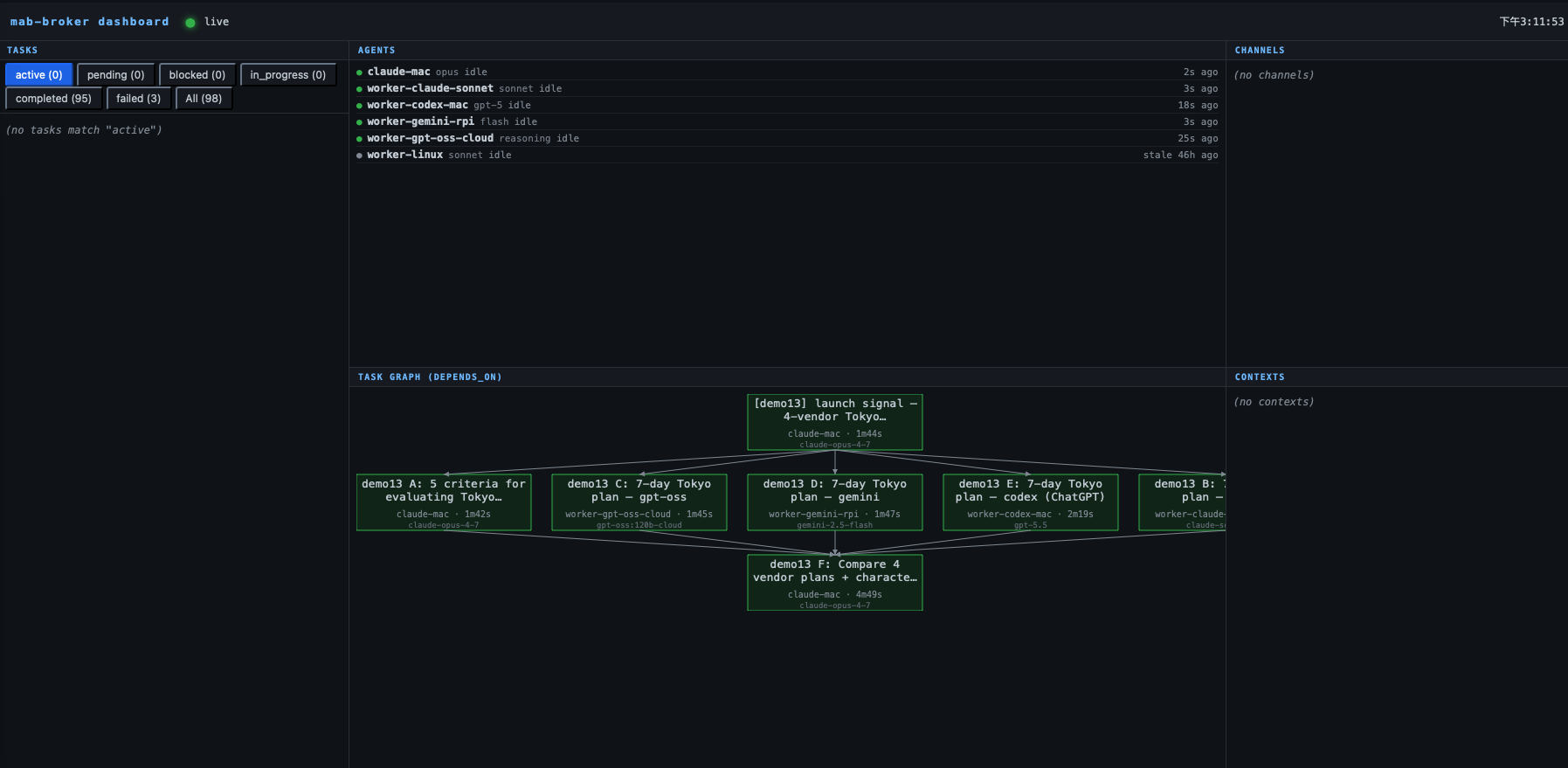
Phase 5a — Read-only web dashboard, 4-vendor task graph. Screenshot above is the lead-mode dashboard at the end of a 7-task fan-out + fan-in plan running across four different LLM vendors simultaneously: claude-sonnet-4-6 (Anthropic Max subscription via
claude-cli), gpt-oss:120b (Ollama Cloud), gemini-2.5-flash (Google AI Studio API), and gpt-5.5 (ChatGPT subscription via Codex CLI). Each box shows the worker, the model, and the wall-clock duration; the same prompt was sent to all four vendor branches so the lead could compare their outputs side-by-side.Top panel: 6 online agents (5 workers + lead). Bottom panel: the depends_on task graph — sentinel "go" task at the top, four vendor plans in parallel below it, gpt-oss/sonnet/gemini/codex all green, comparison task at the bottom synthesising them. The dashboard polls broker state every 1 s; live status lifecycle is gray (pending/blocked) → amber (in_progress) → green (completed) / red (failed). Per-batch grouping via depends_on connected components means each
/lead-modedispatch is its own clean graph — previous runs auto-clear.
🎬 Screencast of the same lifecycle in motion (sentinel release → vendors light up amber → duration ticking → green): issue #1 or directly:
https://github.com/user-attachments/assets/5010b21c-df23-4ee2-b35f-8a84db95ea30
Code: src/mab/broker/routes/dashboard.py (backend snapshot endpoint) + src/mab/broker/static/index.html (single-file vanilla HTML/JS/CSS frontend, no build step). Cross-vendor walkthrough: docs/cookbook.md Recipe 8.
A single-vendor agent stack (Claude Code subagents, OpenAI Assistants, Gemini agents) can already coordinate N copies of its model. mab-broker is for the harder problem: the right LLM for this sub-task lives in another vendor's stack, on your own hardware, or split across both. Examples this codebase exists to enable:
- Claude Opus plans a workflow, dispatches the heavy reasoning step to gpt-oss:120b on Ollama Cloud (1/10 the cost), then routes the polishing pass to Claude Sonnet via subscription — all in one autonomous task chain.
- Local Llama-70b on your GPU box handles PII-bearing input (no cloud), the same lead also dispatches non-sensitive sub-tasks to GPT-4o, both happen in the same plan.
- Anthropic gets rate-limited mid-workflow → broker reroutes the next task to DeepSeek-R1 automatically, because capability is the contract and vendor is interchangeable.
Tasks declare what they need (required_all=["tier:reasoning", "host:cloud"]), agents declare what they offer (["model:gpt-oss:120b-cloud", "family:gpt-oss", "tier:reasoning", "host:cloud", "provider:ollama"]), and the broker does the matching. You can swap a worker's underlying LLM tomorrow without changing a single lead-side prompt.
Where mab-broker isn't a fit
- Single-vendor setups — you already have great native options. Use those.
- Public-internet multi-tenant — TLS / wss / JWT / IP allowlist still pending (Phase 4). Today this is LAN / VPN / Tailscale.
- Synchronous chat — broker is task-shaped, not turn-based dialogue.
What it looks like in practice
┌─────────────────────────────────────────────────────────────┐
│  Lead: Claude Opus (Anthropic API)                          │  ← your laptop
│    "Plan, dispatch, monitor, synthesize"                    │
└──────────────────────┬──────────────────────────────────────┘
              create_task(required_all=[...])
                       │
                       ▼
┌─────────────────────────────────────────────────────────────┐
│  Broker (FastAPI + SQLite + WS)                             │  ← your network
│    Capability-filtered push · atomic claim · data sovereign │
└──┬────────────────────────────────────────┬─────────────────┘
   │ tier:reasoning + host:cloud            │ tier:sonnet + family:claude
   ▼                                         ▼
┌──────────────────────┐                ┌──────────────────────┐
│  Worker A            │                │  Worker B            │
│  adapter: ollama     │                │  adapter: claude-cli │
│  model: gpt-oss:120b │                │  model: claude-sonnet│
│  via Ollama Cloud    │                │  via Max subscription│
│  (OpenAI OSS family) │                │  (Anthropic family)  │
└──────────────────────┘                └──────────────────────┘

                          + add a worker for:
                            – OpenAI direct (API key)
                            – Gemini direct (API key)
                            – Local Llama / Qwen / DeepSeek (GPU box, no internet)
                            – any HTTP-speaking LLM (one ~50-line adapter)
One Python daemon (mab-worker) per worker host, five built-in adapters (anthropic / ollama / claude-cli / gemini / mock), swap with one CLI flag — --adapter X --model Y. No client-side change for the lead when you swap vendors.
Status: Phase 1 + 1.5 + 2.1 + 2.2 + 3a + Phase 3 + Phase 5a fully complete. 212 tests green.
3 vendor families live in production: Anthropic Claude (Opus lead + Sonnet worker via Max subscription), OpenAI OSS (gpt-oss:120b via Ollama Cloud), Google (gemini-2.5-flash via AI Studio on a Raspberry Pi) — all routing via capability tags, lead doesn't see vendor names. Cross-vendor
/lead-modedemos verified end-to-end including a 3-vendor Tokyo itinerary comparison (cookbook Recipe 8) and a playable single-file Chrome-dino game built across two vendors (Recipe 6, examples/dino.html).Phase 5a — Read-only web dashboard ships at
/dashboardon the broker: per-batch task graph (depends_on connected components), live agent state, per-task agent + model + duration metadata, dark "tech" aesthetic with status-lifecycle colours (gray → amber → green/red). Includes the in-place retry primitive — failed tasks reset on the same id with cascade reset of downstream failures, dashboard shows a↻Nbadge and pulse animation for visible retry recovery. See issue #1 for screencast.Reliability hardening: supersede-race fix (zombie WS connections no longer flap status), broker-side stuck-task reaper (worker dies mid-task → auto-fail after heartbeat goes stale).
Cookbook: 8 production-verified recipes in docs/cookbook.md — two-stage thinking, fan-in synthesis, failure cascade, shared context, channels,
/lead-modeend-to-end, adding a third vendor, cross-vendor comparison + retry.
What's in the box
Three runtime roles, one repo, one broker URL:
- Central broker (
mab-broker) — FastAPI + SQLite (WAL) + WebSocket Hub; one binary, zero external dependencies - Interactive MCP agent (
mab-agent) — plugs into Claude Code via.mcp.jsonorclaude mcp add; 14 tools cover roster discovery (list_agents/match_agents), self-declaration (update_my_model/update_my_capabilities), messaging, full task lifecycle (includingdelete_task), and push-drivenwait_for_task. Best for the lead orchestrator and any human-in-the-loop dev work - Autonomous worker daemon (
mab-worker) — headless Python daemon supervised bysystemd --user; pulls tasks via push-drivenwait_for_task, dispatches each through a pluggable LLM adapter, reports back. Four adapters ship in-box:anthropic(api.anthropic.com direct via httpx),ollama(works for local Ollama and Ollama Cloud, also via httpx),claude-cli(spawnsclaude -pper task — gives the worker access to Claude Code's full tool ecosystem), andmock(in-process echo for tests). Best for production workers — daemon mode avoids the Claude Code TUI's user-input-breaks-the-loop race and is supervised, immortal, and observable via journalctl
Plus the cross-cutting machinery:
- Capability-based routing — tasks carry
required_all/required_anytag sets; broker filters WS broadcast to matching online agents and rejects mismatched claims (403) or directed assignments (400) - Model-aware agents —
--model claude-opus-4-7auto-derivesmodel:/family:/tier:/provider:tags so capabilities track the runtime model identity (works on bothmab-agentandmab-worker) - Push-aware tool responses — every MCP tool reply embeds
_pending_messages/_pending_task_eventscounts so Claude Code (which cannot be push-interrupted) is nudged to drain its queue on the next tool call - Atomic task claim —
UPDATE ... WHERE status='pending' RETURNINGguarantees single-winner semantics under concurrent claims - Task delete with
task_event:deleted— creator or current assignee can drop a task in any state; broker auto-clears the assignee'scurrent_taskand broadcasts the deletion - Offline message backfill — messages addressed to an offline agent persist for 7 days; the agent receives them on next reconnect
- Auto-reconnecting WS client — exponential backoff (1→2→4…60s), application-layer text heartbeat keeps
last_heartbeatfresh on the broker - Observability tool —
tools/watch.pyconnects to the broker as a non-MCP agent and prints every received WS event to stdout; the easiest way to verify filter broadcast or chase routing bugs from a third machine - One-shot deployment —
deploy/install.sh(broker),deploy/setup-agent.sh(Claude Code MCP wiring),deploy/setup-worker.sh(daemon) — each is idempotent;deploy/update.shdoes git pull + uv sync + service restart in one go
Quickstart
Install (broker host)
git clone https://github.com/marsyanggo/multi-agent-broker
cd multi-agent-broker
uv sync
uv run mab-broker serve         # listens on 0.0.0.0:8420
For a production-style install with systemd user services (Linux), use the one-shot installers:
# Broker host
./deploy/install.sh                                          # one sudo for enable-linger; rest non-sudo

# Interactive Claude Code agent (any host — lead, dev, debug)
./deploy/setup-agent.sh \
    --broker-url http://broker-host:8420 \
    --api-key   mab-ak-XXXX \
    --model     claude-opus-4-7

# Headless worker daemon (any host — production task processor)
./deploy/setup-worker.sh \
    --broker-url http://broker-host:8420 \
    --api-key   mab-ak-YYYY \
    --adapter   ollama \
    --model     gpt-oss:120b-cloud \
    --ollama-base-url http://localhost:11434           # via local Ollama proxy

# Update + uninstall
./deploy/update.sh                                           # any host: pull + sync + restart + verify
./deploy/uninstall.sh                                        # broker host: remove unit, keep DB
update.sh refuses to run on a dirty tree and uses git pull --ff-only, so it never overwrites local commits — safe to run on production hosts unattended. setup-agent.sh validates broker reachability + API key before writing MCP config, and creates a backup of ~/.claude.json on the fallback path. setup-worker.sh writes a chmod 600 systemd unit with all config (including secrets) as Environment= lines — --name <suffix> lets one host run several workers in parallel (mab-worker-opus.service + mab-worker-llama.service, etc.). See deploy/README.md for the full flow.
Generate an API key per agent
uv run mab-broker gen-key --name claude-laptop
# Registered agent: claude-laptop (id=abc12345)
# API key (save now — it cannot be recovered):
#   mab-ak-XXXXXXXXXXXXXXXX
You can pre-seed capabilities at registration:
uv run mab-broker gen-key --name worker-linux \
  --capabilities tier:sonnet,family:claude,vision
Name conflict? Add --auto-suffix to auto-increment (claude-laptop → claude-laptop-2).
When the broker is installed via
deploy/install.sh, its data dir is moved off$HOME. Re-export the sameMAB_DB_PATHwhen runninggen-keyfrom the same machine, or you'll write keys to a different SQLite file than the broker reads:MAB_DB_PATH=$XDG_DATA_HOME/multi-agent-broker/db.sqlite \ uv run mab-broker gen-key --name claude-laptop
Wire up Claude Code
claude mcp add -s user mab \
  /path/to/mab-agent \
  --broker-url http://192.168.1.100:8420 \
  --api-key mab-ak-XXXXXXXXXXXXXXXX \
  --model claude-opus-4-7
--model claude-opus-4-7 auto-derives capability tags. To override or extend:
mab-agent --broker-url ... --api-key ... \
  --model claude-opus-4-7 \
  --capabilities vision,code-review     # extra tags merged with model derivation
Restart Claude Code. You'll see 14 tools:
- Roster —
list_agents,match_agents,get_agent_info - Self —
report_status,update_my_model,update_my_capabilities - Messaging —
send_message,get_messages - Tasks —
create_task,claim_task,update_task,delete_task,list_tasks - Worker —
wait_for_task(push-driven block on broker WS, used by /worker-mode)
Install a worker daemon (production)
For headless task execution without a Claude Code session in the loop, install mab-worker as a systemd user service:
# On the worker host (broker generated the key, then handed it to you)
./deploy/setup-worker.sh \
  --broker-url http://broker-host:8420 \
  --api-key   mab-ak-YYYYYYYYYYYYYY \
  --adapter   ollama \
  --model     gpt-oss:120b-cloud \
  --ollama-base-url http://localhost:11434       # local Ollama proxies to Ollama Cloud
Adapter choices (--adapter):
| Adapter | Backend | Best for |
|---|---|---|
anthropic |
POST to api.anthropic.com/v1/messages direct via httpx |
Pure-LLM tasks against the official Claude API |
ollama |
POST to /api/chat direct via httpx; auto-handles local + Ollama Cloud auth |
Local GPU models or Ollama Cloud-routed models like gpt-oss:120b-cloud |
claude-cli |
Spawns claude -p <prompt> per task |
Tasks needing Claude Code's tool ecosystem (Bash / Edit / Read / web). Heaviest cold start but most capable |
mock |
In-process echo | Smoke tests, dry runs |
After install, the daemon is supervised:
systemctl --user status mab-worker.service        # is it up?
journalctl --user -u mab-worker.service -f        # tail logs
systemctl --user restart mab-worker.service       # apply config / rotate key
./deploy/update.sh && systemctl --user restart mab-worker.service   # pull repo + restart
Run multiple workers on one host with --name <suffix> — e.g. --name opus-cloud creates mab-worker-opus-cloud.service alongside the default mab-worker.service, each with its own unit file, secrets, and journal.
Try it out
You:    Use the mab tools to create a task that needs tier:opus, then claim it.
Claude: [calls create_task(title="...", required_all=["tier:opus"])]
        [calls claim_task(task_id="...")]   # succeeds because this agent has tier:opus
        [calls update_task(status="completed", result="...")]
If a non-opus agent tries to claim the same task, the broker returns 403 and the task stays pending.
/lead-mode + /worker-mode slash commands
The repo ships two Claude Code skills (under .claude/skills/) that turn any Claude session into either an orchestrator or a worker with one slash command:
| Command | Role | What it does |
|---|---|---|
/lead-mode |
Planner / dispatcher | Scouts the roster, decomposes user goals into sub-tasks, picks best-fit agents by capability, monitors progress, synthesizes results |
/worker-mode |
Interactive worker | Blocks on wait_for_task (push-driven, sub-second latency); claims new work the instant the broker pushes it, executes per task description, reports completed or failed, loops. For production workers, prefer mab-worker daemon — /worker-mode is fine for dev / debug, but Claude Code's interactive TUI means a stray user keystroke breaks the loop. The daemon has no TUI and is supervised by systemd. |
Typical multi-host setup:
- Lead host (laptop) —
/lead-modeonce in Claude Code, then talk to it like a project manager - Production worker hosts (GPU / cloud-LLM boxes) —
setup-worker.shonce, daemon runs forever in background
The skills are pure prompt + existing MCP tools — no daemon process, no new Python. Worker mode runs push-driven via the wait_for_task MCP tool (blocks on mab-agent's WS event queue, returns within ~100ms of broker push); no polling, sub-second routing latency. The standalone mab-worker daemon uses the same primitive but bypasses Claude Code entirely — see deploy/README.md.
See the skill files themselves for the full behaviour spec.
Observing routing live
If you want to see which events reach a given agent without bolting it into Claude Code, run tools/watch.py on the same host as that agent's API key:
python tools/watch.py \
  --broker-url http://192.168.1.100:8420 \
  --api-key mab-ak-XXXX
# stderr: [watch] connected as worker-linux (id=...) caps=[...]
# stdout: one JSON line per received message / task_event
Then create tasks from elsewhere with different required_all sets — non-matching events simply never appear in the watcher's output, which is the cleanest live proof that filter broadcast works. (Used to validate this codebase across a real Linux + macOS setup.)
Architecture
                  ┌────────────────────────────────────────────┐
                  │ Central Broker (FastAPI + SQLite + WS Hub) │
                  │  REST  /api/v1/{agents|messages|tasks}     │
                  │  WS    /api/v1/ws  (push channel)          │
                  │  Capability matcher filters task broadcast │
                  └──┬─────────────────────┬──────────────────┘
                     │                     │
              WS push + REST        WS push + REST
                     │                     │
            ┌────────┴────────┐    ┌───────┴───────────┐
            │   mab-agent     │    │  mab-worker       │
            │   (MCP stdio)   │    │  (systemd daemon) │
            │                 │    │                   │
            │ Claude Code     │    │  Adapter:         │
            │ /lead-mode      │    │   anthropic       │
            │ /worker-mode    │    │   ollama          │
            │ (interactive)   │    │   claude-cli      │
            └─────────────────┘    └───────────────────┘
              lead / dev box           production worker
Roles compose. A small setup has the broker, one lead mab-agent on the user's laptop, and one mab-worker daemon on each GPU / model host. The broker is the only piece that needs to be reachable from every other; agents and workers are clients.
Message + task flow
Claude Code → mab-agent → REST POST /api/v1/tasks (required_all=[tier:opus])
                          │
            broker stores task, computes online agents matching capability
                          │
            WS push task_event:created → ONLY agents with tier:opus
                          │
            One of them: POST /api/v1/tasks/{id}/claim
                          │
            Broker validates claimer.capabilities, then atomic UPDATE
                          │
            WS push task_event:claimed → creator + assignee
                          │
            Assignee: PATCH /api/v1/tasks/{id} { status: completed, result, note }
                          │
            WS push task_event:completed → creator + assignee
Full Phase 1-5 long-form design lives in architcture.md.
Capability tags
Tags follow a prefix:value convention (with bare tags also allowed). The matcher does plain string equality on tags; no glob / regex.
| Prefix | Meaning | Examples |
|---|---|---|
model: |
Exact model identifier | model:claude-opus-4-7, model:gpt-4o, model:llama-3.3-70b |
family: |
Vendor / brand family | family:claude, family:openai, family:google, family:meta |
tier: |
Capability tier within a family | tier:opus, tier:sonnet, tier:haiku, tier:flash, tier:pro |
provider: |
API provider | provider:anthropic, provider:openai, provider:google |
| (bare) | Free-form capability flag | vision, audio, code-review, cn-locale |
mab-agent --model X auto-derives model:, family:, tier:, provider: for known model families. Coverage:
- Closed-API: Claude (opus / sonnet / haiku), GPT (4 / 4o / 5), Gemini (pro / flash / flash-lite) — full
family:+tier:+provider: - Open-source (Anthropic / Meta / Alibaba / DeepSeek / Microsoft / Mistral / OpenAI OSS / Google Gemma):
gpt-oss,llama / llama-3 / llama-3.3 / llama-4,qwen / qwen2.5 / qwen2.5-coder / qwen3,deepseek / deepseek-r1 / deepseek-v3 / deepseek-coder,mistral / mistral-large / mistral-small,gemma / gemma-3,phi / phi-4—family:+tier:(provider intentionally not auto-set since these can be hosted via Ollama, vLLM, Bedrock, etc.) - Ollama tag form
name:tag(e.g.gpt-oss:20b,llama3.3:70b,qwen2.5-coder:32b): auto-addssize:<tag>,host:local, andprovider:ollama. The-cloudsuffix (e.g.gpt-oss:120b-cloud) is recognised as Ollama Cloud:size:120b+host:cloudinstead of polluting the size tag. Pass--capabilitiesto override provider if you're running through vLLM / something else.
Unknown model strings only get model:X (+ size: / provider:ollama if :tag form). Anything richer should be passed via --capabilities.
Examples:
mab-agent --broker-url ... --api-key ... --model gpt-oss:20b
# → [model:gpt-oss:20b, size:20b, host:local, provider:ollama,
#    family:gpt-oss, tier:reasoning]

mab-agent --broker-url ... --api-key ... --model gpt-oss:120b-cloud
# → [model:gpt-oss:120b-cloud, size:120b, host:cloud, provider:ollama,
#    family:gpt-oss, tier:reasoning]
How an agent declares its model
Four ways an agent can claim which model it runs (in order of recommendation):
mab-agent --model Xat startup — derives the standard tags +PATCH /agents/mebefore opening the WebSocket, so the broker has correct caps when the agent comes online. Best for fixed-per-process deployments (Claude Code via MCP).mab-agent --capabilities a,bmerge — combines with--modelfor runtime extras (e.g. addvisionfor a session). Full replacement of stored tags; not append.update_my_model/update_my_capabilitiesMCP tools — the LLM driving the agent can self-update mid-session. Use when the model switches at runtime (e.g. Claude Code/fasttoggle) or to add a per-task skill flag.mab-broker gen-key --capabilities ...— persist a default in the broker DB at registration time. Survives across restarts but won't reflect runtime model changes.
In practice: gen-key for the immutable identity, --model flag for the per-process runtime claim, MCP tools for in-session corrections.
Writing a non-MCP client
Any process speaking REST + WS can join the broker. Reuse BrokerClient directly:
from mab.mcp_server.broker_client import BrokerClient
from mab.shared.capabilities import derive_capabilities_from_model

client = BrokerClient(
    broker_url="http://192.168.1.100:8420",
    api_key="mab-ak-XXXX",
)
# Declare before going online so task routing sees fresh caps.
await client.update_capabilities(
    derive_capabilities_from_model("llama-3.3-70b") + ["gpu-local"]
)
await client.start()           # WS connect + auto-reconnect + heartbeat
# Now drain events as they arrive:
while ...:
    for msg in client.drain_messages():
        ...
    for task in client.drain_task_events():
        ...
tools/watch.py is a complete example of this pattern. A Phase 3 SDK will package it into a proper public API; the helpers above already work today.
Task match semantics
A task carries two optional tag lists, both AND-of-AND-then-AND-of-OR:
create_task(
    title="...",
    required_all=["tier:opus"],            # claimer must have ALL of these
    required_any=["vision", "audio"],      # claimer must have AT LEAST ONE of these
)
| Agent tags | required_all=[tier:opus], required_any=[vision, audio] |
|---|---|
[tier:opus, vision] |
✓ |
[tier:opus, audio] |
✓ |
[tier:opus] |
✗ (fails required_any) |
[tier:sonnet, vision] |
✗ (fails required_all) |
[] (no caps) |
✗ unless both fields are empty |
Empty required_all + empty required_any ⇒ any agent matches (Phase 1 backward-compat behaviour).
Routing behaviour
- Filter broadcast — broker only sends
task_event:createdover WS to matching online agents. Non-matchers never know the task exists via push. - Authoritative claim — even if an agent learns of a task via
list_tasks, claiming it requires capability match; otherwise403. - Directed assignment —
create_task(assigned_to=...)with capability requirements validates the assignee at creation;400if mismatched. - Zero matches — task is still created (status
pending); later-connecting agents that match can pick it up vialist_tasks.
Configuration
Env vars (prefix MAB_):
| Var | Default | Effect |
|---|---|---|
MAB_HOST |
0.0.0.0 |
Broker bind host |
MAB_PORT |
8420 |
Broker port |
MAB_DB_PATH |
~/.multi-agent-broker/db.sqlite |
SQLite location |
MAB_MESSAGE_TTL_DAYS |
7 |
Undelivered message retention |
MAB_HEARTBEAT_INTERVAL_SECONDS |
30 |
WS keepalive + app heartbeat |
MAB_BROKER_URL |
http://localhost:8420 |
(agent) broker to dial |
MAB_API_KEY |
— required — | (agent) auth token |
MAB_MODEL |
— | (agent) model identifier for capability derivation |
MAB_CAPABILITIES |
— | (agent) extra capability tags, comma-separated |
CLI flags on mab-agent mirror the env vars; CLI takes precedence.
Testing
uv run pytest
# 188 tests, ~35s — includes real-subprocess end-to-end demo + live-broker daemon integration
Test layout:
| File | Coverage |
|---|---|
tests/test_db.py |
SQLite CRUD, atomic claim, TTL cleanup, capability migration |
tests/test_auth.py |
API key hashing, Bearer validation, name conflict / auto-suffix |
tests/test_capabilities.py |
Capability matcher (AND-of-all + AND-of-any), model→tag derivation (Claude / GPT / Gemini / Llama / Qwen / DeepSeek / gpt-oss / Phi + Ollama tag heuristic) |
tests/test_routes.py |
REST routes against in-process FastAPI, including capability validation + task delete (creator / assignee / non-owner / 404) |
tests/test_websocket.py |
Hub routing, backfill, agent/task events, capability filter broadcast |
tests/test_broker_client.py |
BrokerClient against a live uvicorn broker (including app heartbeat) |
tests/test_mcp_server.py |
MCP tool wiring (14 tools) + _pending_messages interceptor + update_my_model derivation + wait_for_task push/timeout/filter |
tests/test_e2e_demo.py |
mab-broker serve + 2× mab-agent via MCP stdio (4 demo scenarios) |
tests/worker/test_mock_adapter.py |
MockAdapter contract: fixed / callable / async / error / delay / lifecycle |
tests/worker/test_daemon.py |
WorkerDaemon against live broker: directly-assigned tasks, open-pool claim, adapter error path, per-task timeout, multi-task survival, capability declaration, setup/teardown, stats |
tests/worker/test_anthropic_adapter.py |
AnthropicAdapter against httpx.MockTransport: happy path, system prompt + temperature, multi-block concat, non-text-block skip, HTTP error mapping, empty response, missing key |
tests/worker/test_ollama_adapter.py |
OllamaAdapter against httpx.MockTransport: local no-auth, cloud bearer, system prompt, response trim, HTTP error, malformed response |
tests/worker/test_claude_cli_adapter.py |
ClaudeCLIAdapter with a temp Python shim mimicking claude CLI: version probe, model + flag wiring, prompt template, exit code mapping, empty stdout, subprocess kill on cancel, extra args |
tests/worker/test_cli.py |
mab-worker CLI: parse_capabilities, build_adapter for each of 5 adapters, env-var defaults, required-flag validation |
tests/worker/test_gemini_adapter.py |
GeminiAdapter against httpx.MockTransport: happy path, system prompt, temperature, multi-part text concat, missing key, env key, HTTP error, SAFETY finishReason surfacing, no-candidates |
tests/worker/test_e2e_daemon.py |
End-to-end daemon scenarios: capability-rejected claim, push-after-catchup (true push path), graceful stop mid-task, 10-task burst |
tests/test_dashboard.py |
/api/v1/dashboard/snapshot shape: unauth 401, empty shape, populated state after creating task/channel/context |
tests/test_reaper.py |
Stuck-task reaper: stuck + stale agent → failed + current_task cleared; fresh agent skipped; cascade failure through downstream; ignore pending / completed |
tests/test_retry.py |
In-place retry: reset failed → pending + cleared state + retry note; 400 on non-failed; 404 on missing; counter increment across attempts; reset to blocked if upstream not completed; cascade reset downstream failures |
Roadmap
- Phase 1 ✅ — broker + MCP agent (agent / message / task)
- Phase 1.5 ✅ — one-shot deployment (uv + systemd user service)
- Phase 2.1 ✅ — capability-based task routing
- Phase 2.2 ✅ — task delete +
tools/watch.pyobservability + live multi-agent cross-machine verification - Phase 3a ✅ — Lead Agent enablers: roster (
match_agents+is_stale+current_taskfreshness), capability self-update MCP tools (update_my_model/update_my_capabilities), pre-WS capability declaration, push-drivenwait_for_taskMCP tool - Phase 3 ✅ —
mab-workerdaemon SDK + 4 adapters (Anthropic / Ollama / Claude CLI / Mock),setup-worker.shone-shot install, push-driven event-name-filtered task queue. Production-verified: claude-mac (Opus) → broker → daemon (gpt-oss:120b via Ollama Cloud) end-to-end in ~1s - Phase 3 (D — depends_on) ✅ — task dependencies: blocked status + auto-unblock on upstream completion + failure cascade through downstream chains. Lets a lead fire a whole multi-step plan in one go instead of polling between steps.
- Phase 3 (S — shared context) ✅ — pinned named documents any agent can read. Solves "every task description duplicates the same style guide" and supports auto-promoting upstream task results as named handoff docs.
- Phase 3 (CH — channels) ✅ — named group-broadcast topics. Members get WS push for every new message; non-members can still read history via REST but don't receive pushes and can't post. Distinct from direct messages (1:1) and tasks (claim-lifecycle) — for coordination noise, status updates, open queries. 12 new tests (9 REST + 2 WS + 1 MCP).
- Phase 3 (cookbook) ✅ — 8 production-verified cross-vendor recipes in docs/cookbook.md: two-stage thinking, fan-in synthesis, failure cascade, pinned project spec, group broadcast,
/lead-modeend-to-end (examples/dino.html), adding a third vendor (Google Gemini on RPi), cross-vendor comparison + in-place retry. - Phase 3 (reliability hardening) ✅ — supersede-race fix (two mab-agents sharing an api-key no longer flap status via WS supersede cycle).
- Phase 5 (broker reliability) ✅ — stuck-task reaper: tasks pinned to
assigned/in_progresswhose owner agent goes stale auto-fail with a self-describing note, cascade-fails through downstreamdepends_onchains. Heartbeat-only trigger so long-running LLM calls on healthy workers aren't false-positived. - Phase 5a (read-only web dashboard) ✅ — vanilla HTML+JS+CSS bundled into the broker at
/dashboard(single 28 KB file, no build step). Per-batch task graph viadepends_onconnected-component grouping; live agent state with per-task agent + model + duration metadata; dark / cyan-accent aesthetic; status lifecycle gray → amber → green/red. - Phase 5 (adapter resilience) ✅ —
GeminiAdapter(Google AI Studio, OpenAI-compatible-ish via httpx-direct, 4th built-in adapter).max_output_tokensdefaults raised to 8192 after demo11 silently truncated long-form output. In-place retry primitive:POST /api/v1/tasks/{id}/retryresets a failed task on the same id, cascade-resets downstream failures, dashboard shows↻Nhistory badge + 1s pulse animation while retrying. - Phase 5 (worker ops symmetry) ✅ —
deploy/update-worker.shmirrors the broker'supdate.sh: ff-only pull,uv sync, restart everymab-worker*.service(or filter via--name), per-unit online-status verification via/agents/me. - Test total: 212.
- Phase 4 — TLS + JWT + IP allowlist for public-internet deployment (deferred — LAN deployment works for current use)
- Phase 5b — dashboard write actions (dispatch / claim / delete / send message / retry button on red nodes — retry route already lands)
- Phase 5c — full-text search across messages + task descriptions/results + contexts + channel messages (SQLite FTS5)
License
Installing Multi Agent Broker
This server has no published package — it is built from source. Open the repository and follow its README.
▸ github.com/marsyanggo/multi-agent-brokerFAQ
Is Multi Agent Broker MCP free?
Yes, Multi Agent Broker MCP is free — one-click install via Unyly at no cost.
Does Multi Agent Broker need an API key?
No, Multi Agent Broker runs without API keys or environment variables.
Is Multi Agent Broker hosted or self-hosted?
Self-hosted: the server runs locally on your machine via the install command above.
How do I install Multi Agent Broker in Claude Desktop, Claude Code or Cursor?
Open Multi Agent Broker on unyly.org, pick your client tab (Claude Desktop, Claude Code, Cursor) and press Install — the config is generated automatically, no JSON editing.
Related MCPs
GitHub
PRs, issues, code search, CI status
 by GitHub
Filesystem
Secure file operations with configurable access controls.
Memory
Knowledge graph-based persistent memory system.
Template MCP Server
A CLI tool to create a new Model Context Protocol server project with TypeScript support, dual transport options, and an extensible structure
 by mcpdotdirect
Compare Multi Agent Broker with
Not sure what to pick?
Find your stack in 60 seconds
Author?
Embed badge for your README
Browse similar
All development MCPs