
Music Attribution Scaffold
FreeNot checkedResearch scaffold for multi-source music attribution with transparent confidence scoring. Companion code to Teikari, Petteri. 2026. “Governing Generative Music:

About
Research scaffold for multi-source music attribution with transparent confidence scoring. Companion code to Teikari, Petteri. 2026. “Governing Generative Music: Attribution Limits, Platform Incentives, and the Future of Creator Income.” SSRN Scholarly Paper No. 6109087. SSRN, https://dx.doi.org/10.2139/ssrn.6109087
README

▶ Watch the 1-minute demo · 📄 Read the paper (supplementary material includes an annotated screenshot walkthrough)
CI Tests: 1311 Python 3.13 License: MIT DOI Code style: ruff Type checked: mypy uv Docs
Research-grade music attribution infrastructure with calibrated confidence scoring, multi-source entity resolution, and machine-readable consent.
Music metadata is broken — over 40% of records are incorrect or incomplete across databases that don't talk to each other. When generative AI adds millions of new tracks per month, knowing who made what becomes both a legal and economic emergency. This scaffold provides the open-source infrastructure to address it.

The scaffold unifies fragmented music metadata into confidence-scored attribution records with transparent provenance.
What It Does
| Capability | What It Means | Deep Dive |
|---|---|---|
| Multi-source ETL | Fetches and normalizes metadata from MusicBrainz, Discogs, AcoustID, audio file tags, and artist self-reports | src/music_attribution/etl/ · Docs |
| Entity resolution | 5-strategy cascade: identifiers → fuzzy strings → embeddings → graph → LLM disambiguation | src/music_attribution/resolution/ · Docs |
| Calibrated confidence | Per-field scores via conformal prediction — "90% confident" actually means ≥90% coverage | src/music_attribution/attribution/ · Docs |
| Permission patchbay | MCP server for machine-readable AI training consent (ALLOW / DENY / ASK) | src/music_attribution/mcp/ · Docs |
| Agentic UI | PydanticAI agent + CopilotKit sidebar for natural-language attribution queries | src/music_attribution/chat/ · Docs |
| Voice agent | Pipecat voice pipeline with 5-dimension persona, drift detection, and domain tools | src/music_attribution/voice/ · Guide |
| Editorial frontend | Next.js 15 with confidence gauges, assurance badges, review queue | frontend/ · Docs |
How does the 5-strategy entity resolution cascade work?
Entity resolution answers: "Is the 'Imogen Heap' in MusicBrainz the same person as 'I. Heap' in a Discogs release?" The cascade progresses from cheap/certain to expensive/uncertain:
- Identifier matching — Exact ISRC, ISWC, ISNI, or MBID match. Cheapest and most reliable.
- String similarity — Jaro-Winkler and token-sort ratio on canonical names and aliases. Handles typos and transliterations.
- Embedding similarity — Sentence-transformer embeddings compared via cosine similarity. Catches semantic equivalences that string metrics miss (e.g., "紫雨林" ↔ "Jaurim").
- Graph evidence — Shared collaborators, labels, or recordings boost match probability via Jaccard coefficient.
- LLM disambiguation — For remaining ambiguous cases, an LLM evaluates contextual evidence. Cost-gated and cached.
Each stage produces a confidence score. The cascade short-circuits: if Stage 1 finds a high-confidence match, Stages 2–5 are skipped.
References: Fellegi & Sunter (1969) — foundational probabilistic record linkage model; Papadakis et al. (2021) — modern entity resolution survey.
Architecture
Five sequential pipelines connected by typed Pydantic boundary objects:

  I. ETL          II. ENTITY         III. ATTRIBUTION    IV. API/MCP      V. CHAT
  PIPELINE         RESOLUTION         ENGINE
  ┌─────────┐     ┌─────────────┐    ┌────────────┐     ┌──────────┐    ┌──────┐
  │ Discogs │     │ Fuzzy match │    │ Confidence │     │ FastAPI  │    │ AI   │
  │ MBrainz │────▶│ + dedupe    │───▶│ scoring +  │────▶│ REST +   │───▶│ Chat │
  │ AcoustID│     │ + graph     │    │ provenance │     │ MCP      │    │      │
  └─────────┘     └─────────────┘    └────────────┘     └──────────┘    └──────┘
       │                │                  │                  │              │
  NormalizedRecord  ResolvedEntity   AttributionRecord    JSON + MCP     AG-UI SSE

  Cross-cutting: BatchEnvelope · DriftDetector · PipelineFeedback
  Storage:       PostgreSQL + pgvector
Each boundary crossing carries validation, confidence scores, and provenance metadata. Reverse feedback flows (dispute signals, recalibration requests) travel upstream via PipelineFeedback objects.
Full architecture docs: Architecture Overview · Backend Guide · docs/architecture/
Quick Start
Prerequisites
- Python 3.13+ and uv
- Docker and Docker Compose (for PostgreSQL + pgvector)
- Node.js 18+ and npm (for the frontend)
Setup
git clone https://github.com/petteriTeikari/music-attribution-scaffold.git
cd music-attribution-scaffold

# Install deps, start Docker, run migrations, seed Imogen Heap data
make setup

# Start the backend API + PostgreSQL
make dev
# → http://localhost:8000 (Swagger at /docs)

# In a second terminal: start the frontend
make dev-frontend
# → http://localhost:3000

# Or: full agentic UI (backend + CopilotKit sidebar)
make agent
Environment variables
| Variable | Required | Default | Purpose |
|---|---|---|---|
DATABASE_URL |
Yes | — | PostgreSQL connection string |
ANTHROPIC_API_KEY |
For agent | — | Anthropic API key for the PydanticAI agent |
ATTRIBUTION_AGENT_MODEL |
No | anthropic:claude-haiku-4-5 |
PydanticAI model string |
CORS_ORIGINS |
No | http://localhost:3000 |
Comma-separated CORS origins |
NEXT_PUBLIC_API_URL |
No | http://localhost:8000 |
Backend URL for the frontend |
LOG_LEVEL |
No | INFO |
Python logging level |
ENVIRONMENT |
No | development |
Runtime environment |
Create a .env file in the project root, or export directly. See src/music_attribution/config.py for all options.
Make commands reference
| Command | What It Does |
|---|---|
make setup |
Full setup: deps + Docker + migrations + seed data |
make dev |
Start backend API + PostgreSQL |
make dev-frontend |
Start frontend dev server |
make agent |
Start full agentic UI (backend + CopilotKit) |
make test-local |
Run 687 unit + 43 integration tests locally |
make test |
Run 744 tests in Docker (CI-parity) |
make test-frontend |
Run 560 Vitest tests + WCAG checks |
make test-all |
Full CI: lint + typecheck + backend + frontend |
make lint-local |
ruff check + ruff format --check |
make typecheck |
mypy (strict) |
make test-cov |
pytest with coverage report |
make format |
Auto-format with ruff |
Assurance Levels (A0–A3)
Every attribution carries an assurance level indicating verification depth. These are mapped to international music industry identifiers:

| Level | Verification | Evidence | Typical Identifier | Example |
|---|---|---|---|---|
| A0 | None | Self-declared | — | "I wrote this song" (no external confirmation) |
| A1 | Single source | One database confirms | ISRC | MusicBrainz lists the recording |
| A2 | Multi-source | Independent sources agree | ISWC | MusicBrainz + Discogs + file metadata agree |
| A3 | Identity-verified | Full provenance chain | ISNI / IPI | Artist self-report + ISNI + multiple databases |
How are assurance levels computed?
Assurance levels are determined by the entity resolution cascade and the number of independent sources that agree:
- A0: No external data available. The system has only what the user claimed.
- A1: Exactly one external source confirms (e.g., MusicBrainz has a matching ISRC). Confidence is moderate but un-corroborated.
- A2: Two or more independent sources produce consistent information. Cross-source agreement significantly increases confidence.
- A3: Identity-verified through a chain that includes artist self-report AND an identity standard (ISNI or IPI) AND at least one database match. This is the highest tier — reserved for attributions where the creator's identity is cryptographically or administratively confirmed.
The mapping between assurance levels and identifiers is project-defined and reflects industry best practices, not a formal standard.
Concept page: Assurance Levels
Confidence Scoring
Every attribution field carries a calibrated confidence score. Unlike typical ML "confidence" (often miscalibrated), the scaffold uses conformal prediction with Adaptive Prediction Sets (APS) to provide distribution-free coverage guarantees.

What is conformal prediction and why does it matter?
Traditional ML "confidence scores" are often miscalibrated — a model might say "95% confident" when it's actually correct only 70% of the time. In attribution, this is dangerous: overstating confidence in who created a song can have legal and financial consequences.
Conformal prediction provides distribution-free coverage guarantees:
- Learns a nonconformity score from calibration data (how "unusual" each prediction is).
- At inference, constructs a prediction set that contains the true value with probability ≥ (1 - α).
- If α = 0.10, the resulting 90% prediction set genuinely covers the truth ≥ 90% of the time — no distributional assumptions required.
The scaffold calibrates every attribution field: confidence in creator identity, confidence in role assignment, confidence in recording-to-work linkage.
References: Angelopoulos & Bates (2025) — conformal prediction tutorial; Quach et al. (2024) — conformal prediction applied to language model uncertainty.
Concept page: Conformal Prediction
MCP Consent Infrastructure
The scaffold includes a Model Context Protocol (MCP) server that provides machine-readable permission queries for AI training rights. AI platforms can ask "may I use this recording for training?" and receive structured responses.

AI Platform                    MCP Server                    Rights DB
    │                              │                            │
    │── check_permission ─────────▶│                            │
    │   (recording_id, use_type)   │── query rights ──────────▶│
    │                              │◀── permission + conditions─│
    │◀── ALLOW / DENY / ASK ──────│                            │
    │    + conditions, expiry      │                            │
Responses include: permission status, conditions (attribution required, non-commercial only, etc.), expiry dates, and rights holder contact for ASK responses.
Concept page: MCP Consent · Implementation: src/music_attribution/mcp/
Voice Agent (Experimental)
The scaffold includes an open-source voice agent built on Pipecat (BSD-2-Clause, 10.4k stars). The same 4 domain tools available in the text agent are exposed as voice-callable functions -- ask about confidence scores, search attributions, suggest corrections, and submit feedback by speaking.
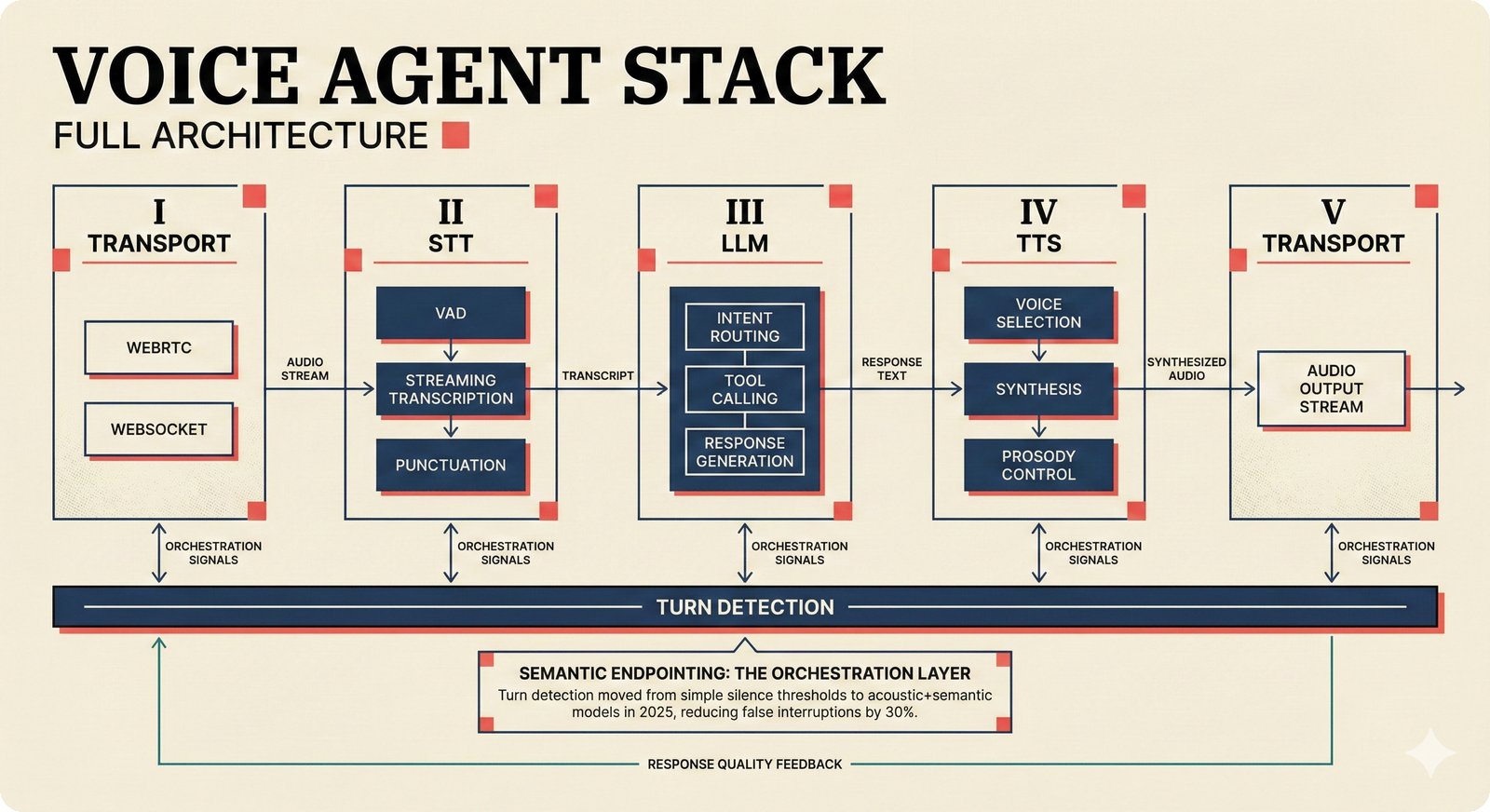
Five-panel architecture: Transport → STT → LLM → TTS → Transport, with semantic endpointing as the orchestration layer.
# Quick start — zero API keys, fully local
uv run python scripts/voice_demo.py

# With custom providers
uv run python scripts/voice_demo.py --stt deepgram --tts elevenlabs

# With drift monitoring
uv run python scripts/voice_demo.py --drift-monitoring --verbose
The pipeline in three lines:
Mic → [Silero VAD → STT → ContextAggregator → LLM (4 tools) → DriftMonitor → TTS] → Speaker
       └─ Pipecat Pipeline ──────────────────────────────────────────────────┘
This is a scaffold, not a production voice product. Every component is swappable with a one-line config change:
| Layer | Default (Zero-Cost) | Commercial Alternative | Config |
|---|---|---|---|
| STT | Whisper (MIT) | Deepgram Nova-3, AssemblyAI | VOICE_STT_PROVIDER |
| TTS | Piper (GPL) / Kokoro (Apache 2.0) | ElevenLabs, Cartesia | VOICE_TTS_PROVIDER |
| Transport | WebSocket | SmallWebRTC, Daily WebRTC | VOICE_TRANSPORT |
| LLM | Any OpenAI-compatible (Ollama, vLLM) | Anthropic, OpenAI | VOICE_LLM_MODEL |
| Persona | 5-dimension prompt-layered | Letta (MemGPT), Mem0 | VOICE_PERSONA_ENABLED |
| Drift | EWMA cosine similarity | -- | VOICE_DRIFT_MONITORING |
| Guardrails | Regex fallback | NeMo Guardrails (Colang 2.0) | VOICE_GUARDRAILS_ENABLED |
What Makes This Different
- Scaffold, not product: Branching paths for every component -- teams with different constraints (budget, latency, licensing) can instantiate different stacks from the same blueprint
- Zero-API-key local dev: Default stack (Whisper + Piper + WebSocket) runs entirely on your machine at $0.00/min
- Protocol-based swapping:
STTServiceProtocol,TTSServiceProtocol, andDriftDetectorProtocoluse Python structural typing -- implement the methods and it just works, no inheritance required - Persona drift prevention: 5-dimension persona architecture with EWMA-smoothed drift detection prevents the 8-turn persona drift cliff documented in the literature (Li et al., 2024)
- Conditional imports: Config, persona, drift, and tool schemas work without Pipecat installed -- only
build_pipecat_pipeline()requires the actual library. All 161 voice tests pass in both modes
Benchmarks (RTX 2070 Super)
STT inference is the latency bottleneck. GPU acceleration provides 4–16x speedup over CPU, with larger models benefiting disproportionately:
| Component | Model | CPU | GPU (CUDA) | Speedup |
|---|---|---|---|---|
| STT (faster-whisper) | tiny | 801 ms | 188 ms | 4.3x |
| STT (faster-whisper) | small | 4,316 ms | 267 ms | 16.2x |
| Drift detection | all-MiniLM-L6-v2 | 4.4 ms | — | — |
Measured on NVIDIA GeForce RTX 2070 Super (7.6 GB VRAM), PyTorch 2.10.0+cu128, 10-second synthetic 440 Hz sine wave (16 kHz, 16-bit PCM). CPU uses int8 quantization; GPU uses float16. Model load times: tiny CPU 5.9s vs CUDA 0.4s; small CPU 41.1s vs CUDA 0.4s.
Run the benchmark yourself
# CPU + GPU benchmark (tiny and small models)
uv run python scripts/benchmark_voice.py --models tiny,small --output results.json

# CPU-only (no CUDA required)
uv run python scripts/benchmark_voice.py --cpu-only --models tiny

# With synthetic command accuracy (WER + domain keyword survival)
uv run python scripts/benchmark_voice.py --models tiny

# End-to-end pipeline with mock LLM (STT → LLM → TTS latency breakdown)
uv run python scripts/benchmark_voice.py --models tiny --mock-llm --llm-delay-ms 200
The benchmark script auto-detects hardware (CPU, GPU, VRAM), applies VRAM guards (skips models too large for available memory), and outputs structured JSON + a summary table. See scripts/benchmark_voice.py.
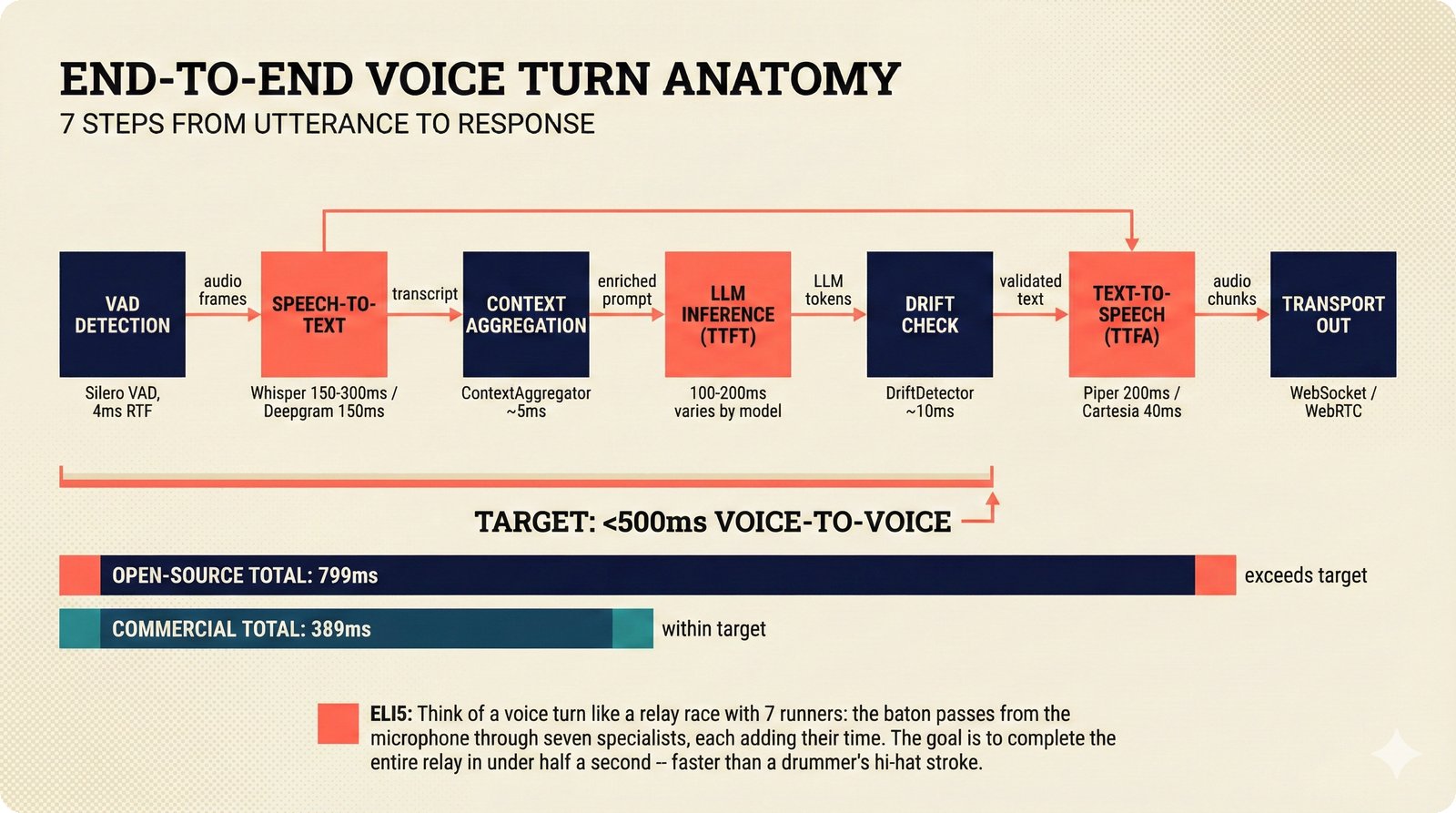
A single voice turn: 7 steps from utterance to response, targeting <500ms total.
Full guide: Voice Agent Implementation · Alternatives table: Component Alternatives · Research base: Voice Agent Research · Figure gallery: 48 voice figures · Implementation: src/music_attribution/voice/
Sample Data
The scaffold ships with 8 Imogen Heap works as seed data, spanning the full confidence spectrum from 0.00 to 0.95:
| Work | Confidence | Assurance | Sources | Status |
|---|---|---|---|---|
| Hide and Seek | 0.95 | A3 | MB, Discogs, AcoustID, Artist | Verified |
| Tiny Human | 0.91 | A3 | MB, Discogs, Artist | Verified |
| The Moment I Said It | 0.82 | A2 | MB, Discogs, File | Stable |
| Goodnight and Go | 0.72 | A2 | MB, Discogs | Stable |
| Headlock | 0.58 | A1 | MB, Discogs | Needs review |
| Just for Now | 0.35 | A1 | MB only | Needs review |
| 2-1 | 0.28 | A1 | File metadata only | Needs review |
| Blanket (unreleased) | 0.00 | A0 | None | Needs review |
Each record carries a full provenance chain showing how confidence evolved through fetch → resolve → score → review events.
Why Imogen Heap?
Imogen Heap is both a critically acclaimed artist and a pioneer in music attribution technology. Her Mycelia project (2015) explored blockchain-based music attribution. Her discography spans well-attributed major-label releases (high confidence) through unreleased demos (zero confidence), providing natural coverage across all assurance levels.
Project Structure
music-attribution-scaffold/
├── src/music_attribution/          # Python package
│   ├── schemas/                    # Pydantic boundary objects
│   ├── etl/                        # Data source connectors + quality gate
│   ├── resolution/                 # 5-strategy entity resolution cascade
│   ├── attribution/                # Aggregation, conformal scoring, priority queue
│   ├── api/                        # FastAPI routes: attribution, health, permissions
│   ├── chat/                       # PydanticAI agent + AG-UI endpoint
│   ├── mcp/                        # MCP permission patchbay server
│   ├── voice/                      # Pipecat voice agent pipeline + persona
│   ├── db/                         # SQLAlchemy models, 8-table schema
│   ├── search/                     # Hybrid search (text + vector + graph)
│   ├── pipeline/                   # DAG runner for orchestration
│   ├── observability/              # Prometheus metrics
│   └── seed/                       # Imogen Heap mock data
├── tests/                          # 744 tests: 687 unit + 43 integration + 14 eval
├── frontend/                       # Next.js 15, TypeScript strict, Tailwind v4
├── docker/                         # Dockerfiles: dev, test, prod
├── alembic/                        # Database migrations
├── docs/                           # MkDocs site + PRD + knowledge base
└── pyproject.toml                  # Single source of truth for all deps
Each module has its own README with architecture details:
| Module | README | What's Inside |
|---|---|---|
| Python package | src/music_attribution/ | Package overview, module map |
| ETL pipeline | src/music_attribution/etl/ | Connectors, quality gate, normalization |
| Entity resolution | src/music_attribution/resolution/ | 5-strategy cascade, Splink, embeddings |
| Attribution engine | src/music_attribution/attribution/ | Aggregation, conformal scoring, review queue |
| API | src/music_attribution/api/ | FastAPI routes, middleware, OpenAPI |
| Chat agent | src/music_attribution/chat/ | PydanticAI tools, AG-UI streaming |
| MCP server | src/music_attribution/mcp/ | Permission queries, consent model |
| Schemas | src/music_attribution/schemas/ | All Pydantic boundary objects |
| Frontend | frontend/ | Next.js 15, design system, components |
| Tests | tests/ | Testing strategy, fixtures, CI |
| Docs | docs/ | MkDocs site, figures, knowledge base |
| Architecture | docs/architecture/ | System diagrams, ADRs, security |
| PRD | docs/prd/ | Probabilistic decision network |
Testing
1,304 tests across backend and frontend:
make test-local          # 744 backend tests locally (~30s)
make test                # 744 backend tests in Docker (CI-parity, ~90s)
make test-frontend       # 560 Vitest tests + WCAG accessibility checks (~15s)
make test-all            # Full CI: lint + typecheck + all tests
Test architecture
| Tier | Count | Speed | Infrastructure | What It Tests |
|---|---|---|---|---|
| Unit | 687 | ~30s | None (all mocked) | Business logic, schema validation, algorithm correctness |
| Integration | 43 | ~60s | Docker (PostgreSQL + pgvector) | Database round-trips, API endpoints, search |
| Eval | 14 | ~5s | None | Benchmark validation, output schema checks |
| Frontend | 560 | ~15s | jsdom (Vitest) | Components, hooks, stores, WCAG accessibility |
| Smoke | — | ~5s | Docker | Container health, migration success |
All tests run in CI via GitHub Actions with path-based filtering — backend changes don't trigger frontend CI and vice versa. See tests/README.md.
Documentation
| Resource | Description |
|---|---|
| GitHub Pages site | Getting started, concepts, API reference, tutorials |
| Concepts | Oracle Problem, A0–A3 assurance, conformal prediction, MCP consent, entity resolution |
| API Reference | Auto-generated from numpy-style docstrings (mkdocstrings) |
| Tutorials | Reproducing the paper, adding data sources, API examples |
| Troubleshooting | 15 common issues: Docker, database, testing, frontend, CI |
| PRD Decision Network | 85 probabilistic decision nodes, 5 levels, 4 team archetypes |
| FinOps Landscape | Deployment cost analysis: 5 paths, DevOps tax, cloud credits, egress optimization |
| Geopolitical Risk Assessment | Cloud sovereignty: CLOUD Act, EU providers, Schrems III, Section 301 |
| Knowledge Base | RAG-optimized markdown: attribution papers, agentic systems research |
| Pitch Deck | 12 investor slides: market, architecture, moat, revenue, roadmap |
| Advanced Due Diligence | 18 deep-dive slides: technical, competitive, financial, team |
Preview docs locally:
uv sync --group docs && uv run --group docs mkdocs serve
# → http://localhost:8000
Music AI Attribution Landscape
The music AI attribution space is undergoing rapid consolidation. This section provides a compact overview — see the full landscape report for detailed company profiles, academic papers, and buy-vs-build analysis.
Attribution Infrastructure
| Company | Approach | Funding | Key Differentiator |
|---|---|---|---|
| Sureel AI | Training-time gradient tracking | Undisclosed | 86–90% accuracy claimed; STIM partnership; 5 patents |
| Musical AI | Training-time influence tracking | $6M | Fairly Trained certified; Beatoven.ai integration |
| Vermillio | Content monitoring (TraceID) | $16M | Sony Music's first AI investment; TIME100 |
| ProRata.ai | Cross-media attribution | $40M | UMG partnership; beyond music |
| Pex | Content identification | Established | Positioning for AI attribution |
| Auracles | Artist-controlled digital identity & permissions | Undisclosed | Founded by Imogen Heap; artist-verified metadata layer |
| Klay Vision | Large Music Model with per-use attribution | Licensed by all 3 majors | First to secure UMG + Sony + WMG licensing (Nov 2025) |
| SoundPatrol | Neural fingerprinting (semantic similarity) | Undisclosed | UMG & Sony collaboration; catches AI derivatives beyond exact matching |
| Orfium (AIXPERT) | Explainable AI for copyright attribution | EUR 7.5M EU grant | 3-year research consortium; 3 of 135 proposals selected |
| Audible Magic | Automated content recognition | Established | 25+ years; Udio partnership; "Broad Spectrum" altered-audio detection |
| BMAT | Audio fingerprinting at scale | Established | 80M IDs/day; 100+ CMOs; 2,000+ labels in 85 countries |
| Muso.AI | Verified music credits platform | Established | 50M+ verified tracks; identity verification via ID scan |
| This scaffold | A0–A3 assurance + conformal prediction | Open-source | Transparent, auditable, MCP-native |
AI Music Generation (with attribution status)
| Platform | Funding | Attribution Status |
|---|---|---|
| Suno | $375M+ ($2.45B val.) | Settling lawsuits; licensed-only models in 2026 |
| Udio | Settled | Pivoting to walled-garden fan remixing |
| Soundverse | Undisclosed | Published ethical framework; DNA Models for artist-owned AI |
| Boomy | Established | Fairly Trained certified; copyright-safe models |
| Stability AI | Established | Licensed data from AudioSparx |
| Jen | Backed by Futureverse | Fairly Trained certified; outputs vetted against 150M tracks |
| LifeScore | Warner Music investment | Provenance-tracked adaptive music; co-founded with Siri co-inventor |
| Rightsify | Established | Owns 12M+ songs for training; Fairly Trained certified; Hydra II model |
Licensing & Certification
| Entity | Role |
|---|---|
| Fairly Trained | Certification body — 19 certified entities |
| LANDR Fair Trade AI | Pro-rata revenue sharing for opted-in artists |
| Lemonaide | Cohort-based attribution; Fairly Trained certified |
| SoundExchange AI Registry | ISRC-based opt-in/opt-out for AI training |
| STIM | World-first collective AI music licence (2025) |
| Kits AI | Ethical voice cloning with dynamic revenue-sharing |
| VEVA Collect | Attribution-by-design — DAW plugin captures credits at recording time; Library of Congress partner |
| Digimarc | Audio watermarking (NASDAQ: DMRC); survives compression/remixing; C2PA-aligned |
AI Music Detection
| Company | Approach | Key Differentiator |
|---|---|---|
| Ircam Amplify | AI-generated music detector (98.5% accuracy) | Model-specific: identifies which AI (Suno, Udio, etc.) produced a track |
| MatchTune / CoverNet | Cover + AI clone detection across platforms | Catches slowed, pitch-shifted, filtered versions; real-time alerts |
| Deezer | Platform-integrated AI detection; two patents filed | First streamer to label AI music; detected 60K AI tracks/day (Jan 2026); licensing tech to industry |
| Resemble AI | Detect-2B model for AI audio (94–98% accuracy) | Combines generation + detection + watermarking; watermark survives model training |
| Sensity AI | Multi-modal deepfake detection (audio + video + image) | Forensic approach; serves defense & law enforcement on four continents |
| Kliga | Consumer-facing AI music detector (99.9% claimed) | Client-side processing; accepts Spotify URLs; Show HN project |
Music Metadata & Credits
| Company | Approach | Key Differentiator |
|---|---|---|
| Musixmatch | Lyrics + metadata database (12M+ songs, 250+ languages) | Apple Music, Spotify, Google partnerships; AI licensing deals with all 3 major publishers |
| Cyanite | AI-powered music tagging & similarity search | 100+ music companies; taxonomy translation across different data standards |
| Bridge.audio | Collaboration + metadata + sync licensing | $3.28M seed (2024); captures rights splits at creation; Paris-based |
| OpenPlay | Enterprise catalog management & rights delivery | Spun out of Concord (2013); trusted by major labels; deep API platform |
| rightsHUB | Cloud-based rights & metadata management | Rights-neutral (takes no ownership); DataDoktor compliance checker |
Audio Recognition & Fingerprinting APIs
| Company | Approach | Key Differentiator |
|---|---|---|
| ACRCloud | Cloud fingerprinting & recognition API | Broadcast monitoring; content protection; API-first integration |
| AudD | Music recognition API (neural fingerprinting) | Enterprise endpoint processes hours-long mixes; Warner, UMG, Sony as customers |
Voice Identity & Ethical Voice AI
| Company | Approach | Key Differentiator |
|---|---|---|
| Vocalist.ai | AI vocal transformation with royalty-sharing | Artists share subscription revenue when their voice is used; founded by songwriter Andrew Frampton |
| Respeecher | Consent-based voice cloning | Hollywood-proven (Lucasfilm/Mandalorian); explicit consent per project; music-specific tools |
Audio Processing & Stem Separation
| Company | Approach | Key Differentiator |
|---|---|---|
| AudioShake | AI stem separation for any recording | $24.1M raised; all 3 majors; preparing audio for AI training; 100M+ minutes processed |
| Music.AI | Orchestrator platform (50+ AI audio modules) | 18-stem separation; trained exclusively on owned/licensed music; batch API |
Royalty Infrastructure
| Company | Approach | Key Differentiator |
|---|---|---|
| Beatdapp | Streaming fraud detection | $17M raised; UMG partnership; <0.001% false positive; claims fraud costs $2B/yr |
| Revelator | Blockchain-based royalty distribution (Base, Polygon) | Smart contract splits; daily USDC settlement cycle; Artist Wallet |
| Utopia Music | Data-tracking music ecosystem | Acquired Musimap (emotional AI) + Lyric Financial; global consumption data |
| Songtradr | B2B music tech platform | $30M+ Series C; acquired Bandcamp + Musicube (50M+ titles); end-to-end supply chain |
Provenance & Opt-Out Infrastructure
| Company | Approach | Key Differentiator |
|---|---|---|
| Spawning AI | Creator opt-out from AI training datasets | 78M artworks opted out; ArtStation & Shutterstock partnerships; API for compliance |
| Numbers Protocol | Blockchain provenance for digital media | Capture → Certify → Check framework; Numbers ID (Nid) for any media file |
| Yakoa | Digital rights protection & originality detection | $4.8M raised; AI maps creative evolution across media; NFT forgery detection |
Standards Bodies & Research
| Entity | Role |
|---|---|
| DDEX | Industry standard for music metadata exchange (ERN 4.3.x); AI Ad Hoc Group developing AI-specific standards |
| Fraunhofer IDMT | 20+ years audio research; pioneering "creative weight" attribution — quantifying how much a work shapes AI outputs |
| Dataset Providers Alliance | Alliance promoting ethical AI data sourcing; 5 compensation structures; cross-media (music, image, text, video) |
Open-Source Tools
| Library | Stars | Purpose | License |
|---|---|---|---|
| librosa | 8.2k | Audio features, spectrograms | ISC |
| essentia | 3.4k | Comprehensive MIR analysis | AGPL-3.0 |
| dejavu | 6.7k | Audio fingerprinting (Shazam-like) | MIT |
| chromaprint | 1.2k | AcoustID fingerprinting | LGPL |
| musicbrainzngs | ~500 | MusicBrainz API bindings | ISC |
| Splink | 4k+ | Probabilistic record linkage | MIT |
| MiRA | New | Music replication assessment | Open |
| CLAP | ~1k | Language-audio embeddings | Apache-2.0 |
Academic research highlights
| Paper | Year | Key Contribution |
|---|---|---|
| Choi et al. — Large-Scale TDA via Unlearning (Sony) | NeurIPS 2025 | First large-scale training data attribution for music generation |
| Morreale et al. — Attribution-by-Design | 2025 | Inference-time provenance; argues TDA is impractical at scale |
| Barnett et al. — Musical Roots via Audio Embeddings | 2024 | CLMR and CLAP embeddings across 5M clips |
| Epple et al. — Watermarking Training Data | 2024 | Audio watermarks persist through training |
| Batlle-Roca et al. — MiRA | ISMIR 2024 | Model-independent replication detection at >10% rates |
| Afchar et al. — AI Music Detection | ICASSP 2025 | 99.8% detection accuracy; poor robustness to manipulation |
The two fundamental paradigms: post-hoc TDA (Sony — compute influence after training) vs. attribution-by-design (Morreale — embed provenance in architecture). This scaffold's A0–A3 levels bridge both: we don't require training-time access but incentivize it through higher assurance ratings.
Full survey: docs/planning/music-tech-landscape/04-academic-research.md
Market context
- Market size: Generative AI in music projected $558M (2024) → $7.4B (2035) at 26.5% CAGR
- Funding concentration: Suno ($375M+), Vermillio ($16M), Musical AI ($6M), >$250M equity across the sector in 2025
- The uncomfortable truth (Water & Music): "Perfect attribution for music AI doesn't currently exist. All attribution approaches studied provide approximations at best."
- This scaffold's position: To our knowledge, the only open-source, auditable, research-backed attribution infrastructure with formal uncertainty quantification
Full analysis: docs/planning/music-tech-landscape/
Technology Stack
| Layer | Choice | Rationale |
|---|---|---|
| Language | Python 3.13 | Type hints, async, scientific ecosystem |
| Package manager | uv | 10–100x faster than pip, lockfile reproducibility |
| Web framework | FastAPI + async SQLAlchemy | Native async, auto OpenAPI docs, Pydantic integration |
| Database | PostgreSQL + pgvector | JSONB for metadata, vector similarity for embeddings |
| Agent | PydanticAI | Type-safe agent framework, FallbackModel for resilience |
| Agentic UI | CopilotKit (AG-UI protocol) | SSE streaming, tool-use visualization, state sync |
| Entity resolution | Splink + jellyfish + thefuzz | Fellegi-Sunter model, EM parameter estimation |
| MCP server | MCP Python SDK (FastMCP) | Machine-readable permission queries |
| Frontend | Next.js 15, React 19, TypeScript strict | App Router, server components |
| CSS | Tailwind v4 + CSS custom properties | Zero hardcoded hex, full design token system |
| State | Jotai | Atomic state for theme, role mode, works |
| Observability | Prometheus + PostHog | Metrics + product analytics |
| Quality | ruff + mypy + pre-commit | Fast linting, strict typing, 13 hooks |
Each choice is documented as a decision node in the Probabilistic PRD. The PRD models 85 decision nodes across 5 levels, with conditional probabilities weighted by four team archetypes (Engineer-Heavy, Musician-First, Solo Hacker, Well-Funded).
Standards and Identifiers
| Standard | Body | Purpose in Scaffold |
|---|---|---|
| ISRC | IFPI | Recording-level identifier (A1 assurance) |
| ISWC | CISAC | Musical work composition identifier (A2 assurance) |
| ISNI | ISNI-IA | Creator identity verification (A3 assurance) |
| IPI | CISAC | Interested Party Information — rights society ID |
| DDEX ERN | DDEX | Label/distributor metadata exchange (future) |
| C2PA | C2PA | Content provenance manifests (future) |
| ISO/IEC 42001 | ISO | AI management system compliance |
Contributing
- Use
uvfor all dependency management — pip and conda are banned. - Run
pre-commit run --all-filesbefore pushing. All 13 hooks must pass. - Write tests for all new functionality. Follow tests/README.md.
- Type-annotate all public functions. Use
from __future__ import annotations. - Use
pathlib.Pathfor file paths. Always specifyencoding='utf-8'. - Never modify sections marked with
# AIDEV-IMMUTABLE.
See .claude/CLAUDE.md for the full development behavior contract.
Roadmap
Current focus areas tracked as GitHub Issues:
| Area | Status | Issues |
|---|---|---|
| ETL orchestration (Prefect 3.x) | Planned | #26, #57 |
| C2PA provenance manifests | Planned | #24 |
| AG-UI production adapter | In progress | #30 |
| OpenTelemetry instrumentation | Planned | #55 |
| Bayesian network signal integration | Planned | #27 |
| Voice/likeness protection (ELVIS Act) | Planned | #21 |
| Feedback → confidence calibration loop | In progress | #20 |
References
Academic references used throughout the scaffold (30 citations)
Confidence and Calibration
- Angelopoulos, A. N. & Bates, S. (2025). "Conformal Prediction: A Gentle Introduction." arXiv:2504.14154.
- Quach, V. et al. (2024). "Conformal Language Modeling." arXiv:2512.12844.
- Tian, K. et al. (2025). "SConU: Selective Conformal Uncertainty in LLMs." arXiv:2503.15850.
- Beigi, H. et al. (2024). "Conformal Prediction for LLMs." arXiv:2410.20199.
- Wang, Z. et al. (2025). "Uncertainty Quantification in LLMs." arXiv:2506.17419.
- Stengel-Eskin, E. et al. (2025). "Calibrated Self-Rewarding Vision Language Models." arXiv:2601.15778.
Entity Resolution and Data Engineering
- Fellegi, I. P. & Sunter, A. B. (1969). "A Theory for Record Linkage." JASA, 64(328), 1183–1210.
- Papadakis, G. et al. (2021). "An Overview of Blocking Methods for Entity Resolution." ACM Computing Surveys.
- Narayan, A. et al. (2024). "Can LLMs Replace Data Engineers?" arXiv:2512.23737.
- Monarch, R. (2023). "An Overview of Human-in-the-Loop ML." arXiv:2307.15475.
- Settles, B. (2009). "Active Learning Literature Survey." University of Wisconsin-Madison.
Attribution and Provenance
- Teikari, P. (2026). "Governing Generative Music." SSRN No. 6109087.
- Teikari, P. & Fuenmayor, E. (2026). "Digital Product Passports as Agentic Supply Chain Infrastructure." SSRN No. 6068907.
- Morreale, F. et al. (2025). "Music and GenAI." arXiv:2510.08062.
- Anthropic. (2025). "Model Context Protocol Specification."
Audio Security
- Azzuni, M. & Saddik, A. (2025). "Audio Watermarking Survey." arXiv:2505.00579.
- Li, Y. et al. (2025). "Music Watermarking." arXiv:2511.21577.
- Nemecek, J. et al. (2025). "Adversarial Audio Watermark Removal." arXiv:2505.23814.
Concept Drift
- Lu, J. et al. (2019). "Learning under Concept Drift: A Review." IEEE TKDE, 31(12).
- Evidently AI. (2024). "ML Monitoring Documentation."
Standards and Governance
- AICPA. (2017). "SOC 2 Trust Services Criteria."
- ISO/IEC. (2023). "42001: AI Management System Standard."
- IFPI. (2024). "ISRC Handbook."
- CISAC. (2024). "ISWC Standard."
- ISNI International Agency. (2024). "ISNI Technical Documentation."
Economics and Theory
- Coase, R. H. (1937). "The Nature of the Firm." Economica, 4(16), 386–405.
- Becker, G. S. (1968). "Crime and Punishment: An Economic Approach." Journal of Political Economy, 76(2), 169–217.
- Posner, E. A. & Weyl, E. G. (2019). Radical Markets. Princeton University Press.
- Bourdieu, P. (1984). Distinction: A Social Critique of the Judgement of Taste. Harvard University Press.
Development
This scaffold was developed with extensive use of Anthropic's Claude Opus 4.5 and Opus 4.6 via Claude Code, functioning as a pair-programming agent for multi-file refactors, test generation, and architectural reasoning. All figures were generated using Nano Banana Pro.
Citation
@article{teikariGoverningGenerativeMusic2026,
  title     = {Governing {Generative} {Music}: {Attribution} {Limits},
               {Platform} {Incentives}, and the {Future} of {Creator} {Income}},
  author    = {Teikari, Petteri},
  year      = {2026},
  journal   = {SSRN Electronic Journal},
  doi       = {10.2139/ssrn.6109087},
  url       = {https://papers.ssrn.com/sol3/papers.cfm?abstract_id=6109087},
  keywords  = {Generative AI, Attribution Infrastructure, Music Industry,
               Platform Economics, Provenance Verification, Transaction Costs}
}
License
Installing Music Attribution Scaffold
This server has no published package — it is built from source. Open the repository and follow its README.
▸ github.com/petteriTeikari/music-attribution-scaffoldFAQ
Is Music Attribution Scaffold MCP free?
Yes, Music Attribution Scaffold MCP is free — one-click install via Unyly at no cost.
Does Music Attribution Scaffold need an API key?
No, Music Attribution Scaffold runs without API keys or environment variables.
Is Music Attribution Scaffold hosted or self-hosted?
Self-hosted: the server runs locally on your machine via the install command above.
How do I install Music Attribution Scaffold in Claude Desktop, Claude Code or Cursor?
Open Music Attribution Scaffold on unyly.org, pick your client tab (Claude Desktop, Claude Code, Cursor) and press Install — the config is generated automatically, no JSON editing.
Related MCPs
GitHub
PRs, issues, code search, CI status
 by GitHub
Filesystem
Secure file operations with configurable access controls.
Memory
Knowledge graph-based persistent memory system.
Template MCP Server
A CLI tool to create a new Model Context Protocol server project with TypeScript support, dual transport options, and an extensible structure
 by mcpdotdirect
Compare Music Attribution Scaffold with
Not sure what to pick?
Find your stack in 60 seconds
Author?
Embed badge for your README
Browse similar
All development MCPs