

About
Permit.io authorization middleware for FastMCP servers
README
A FastMCP middleware that adds Permit.io authorization to your MCP servers. This middleware intercepts MCP requests and validates them against Permit.io policies before allowing them to proceed.
Installation
# Using UV (recommended)
uv add permit-fastmcp

# Using pip
pip install permit-fastmcp
Quick Start
from fastmcp import FastMCP
from permit_fastmcp.middleware.middleware import PermitMcpMiddleware

mcp = FastMCP("My MCP Server")

# Add Permit.io authorization middleware
mcp.add_middleware(PermitMcpMiddleware(
    permit_pdp_url="http://localhost:7766",
    permit_api_key="your-permit-api-key"
))

@mcp.tool
def my_tool(data: str) -> str:
    return f"Processed: {data}"

if __name__ == "__main__":
    mcp.run(transport="http")
How Policy Mapping Works
- MCP server methods (e.g.,
tools/list,resources/read):- Resource:
{server_name}_{component}(e.g.,myserver_tools) - Action: The method verb (e.g.,
list,read)
- Resource:
- Tool execution (method
tools/call):- Resource:
{server_name}(e.g.,myserver) - Action: The tool name (e.g.,
greet)
- Resource:
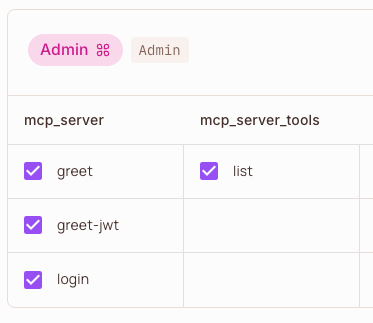
Example: In Permit.io, the 'Admin' role is granted permissions on resources and actions as mapped by the middleware. For example, 'greet', 'greet-jwt', and 'login' are actions on the 'mcp_server' resource, and 'list' is an action on the 'mcp_server_tools' resource.
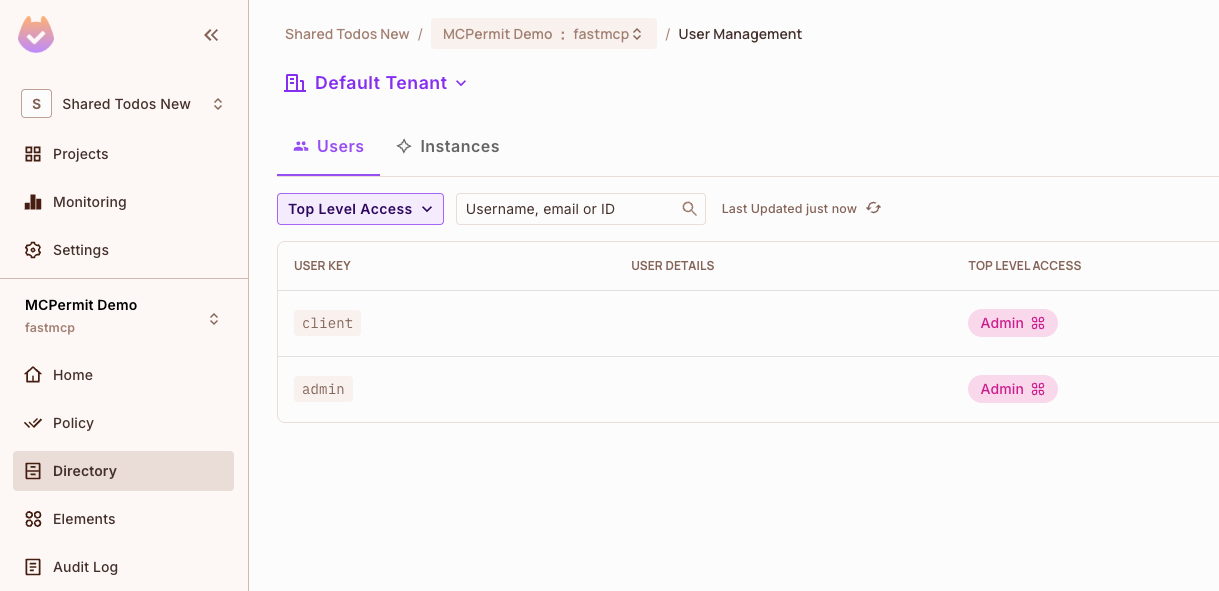
Note: Don’t forget to assign the relevant role (e.g., Admin, User) to the user authenticating to your MCP server (such as the user in the JWT) in the Permit.io Directory. Without the correct role assignment, users will not have access to the resources and actions you’ve configured in your policies.
Example: In Permit.io Directory, both 'client' and 'admin' users are assigned the 'Admin' role, granting them the permissions defined in your policy mapping.
ABAC Policies with Tool Arguments
The middleware supports Attribute-Based Access Control (ABAC) policies that can evaluate tool arguments as attributes. Tool arguments are automatically flattened as individual attributes (e.g., arg_name, arg_number) for granular policy conditions.
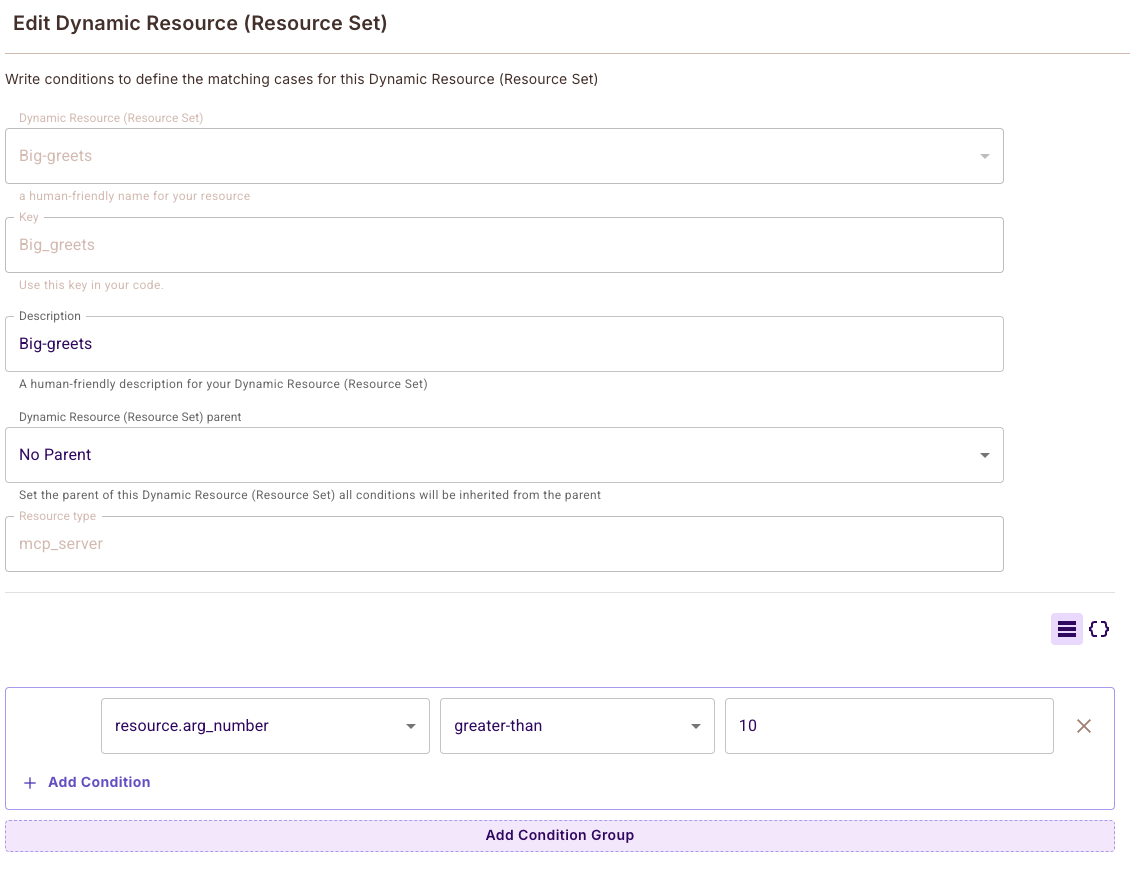
Example: Create dynamic resources with conditions like resource.arg_number greater-than 10 to allow the conditional-greet tool only when the number argument exceeds 10.
For detailed ABAC configuration and examples, see ABAC Policies with Tool Arguments.
Example: JWT Authentication
See permit_fastmcp/example_server/example.py for a full example of JWT-based authentication and usage.
More Documentation
- Advanced Configuration
- Identity Modes & Environment Variables
- Detailed Policy Mapping
- Configuration Reference
- Troubleshooting
- Getting Started & FAQ
License
This project is licensed under the Apache License 2.0. See the LICENSE file for details.
Installing Permit Fastmcp
This server has no published package — it is built from source. Open the repository and follow its README.
▸ github.com/permitio/permit-fastmcpFAQ
Is Permit Fastmcp MCP free?
Yes, Permit Fastmcp MCP is free — one-click install via Unyly at no cost.
Does Permit Fastmcp need an API key?
No, Permit Fastmcp runs without API keys or environment variables.
Is Permit Fastmcp hosted or self-hosted?
Self-hosted: the server runs locally on your machine via the install command above.
How do I install Permit Fastmcp in Claude Desktop, Claude Code or Cursor?
Open Permit Fastmcp on unyly.org, pick your client tab (Claude Desktop, Claude Code, Cursor) and press Install — the config is generated automatically, no JSON editing.
Related MCPs
GitHub
PRs, issues, code search, CI status
 by GitHub
Filesystem
Secure file operations with configurable access controls.
Memory
Knowledge graph-based persistent memory system.
Template MCP Server
A CLI tool to create a new Model Context Protocol server project with TypeScript support, dual transport options, and an extensible structure
 by mcpdotdirect
Compare Permit Fastmcp with
Not sure what to pick?
Find your stack in 60 seconds
Author?
Embed badge for your README
Browse similar
All development MCPs