
Pocketpedia
FreeNot checkedOffline English Wikipedia for local LLMs: CLI + MCP server. A 4B model with it beats a 120B model answering from memory on held-out PopQA.

About
Offline English Wikipedia for local LLMs: CLI + MCP server. A 4B model with it beats a 120B model answering from memory on held-out PopQA.
README
Offline English Wikipedia for local LLMs: a 14 GB index on your own disk, a command line tool and an MCP server. Search runs locally (re-ranking uses a local embedding model by default), so nothing leaves your machine.
A 4B model with Pocketpedia beats a 120B model answering from memory. On the same 500 held-out PopQA questions, Gemma 3 4B with Pocketpedia scored 49.6% (95% CI 45.2–54.0). GPT-OSS 120B without it scored 34.4% (30.4–38.7), even on the scoring most favourable to it.
| Model, 1,000 held-out PopQA questions | From memory | With Pocketpedia |
|---|---|---|
| Gemma 3 4B | 16.0% | 52.8% |
| Qwen 3.5 35B-A3B (≈3B active) | 30.5% | 61.3% |
| DeepSeek-flash (hosted) | 57.1% | 64.7% |
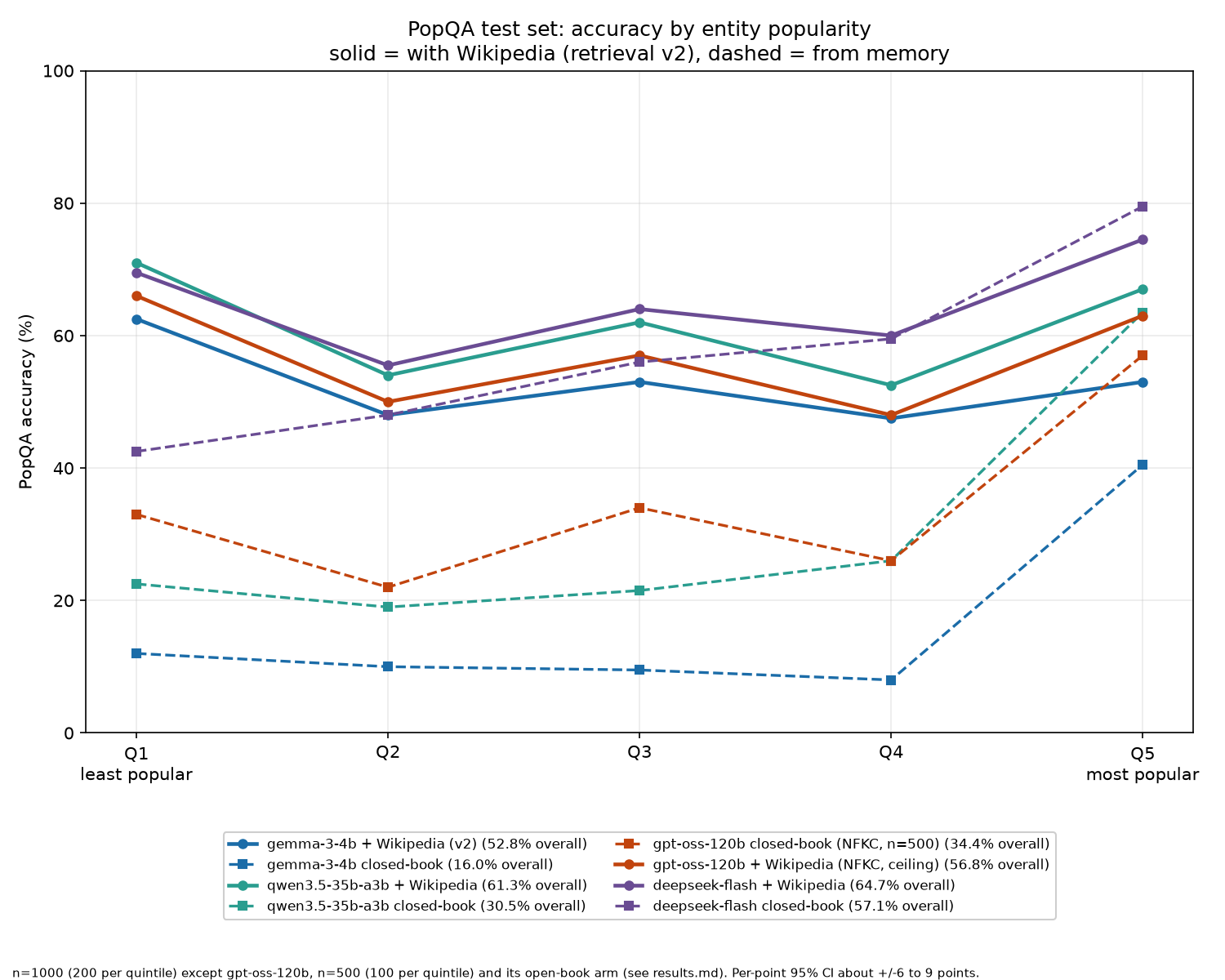
The gain is largest on obscure entities, the long tail a small model cannot memorise. On SimpleQA (300 questions), Gemma 3 4B goes from 3.3% to 40.3% correct.
How the numbers were made, and what they don't show:
- The plan and the bar for "good enough to publish" were written down before any results.
- Retrieval was tuned on 300 development questions. All headline numbers come from 1,000 different test questions (200 per popularity quintile, seed 20261031).
- A fresh clone reproduced the Gemma numbers exactly (bar check).
- GPT-OSS 120B and Qwen 3.8 27B ran on a stratified half (500 questions); the headline compares the same 500. Mistral Medium 3.5 128B could not be loaded and was not run.
- GPT-OSS often put narrow no-break spaces inside names. Its plain-match score was 19.8%; the 34.4% above is after Unicode normalisation, which was added after registration in its favour.
- PopQA is entity-centric and Wikipedia-native, close to the best case for this approach. SimpleQA was graded by a local GPT-OSS 120B with the official template, not the official grader, so it is not comparable with published SimpleQA scores.
Full tables and limitations: bench/results.md. Benchmark instructions: bench/README.md.
Quickstart
Requires Python 3.12 or later with SQLite FTS5. From a clone of this repository:
python3 -m venv .venv
. .venv/bin/activate
pip install -e '.[build]'
pocketpedia download
pocketpedia build
pocketpedia doctor
pocketpedia search "Who directed Pixels" --retrieval v1
pocketpedia read "Pixels (2010 film)" --max-chars 3000
The download is the 41 English wikimedia/wikipedia 20231101.en parquet
shards, about 11.6 GB. Building took about five minutes on the benchmark
machine; allow roughly 25 GB for the download and indexes, plus room for
caches (the benchmark directory reached about 26 GB). Build time depends on your
CPU and disk. No Wikipedia text or index is shipped with this package.
Downloads run three shards at a time. Re-running resumes .part files and skips
completed shards. Use an empty download directory when switching from the old
shell downloader, which did not distinguish partial from complete files.
build refuses to overwrite an existing index; choose a new --out to rebuild.
Data defaults to ~/.pocketpedia. --data-dir overrides $POCKETPEDIA_HOME,
which overrides that default. Options work before or after the command.
pocketpedia download --dir /path/to/parquet
pocketpedia build --parquet /path/to/parquet --out /path/to/data/index
pocketpedia search "Who directed Pixels" -k 5 --json --retrieval v1 --data-dir /path/to/data
pocketpedia doctor --data-dir /path/to/data
index/index.sqlite holds titles and leads; index/fulltext.sqlite holds
compressed full articles. Read and v1 search need no service. PyArrow is imported
only by build; pip install -e . is enough to use an existing index.
Python 3.14 uses stdlib zstd; Python 3.12–3.13 install zstandard automatically.
Retrieval
V1 is the benchmark's boosted retrieval: the longest question span matching an article title goes first, followed by SQLite FTS5 BM25 results over titles and leads. A lead is the first two nonempty paragraphs, capped at 1,500 characters. V2 adds parenthesised title candidates, uses embeddings to select five articles, splits their first 8,000 words into roughly 120–200-word passages, then reranks the top 30 BM25 passages with embeddings. The packaged v2 configuration is frozen to the benchmark.
Search defaults to v2, using an OpenAI-compatible embeddings service at
http://localhost:1234/v1 with text-embedding-nomic-embed-text-v1.5 (as served
by LM Studio in the benchmark). Override the service with --embed-url or
$POCKETPEDIA_EMBED_URL, and the model with --embed-model:
pocketpedia search "Who directed Pixels" --retrieval v2 \
  --embed-url http://localhost:1234/v1 \
  --embed-model text-embedding-nomic-embed-text-v1.5
Vectors are cached in embcache.sqlite in the data directory. Changing the
endpoint or model uses distinct cache keys. V2 sends questions and candidate
Wikipedia passages to that endpoint; use a local service to keep processing
offline. Changing models can change results, and the frozen prefixes are for
the Nomic model. If embeddings are unavailable, search warns once on stderr
and uses v1 for the rest of that command or MCP session. doctor probes the
embedding endpoint without writing a cache; an unavailable optional endpoint
does not make a healthy index fail its check.
MCP
The stdlib server uses newline-delimited JSON-RPC over stdio, protocol version
2025-06-18. Diagnostics go to stderr. It provides:
wikipedia_search(query, k=5): titled passages with v2 and the warned v1 fallback.wikipedia_read(title, max_chars=20000, offset=0): full-text paging, withtotal_charsandnext_offset. Offsets count characters;nullmeans the end.wikipedia_lookup(title): existence, canonical title and lead, case-insensitively.
Claude Code setup (activate the environment containing pocketpedia first):
claude mcp add pocketpedia -- pocketpedia mcp --data-dir "$HOME/.pocketpedia"
For a generic MCP client that accepts mcpServers configuration:
{
  "mcpServers": {
    "pocketpedia": {
      "command": "pocketpedia",
      "args": ["mcp", "--data-dir", "~/.pocketpedia"]
    }
  }
}
The client must be able to find the installed pocketpedia executable. If it
does not inherit your shell's PATH, set command to the executable in your
virtual environment. Tool failures return isError: true and leave the server running.
Limits and attribution
This is English Wikipedia from November 2023. It cannot provide current
facts, and retrieval can select the wrong entity or miss information outside
the lead or passage window. read accesses the full stored article. There is
no generative answer model in Pocketpedia; your client interprets the passages.
V2 needs an embedding endpoint on a cold cache. V1 works entirely offline.
Code is MIT licensed, copyright Jon Hammant. Wikipedia text is
downloaded by the user and is licensed separately under
CC BY-SA 4.0, with some text
also available under the GFDL; see
Wikipedia's copyright notice.
When quoting or redistributing text, credit Wikipedia and its contributors,
link the source article and licence, indicate changes, and comply with
share-alike requirements. Returned canonical titles identify the source:
for example, Pixels (2010 film) corresponds to
its Wikipedia article.
The live article may differ from the 2023 snapshot. Preserve provenance when
building answers from retrieved passages.
Development
pip install -e '.[build]'
python -m unittest discover -s tests
ruff check src tests
ruff format --check src tests
Tests build twenty invented articles in temporary directories and need no
network or LM Studio. The subprocess test exercises the installed MCP command.
An additional test compares 20 development questions with stored boosted
passages if bench/data contains the existing index
and PopQA files; it skips otherwise. The parquet build test runs when the build
extra is installed. See bench/README.md for benchmark reproduction.
Installing Pocketpedia
This server has no published package — it is built from source. Open the repository and follow its README.
▸ github.com/jhammant/pocketpediaFAQ
Is Pocketpedia MCP free?
Yes, Pocketpedia MCP is free — one-click install via Unyly at no cost.
Does Pocketpedia need an API key?
No, Pocketpedia runs without API keys or environment variables.
Is Pocketpedia hosted or self-hosted?
Self-hosted: the server runs locally on your machine via the install command above.
How do I install Pocketpedia in Claude Desktop, Claude Code or Cursor?
Open Pocketpedia on unyly.org, pick your client tab (Claude Desktop, Claude Code, Cursor) and press Install — the config is generated automatically, no JSON editing.
Related MCPs
Postgres
Query your database in natural language
 by Anthropic
wenb1n-dev/SmartDB_MCP
Connect to multiple databases at once (MySQL, PostgreSQL, SQL Server, MariaDB, Dameng, Oracle) for operations, health analysis and SQL optimization.
 by wenb1n-dev
Postgres Server
This server enables interaction with PostgreSQL databases through the Model Context Protocol, optimized for the AWS Bedrock AgentCore Runtime. It provides tools
 by madhurprash
PostgreSQL
Read-only database access with schema inspection.
by modelcontextprotocolRedis
Interact with Redis key-value stores.
by modelcontextprotocolSQLite
Database interaction and business intelligence capabilities.
by modelcontextprotocolmxcp
Open-source framework for building enterprise-grade MCP servers using just YAML, SQL, and Python, with built-in auth, monitoring, ETL and policy enforcement.
 by raw-labs
julien040/anyquery
Query apps with SQL from a single local-first binary; also connects to PostgreSQL, MySQL and SQLite-compatible databases.
 by julien040
drakonkat/wizzy-mcp-tmdb
Search and retrieve movie, TV show and person information from The Movie Database (TMDB) API.
 by drakonkat
longevity-genie/opengenes-mcp
Query the OpenGenes database for aging and longevity research.
 by longevity-genie
Compare Pocketpedia with
Not sure what to pick?
Find your stack in 60 seconds
Author?
Embed badge for your README
Browse similar
All data MCPs