
PrismAId
FreeNot checkedMCP server that enables AI assistants to drive systematic literature review workflows, including screening, downloading, converting, and reviewing papers throug

About
MCP server that enables AI assistants to drive systematic literature review workflows, including screening, downloading, converting, and reviewing papers through natural language conversation.
README
Open Science AI Tools for Systematic, Protocol-Based Literature Reviews
prismAId offers a suite of tools using generative AI models to streamline systematic reviews of scientific literature.
It provides simple-to-use, efficient, and replicable methods for screening and analyzing research papers with no coding skills required.
GitHub Release GitHub top language Go Report Card Go Reference PyPI - Version R-universe status badge
Toolkit Overview
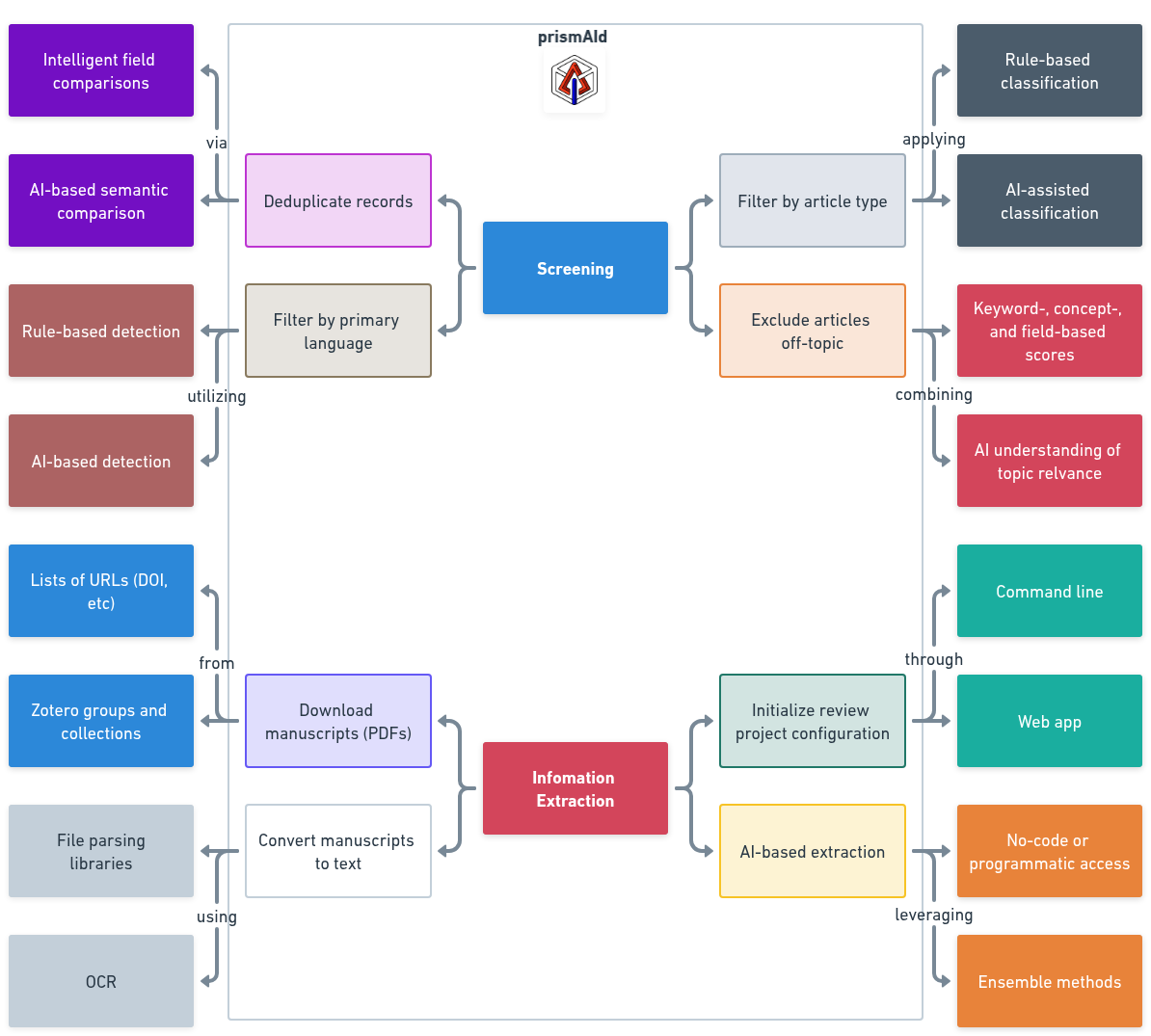
prismAId offers a comprehensive set of tools for systematic literature reviews:
Core Tools
- Screening - Filter and tag manuscripts to identify items for exclusion
- Download - Download papers from Zotero collections or from URL lists
- Convert - Convert files (PDF, DOCX, HTML) to plain text for analysis
- Review - Process systematic literature reviews based on TOML configurations
- RevAIse documentation support - Optionally document review stages as RevAIse review records
Workflow
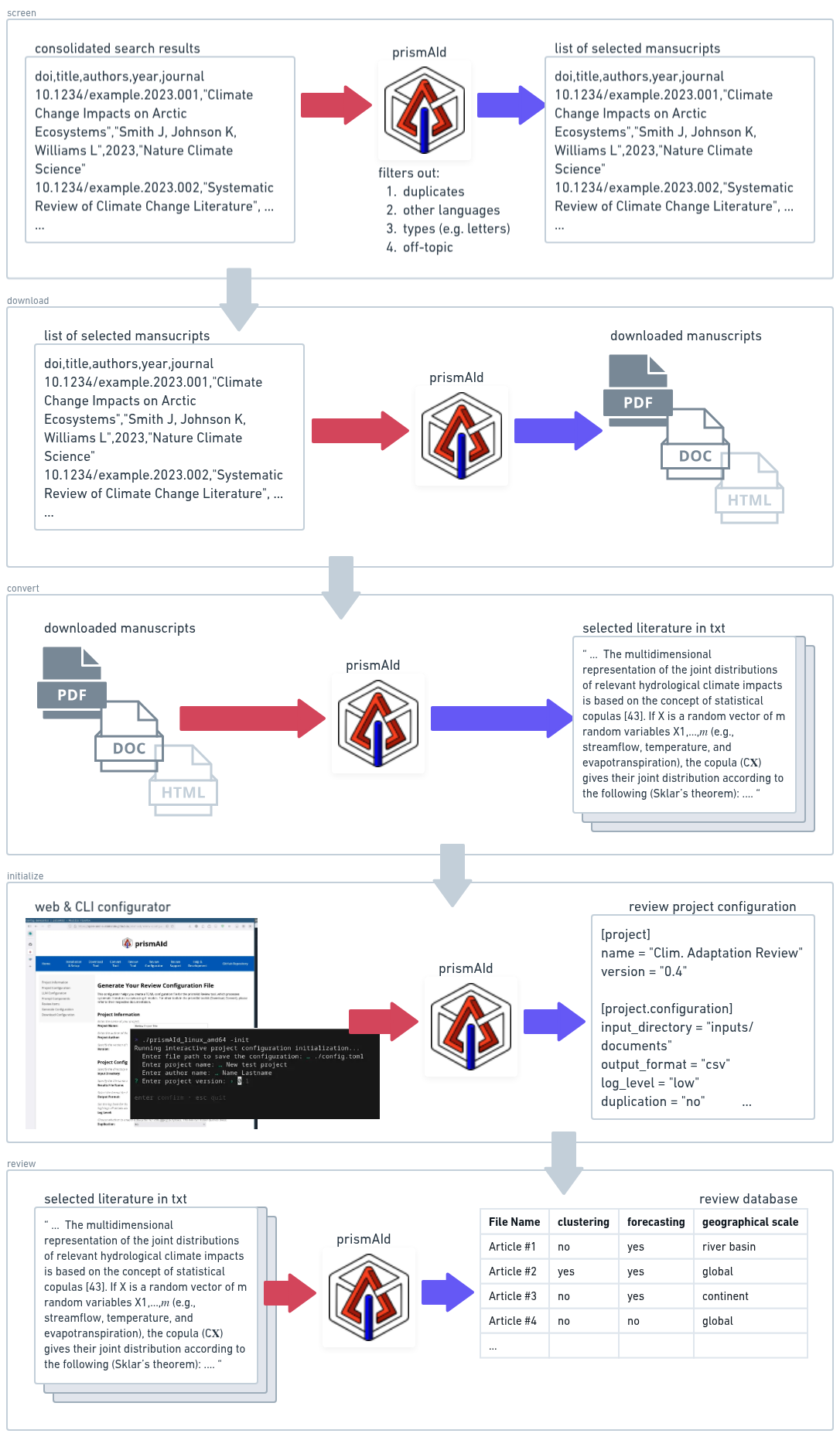
Our tools support a comprehensive systematic review workflow following the standard sequence: Search → Screen → Download → Convert → Review. RevAIse support can document Zotero download, screening, and review/extraction stages in one cumulative review record.
Access Methods
- AI agents via the MCP server - A main entry point: connect an AI assistant to the prismAId MCP server and drive every tool in conversation
- Command Line Interface - For users who prefer terminal-based workflows
- Web Initializer - A browser-based setup tool for configuring reviews
- Programming Libraries - API access through multiple languages:
- Go (native implementation)
- Python package
- R package
- Julia package
Specifications
- Review protocol: Supports any literature review protocol with a preference for PRISMA 2020, which inspired our project name.
- Review documentation: Optional RevAIse review-record support with cumulative updates and automatic backups; see the RevAIse integration guide.
- Protocol conformance: Check RevAIse review records against reporting protocols such as PRISMA 2020, and get a protocol's full requirement checklist, using the SHACL shapes published by RevAIse; see the conformance and guidance docs.
- Distribution: Available as:
- Supported LLMs:
- OpenAI: GPT-3.5 Turbo, GPT-4 Turbo, GPT-4o, GPT-4o Mini, GPT-4.1, GPT-4.1 Mini, GPT-4.1 Nano, GPT-5, GPT-5.1, GPT-5.2, GPT-5 Mini, GPT-5 Nano, o1, o1 Mini, o3, o3 Mini, and o4 Mini
- GoogleAI: Gemini 1.5 Pro, Gemini 1.5 Flash, Gemini 2.0 Flash, Gemini 2.0 Flash Lite, Gemini 2.5 Pro, Gemini 2.5 Flash, Gemini 2.5 Flash Lite, Gemini 3 Pro Preview, and Gemini 3 Flash Preview
- Cohere: Command, Command Light, Command R, Command R+, Command R7B, Command R (August 2024), Command A, and Command A Reasoning
- Anthropic: Claude 3 Sonnet, Claude 3 Opus, Claude 3 Haiku, Claude 3.5 Haiku, Claude 3.5 Sonnet, Claude 3.7 Sonnet, Claude 4.0 Sonnet, Claude 4.0 Opus, Claude 4.5 Opus, Claude 4.5 Sonnet, and Claude 4.5 Haiku
- DeepSeek: DeepSeek Chat v3, and DeepSeek Reasoner v3
- Perplexity: Sonar, Sonar Pro, Sonar Reasoning Pro, and Sonar Deep Research
- Cloud Providers: AWS Bedrock, Azure AI, Vertex AI
- Self-Hosted: OpenAI-compatible endpoints
- Screening capabilities: Deduplication, language filtering, article type classification, and off-topic detection
- Output format: Data in CSV or JSON formats
- Performance: Efficiently processes extensive datasets with minimal setup and no coding required
- Programming Language: Core implementation in Go with bindings for Python, R, and Julia
Documentation
All information on installation, usage, and development is available at prismaid.review and in the prismAId User Manual.
Credits
Authors
Riccardo Boero - [email protected]
Acknowledgments
This project was initiated with the generous support of a SIS internal project from NILU. Their support was crucial in starting this research and development effort. Further, acknowledgment is due for the research credits received from the OpenAI Researcher Access Program and the Cohere For AI Research Grant Program, both of which have significantly contributed to the advancement of this work.
License
GNU AFFERO GENERAL PUBLIC LICENSE, Version 3
Contributing
Contributions are welcome! Please follow guidelines at https://github.com/open-and-sustainable/prismaid?tab=contributing-ov-file.
Citation
Boero, R. (2024). prismAId - Open Science AI Tools for Systematic, Protocol-Based Literature Reviews. Zenodo. DOI: 10.5281/zenodo.11210796
Installing PrismAId
This server has no published package — it is built from source. Open the repository and follow its README.
▸ github.com/open-and-sustainable/prismaidFAQ
Is PrismAId MCP free?
Yes, PrismAId MCP is free — one-click install via Unyly at no cost.
Does PrismAId need an API key?
No, PrismAId runs without API keys or environment variables.
Is PrismAId hosted or self-hosted?
Self-hosted: the server runs locally on your machine via the install command above.
How do I install PrismAId in Claude Desktop, Claude Code or Cursor?
Open PrismAId on unyly.org, pick your client tab (Claude Desktop, Claude Code, Cursor) and press Install — the config is generated automatically, no JSON editing.
Related MCPs
Notion
Read and write pages in your workspace
 by Notion
Linear
Issues, cycles, triage — from Claude
 by Linear
Google Drive
Search and read your Drive files
 by Google
mindsdb/mindsdb
Connect and unify data across various platforms and databases with [MindsDB as a single MCP server](https://docs.mindsdb.com/mcp/overview).
 by mindsdb
Compare PrismAId with
Not sure what to pick?
Find your stack in 60 seconds
Author?
Embed badge for your README
Browse similar
All productivity MCPs