
Ratebook
FreeNot checkedProvides electricity tariff queries and rate calculations for US utilities, enabling cost estimation and optimal charging schedules.

About
Provides electricity tariff queries and rate calculations for US utilities, enabling cost estimation and optimal charging schedules.
README
The open rate engine for the electrified home — an openly licensed database of US electricity tariffs, an open-source rate-calculation engine, and an MCP server, so any app, device, or agent can answer "what will this kWh cost me, and when should I charge?"
License: Apache-2.0 Data: CC0-1.0 Python 3.12+ CI
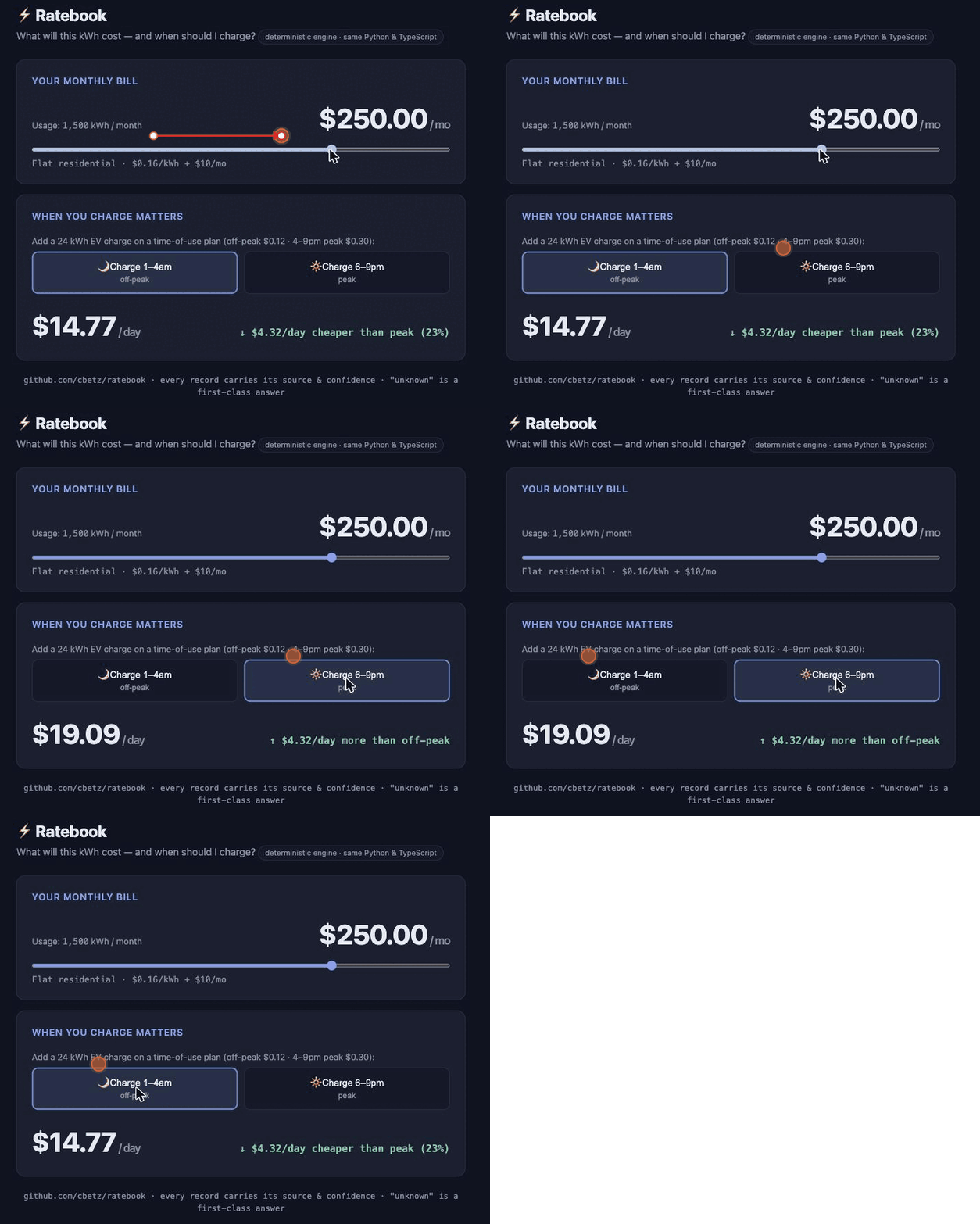
↑ The real engine running in the browser. Try it yourself: demo/demo.html.
Status: pre-release. What works today: a deterministic rate engine (Python + a TypeScript port held to it byte-for-byte), cross-validated against NREL's PySAM and shown to reproduce a real bill's total once its components are supplied; an LLM pipeline that extracts tariff structure from utility PDFs; an MCP server; and a Home Assistant integration. What's still in progress: broad utility coverage, freshness automation, and a reproducible public accuracy scorecard. See docs/ROADMAP.md.
Quickstart
The engine has no I/O and no required data download — price a tariff in a few lines:
git clone https://github.com/cbetz/ratebook && cd ratebook
uv sync
uv run python quickstart.py   # or paste the snippet below into `uv run python`
from datetime import date
from decimal import Decimal
from ratebook import (
    Tariff, TariffIdentity, Sector, EnergyRateStructure, EnergyPeriod, EnergyTier,
    Schedule, FixedCharge, FixedChargeUnit, Usage, BillingWindow, estimate_bill,
)

# A flat residential tariff: $0.10276/kWh + $11.30/month (PECO Rate R distribution).
no_tou = tuple(tuple(0 for _ in range(24)) for _ in range(12))  # 12 months × 24 hours, one period
tariff = Tariff(
    energy=EnergyRateStructure(periods=(EnergyPeriod(tiers=(EnergyTier(rate=Decimal("0.10276")),)),)),
    schedule=Schedule(weekday=no_tou, weekend=no_tou),
    identity=TariffIdentity(plan_code="R", plan_name="Example flat residential", sector=Sector.RESIDENTIAL),
    fixed_charges=(FixedCharge(Decimal("11.30"), FixedChargeUnit.PER_MONTH),),
)

bill = estimate_bill(tariff, Usage.aggregate(1244), BillingWindow(date(2026, 4, 28), 30))
print(f"ok={bill.ok}  total=${bill.total}")   # ok=True  total=$139.13344  →  1244 kWh × $0.10276 + $11.30
Real tariffs round-trip through JSON via Tariff.from_json(...). To work with corpus data, load
the URDB seed set (uv run ratebook-data urdb) or run the MCP server (uv run ratebook-mcp) and
ask an agent lookup_tariff / estimate_bill / compare_plans / best_charge_window.
Development
Python 3.12+, uv workspace with these packages:
packages/ratebook (rate engine), packages/ratebook-data (data plant),
packages/ratebook-mcp (MCP server), packages/ratebook-ts (the TypeScript engine port —
pnpm + vitest, held to the Python engine via shared JSON test vectors), and
packages/ratebook-homeassistant (a Home Assistant custom integration: electricity-price +
cheapest-charge-window sensors).
uv sync                            # install all workspace packages + dev tools
uv run pytest                      # Python tests
uv run ruff check .                # lint
uv run ratebook-data urdb          # download URDB bulk CSV → data/raw/, load into data/ratebook.duckdb
uv run ratebook-mcp                # run the MCP server (stdio)

pnpm -C packages/ratebook-ts install && pnpm -C packages/ratebook-ts test   # TS engine + vectors
The PySAM cross-validation runs in CI against committed tariff fixtures (uv sync --group validation installs the oracle). The MCP tool tests additionally need the built corpus and run
locally (uv run ratebook-data urdb); they skip otherwise. The two engines must never
diverge: both reproduce packages/ratebook/tests/vectors/v0_bills.json byte-for-byte. Regenerate
it with uv run python packages/ratebook/tests/generate_vectors.py.
See CONTRIBUTING.md — the highest-value contribution is a tariff correction (report a wrong or stale rate with its source PDF).
License
Code is licensed under Apache-2.0. Published datasets are dedicated to the public domain under CC0-1.0. The seed corpus derives from the U.S. Utility Rate Database (CC0).
Installing Ratebook
This server has no published package — it is built from source. Open the repository and follow its README.
▸ github.com/cbetz/ratebookFAQ
Is Ratebook MCP free?
Yes, Ratebook MCP is free — one-click install via Unyly at no cost.
Does Ratebook need an API key?
No, Ratebook runs without API keys or environment variables.
Is Ratebook hosted or self-hosted?
Self-hosted: the server runs locally on your machine via the install command above.
How do I install Ratebook in Claude Desktop, Claude Code or Cursor?
Open Ratebook on unyly.org, pick your client tab (Claude Desktop, Claude Code, Cursor) and press Install — the config is generated automatically, no JSON editing.
Related MCPs
GitHub
PRs, issues, code search, CI status
 by GitHub
Filesystem
Secure file operations with configurable access controls.
Memory
Knowledge graph-based persistent memory system.
Template MCP Server
A CLI tool to create a new Model Context Protocol server project with TypeScript support, dual transport options, and an extensible structure
 by mcpdotdirect
Compare Ratebook with
Not sure what to pick?
Find your stack in 60 seconds
Author?
Embed badge for your README
Browse similar
All development MCPs