
Satori
FreeNot checkedA self-learning MCP server for Claude Code that captures user corrections and tool failures, distills them into skill drafts, and activates them only after huma

About
A self-learning MCP server for Claude Code that captures user corrections and tool failures, distills them into skill drafts, and activates them only after human approval.
README
satori
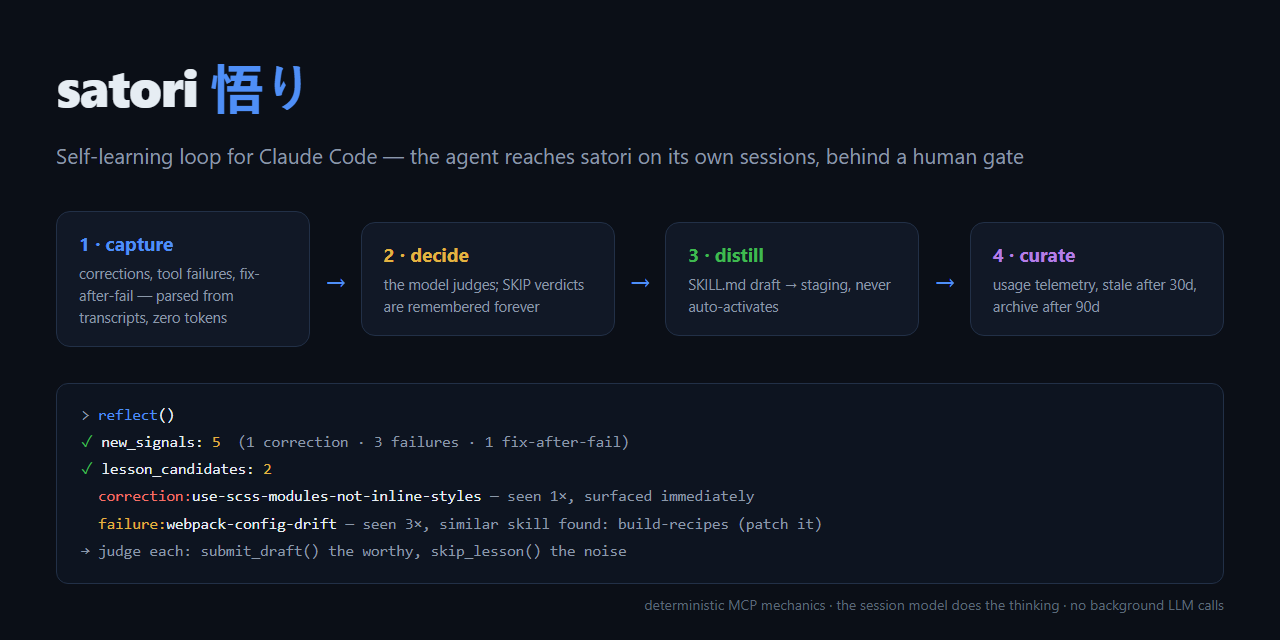
A self-learning loop for Claude Code — the model learns skills from its own sessions. Fully automatic, fully visible, fully reversible.
Status License Stars Last Commit
⚠️ Beta disclaimer
This is beta software I build for myself and share with the community as-is. It parses your session transcripts, stores lesson data locally and — by default, automatically — activates skills that will instruct your future Claude sessions. Every activation is announced in chat (⛩) and reversible in one call (
retire_skill), but do readserver.pyand watch what your agent learns. It works on my setup; I can't guarantee yours and take no responsibility for the skills your agent teaches itself. Want to pre-approve everything instead?SATORI_AUTO_APPROVE=0.
satori is an MCP server + hooks that give Claude Code a closed self-learning loop: user corrections and tool failures become lesson candidates, lessons become skill drafts, drafts become active skills — automatically, visibly, reversibly. Windows-native, works in Claude Desktop, zero bash wrappers.
Two principles you won't find together elsewhere: the server does only deterministic mechanics (parsing, counters, storage, validation) — the thinking is done by the calling model right in the session, no background LLM calls, no extra bills; and fully automatic, fully visible, fully reversible — validated drafts activate on their own, every loop event is announced in chat with a ⛩ marker, and retire_skill undoes any activation in one call (prefer a manual approval gate instead? SATORI_AUTO_APPROVE=0).
Features
- 4-stage loop — capture → decide → distill → curate;
reflect()is called several times per session - User correction = signal #1 — surfaces as a candidate after a single occurrence (Devin's mechanic); tool failures wait for recurrence
- Patch-not-append — a recurring signal bumps
seen_countinstead of piling up rows - SKIP gate, forever — "not skill-worthy" verdicts are remembered; rejected noise never comes back
- Fully automatic — a validated draft activates immediately (backup of anything it overwrites,
retire_skill= one-call undo);SATORI_AUTO_APPROVE=0switches to a manual staging gate - The trigger is sacred —
description: Use when ...is mandatory: recall works when a note says when to recall it, not what it does - pinned_project — a lesson is global or pinned to one project; approve routes it to the right skills folder
- Draft validation — frontmatter, size, secrets (also redacted at rest), prompt-injection markers (EN+RU)
- FTS5 search over past sessions — "when did I fix exactly this error" finds the actual transcript
- Curator — usage telemetry; unused drafts go stale in 30 days, archived in 90
- Smart nudge hooks — silent by default; they speak only on a correction (instantly) or accumulated work; a declined nudge stays declined
- Visible audit trail — every loop event surfaces in chat as a ⛩ marker line: what fired, why, what was staged or skipped
- dream/wake integration — the dream-skill consolidation pass harvests satori's staging and promotes/retires drafts through its validator gate
Quick Start
Easiest — let Claude install it. Paste this message into Claude Code:
Install the satori self-learning loop from https://github.com/timoncool/satori:
1) clone the repo to a permanent location (not a temp dir — the MCP runs from it);
2) create a venv inside it and install the single dependency: fastmcp;
3) register the MCP in my .mcp.json (project or global) as "satori" with
   command = absolute path to the venv python and args = [absolute path to server.py];
4) recommended: add the three nudge hooks (UserPromptSubmit / Stop / SessionEnd,
   all calling hooks/nudge.py with the venv python — exact JSON is in the README
   "Quick Start" step 3) into ~/.claude/settings.json, PRESERVING my existing hooks;
5) smoke-test: import server in the venv and show me what got configured;
then remind me to restart Claude Code / Desktop so the MCP and hooks load.
That's it — Claude clones, wires configs, verifies and reports. Manual way:
Clone & install the one dependency
git clone https://github.com/timoncool/satori.git
cd satori && python -m venv .venv && .venv\Scripts\pip install fastmcp
Register the MCP — in your project's
.mcp.json(or global config):"satori": { "command": "<path>\\satori\\.venv\\Scripts\\python.exe", "args": ["<path>\\satori\\server.py"] }(Optional) nudge hooks — three hooks onto one script in
~/.claude/settings.json:"UserPromptSubmit": [{"matcher": "", "hooks": [{"type": "command", "command": "<venv-python> <path>/hooks/nudge.py prompt-submit", "timeout": 10}]}], "Stop": [{"matcher": "", "hooks": [{"type": "command", "command": "<venv-python> <path>/hooks/nudge.py stop", "timeout": 10}]}], "SessionEnd": [{"matcher": "", "hooks": [{"type": "command", "command": "<venv-python> <path>/hooks/nudge.py session-end", "timeout": 60}]}]Restart Claude Code / Desktop.
How it works
session transcript
      │  (hook/tool call — parsing costs 0 tokens)
      ▼
① capture   reflect() reads what's new since the stored offset: corrections,
            failures, fix-after-fail, complex segments (≥12 calls + ≥2 edits)
      ▼
② decide    the model judges candidates (corrections after 1×, the rest after 2×):
            noise → skip_lesson (forever), worthy → a draft
      ▼
③ distill   submit_draft → validated, provenance-stamped, staged AND auto-activated
            into ~/.claude/skills/ (or the pinned project). ⛩ announced in chat;
            retire_skill = one-call undo. Manual gate: SATORI_AUTO_APPROVE=0
      ▼
④ curate    usage telemetry, stale at 30d, archive at 90d
Hooks (all optional, all silent by default): UserPromptSubmit — on a correction injects one line "fix it, then reflect" (series-deduplicated); on ≥25 accumulated tool calls — same, and repeats only after the next full threshold; Stop — same threshold at turn end; SessionEnd — silent capture directly in Python, no model involved at all. When a nudge does fire, the model opens its reply with a visible ⛩ satori: ... marker and reports what was recorded — you always see the loop working.
Anti-pollution by construction: the loop never writes into Claude's memory (only its own SQLite + staging); context injections are one line and only when warranted; an ignored nudge doesn't nag.
Tools
| Tool | What it does |
|---|---|
reflect(transcript_path?) |
stages 1+2+4: signals since offset, aggregation, candidates + similar existing skills, curator tick |
skip_lesson(key, reason) |
permanent SKIP |
submit_draft(name, markdown, lesson_key?, patches?, pinned_project?) |
draft into staging with full validation |
retire_skill(name) |
one-call undo: live skill + staging copy → archive, pre-activation backup restored |
approve_draft(name, dest_dir?) |
manual-mode gate (SATORI_AUTO_APPROVE=0): staging → active skills |
session_search(query, limit?) |
FTS5 over all past transcripts |
loop_status() |
loop telemetry |
Configuration (env)
| Variable | Default | Meaning |
|---|---|---|
SATORI_AUTO_APPROVE |
1 | fully automatic activation; 0 = manual staging gate |
SN_PROMOTE_AT |
2 | recurrences before a candidate (except corrections) |
SN_CORRECTION_PROMOTE_AT |
1 | user corrections surface immediately |
SN_SEGMENT_TOOL_CALLS / SN_SEGMENT_FILE_EDITS |
12 / 2 | "complex segment" threshold |
SN_STALE_DAYS / SN_ARCHIVE_DAYS |
30 / 90 | draft aging |
SN_NUDGE_MIN_CALLS |
25 | accumulated work before a nudge |
SN_NUDGE_COOLDOWN_MIN / SN_CORR_COOLDOWN_MIN |
10 / 3 | nudge cooldowns |
SN_STOP_NUDGE |
1 | Stop-hook nudge (0 = off) |
Works best with dream-skill
dream-skill is this project's sibling — memory consolidation for Claude Code (dream = read-only pass, wake = gated apply, full rollback). satori handles procedural memory (skills), dream/wake handles factual memory (notes, rules, index) — and they meet in the middle:
- satori runs fully automatic inside sessions; dream is the periodic auditor: its Skill harvest phase reads satori's staging + usage telemetry and proposes
retire_skillfor stale/duplicate self-taught skills (andpromote_skillif you run satori in manual mode) - dream's validator re-checks every self-taught skill against a hard checklist:
Use whentrigger, no injection markers, no duplicates - wake applies the audit, logs everything, and its
rollbackrestores skills too
Each works standalone; together the cycle is complete: сон → пробуждение → прозрение (dream → wake → satori).
Standing on shoulders
An honest list of sources: Hermes Agent (Nous) — the 4-stage cycle, FTS5, periodic self-reflection; claude-self-improving-skills — complexity thresholds, patch-over-create, curator, telemetry, "declined stays declined"; claude-evolve — objective signals, patch-not-append; claude-harness-hermes — permanent SKIP, redaction at rest; Devin (Cognition) — corrections at threshold 1, the trigger as a sacred field, pinned scoping, injection scanning; dream-skill (ours) — the staging gate.
Other Projects by @timoncool
| Project | Description |
|---|---|
| dream-skill | Memory consolidation for Claude Code — dream/wake with a gate |
| trail-spec | TRAIL — cross-MCP content tracking protocol |
| telegram-api-mcp | Full Telegram Bot API as MCP server |
| civitai-mcp-ultimate | Civitai API as MCP server |
| GitLife | Your life in weeks — interactive calendar |
Authors
- Nerual Dreming — Telegram | neuro-cartel.com | ArtGeneration.me
Support the Author
I build open-source software and do AI research. Most of what I create is free and available to everyone. Your donations help me keep creating without worrying about where the next meal comes from =)
All donation methods | dalink.to/nerual_dreming | boosty.to/neuro_art
- BTC:
1E7dHL22RpyhJGVpcvKdbyZgksSYkYeEBC - ETH (ERC20):
0xb5db65adf478983186d4897ba92fe2c25c594a0c - USDT (TRC20):
TQST9Lp2TjK6FiVkn4fwfGUee7NmkxEE7C
Star History

License
Installing Satori
This server has no published package — it is built from source. Open the repository and follow its README.
▸ github.com/timoncool/satoriFAQ
Is Satori MCP free?
Yes, Satori MCP is free — one-click install via Unyly at no cost.
Does Satori need an API key?
No, Satori runs without API keys or environment variables.
Is Satori hosted or self-hosted?
Self-hosted: the server runs locally on your machine via the install command above.
How do I install Satori in Claude Desktop, Claude Code or Cursor?
Open Satori on unyly.org, pick your client tab (Claude Desktop, Claude Code, Cursor) and press Install — the config is generated automatically, no JSON editing.
Related MCPs
GitHub
PRs, issues, code search, CI status
 by GitHub
Filesystem
Secure file operations with configurable access controls.
Memory
Knowledge graph-based persistent memory system.
Template MCP Server
A CLI tool to create a new Model Context Protocol server project with TypeScript support, dual transport options, and an extensible structure
 by mcpdotdirect
Amap Maps Mcp Server
MCP server for using the AMap Maps API
 by duxiaohui
Supabase
Database, auth and storage
 by Supabase
Everything
Reference / test server with prompts, resources, and tools.
Git
Tools to read, search, and manipulate Git repositories.
Sequential Thinking
Dynamic and reflective problem-solving through thought sequences.
Time
Time and timezone conversion capabilities.
Compare Satori with
Not sure what to pick?
Find your stack in 60 seconds
Author?
Embed badge for your README
Browse similar
All development MCPs