
Scpi
FreeNot checkedThe Python-powered SCPI/VISA hardware instrument interface for the Model Context Protocol.

About
The Python-powered SCPI/VISA hardware instrument interface for the Model Context Protocol.
README
LabLink gives agents a SCPI wire; scpi-mcp gives agents oscilloscope expertise.
scpi-mcp is a Model Context Protocol server
that lets an agent operate an oscilloscope — not just push SCPI strings at one.
It exposes goal-level tools (capture this signal, measure that, characterize a
channel) backed by a clean, instrument-agnostic interface. All vendor SCPI lives
in the underlying instrument library; the MCP layer stays a thin, uniform wrapper
with no raw-SCPI escape hatch.
.-"""-.
/ .===. \ Skippi 🧚♂️
\/ 6 6 \/ the artistic scope gremlin
( \___/ ) "every waveform is a portrait of the magic pixies"
___ooo___ooo___
Skippi is the mascot — the artistic gremlin who lives in the scope and paints pictures of the magic pixies (the ones who carry every electron down the probe). When you see a clean trace, that's Skippi's latest masterpiece.
Scope
First instrument: Rigol DS1054Z (unlocked to DS1104Z base) — 4 analog
channels, 100 MHz. No :SOURce (function generator) or :LA (logic analyzer)
support. Reachable over USB or LAN (TCPIP::<ip>::INSTR).
Architecture
transport/— owns discovery. Enumerates USB, falls back to best-effort LAN auto-discovery, then to an IP prompt; resolves a single VISA resource string and hands it to the instrument layer. Discovery never leaks upward.instruments/— vendor-specific backends behind one abstractbase.pyinterface.rigol_ds1000z.pyis a thin wrapper over the (complete) library;mock.pyimplements the same interface with zero hardware. Adding an instrument is one new file here and zero changes totools/.tools/— instrument-agnostic MCP tools that call onlybase.py.config.py— permission tiers (read_only/read_config/full), enforced at the tool layer. The server refuses; the model never decides.
Status
Live hardware, active bench use. The Rigol DS1054Z is connected and scpi-mcp is driving real measurements — see Skippi in the Wild for captures. The mock backend remains available for development and CI.
Quickstart
uv sync
uv run pytest          # all green against the mock, zero hardware
uv run scpi-mcp        # start the MCP server (mock backend by default)
Skippi in the Wild
Real captures from the bench, analyzed live via scpi-mcp.
Power-off — relay coil with freewheel diode
The setup: A 24 V relay coil (with freewheel diode installed) powered from a bench supply. Probed at the moment of power-off to observe inductive kickback. CH1 watches the supply rail; CH2 sits across the freewheel diode.
Prompts used:
Grab the scope screen.
What are the min and max voltages on each channel?
Is that spike on CH2 actually 60 V, or is the scale messing with me?
scpi-mcp called capture_screen and measure_snapshot, then explained the
visual illusion: CH2 is set to 1 V/div, so its 5.36 V kickback spike fills
5+ of the 8 vertical divisions and looks enormous. CH1 is at 8 V/div, so
the 24 V rail only occupies ~3 divisions despite being far larger in absolute
terms. No 60 V spike — the freewheel diode clamped it cleanly to
V_supply + V_f ≈ 24.7 V, right where it should be.
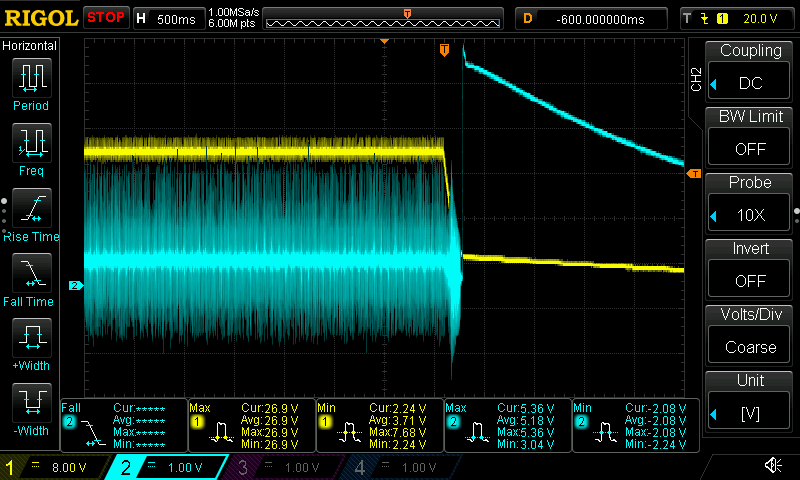
500 ms/div (5 s full sweep). CH1 yellow, 8 V/div: 24 V supply decaying from 26.9 V → 2.24 V. CH2 cyan, 1 V/div: freewheel diode kickback, max 5.36 V, min −2.08 V.
Power-off — bare coil, no freewheel diode
The setup: The same 24 V relay coil, but with the freewheel diode removed — a bare inductor. Powered from a bench supply (100 nF across the rail to tame switch-mode ripple). Two 10x probes straddle the disconnect on the high side: CH1 on the supply side, CH2 on the coil side. Power is cut by pulling the + lead, and a single-shot trigger catches the unclamped kickback.
Prompts used:
Prime the scope for a single-shot on CH2 falling — I'll pull the + lead.
We didn't clear the clipping — reset V/div on CH2 and re-arm for another one-shot.
Got it — grab the screencap and give me the true peak.
scpi-mcp armed a single-shot falling-edge trigger on CH2, watched the trigger status, and grabbed the screen plus both channel waveforms the instant it fired. This time the scale fought back the other way: the kick kept overflowing the window — it railed at ±130 V, then again at −304 V — so scpi-mcp stepped CH2 coarser to 100 V/div until the whole transient fit. With no freewheel diode to absorb it, the collapsing field threw a −436 V spike with a +240 V overshoot — a ~676 Vpp ring, roughly 18x the 24 V rail — then bled off exponentially back toward the rail over ~1 ms. Compare the clamped case above, where the diode held the same coil to ≈24.7 V.

200 µs/div. CH1 yellow, 20 V/div: supply side holds ~24 V with a small coupled ring at the break. CH2 cyan, 100 V/div: bare-coil kickback — peak −436 V, +240 V overshoot (~676 Vpp), then exponential bleed-back. No freewheel diode; contrast the ≈24.7 V clamped result above.
License
MIT
Installing Scpi
This server has no published package — it is built from source. Open the repository and follow its README.
▸ github.com/armchairdeity/mcp-server-scpiFAQ
Is Scpi MCP free?
Yes, Scpi MCP is free — one-click install via Unyly at no cost.
Does Scpi need an API key?
No, Scpi runs without API keys or environment variables.
Is Scpi hosted or self-hosted?
Self-hosted: the server runs locally on your machine via the install command above.
How do I install Scpi in Claude Desktop, Claude Code or Cursor?
Open Scpi on unyly.org, pick your client tab (Claude Desktop, Claude Code, Cursor) and press Install — the config is generated automatically, no JSON editing.
Related MCPs
GitHub
PRs, issues, code search, CI status
 by GitHub
Filesystem
Secure file operations with configurable access controls.
Memory
Knowledge graph-based persistent memory system.
Template MCP Server
A CLI tool to create a new Model Context Protocol server project with TypeScript support, dual transport options, and an extensible structure
 by mcpdotdirect
Compare Scpi with
Not sure what to pick?
Find your stack in 60 seconds
Author?
Embed badge for your README
Browse similar
All development MCPs