loading…
en/
Browse all
sifter-ai/sifter
FreeStructure any document, query it like a database. Open-source extraction engine that turns any document into typed, schema-defined records, queryable in natural
About
Structure any document, query it like a database. Open-source extraction engine that turns any document into typed, schema-defined records, queryable in natural language from Claude, ChatGPT, Gemini, or any MCP client.
README
CI codecov PyPI npm Python Node License: MIT
Your documents are a dark database.
Open-source document intelligence engine — schema-driven extraction, NL query, MCP server, Python and TypeScript SDKs. Self-hostable under MIT.
Why not RAG?
RAG is built for retrieval — find me chunks similar to this query. It breaks on homogeneous collections like invoices, contracts, or receipts where every document looks alike and the question is an aggregation, not a search.
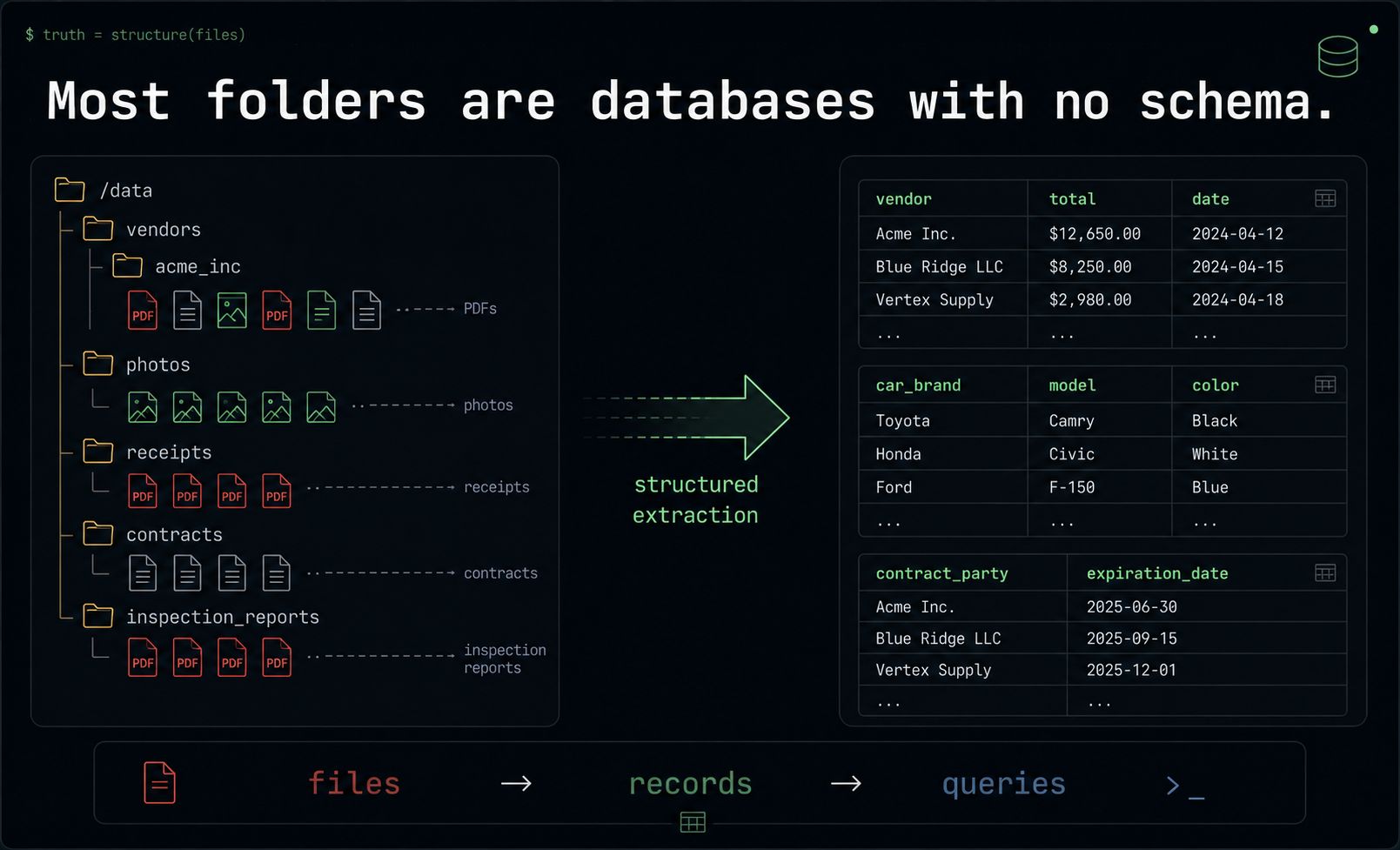
Sifter's approach: extract structured fields once (client, date, total), store them as typed records, query with real filters and aggregations. The answer is exact and reproducible — because it's a database query, not a similarity search.
Quickstart
git clone https://github.com/sifter-ai/sifter
cd sifter/code
cp server/.env.example server/.env.local    # set SIFTER_DEFAULT_API_KEY (required)
docker compose up -d
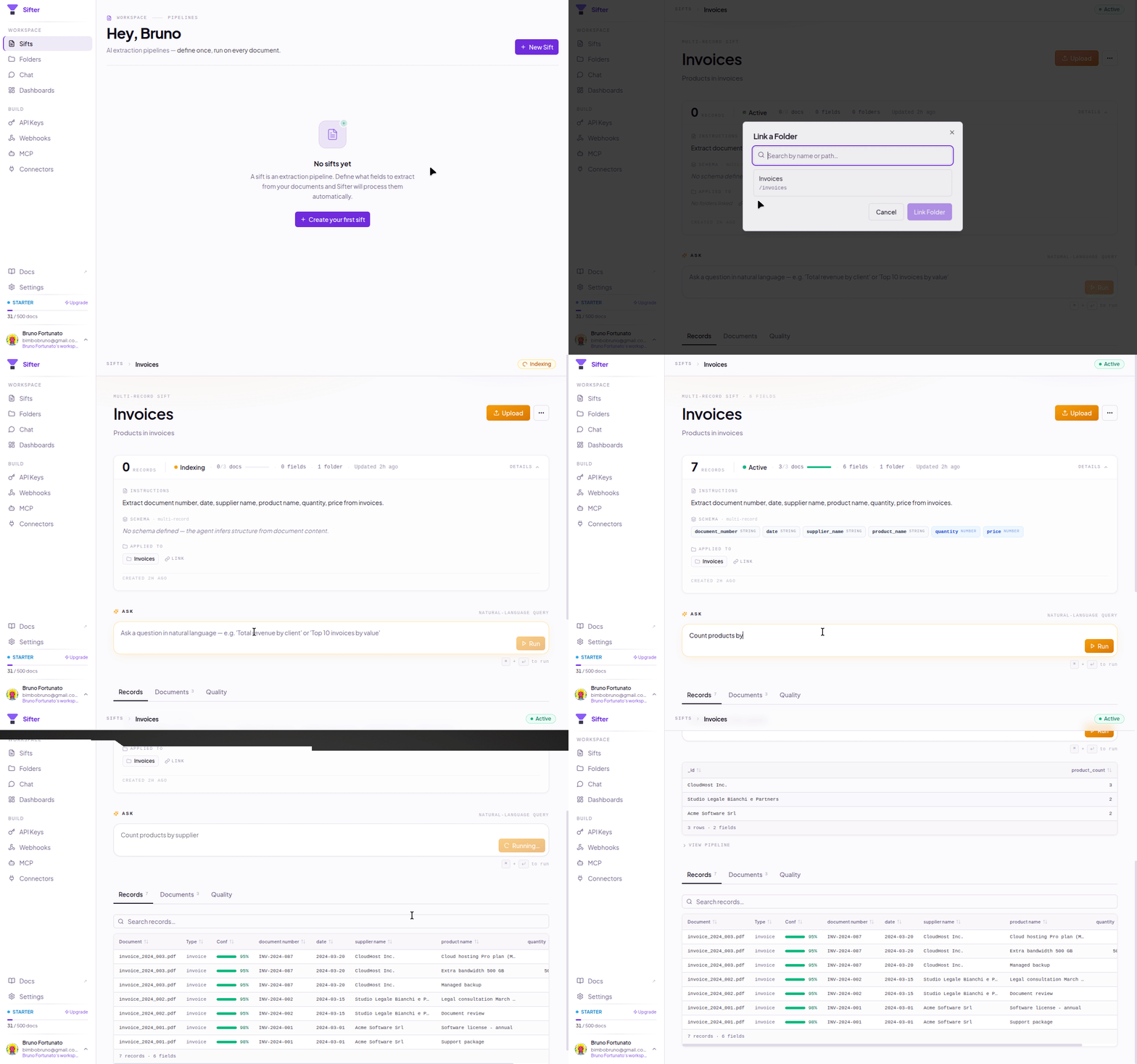
Open http://localhost:3000 — create a sift, upload documents, query results.
Python SDK
pip install sifter-ai
from sifter import Sifter

s = Sifter(api_key="sk-...")

sift = s.create_sift("Invoices", "client name, date, total amount")
sift.upload("./invoices/")
sift.wait()

for record in sift.records():
    print(record["extracted_data"])
# {"client": "Acme Corp", "date": "2024-01-15", "total_amount": 1500.0}
TypeScript SDK
npm install @sifter-ai/sdk
import { Sifter } from "@sifter-ai/sdk";

const client = new Sifter({ apiKey: "sk-..." });

const sift = await client.createSift("Invoices", "client, date, total amount");
await sift.upload("./invoices/");
await sift.wait();

const records = await sift.records();
console.log(records);
MCP server (Claude Desktop / Cursor / AI agents)
{
  "mcpServers": {
    "sifter": {
      "command": "uvx",
      "args": ["sifter-mcp", "--base-url", "http://localhost:8000"],
      "env": { "SIFTER_API_KEY": "sk-dev" }
    }
  }
}
Then ask:
"What's the total unpaid across all invoices from last quarter?" "Show me all contracts expiring in the next 90 days." "Which candidates have Python and more than 5 years experience?"
Sifter answers with structured data — exact counts, sums, filtered rows. Not a text blob.
Want a remote MCP URL without running a local server? → Sifter Cloud
Dashboard
Sifter includes a built-in dashboard — no Metabase, no Grafana, no SQL required.
Describe what you want to see in plain language:
sift = client.sifts.get("invoices")
sift.create_dashboard("Show total invoiced and unpaid by vendor, monthly trend")
Produces KPI tiles, breakdowns, and time-series — updated automatically on every extraction.
What's included
- Schema-driven extraction — describe what to extract in natural language; schema is inferred automatically and exported as Pydantic / TypeScript types
- NL query — ask questions in plain language; Sifter generates inspectable MongoDB aggregation pipelines
- MCP server — stdio transport, read + write tools, zero custom integration code
- REST API + SDKs — full OpenAPI spec, typed clients for Python and TypeScript
- Webhooks — HMAC-signed HTTP callbacks on every extraction event
- Spec-driven dashboards — short NL spec → auto-generated board (KPI, breakdown, table, time series)
- CLI —
sifter extract,sifter records,sifter siftsfor terminal workflows and CI - Self-hostable — Docker Compose, bring your own MongoDB and LLM API key
Don't want to run infrastructure?
Sifter Cloud is the managed version — no Mongo, no ops, remote MCP endpoint, Google Drive and email ingress. Free tier available.
Docs
Full documentation at docs.sifter.run — quickstart, SDK reference, MCP guide, cookbook, self-hosting.
License
MIT — see LICENSE.
Created by Bruno Fortunato.
Install sifter-ai/sifter in Claude Desktop, Claude Code & Cursor
Run in your terminal:
claude mcp add sifter-ai-sifter -- npx FAQ
Is sifter-ai/sifter MCP free?
Yes, sifter-ai/sifter MCP is free — one-click install via Unyly at no cost.
Does sifter-ai/sifter need an API key?
No, sifter-ai/sifter runs without API keys or environment variables.
Is sifter-ai/sifter hosted or self-hosted?
Self-hosted: the server runs locally on your machine via the install command above.
How do I install sifter-ai/sifter in Claude Desktop, Claude Code or Cursor?
Open sifter-ai/sifter on unyly.org, pick your client tab (Claude Desktop, Claude Code, Cursor) and press Install — the config is generated automatically, no JSON editing.


