
Strava Bridge
FreeNot checkedBridges local stdio MCP clients like Codex and OpenCode to Strava's official MCP endpoint, enabling Strava data access via imported OAuth credentials from Claud

About
Bridges local stdio MCP clients like Codex and OpenCode to Strava's official MCP endpoint, enabling Strava data access via imported OAuth credentials from Claude Code without a developer app.
README
Use Strava's official MCP from Codex, OpenCode, and other local stdio MCP clients without creating your own Strava developer app.
The bridge runs locally on Apple Silicon macOS. Its OAuth credential is kept in macOS Keychain, large activity streams stay in local files, and GPS/location data is blocked before it can enter the AI context.
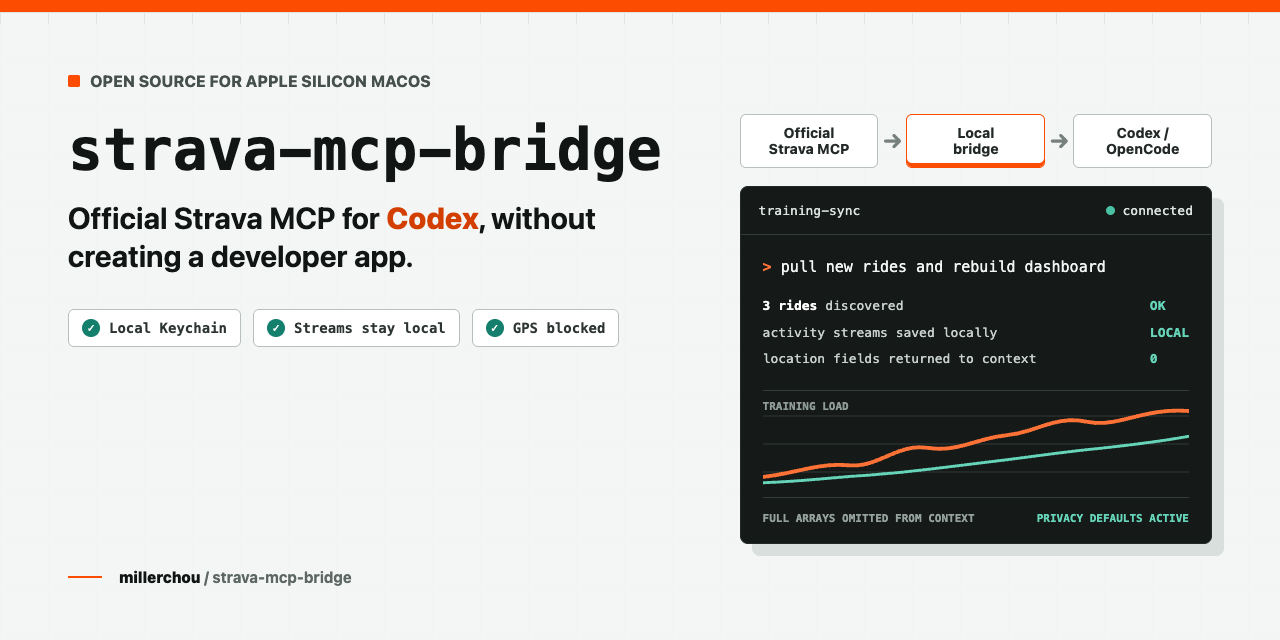
What It Enables
Once connected, a local coding agent can use Strava data as part of a real project workflow instead of working from copied summaries or synthetic data.
You: Pull my new rides since the local watermark and rebuild my training dashboard.

Codex:
  3 new rides found through the official Strava MCP
  full activity streams saved locally, omitted from model context
  training summary and fitness chart rebuilt
  no GPS, location, or polyline fields returned to the conversation
Other example tasks:
- "Compare heart-rate load across my rides this week."
- "Fetch the non-location streams for this activity and update my analysis."
- "Use my latest cycling data to refresh the PMC/TRIMP dashboard in this repo."
The bridge supplies the safe Strava connection. Your agent can then combine the result with local scripts, notebooks, dashboards, or training-analysis code.
Why This Exists
Strava publishes an official MCP connector, but its documented first-time authorization flow currently targets Claude clients. Codex supports MCP, yet it cannot currently complete this Strava OAuth bootstrap directly.
strava-mcp-bridge fills that gap:
- You authorize the official Strava MCP once through Claude Code.
- You explicitly run
strava-mcp-bridge bootstrap. - The bridge migrates the authorized credential into its own Keychain item.
- It maintains the rotating refresh-token chain and forwards approved MCP
requests to
https://mcp.strava.com/mcp. - Normal Codex/OpenCode use no longer reads or invokes Claude Code.
This is not a Strava REST API wrapper and does not provide shared credentials or bypass user authorization.
Choose The Right Path
| Path | Create your own Strava app? | Credential custody | Strava interface | Main tradeoff |
|---|---|---|---|---|
| Official connector in Claude | No | Official client | Official Strava MCP | Simplest if Claude already fits your workflow |
| Community self-hosted Strava MCP | Usually yes | Local | Strava REST API | Broad client support, but you own the app and OAuth plumbing |
| Managed connector | Usually no | Third-party service | Provider-managed API/MCP | Easy setup, but credentials and activity data pass through another service |
| strava-mcp-bridge | No | Local macOS Keychain | Official Strava MCP | One-time Claude Code bootstrap; Apple Silicon macOS only |
Managed connector behavior varies by provider. Review its data path and terms before connecting fitness data.
Good Fit / Not A Fit
Use this bridge when all of these are true:
- You use Codex, OpenCode, or another client that can run local stdio MCP servers.
- You have access to Strava's official MCP through an eligible Strava subscription.
- You do not want to create and maintain a Strava developer app.
- You prefer local credential custody and conservative data controls.
- You are on an Apple Silicon Mac.
Use another path when any of these are true:
- Claude's official connector already covers your workflow.
- Creating a Strava developer app is acceptable and you want a conventional REST API integration.
- Your source of truth is Garmin, Intervals.icu, Apple Health, or another system.
- You need Linux, Windows, or Intel Mac support.
- You do not have an eligible Strava subscription.
Requirements
- Apple Silicon macOS (
darwin arm64) - Node.js 22+
- Xcode Command Line Tools (
xcode-select --install) - An eligible Strava subscription
- One successful official Strava MCP authorization in Claude Code
A paid Claude subscription is not required by this bridge. The authorization has also been validated with Claude Code launched through Ollama; the important component is the Claude Code OAuth client, not the model backend.
Install
npm install -g strava-mcp-bridge
Install the bundled Codex skill explicitly at user scope:
strava-mcp-bridge skill install
This writes only to $HOME/.agents/skills/strava-mcp-bridge; it does not edit
Codex or MCP configuration. To keep the skill inside one project instead:
strava-mcp-bridge skill install --project-dir /absolute/path/to/project
Start a new Codex task after installation, then invoke
$strava-mcp-bridge. Existing different skill content is never overwritten
unless you review the target and pass --force explicitly.
1. Authorize The Official Strava MCP Once
Add the official endpoint to Claude Code:
claude mcp add --transport http strava https://mcp.strava.com/mcp
Inside Claude Code, run /mcp, select strava, and complete the Strava browser
authorization. This is the only step that needs Claude Code.
2. Bootstrap The Local Bridge
strava-mcp-bridge bootstrap
bootstrap:
- builds the native Keychain helper when needed;
- imports and claims the authorized refresh-token chain;
- stores the bridge-owned credential in macOS Keychain;
- prints a project-scoped Codex MCP configuration snippet;
- never prints token values.
Add the generated snippet to the target project's .codex/config.toml, restart
Codex (or start a new task), then call health before enabling activity tools.
For a training sync configuration:
strava-mcp-bridge config codex \
  --profile training-sync \
  --stream-output-dir /absolute/path/to/your/project/strava-streams
The generated profile exposes:
healtheligibilitylist_activitiesget_activity_streamsget_activity_performance
The bundled Codex skill guides the
agent through doctor, bootstrap, project-level configuration, and safe
failure handling. A source checkout exposes it as a repository skill; the
skill install command makes it discoverable from other projects.
How It Works
flowchart LR
    C["Codex / OpenCode"] -->|"stdio MCP"| B["strava-mcp-bridge"]
    B -->|"approved JSON-RPC + Bearer token"| S["Official Strava MCP"]
    B -->|"read / rotate credential"| K["macOS Keychain"]
    B -->|"full non-location streams"| F["Local 0600 files"]
    B -. "GPS / location blocked" .-> X["AI context"]
The bridge is both a transport adapter and a local policy boundary:
- remote Streamable HTTP MCP is presented as a local stdio MCP server;
tools/callis denied unless its tool name is explicitly allowlisted;tools/listis filtered to the local allowlist;- access tokens are sent only to the pinned official MCP endpoint by default;
- OAuth refresh uses the pinned Strava token endpoint and MCP resource;
- MCP sessions are reinitialized after expiry and deleted on stdio shutdown.
Privacy Defaults
Location Data
get_activity_streams requires an explicit stream list. The accepted streams
are:
time, heart_rate, velocity_smooth, cadence, altitude,
distance, temp, watts, grade_smooth, moving
Location/GPS/polyline-like streams are rejected before forwarding. Other structured tool responses are recursively redacted for common location keys, coordinate text, coordinate arrays, polylines, maps, and token-like fields. Opaque non-JSON text and non-text content blocks fail closed.
Large Streams
Full stream arrays are never returned to the MCP client context. They are
written atomically to a current-user-owned directory (0700) as regular files
with mode 0600. The tool result contains only the path, stream names, point
counts, and omitted_from_context=true.
Default location:
~/Library/Application Support/strava-mcp-bridge/streams/
Retention cleanup is a dry run unless --yes is supplied:
strava-mcp-bridge streams prune --older-than-days 30
strava-mcp-bridge streams prune --older-than-days 30 --yes
See SECURITY.md and THREAT_MODEL.md for the complete controls and residual risks.
Credential Lifecycle
The bridge-owned Keychain item is:
Strava MCP Bridge Native-credentials
The explicit import is a credential ownership migration, not a passive copy. Strava refresh tokens rotate, so claiming the chain for bridge-owned operation can make Claude Code's previous copied refresh token stale. Claude Code can reauthorize later if it needs its own connection again.
Normal MCP startup reads only the bridge-owned Keychain item. It does not import from Claude Code or modify Claude Code configuration.
Keychain Permission Dialogs
During bootstrap, macOS may show two different prompts:
/usr/bin/securityreadingClaude Code-credentials: choose Allow, not Always Allow. This is the explicit one-time import.strava-keychain-helperreading the bridge-owned item: Allow is the least-privilege choice. Always Allow avoids repeat prompts but accepts the documented same-user helper risk.
A rebuilt helper may trigger a new prompt after an upgrade.
Useful Commands
| Command | Purpose |
|---|---|
strava-mcp-bridge doctor |
Read-only platform/helper/credential check |
strava-mcp-bridge bootstrap |
Set up helper, credential, and config snippet |
strava-mcp-bridge auth status --json |
Show non-sensitive credential metadata |
strava-mcp-bridge skill install |
Install the bundled Codex skill at user scope |
strava-mcp-bridge skill install --project-dir <path> |
Install it in one project |
strava-mcp-bridge config codex --profile minimal |
Print minimal Codex config |
strava-mcp-bridge config codex --profile training-sync |
Print cycling-sync config |
strava-mcp-bridge streams prune --older-than-days 30 |
Preview stream retention cleanup |
strava-mcp-bridge auth remove |
Preview bridge credential removal |
strava-mcp-bridge auth remove --yes |
Delete only the bridge-owned credential |
See strava-mcp-bridge --help for endpoint, timeout, data-directory, and
diagnostic override options.
Removing Access
strava-mcp-bridge auth remove          # dry run
strava-mcp-bridge auth remove --yes    # remove local bridge credential
This never removes Claude Code's credential. To revoke access on Strava's side, deauthorize the connection in Strava's connected-app settings.
Current Status
- Experimental
0.1.x - Apple Silicon macOS only
- Official Strava MCP, not a REST API reimplementation
- First OAuth bootstrap still requires Claude Code
- No verified standards-only dynamic client registration path exists today
- Published in the official MCP Registry as
io.github.millerchou/strava-mcp-bridge - Strava says support for other clients is planned
The restriction appears at OAuth client registration/token issuance, not at the LLM model or a simple User-Agent check. Generic RFC 7591 registration attempts were rejected during isolated testing.
Development
npm test
npm run build:keychain-helper
npm pack --dry-run
Tests use local mocks. They do not contact Strava or read Keychain.
Release-owner instructions are in RELEASING.md.
Disclaimer
This is an unofficial community project. It is not affiliated with or endorsed by Strava, Anthropic, OpenAI, or the OpenCode maintainers. Strava can change its OAuth, MCP, subscription, or client-support behavior at any time.
Install Strava Bridge in Claude Desktop, Claude Code & Cursor
unyly install strava-mcp-bridgeInstalls into Claude Desktop, Claude Code, Cursor & VS Code — handles npx, uvx and build-from-source repos for you.
First time? Get the CLI: curl -fsSL https://unyly.org/install | sh
Or configure manually
Run in your terminal:
claude mcp add strava-mcp-bridge -- npx -y strava-mcp-bridgeFAQ
Is Strava Bridge MCP free?
Yes, Strava Bridge MCP is free — one-click install via Unyly at no cost.
Does Strava Bridge need an API key?
No, Strava Bridge runs without API keys or environment variables.
Is Strava Bridge hosted or self-hosted?
Self-hosted: the server runs locally on your machine via the install command above.
How do I install Strava Bridge in Claude Desktop, Claude Code or Cursor?
Open Strava Bridge on unyly.org, pick your client tab (Claude Desktop, Claude Code, Cursor) and press Install — the config is generated automatically, no JSON editing.
Related MCPs
GitHub
PRs, issues, code search, CI status
 by GitHub
Filesystem
Secure file operations with configurable access controls.
Memory
Knowledge graph-based persistent memory system.
Template MCP Server
A CLI tool to create a new Model Context Protocol server project with TypeScript support, dual transport options, and an extensible structure
 by mcpdotdirect
Compare Strava Bridge with
Not sure what to pick?
Find your stack in 60 seconds
Author?
Embed badge for your README
Browse similar
All development MCPs