
Swiss Procurement
БесплатноНе проверенMCP server providing read access to Swiss public procurement data via the official simap.ch API, covering all cantons and the Confederation with intraday update

Описание
MCP server providing read access to Swiss public procurement data via the official simap.ch API, covering all cantons and the Confederation with intraday updates. It enables searching tenders, awards, construction codes, and procurement offices through natural language queries.
README
Part of the Swiss Public Data MCP Portfolio — open-source MCP servers connecting AI agents to Swiss public and open data.
This is a private project. It is independent of any employer or institutional affiliation and represents no official position of any authority.
swiss-procurement-mcp
CI PyPI Python License: MIT MCP Portfolio Deutsch
MCP server for Swiss public procurement — read access to the official simap.ch API, covering all cantons and the Confederation, updated intraday.
🎯 Anchor demo query
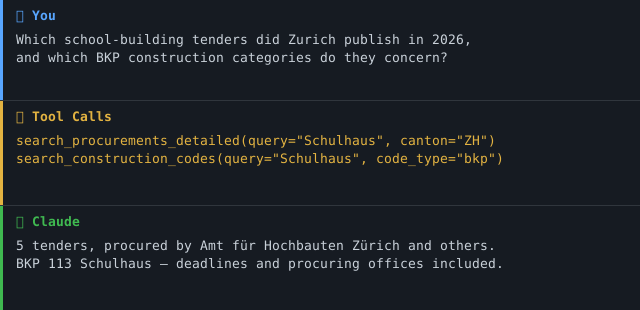
«Which school-building tenders did the City of Zurich publish in 2026, which BKP construction categories do they concern, and who are the procuring offices?»
A single search_procurements_detailed(query="Schulhaus", canton="ZH", published_from="2026-01-01")
returns the leading tenders already expanded with their BKP construction codes and
procuring offices — connecting procurement to school-building planning in one call
(optionally paired with search_construction_codes to resolve a category).
Demo
Why this server exists
Swiss public procurement is published on simap.ch. The platform's web UI is searchable by hand, but the amtsblatt-mcp server only reaches the three cantons (AR, BS, TI) that still mirror tenders to the Amtsblattportal — Zurich among the missing.
simap closes that gap: it operates a documented OpenAPI 3 read API (v1.5.1)
whose search and detail endpoints are marked security: None and are callable
without authentication. This server wraps exactly those read endpoints.
Mnemonic: The web UI is the front door; the API is the loading dock. Probe the dock.
Architecture decision
Architecture A (live API only, short-lived cache).
- The public search, detail and reference endpoints are unauthenticated and were confirmed working live (2026-07-26).
- Publications change intraday, so the cache TTL is deliberately short (30 min).
- The ~200 write /
my// OIDC-protected endpoints (publishing tenders, submitting offers) are out of scope — this server never writes.
Every response carries source and provenance (live_api / cached /
degraded). Upstream failure yields a degraded envelope, never a silent empty
list.
Live-probe findings (2026-07-26)
| Endpoint | Auth | Result |
|---|---|---|
/publications/v2/project/project-search |
none | 20 hits, canton filter, current-day |
/publications/v1/.../publication-details/... |
none | full record: criteria, deadlines, codes |
/publications/v1/publication/{id}/past-publications |
none | project lifecycle |
/codes/v1/cpv/search |
none | CPV full-text search |
/codes/v1/{bkp,npk,ebkp-h,ebkp-t,oag,cpc}/search |
none | Swiss construction codes |
/procoffices/v1/po/public |
none | ~1 MB office list (client-side filter) |
/cantons/v1, /countries/v1 |
none | reference data |
Known findings
- Wrong host, wrong conclusion. The read API lives under
www.simap.ch/api. Thesimap.ch/deweb UI is a separate SSR app that exposes none of it — probing the UI produced an earlier, mistaken "no API" verdict. langis mandatory on project-search. Omitting it is HTTP 400 (errorCodeE0025), not an empty result. The client injects a default.- Award is not "award".
newestPubTypes=awardreturns HTTP 400. Awards are split by procedure:award_tender,award_study_contract,award_competition,direct_award. Thesearch_awardstool queries all four. - Canton ids are bare.
ZH, notCH-ZH. Passing an ISO subdivision code silently matches nothing; this server rejects it with a clear error. - A session cookie is required. The first request sets it; a persistent HTTP client handles this transparently.
Tools
| Tool | Purpose |
|---|---|
search_procurements |
Search projects by canton, CPV, process type, date, text |
search_procurements_detailed |
Search + full detail for the top n hits in one call (aggregated) |
search_awards |
Awarded contracts only (all four award types at once) |
get_procurement_details |
Full record for one publication |
get_publication_history |
Earlier publications of the same project (tender → award) |
search_cpv_codes |
Resolve keywords to CPV classification codes |
search_construction_codes |
Swiss construction codes (BKP, NPK, eBKP, OAG, CPC) |
find_procurement_office |
Public procurement offices by partial name |
source_status |
Reachability and latency of the simap.ch API |
All tools carry readOnlyHint, idempotentHint and openWorldHint (they query
the live simap.ch API).
Every tool takes a single validated argument object. Bounds, allow-lists and patterns are declared on the input models in inputs.py — so an out-of-range limit or an unknown canton is rejected before any upstream request, and the constraints are visible to the model in the tool schema rather than buried in the tool body:
search_procurements({"canton": "ZH", "query": "Schulhaus", "limit": 20})
The models set strict=True (no silent "10" → 10 coercion) and
extra="forbid" (unknown fields are rejected, not ignored). The canton, process
type, publication type, code system and language allow-lists are derived from
constants.py, so they cannot drift from the probe-verified tables.
What canton= means
simap offers exactly one geographic filter, orderAddressCantons, and it selects
by where the work is delivered — not by who is procuring. When a procuring
office files a free-text address, the structured canton is null and the
publication is invisible to that filter. Measured CH-wide over 500 projects
published since 2026-07-01: 303 (60.6%) carry no canton, among them the Amt
für Hochbauten Zürich, Grün Stadt Zürich, USZ, BBL and SBB.
canton_match therefore makes the question explicit:
| Value | Matches | Zurich, 2026-07-01…27 |
|---|---|---|
procuring_body (default) |
procured by that canton's public bodies, incl. communal and subordinate offices (issuedByOrganizations) |
410 projects |
place_of_delivery |
the work is delivered there (orderAddressCantons) |
263 projects |
both |
union of the two; two upstream calls, no pagination | 441 projects |
The 31 projects only place_of_delivery finds are federal bodies procuring in
Zurich (ETH, Empa, Flughafen Zürich AG) — a different question, not a gap, which
is why this is three explicit semantics rather than a silent union.
Every response states in note which semantics were applied.
Portfolio connections
- A vendor's UID links to register-mcp.
- BKP / eBKP construction codes on a tender connect procurement to school-building planning and to zh-education-mcp.
- Complements amtsblatt-mcp with national coverage instead of three cantons.
Installation
uvx swiss-procurement-mcp
Claude Desktop
{
  "mcpServers": {
    "swiss-procurement": {
      "command": "uvx",
      "args": ["swiss-procurement-mcp"]
    }
  }
}
Cloud (Render / Railway)
MCP_TRANSPORT=sse HOST=0.0.0.0 PORT=8000 python -m swiss_procurement_mcp
Container
docker compose up --build # SSE on :8000
The image is multi-stage and runs as a non-root system user. compose.yaml
adds a read-only root filesystem, drops all capabilities, sets
no-new-privileges, and caps memory, CPU and PIDs. No secret is needed at
runtime — the wrapped simap.ch endpoints are public.
CI builds the image on every push and asserts both properties that matter:
that the container does not run as uid 0, and that the server still imports
under --read-only --cap-drop ALL.
Configuration
| Variable | Default | Purpose |
|---|---|---|
MCP_TRANSPORT |
stdio |
stdio | sse | streamable-http |
MCP_HOST / HOST |
127.0.0.1 |
HTTP binding (cloud transports only). Defaults to loopback; set 0.0.0.0 explicitly to expose all interfaces in a cloud deployment. |
MCP_CORS_ORIGINS |
(unset) | Comma-separated origins allowed to call the HTTP transports from a browser. Unset means no cross-origin browser access at all — stdio and non-browser clients are unaffected. Mcp-Session-Id is exposed and accepted for the listed origins, so a browser client can hold a session. * is honoured but logs a warning and disables credentials, because browsers reject a wildcard origin together with credentials. |
MCP_STATELESS |
(off) | Set to 1 to run the streamable-http transport with no session tracking. Removes session affinity as a concern for multi-instance deployments; gives up SSE stream resumption and server-initiated notifications. No effect on the legacy SSE transport, which logs a warning if asked. See docs/load-balancing.md. |
PORT / MCP_PORT |
8000 |
HTTP port (cloud transports only) |
LOG_LEVEL |
INFO |
DEBUG | INFO | WARNING | ERROR. Structured JSON, one object per line, always on stderr — stdout carries the MCP protocol on a stdio transport. |
No API keys — the wrapped simap.ch read endpoints are fully public.
Built on structlog. Every event emitted during a
tool call carries that call's correlation_id, bound via contextvars — so a
failure logged deep inside the HTTP client can be joined to the request that
caused it without threading context through every function.
| Level | Emitted when |
|---|---|
DEBUG |
a tool call was entered (tool_call_started) — tells you whether a hung call ever started |
INFO |
a tool call finished cleanly, with latency |
WARNING |
simap.ch was unreachable or errored (upstream_degraded) |
ERROR |
a tool call raised |
Records carry the exception type only — never its message and never an upstream response body (OBS-002).
{"event":"tool_call_started","tool":"search_procurements","correlation_id":"23221af26ae640c7","level":"debug","timestamp":"2026-07-27T22:20:07.494276Z"}
{"status":"ok","latency_ms":312,"event":"tool_call","tool":"search_procurements","correlation_id":"23221af26ae640c7","level":"info","timestamp":"2026-07-27T22:20:07.806Z"}
MCP Protocol Version
Served via the initialize handshake |
2024-11-05 … 2025-11-25 — the handshake ceiling |
| Served via the per-request envelope | 2026-07-28 |
| Who picks | The client's first request, once per connection. A request carrying the 2026-07-28 _meta envelope opens a modern connection; anything else opens a handshake connection. |
| Pinned in | MCP_PROTOCOL_VERSION in server.py |
| SDK | mcp>=2.0.0,<3 |
| Cache hints | tools/list, server/discover, prompts/list, resources/list, resources/templates/list: ttlMs 300000, cacheScope public |
| Server identity | server/discover answers name, title, version (the installed distribution's) and websiteUrl, plus server-level instructions |
| Verified by | tests/test_modern_era.py — real 2026-07-28 envelope requests over HTTP and stdio |
The MCP Python SDK negotiates the protocol version in the session layer and offers no constructor parameter for it, so the version cannot be pinned by configuration. It is pinned as a declared constant and enforced by detection:
- At runtime, a mismatch between the constant and the SDK logs a
protocol_version_driftevent atWARNING. The server keeps working. - In CI,
tests/test_protocol_version.pyfails.
That split is deliberate. An SDK bump should break our build, not the runtime
of someone who upgraded mcp in their own environment.
What the two eras actually do differently
The pin used to be checked against SDK constants and one initialize round
trip. That round trip can only ever reach the handshake era, which caps at
2025-11-25 — so nothing in this repository had ever sent a 2026-07-28
request. A server can pin a revision it answers with 400 and stay green.
Measured on 2026-09-18 against mcp 2.2.0, through both transports:
There is no handshake.
server/discoverreplaces it, and it is the only place a native client can ask who this server is. Every request carries its own_metaenvelope (protocol version, client info, client capabilities); without it the server answers-32602.Requests route by header.
Mcp-MethodandMcp-Namemust agree with the body, or the request is refused with-32020before the tool runs — so a proxy that reads only headers cannot be pointed at a different tool than the body names. (Mcp-Param-*is unused here; see _cors.py.)initializegets three different answers, and the transport is not what separates them. The first write-up here called the HTTP and stdio cases "two sides" of one situation; they differ in two variables at once, transport and history, so neither explains the other. The three measured cells:Situation Answer enveloped initialize, alone, over HTTP-32601METHOD_NOT_FOUND, HTTP 404initializeafter a modern request, over stdio-32022UNSUPPORTED_PROTOCOL_VERSIONenveloped initializefirst, over stdioaccepted — a 2025-11-25handshakeThe fourth cell does not exist: over stdio an
initializewithout history opens a legacy connection instead of being refused, so the HTTP situation cannot be reproduced there. Note the third row — stamping the envelope oninitializesilently gets you a connection of an older era, with nothing saying the envelope was ignored.Capabilities read differently per era, and this is the SDK's doing, not a setting here. At
2026-07-28the SDK derivestools.listChanged,prompts.listChanged,resources.listChangedandresources.subscribefrom one fact — whethersubscriptions/listenis served — andMCPServerregisters that unconditionally. Soserver/discoverreports all four astruewhereinitializereports all four asfalse, for the same server.
Update policy
- Dependabot opens SDK update PRs monthly (
.github/dependabot.yml). - When an SDK update moves the protocol version, the CI test fails. The fix is
not to edit the constant blindly: read the spec changelog for what changed
between the two versions, verify the server still behaves, then bump the
constant, this section and
CHANGELOG.mdin one commit. - Protocol-version bumps are called out explicitly in
CHANGELOG.md, not folded into a dependency-bump line.
Primitives: tools only
This server exposes tools and neither resources nor prompts. That is a decision, not an omission, so here is the reasoning (ARCH-008).
Why not resources. Resources address identifiable, listable content —
GET-like reads the client can enumerate and cache. simap's endpoints are the
opposite: every useful call is a query with filters over a corpus of ~200k
publications that changes intraday. A resource URI would either enumerate
something unbounded or encode a full query in the URI, which is a tool with
extra steps.
Two tools were checked concretely for migration potential and rejected for specific reasons, not by blanket policy:
| Candidate | Why it stays a tool |
|---|---|
source_status |
Genuinely resource-shaped — one fixed, cacheable document. But it exists to be called when a result looks wrong, and a resource the model has to remember to re-read is worse at that job than a tool it can invoke on suspicion. |
search_cpv_codes |
The CPV catalogue is finite and stable enough to enumerate. But it is ~10k entries; exposing it as a resource would push the whole classification into the context window, when the point of the tool is that the server does the lookup. |
Why not prompts. A curated prompt list would encode question templates ("which tenders in canton X…"). The tool docstrings already carry that guidance where the model actually reads it, and prompts would duplicate it in a second place that can drift — this repo has already been bitten twice by exactly that class of duplication.
This will be revisited if the server ever gains a genuinely enumerable, slow-changing dataset.
Testing
PYTHONPATH=src pytest tests/ -m "not live"   # offline, respx-mocked
PYTHONPATH=src pytest tests/ -m live         # hits the real API
See EXAMPLES.md for use cases grouped by audience (schools, public, administration, developers) and a tool-selection reference table.
Known limitations
- Projects, not publications.
project-searchindexes projects and represents each by its newest publication. A project tendered in March and awarded in July appears once, as the July award;search_awardslikewise only finds projects whose newest publication is an award, so a later correction hides it.get_publication_historyreaches the earlier publications. - Lot-based procurements are traced per lot. Upstream keeps the publication
history per lot, so
get_publication_historyneeds alot_idwhenever the search result showslots_type: "with"— take one from that result'slotslist. Without it the source answers HTTP 400 and the tool reports a degraded response naming the missing parameter. Measured 2026-08-29 over 80 publications: all 4 with lots behaved this way, all 76 without lots answered directly. - At least one filter is required. simap answers a filterless query with nothing rather than everything, so the tools refuse it with that reason instead of reporting an empty result.
- Read-only by design. Publishing and submission endpoints exist in the simap API but are deliberately not wrapped.
- Award coverage is uneven across cantons; some publish awards diligently, others rarely. Absence of an award is not proof none happened.
- No contract values in search results. Amounts, where published, live in the detail record's statistics section, which varies by procedure.
- Unofficial client. Publications remain authoritative on simap.ch itself.
Project structure
swiss-procurement-mcp/
├── src/swiss_procurement_mcp/
│   ├── server.py      # MCPServer tools (9, read-only)
│   ├── client.py      # simap.ch HTTP client + retry + normalisation
│   ├── constants.py   # probe-derived lookup tables (cantons, pub types, codes)
│   ├── models.py      # Pydantic v2 envelopes (source + provenance)
│   ├── inputs.py      # strict Pydantic tool-input models (bounds, allow-lists)
│   ├── _fuzzy.py      # term widening for the taxonomy lookups (ARCH-003)
│   ├── _log.py        # structured JSON logging to stderr + @logged_tool
│   ├── _net.py        # DNS-pinned transport (egress allow-list)
│   ├── _cors.py       # CORS layer for the HTTP transports
│   └── __main__.py    # Dual-transport entry point (stdio / SSE / streamable-http)
├── tests/             # respx-mocked + @pytest.mark.live
└── .github/workflows/ # CI + OIDC PyPI/MCP-registry publish
Why there is no tools/ package
The portfolio structure standard asks for a tools/ package once a server
exposes more than five tools. This one exposes nine and keeps them in
server.py, which is a deliberate deviation rather than an oversight — recorded
here because this is where the standard, and anyone comparing against it, looks.
server.py is ~900 lines and the surrounding modules above are already split out
by concern, so the intent of the standard — a codebase navigable without
scrolling one omnibus file — is met. What the split would add is the literal file
layout.
The companion server amtsblatt-mcp is the case where it was worth doing: its
server.py had grown to 2477 lines holding HTTP plumbing, XML parsing, a
taxonomy cache, the input models and every handler, and it was split in that
project's 0.21.0. That refactor is also the reason for caution here — it
introduced a defect (an extracted module captured a cache global by value, so a
tool silently reported stale state) that the entire test suite passed
through, because no test covered the affected path. It was caught by reading
the diff.
Moving nine handlers for the literal form of a standard whose intent is already
satisfied would take that risk for no navigational gain. This should be revisited
if server.py passes roughly 1500 lines.
Maturity & updates
Phase 1 — read-only (see ROADMAP.md for the phase-specific backlog and what a phase transition would require). This server wraps only the public read endpoints; the write / OIDC-protected simap endpoints are deliberately out of scope. See the SECURITY.md re-evaluation triggers for the conditions that would move it to a write phase.
The server targets the MCP spec version pinned as MCP_PROTOCOL_VERSION — see
MCP Protocol Version above for the current value and
how the pin is enforced. SDK and dependency updates arrive as
Dependabot PRs, so a breaking protocol or SDK change
is reviewed deliberately rather than drifting in silently.
Contributing
Contributions are welcome — see CONTRIBUTING.md for how to report bugs, suggest a new endpoint, or submit code.
Security
This is a read-only, no-PII, public-open-data server. Audited against the portfolio MCP best-practice catalogue (15 pass / 16 partial / 1 fail across 32 applicable checks, production-ready). See SECURITY.md for the posture and how to report a vulnerability, and audits/ for the full report.
License
MIT License — see LICENSE. The tenders are official public-procurement announcements; simap.ch publishes no explicit open-data licence, so reuse follows the simap.ch terms (see Credits).
Author
Hayal Oezkan · github.com/malkreide
Changelog
See CHANGELOG.md.
Credits
- Data: simap.ch read API v1.5.1, operated by the simap.ch association. API docs: simap.ch/api-doc — machine-readable OpenAPI spec at /api/specifications/simap.yaml, which a live test checks the enum constants against. Guides: kissimap.ch.
- The underlying tenders are official public-procurement announcements by Swiss public bodies. simap.ch publishes no explicit open-data licence; reuse is subject to the simap.ch terms. Attribute the source as simap.ch (Verein simap.ch).
- Built following the
mcp-data-source-probemethodology.
The code in this repository is MIT licensed; the data is simap.ch's, under its terms (see above). Public money, public code.
Установка Swiss Procurement
У этого сервера нет опубликованного пакета — он собирается из исходников. Открой репозиторий и следуй инструкции в README.
▸ github.com/malkreide/swiss-procurement-mcpFAQ
Swiss Procurement MCP бесплатный?
Да, Swiss Procurement MCP бесплатный — установка в пару кликов через Unyly без оплаты.
Нужен ли API-ключ для Swiss Procurement?
Нет, Swiss Procurement работает без API-ключей и переменных окружения.
Swiss Procurement — hosted или self-hosted?
Доступен hosted-вариант: Unyly запускает сервер в облаке, локальная установка не обязательна.
Как установить Swiss Procurement в Claude Desktop, Claude Code или Cursor?
Открой Swiss Procurement на unyly.org, выбери вкладку своего клиента (Claude Desktop, Claude Code, Cursor) и нажми Install — конфиг сгенерируется автоматически, без правки JSON.
Похожие MCP
GitHub
PRs, issues, code search, CI status
 автор: GitHub
Filesystem
Secure file operations with configurable access controls.
Memory
Knowledge graph-based persistent memory system.

Unyly Deploy
Deploy sites and MCP servers to Unyly straight from your AI agent
 автор: Unyly
Amap Maps Mcp Server
MCP server for using the AMap Maps API
 автор: duxiaohui
PayMCP
Lightweight payments layer for MCP servers: turn tools into paid endpoints with a two-line decorator. [PyPI](https://pypi.org/project/paymcp/) · [npm](https://w
 автор: blustAI
Server For Power BI
Enables exploring Microsoft Fabric / Power BI workspaces and semantic models, and executing ad-hoc DAX queries.
 автор: Mitsubishi-Fuso
Template MCP Server
A CLI tool to create a new Model Context Protocol server project with TypeScript support, dual transport options, and an extensible structure
 автор: mcpdotdirect
Supabase
Database, auth and storage
 автор: Supabase
Everything
Reference / test server with prompts, resources, and tools.
Compare Swiss Procurement with
Не уверен что выбрать?
Найди свой стек за 60 секунд
Автор?
Embed-бейдж для README
Похожее
Все в категории development